October 21, 2026
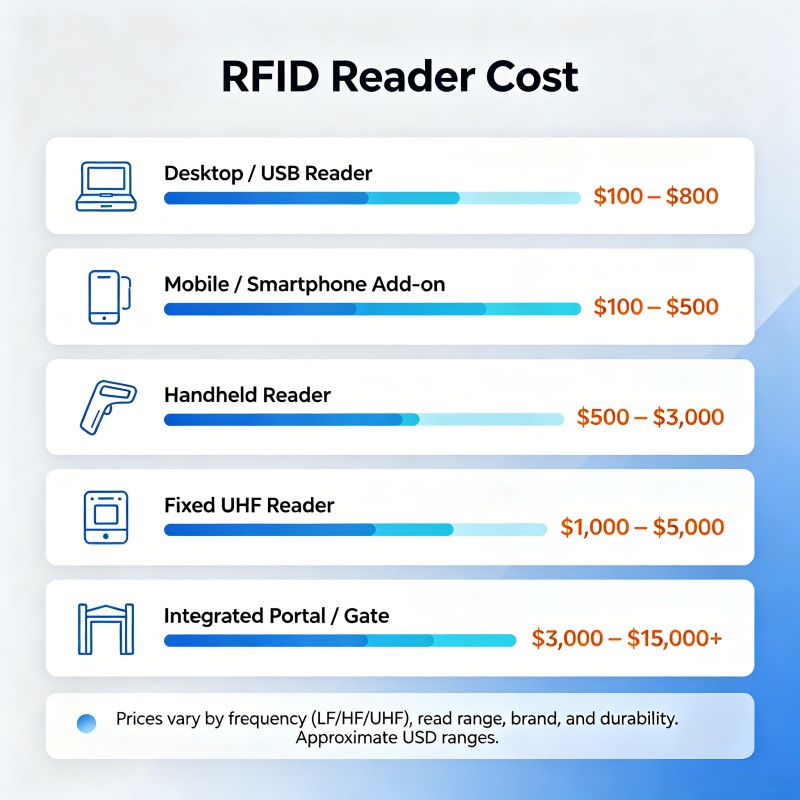
The RFID reader cost can range from less than US$20 for a basic NFC reader to several hundred or even thousands of dollars for industrial-grade UHF RFID readers and complete multi-antenna systems. The large price difference comes from the RFID frequency, reading distance, number of antennas, communication interfaces, housing, processing capability, environmental protection, and software requirements.
For a buyer, the cheapest RFID reader is not necessarily the most cost-effective option. A warehouse may need a long-range UHF reader, while a retail store may only require an HF or NFC reader for short-range identification.
This guide explains RFID reader cost, compares different reader types, analyzes the factors affecting price, and provides a practical purchasing guide for distributors, system integrators, factories, warehouses, retailers, and other B2B buyers.
How Much Does an RFID Reader Cost?
The price of an RFID reader depends primarily on its technology and application.
As a general purchasing reference:
| RFID Reader Type | Typical Price Range | Common Applications |
|---|---|---|
| Basic NFC Reader | US$10–50 | NFC cards, smartphones, access applications |
| HF RFID Reader | US$30–150 | Library, access control, asset identification |
| Desktop RFID Reader | US$50–300 | Retail, inventory, small asset management |
| Fixed UHF RFID Reader | US$300–1,500+ | Warehouse, logistics, industrial tracking |
| Industrial UHF Reader | US$800–3,000+ | Manufacturing, portals, production lines |
| Integrated RFID Reader | US$1,000–5,000+ | Automated industrial systems |
| Handheld RFID Reader | US$500–3,000+ | Inventory, field service, warehouse operations |
| Multi-Antenna RFID System | US$1,500–5,000+ | Dock doors, warehouse portals, automated tracking |
These figures are general market-oriented reference ranges rather than fixed quotations. Actual prices vary considerably between manufacturers, specifications, order quantities, software packages, accessories, and certification requirements.
For B2B buyers, it is better to request a quotation based on a complete specification instead of comparing the price of two RFID readers only by their product names.
Why Is RFID Reader Cost So Different?
Two products can both be called “RFID readers” while having completely different hardware architectures.
For example, an NFC reader designed to read a card at a few centimeters does not require the same RF power, antenna configuration, processing capability, or enclosure as an industrial UHF reader designed to identify hundreds of tags across a warehouse portal.
The main cost factors include:
- RFID frequency
- Reading range
- RF output power
- Antenna ports
- Number of antennas
- Tag-reading speed
- Supported protocols
- Communication interfaces
- Processor and memory
- IP protection
- Operating temperature
- Display and keypad
- Battery capacity
- Software and SDK
- Certifications
- OEM customization
- Production quantity
Understanding these factors is more useful than simply asking, “How much is an RFID reader?”
RFID Reader Cost by Frequency
Frequency is one of the first specifications a buyer should determine.
LF RFID Readers
Low-frequency RFID systems commonly operate around 125 kHz or 134.2 kHz, depending on the application and standard.
They are frequently associated with:
- Animal identification
- Access control
- Vehicle identification
- Industrial identification
LF readers generally have relatively short reading ranges and are designed for specific identification applications.
For example, animal RFID readers may use 134.2 kHz technology to communicate with compatible animal identification transponders.
HF RFID Readers
HF RFID operates at 13.56 MHz.
Applications include:
- Smart cards
- Library management
- Access control
- Product authentication
- NFC-related applications
- Asset identification
HF readers can be relatively affordable because many applications only require short-range communication.
NFC Readers
NFC is also based on 13.56 MHz technology and is widely used for:
- Smartphones
- Contactless cards
- Digital business cards
- Product authentication
- Smart packaging
- Customer engagement
Basic USB NFC readers may be inexpensive, while industrial or customized NFC readers can cost significantly more.
UHF RFID Readers
UHF RFID is widely used for long-range identification.
Typical applications include:
- Warehouse inventory
- Logistics
- Retail inventory
- Manufacturing
- Vehicle tracking
- Pallet identification
- Supply-chain management
Because UHF systems require higher RF performance, advanced antenna configurations, faster tag processing, and more sophisticated hardware, UHF RFID reader cost is normally higher than basic NFC or HF reader cost.
Fixed RFID Reader Cost vs Handheld RFID Reader Cost
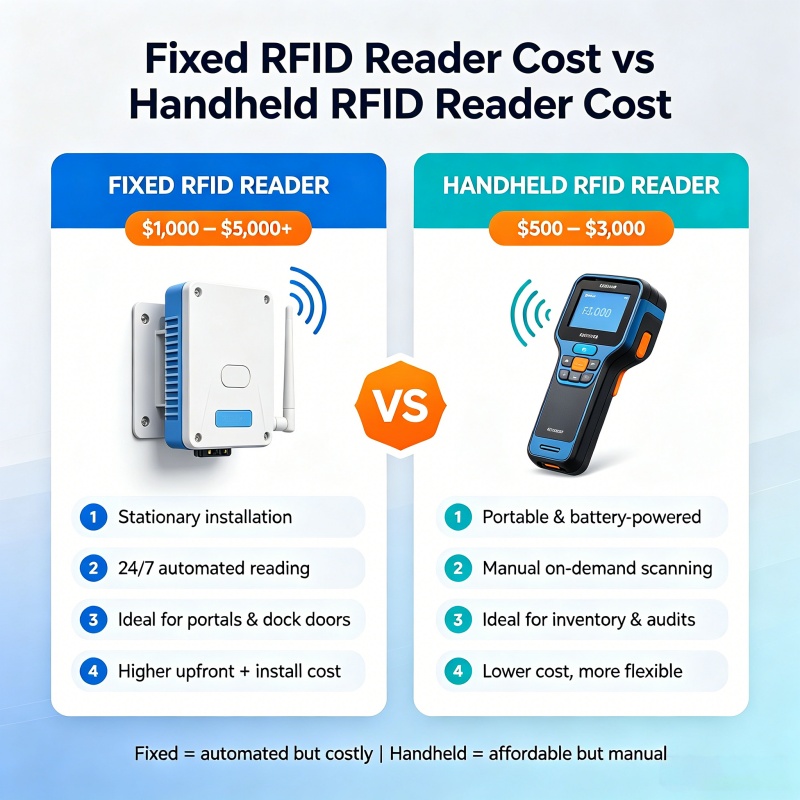
One of the most important purchasing decisions is whether you need a fixed or handheld reader.
Fixed RFID Reader
A fixed RFID reader is permanently installed at a location such as:
- Warehouse entrance
- Conveyor line
- Loading dock
- Production station
- Retail gate
- Vehicle checkpoint
A typical industrial fixed UHF reader may cost hundreds to several thousand U.S. dollars, depending on the configuration.
The total system cost can also include:
- Antennas
- RFID cables
- Mounting brackets
- Power supply
- Industrial enclosure
- Network connection
- Software
Handheld RFID Reader
A handheld RFID reader combines an RFID module with a mobile computer or Android terminal.
It is useful for:
- Warehouse counting
- Retail stocktaking
- Asset audits
- Field service
- Equipment inspection
Because it integrates more hardware into one device, handheld RFID reader cost is usually higher than that of a basic desktop reader.
RFID Reader Cost for Warehouse Applications
Warehouse RFID systems are one of the most common B2B applications.
A basic warehouse system may require:
RFID Reader + Antenna + Tags + Software
For a dock-door installation, the configuration may become:
Fixed UHF Reader + 2–4 Antennas + RFID Tags + Industrial Computer + Software
Therefore, the reader price alone does not represent the actual project cost.
For example, a US$600 reader may appear inexpensive until the buyer adds antennas, cables, mounting equipment, software integration, installation, and networking.
A more useful calculation is:
Total RFID System Cost = Reader + Antennas + Tags + Accessories + Software + Installation + Integration
What Determines UHF RFID Reader Cost?
For UHF applications, several technical specifications have a direct influence on price.
Reading Range
A reader designed for short-range inventory work may have very different hardware requirements from a portal designed to identify tags several meters away.
However, buyers should not judge reader quality solely by the advertised maximum range.
Actual performance depends on:
- Tag type
- Antenna gain
- Reader power
- Orientation
- Material
- Environmental conditions
- Tag placement
Number of Antenna Ports
A reader with one antenna port is generally simpler than a four-port reader.
Multi-antenna systems can cover larger areas and support more sophisticated applications.
Tag Reading Speed
Warehouse applications may require fast identification of multiple tags simultaneously.
High-performance readers can process large numbers of tag responses efficiently, which can increase hardware and processing requirements.
Communication Interface
Common interfaces include:
- USB
- Ethernet
- RS232
- RS485
- Wi-Fi
- Bluetooth
- GPIO
Industrial readers with multiple communication options may cost more than basic desktop readers.
RFID Reader Cost by Application
Different industries have different requirements.
Retail
Retailers may use RFID readers for:
- Apparel inventory
- Stock counting
- Loss prevention
- Item identification
The required hardware can range from handheld devices to fixed readers.
Warehousing
Warehouse applications often require UHF fixed readers and antennas for:
- Pallet tracking
- Carton identification
- Receiving
- Shipping
- Inventory management
Manufacturing
Manufacturers may integrate RFID readers into production lines to track:
- Work-in-process
- Components
- Tools
- Containers
- Finished products
Industrial environments may require more durable readers and additional interfaces.
Healthcare
RFID readers can be used for:
- Equipment tracking
- Medical asset management
- Patient identification
- Inventory control
Healthcare applications may have additional security and data-management requirements.
Libraries
HF RFID readers are commonly used for:
- Book identification
- Self-service checkout
- Returns
- Inventory management
These systems typically have very different cost requirements from industrial UHF systems.
Animal Identification
Animal RFID readers are designed to read compatible animal identification transponders.
For applications involving livestock or pets, buyers should confirm the appropriate frequency and animal-identification standard rather than purchasing a general-purpose RFID reader.
RFID Reader vs RFID Scanner
The terms RFID reader and RFID scanner are sometimes used interchangeably, but they can describe different product concepts depending on the industry.
An RFID reader communicates with RFID tags using radio frequency.
A barcode scanner, by comparison, reads an optical barcode.
The difference is important because RFID can identify tags without requiring the same direct visual alignment needed by many barcode systems.
| Feature | RFID Reader | Barcode Scanner |
|---|---|---|
| Technology | Radio frequency | Optical |
| Line of sight | Usually not required | Usually required |
| Multiple items | Can read multiple tags | Typically scans individually |
| Tag condition | Can work without visual printing | Barcode must be readable |
| Data capacity | Depends on RFID tag | Depends on barcode |
| Typical applications | Inventory, logistics, tracking | Retail checkout, identification |
For high-volume inventory operations, RFID can provide significant automation advantages.
RFID Reader Cost vs Barcode Scanner Cost
A basic barcode scanner can be cheaper than an RFID reader.
However, comparing only the hardware purchase price can be misleading.
An RFID system may reduce labor requirements for repetitive identification tasks because multiple tagged objects can potentially be identified automatically.
For example, instead of scanning individual boxes one by one, a properly configured RFID portal can identify multiple tagged items as they pass through the reading zone.
Therefore, buyers should evaluate:
Hardware Cost + Labor Cost + Process Efficiency + Integration Cost
rather than looking only at the initial equipment price.
What Is Included in an RFID Reader Price?
Before purchasing, ask the supplier exactly what is included.
A quotation may include:
- RFID reader
- Power adapter
- Antenna
- Antenna cable
- Mounting accessories
- Software
- SDK
- Communication interface
- Configuration software
- Warranty
- Technical support
But some suppliers quote the reader only.
For example:
RFID reader: US$500
does not necessarily mean:
Complete RFID system: US$500.
This distinction is particularly important when comparing international suppliers.
RFID Reader OEM and ODM Cost
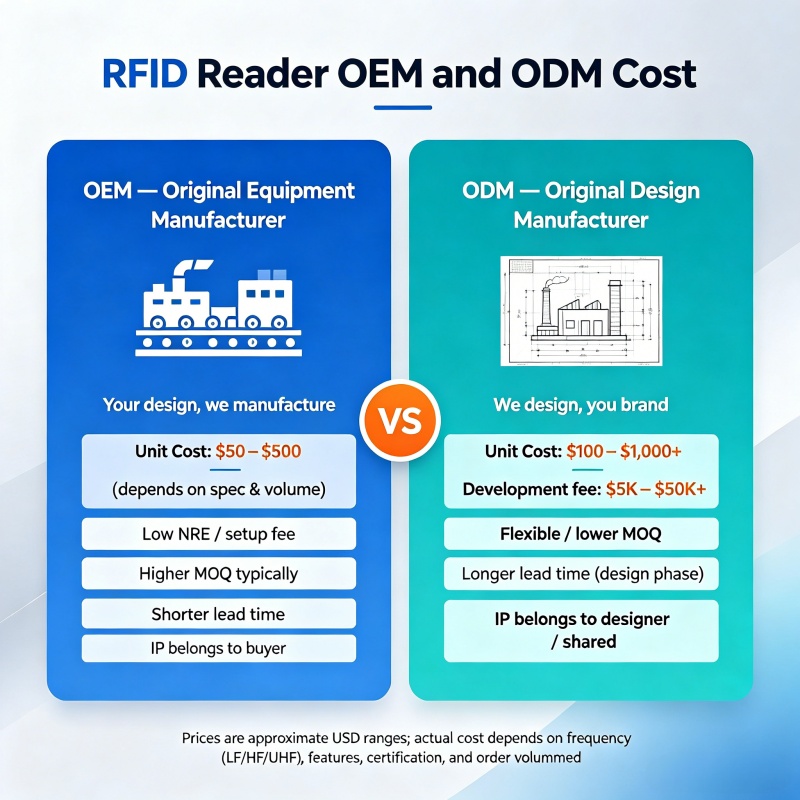
For distributors and system integrators, OEM customization can change the final price.
Common customization options include:
- Custom enclosure
- Private-label logo
- Customized firmware
- Custom communication protocol
- Customized connectors
- Custom antenna
- Color and housing design
- Packaging
- User manual
- Software interface
- SDK integration
Small OEM orders may have higher unit prices because engineering and tooling costs are spread over fewer units.
For larger orders, manufacturers can often optimize production and reduce the average unit cost.
How to Reduce RFID Reader Cost
The cheapest specification is not always the best way to reduce total cost.
Instead, buyers should optimize the complete system.
Choose the Correct Frequency
Do not purchase a UHF reader when HF or NFC is sufficient.
Likewise, using a short-range HF system for a warehouse portal can create poor performance and additional costs.
Avoid Unnecessary Features
If the application only requires Ethernet communication, there may be little reason to pay for multiple wireless interfaces.
Optimize Antenna Quantity
More antennas can increase coverage but also increase hardware and installation costs.
Choose the number based on the actual reading zone.
Buy Readers and Tags Together
For large projects, purchasing compatible RFID readers and tags from the same supplier can simplify testing and system matching.
Consider Total Cost of Ownership
A slightly more expensive reader may be cheaper over several years if it provides:
- Better reliability
- Lower downtime
- Easier maintenance
- Better software support
- Longer product life
How to Choose an RFID Reader for Your Application
Before requesting a quotation, define these parameters.
1. What type of RFID tag are you using?
Determine whether your tags are:
- LF
- HF
- NFC
- UHF
2. What is the required reading distance?
Specify the actual operating range rather than simply asking for a “long-range reader.”
3. How many tags must be read?
A warehouse portal may need to identify many tags simultaneously.
4. What environment will the reader operate in?
Consider:
- Indoor/outdoor
- Dust
- Moisture
- Temperature
- Metal
- Chemicals
- Vibration
5. What interface do you need?
Examples include Ethernet, USB, RS232, RS485, Wi-Fi, or Bluetooth.
6. Do you need OEM customization?
If you are a distributor or branded-product company, determine whether private labeling or firmware customization is required.
7. What quantity will you purchase?
MOQ can significantly influence the final unit price.
RFID Reader Procurement Checklist for B2B Buyers
Before placing an order, ask the manufacturer:
- What RFID frequency does the reader support?
- Which RFID protocols are compatible?
- What is the maximum recommended reading distance?
- How many antenna ports are available?
- What is the maximum tag-reading speed?
- Which communication interfaces are supported?
- What operating temperature range is available?
- Is an IP-rated enclosure available?
- Does the reader support SDK/API integration?
- Is custom firmware available?
- Can the housing be customized?
- What is the MOQ?
- What is the sample lead time?
- What is the mass-production lead time?
- What warranty is provided?
- Are antennas included?
- Are cables included?
- What certifications are available for the target market?
- Can the supplier provide technical documentation?
- Can the reader be tested with our RFID tags before mass production?
This checklist can prevent a common purchasing mistake: selecting a reader based on price before confirming whether it actually works with the existing RFID system.
RFID Reader Standards and Compliance
RFID readers should be evaluated according to the frequency and target market.
Depending on the application, buyers may need to consider standards and regulatory requirements related to:
- RFID air-interface protocols
- Frequency allocation
- Radio emissions
- Electrical safety
- Electromagnetic compatibility
- Environmental requirements
For UHF RFID, EPCglobal UHF Gen2 / ISO/IEC 18000-63 is particularly relevant to many supply-chain applications.
For HF/NFC applications, standards in the ISO/IEC 14443 and ISO/IEC 15693 families may be relevant depending on the tag and application.
For animal identification, ISO 11784/11785 may be applicable.
The exact compliance requirements should always be confirmed for the destination market and intended application.
What Is the Total Cost of an RFID System?
When planning an RFID project, the reader is only one component.
A practical cost structure is:
RFID System Cost = Readers + Antennas + Tags + Cables + Controllers + Software + Installation + Integration + Maintenance
For example, a warehouse may require:
- 4 fixed UHF readers
- 12 antennas
- Thousands of RFID tags
- Network equipment
- RFID middleware
- Installation
- ERP/WMS integration
In this situation, reducing the reader price by US$100 may have much less impact than optimizing tag consumption or software integration.
This is why professional B2B buyers should calculate total project cost, not simply compare the price of individual readers.
RFID Reader Cost: What Should You Pay?
There is no single “correct” RFID reader price.
A basic NFC reader may cost only tens of dollars, while a high-performance industrial UHF reader can cost thousands.
A practical way to classify the market is:
US$10–50: Basic NFC/entry-level readers
US$50–300: Desktop and general-purpose RFID readers
US$300–1,500+: Fixed UHF RFID readers
US$500–3,000+: Handheld and industrial RFID readers
US$1,500–5,000+: Multi-reader or integrated RFID systems
These ranges should be treated as purchasing references rather than universal quotations.
The right price depends on what the reader needs to accomplish.
Frequently Asked Questions About RFID Reader Cost
How much does an RFID reader cost?
An RFID reader can cost from around US$10 to several thousand dollars, depending on the technology, frequency, reading range, antenna configuration, interfaces, and industrial requirements.
What is the cheapest RFID reader?
Basic NFC or low-end HF readers are generally among the least expensive RFID reader options. However, they are not suitable for every application.
How much does a UHF RFID reader cost?
A fixed UHF RFID reader commonly falls into the hundreds to thousands of U.S. dollars, depending on RF performance, antenna ports, communication interfaces, enclosure, and software capabilities.
Is RFID more expensive than barcode?
The initial RFID hardware and tag cost can be higher than barcode equipment, but RFID can reduce manual scanning and improve automation. The best choice depends on the application and total operating cost.
How much does a handheld RFID reader cost?
Handheld RFID readers can range from several hundred to several thousand dollars depending on the RFID module, mobile operating system, screen, battery, scanning performance, and industrial design.
Does an RFID reader need an antenna?
Many fixed RFID systems require external antennas, although some readers have integrated antennas. Buyers should confirm whether the antenna is included in the quotation.
How far can an RFID reader read a tag?
Reading distance depends on the frequency, reader power, antenna, tag design, tag orientation, materials, and environment. UHF systems generally support much longer reading distances than NFC or HF systems.
Can one RFID reader read multiple tags?
Yes. Many RFID systems, especially UHF systems, are designed to identify multiple tags within the reader’s operating area.
Do RFID readers need software?
Basic readers may work with simple commands, while commercial and industrial systems often require software, SDKs, APIs, middleware, or integration with ERP/WMS platforms.
What should I consider when buying an RFID reader?
Focus on frequency, tag compatibility, reading distance, tag-reading speed, antenna ports, communication interfaces, environmental requirements, certifications, software integration, MOQ, and after-sales support.
Can RFID readers be customized?
Yes. Depending on the manufacturer, OEM/ODM customization may include enclosure design, firmware, communication interfaces, branding, packaging, and software integration.
Final Thoughts on RFID Reader Cost
The answer to “How much does an RFID reader cost?” depends on the application more than the product name.
A basic NFC reader may cost only a few tens of dollars, while an industrial UHF reader or complete multi-antenna RFID system can cost several thousand dollars.
For B2B buyers, the best purchasing strategy is to define the application first and the budget second.
Start with:
Tag Type → Frequency → Reading Distance → Reading Volume → Antennas → Interface → Environment → Software → Quantity
Then compare suppliers based on unit price, system compatibility, reliability, customization, technical support, lead time, and total cost of ownership.
For distributors, system integrators, warehouses, manufacturers, and retailers, this approach makes it much easier to find an RFID reader that delivers the right balance between price and performance, rather than simply choosing the cheapest device on the market.

Do RFID is a leading China-based manufacturer with over 15 years of experience. We specialize in customized RFID readers, tags, and cards, delivering high-quality, tailored solutions that meet your unique business needs and drive seamless, efficient identification.