October 21, 2026
If you are comparing RFID vs NFC tag, the first thing to understand is that they are related technologies, but they are not exactly the same.
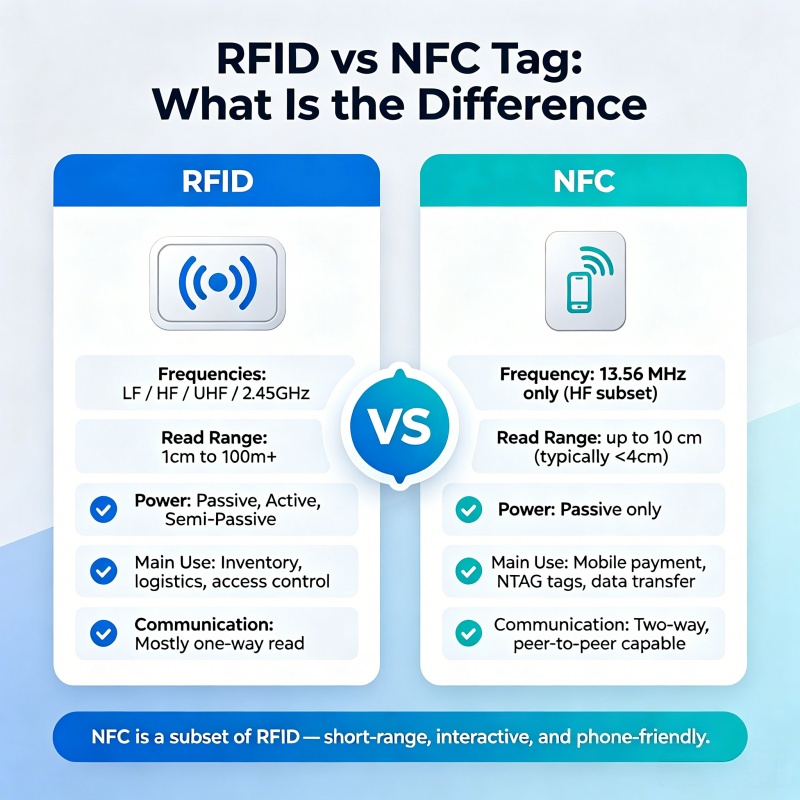
RFID is a broad technology family used to identify and track objects through radio communication. NFC is a short-range wireless technology that operates at 13.56 MHz and is closely related to HF RFID. In fact, many NFC tags can be considered a specialized type of HF RFID tag, but not every RFID tag is an NFC tag.
The practical difference becomes important when choosing tags for inventory management, asset tracking, access control, product authentication, mobile marketing, smart packaging, payments, or customer engagement.
This guide compares RFID and NFC tags by frequency, reading distance, smartphone compatibility, data storage, security, applications, cost, and procurement requirements.
RFID vs NFC Tag: Quick Comparison
| Feature | RFID Tag | NFC Tag |
|---|---|---|
| Technology scope | Broad identification technology | Short-range wireless technology |
| Common frequencies | LF, HF, UHF | 13.56 MHz |
| Typical read range | A few centimeters to several meters, depending on type | Usually a few centimeters |
| Smartphone reading | Usually no for UHF/LF; some HF tags yes | Yes, with compatible NFC smartphones |
| Multi-tag reading | Excellent with many RFID systems | Usually designed for one-to-one interaction |
| Main purpose | Identification, tracking and inventory | Tap-to-connect, authentication and data exchange |
| Common applications | Warehouse, logistics, retail, livestock, assets | Marketing, smart packaging, access, product authentication |
| Reader requirement | Dedicated RFID reader often required | NFC-enabled smartphone can often act as reader |
| Data interaction | Identification and automated collection | Interactive communication |
| Best for | Automatic identification at distance | Close-range user interaction |
The key point is simple:
RFID is the larger category, while NFC is a specific short-range communication technology closely associated with 13.56 MHz HF RFID.
What Is an RFID Tag?
RFID stands for Radio Frequency Identification.
An RFID system uses radio waves to communicate between a reader and an electronic tag. The tag normally contains an IC and antenna, allowing it to store an identifier or other data and communicate with an RFID reader.
RFID tags can be divided into several major categories according to operating frequency:
- LF RFID
- HF RFID
- UHF RFID
- Active RFID
The operating frequency has a major effect on reading distance, data communication, tag design, environmental performance and application.
For example, UHF passive RFID is widely used for item-level identification and inventory applications. GS1 describes EPC Gen2 as a major air-interface protocol for passive UHF RFID, operating in the 860–930 MHz range.
The read range of RFID is not a fixed number. GS1 notes that passive RFID range depends on factors including frequency, reader power, interference, antenna design, tag orientation and the surrounding environment. UHF passive RFID can typically operate over several meters, while some specialized systems can achieve considerably longer distances.
What Is an NFC Tag?
NFC stands for Near Field Communication.
NFC operates at 13.56 MHz and is designed for short-range communication between compatible devices.
Unlike a typical long-range UHF RFID deployment, NFC is designed around very close interaction. A consumer can simply bring an NFC-enabled smartphone close to a tag to trigger an action, such as:
- Opening a website
- Displaying product information
- Sharing contact information
- Authenticating a product
- Launching an application
- Connecting to a service
- Recording an interaction
- Accessing digital content
The underlying technology is based on inductive coupling and short-range communication. ECMA-340, for example, defines NFC communication at the 13.56 MHz center frequency and specifies communication modes, modulation, coding and data exchange procedures.
This makes NFC particularly attractive when the end user needs to interact directly with the tag.
Is NFC the Same as RFID?
No.
This is one of the most important points when researching RFID vs NFC tag.
RFID is a broad technology category covering multiple frequency bands and communication standards. NFC is a short-range communication technology centered on 13.56 MHz.
The relationship can be understood as:
RFID → HF RFID → 13.56 MHz technologies → NFC-related applications
However, this does not mean that every 13.56 MHz RFID tag is automatically an NFC tag.
For example, 13.56 MHz HF RFID includes standards such as ISO/IEC 14443 and ISO/IEC 15693. NFC Forum specifications map different NFC tag types to these technologies. NFC Forum Type 2 and Type 4 tags are associated with ISO/IEC 14443, while NFC Forum Type 5 is based on ISO/IEC 15693.
Therefore, when selecting a tag, the correct question is not simply:
“Is it 13.56 MHz?”
Instead, ask:
“Which IC, protocol, standard and reader ecosystem does the tag support?”
RFID vs NFC Tag: Frequency Difference
Frequency is one of the easiest ways to understand the difference.
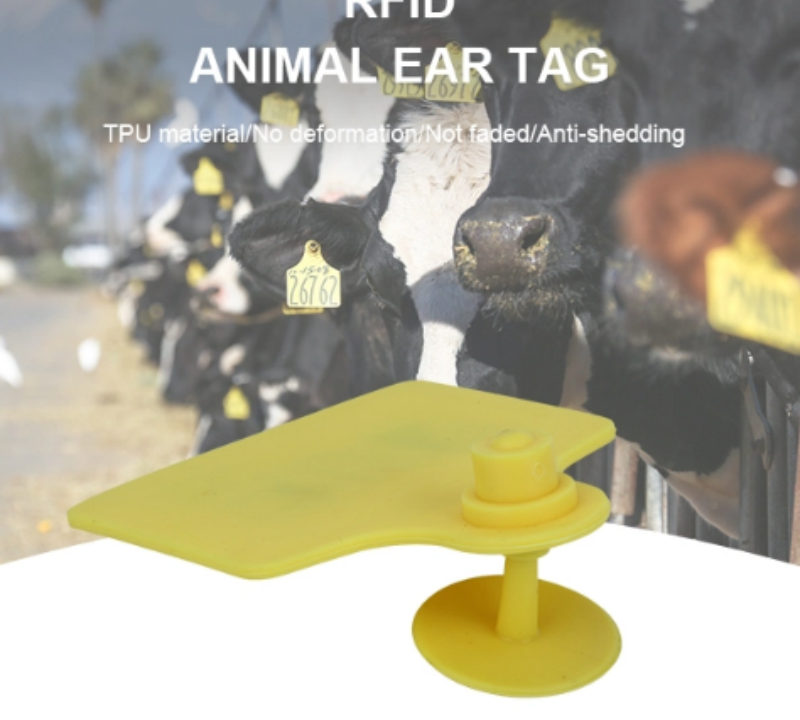
LF RFID
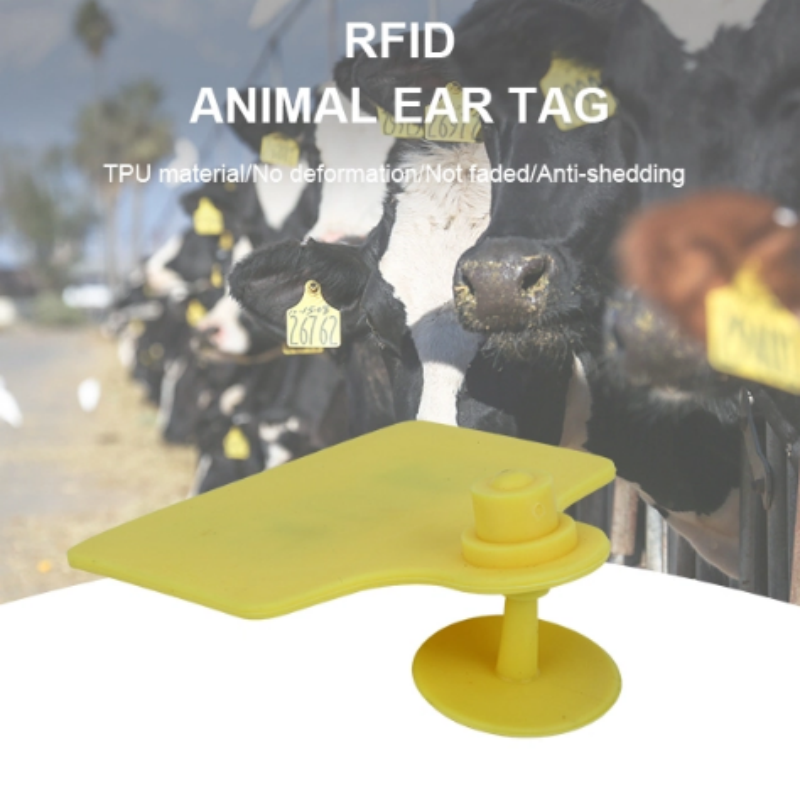
LF RFID generally operates around 125 kHz or 134.2 kHz.
It is commonly used for applications such as:
- Animal identification
- Access control
- Industrial identification
- Certain specialized tracking systems
LF systems generally have shorter read ranges but can work effectively in applications where the tag is close to the reader.
HF RFID
HF RFID operates at 13.56 MHz.
It is used for:
- Smart cards
- Library management
- Access control
- Product identification
- Asset tracking
- NFC-related applications
Some HF RFID technologies have much longer reading distances than conventional NFC interaction.
UHF RFID
UHF RFID generally operates in the 860–960 MHz region, depending on the regional regulatory environment.
It is widely used for:
- Warehouse inventory
- Retail item tracking
- Logistics
- Pallet identification
- Supply-chain visibility
- Manufacturing
ISO/IEC 18000-61, for example, defines an RFID air interface for the 860–960 MHz ISM band for item-management applications.
NFC
NFC operates at 13.56 MHz.
Its major advantage is not long-distance identification. Instead, it provides intentional close-range interaction between a tag and an NFC-enabled device.
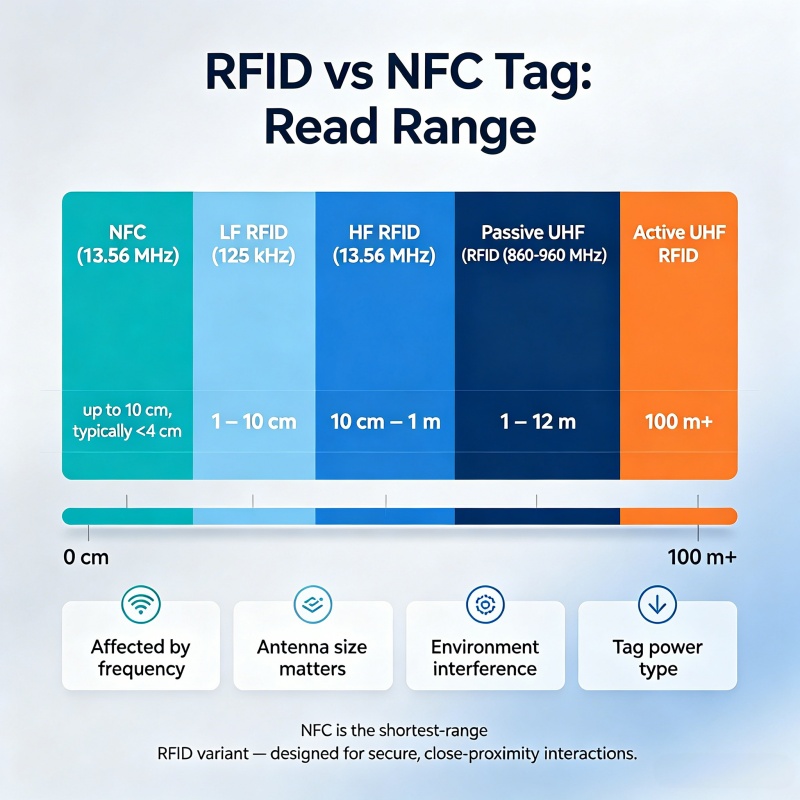
RFID vs NFC Tag: Read Range
Read range is one of the biggest practical differences.
There is no universal RFID read distance because RFID covers several technologies.
Typical ranges can be broadly understood as:
| Technology | Approximate Typical Range | Main Advantage |
|---|---|---|
| LF RFID | Centimeters to around 1 m | Robust close-range identification |
| HF RFID | Centimeters to around 1 m+ depending on standard/system | Versatile identification |
| NFC | Usually a few centimeters | Simple smartphone interaction |
| UHF RFID | Several meters | Long-range inventory and tracking |
| Active RFID | Tens of meters or more | Long-range powered identification |
These numbers are only engineering reference ranges. Actual performance depends heavily on antenna size, reader power, tag IC, mounting surface, orientation and surrounding materials. GS1 specifically emphasizes that RFID read range is application-dependent rather than a single fixed specification.
For example, ETSI documentation gives approximately 10 cm for ISO/IEC 14443 applications, around 150 cm for ISO/IEC 15693 applications, and around 150 cm for certain 13.56 MHz logistics RFID systems.
So if your requirement is:
“I want to scan hundreds of products from several meters away.”
UHF RFID is generally a much better fit.
If your requirement is:
“I want customers to tap a product with their phone.”
NFC is usually the better choice.
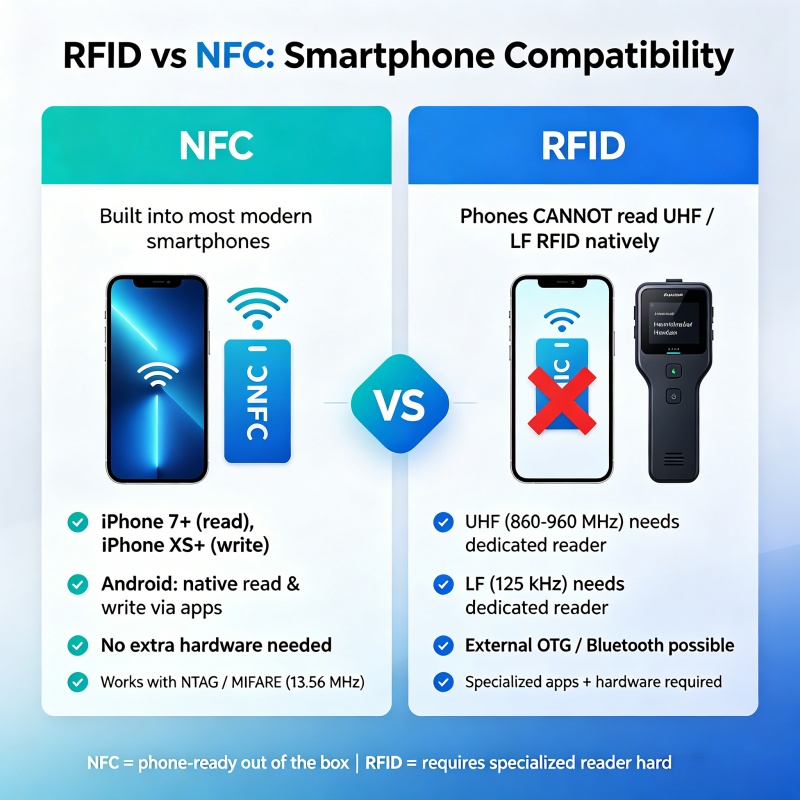
RFID vs NFC: Smartphone Compatibility
This is where NFC has a major advantage.
Most modern smartphones with NFC functionality can interact directly with compatible NFC tags.
A customer can simply:
- Unlock or activate the phone if required.
- Bring the phone close to the tag.
- Detect the NFC tag.
- Read the stored information.
- Trigger an action such as opening a URL.
A typical UHF RFID tag does not work this way.
A UHF RFID system normally requires:
- UHF RFID reader
- UHF antenna
- RFID tags
- Reader software
- Communication interface
This difference has a major impact on project cost.
For a consumer-facing product, NFC can eliminate the need for a dedicated reader on the customer’s side.
For warehouse automation, dedicated RFID infrastructure is normally more appropriate.
RFID vs NFC Tag for Data Storage
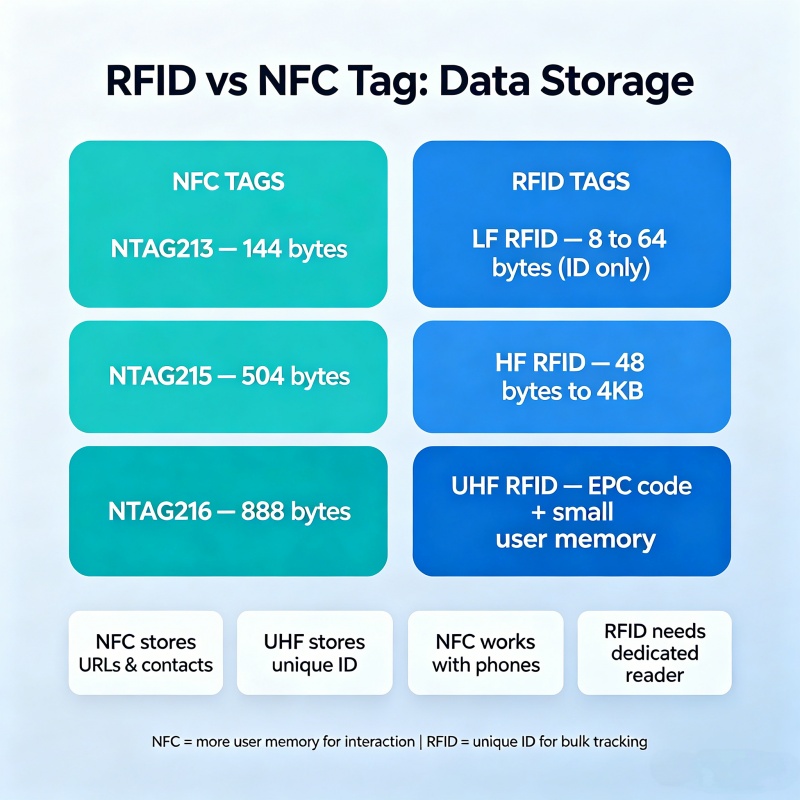
Both RFID and NFC tags can store information, but the available memory depends on the specific IC.
An RFID tag may contain:
- Unique identifier
- EPC
- Product code
- Serial number
- Inventory information
- User memory
- Access-control data
An NFC tag may contain:
- URL
- Text
- Contact information
- Digital business card
- Product information
- Authentication data
- NDEF records
For NFC applications, the NDEF format is particularly important because it allows compatible devices to interpret information stored on the tag.
When purchasing NFC tags, do not choose an IC only according to memory size. Consider the complete requirement:
IC + memory + protocol + phone compatibility + security + antenna + tag size.
For example, NTAG213, NTAG215 and NTAG216 are popular NFC IC families, but they provide different memory capacities and should be selected according to the actual data requirement.
RFID vs NFC Tag: Security
Security requirements can be very different depending on the application.
A basic NFC sticker containing a public URL does not provide the same security level as a secure contactless smart card.
Similarly, “RFID” does not automatically mean “secure.”
Security can involve:
- Password protection
- Access control
- Authentication
- Encryption
- Unique identifiers
- Secure memory
- Anti-cloning mechanisms
- Backend verification
- Dynamic authentication
For payment, identity and access-control applications, secure smart-card technologies may be required rather than a basic NFC sticker.
ISO/IEC 14443 technologies are widely associated with proximity cards and secure contactless applications, while ISO/IEC 15693 is designed for vicinity applications.
Therefore, if you are buying NFC tags for anti-counterfeiting or product authentication, the tag alone should not be considered the entire security solution.
A stronger system may combine:
NFC tag + unique ID + secure backend + authentication algorithm + database verification.
RFID vs NFC Tag for Different Applications
RFID for Warehouse Inventory
UHF RFID is usually the stronger choice when a company needs to identify large numbers of products quickly.
For example, a warehouse may need to scan:
- 100 cartons
- 500 garments
- 1,000 packages
- Multiple pallets
A worker does not necessarily need to scan every item individually.
This is one of the biggest advantages of UHF RFID over NFC.
NFC for Smart Packaging
NFC is highly suitable for consumer products.
An NFC tag can be integrated into:
- Wine labels
- Cosmetic packaging
- Luxury goods
- Electronics
- Pharmaceutical packaging
- Food packaging
- Promotional products
A customer taps the product with a smartphone and receives digital information.
NFC for Product Authentication
NFC can be used to connect a physical product with a digital identity.
For example:
Product → NFC UID → Online database → Authentication result
This can help brands create a more interactive anti-counterfeit system.
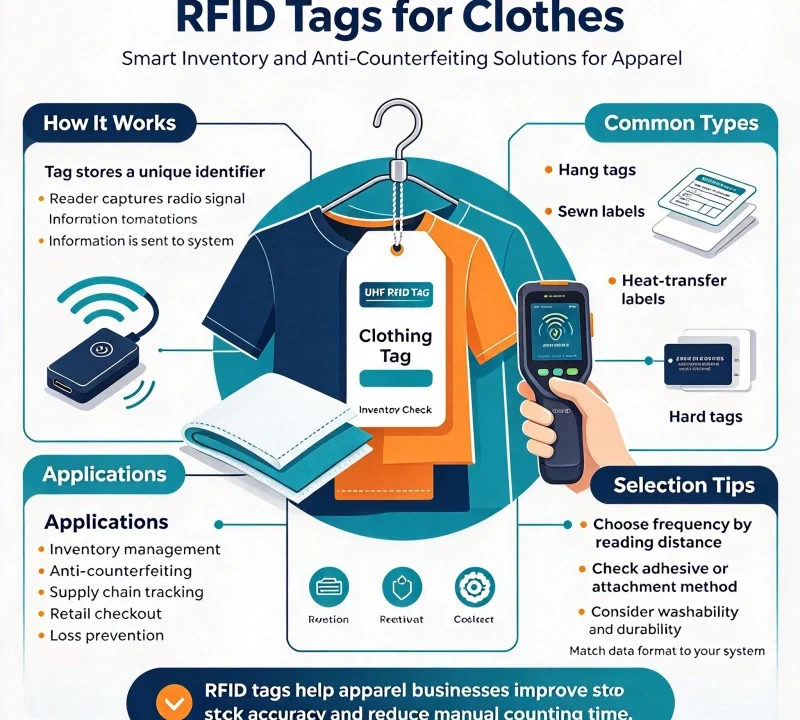
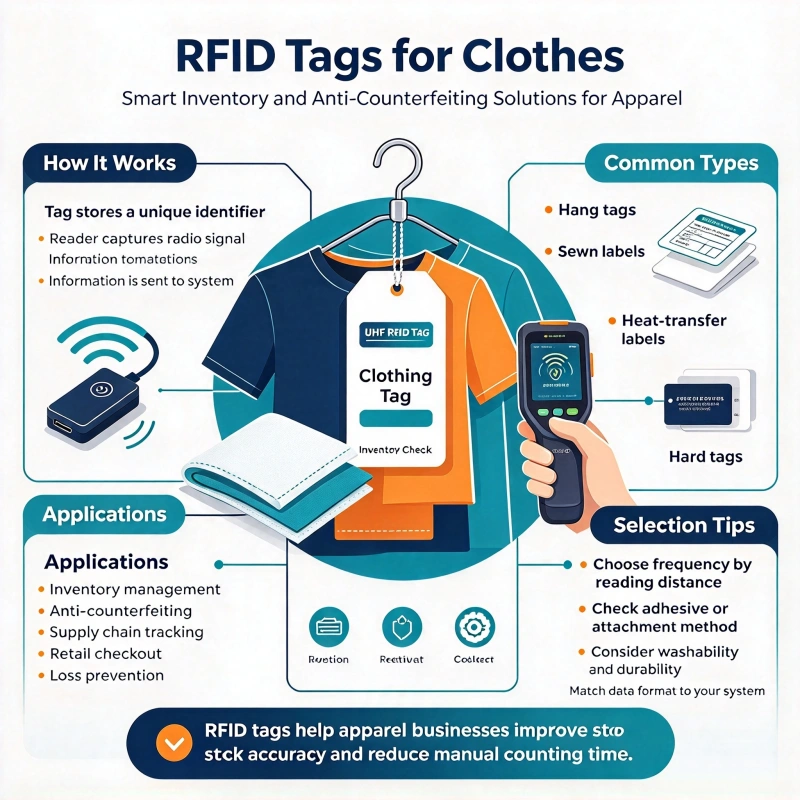
RFID for Retail
Retailers can use UHF RFID for:
- Stock counting
- Item location
- Receiving
- Shipping
- Inventory accuracy
- Loss prevention
- Store replenishment
The ability to read multiple tags without direct line-of-sight makes UHF RFID particularly useful for automated inventory processes.
NFC for Marketing
NFC can turn packaging or printed materials into interactive touchpoints.
For example:
Poster → NFC tag → Smartphone → Product landing page
This reduces the need for manually typing URLs.
RFID vs NFC Tag: Which Is Better for Inventory?
For most large-scale inventory applications, UHF RFID is the better choice.
Why?
Because inventory systems usually prioritize:
- Longer read range
- Fast scanning
- Multiple-tag reading
- Automation
- Integration with warehouse systems
- Reduced manual scanning
NFC is better when the goal is individual interaction.
For example:
| Requirement | Better Choice |
|---|---|
| Scan products from several meters | UHF RFID |
| Scan hundreds of items quickly | UHF RFID |
| Smartphone interaction | NFC |
| Tap-to-open website | NFC |
| Smart product packaging | NFC |
| Warehouse inventory | UHF RFID |
| Consumer authentication | NFC |
| Retail item tracking | UHF RFID |
| Contactless card application | NFC/HF |
| Asset identification at close range | HF RFID/NFC depending on system |
RFID vs NFC Tag for Access Control
Both technologies can be used in access control, but the exact choice depends on the security level and existing infrastructure.
Basic RFID access cards can be used for identification.
NFC-compatible credentials can also allow smartphones or NFC-enabled devices to interact with access systems.
For a professional access-control project, however, the buyer should evaluate:
- Authentication method
- Encryption
- Card technology
- Reader compatibility
- Credential management
- Backend security
- Cloning resistance
- Existing access-control infrastructure
Do not select a tag simply because it is advertised as “RFID” or “NFC.”
The reader and credential technology must be compatible.
RFID vs NFC Tag Cost
The cost difference depends heavily on tag type, quantity and customization.
A basic NFC sticker may be relatively inexpensive when purchased in large quantities, while a specialized UHF RFID tag can cost more because of its IC, antenna construction, material and performance requirements.
The total cost can include:
- RFID/NFC IC
- Antenna
- Inlay
- Paper, PET or other substrate
- Adhesive
- Printing
- Encoding
- Die cutting
- Lamination
- Testing
- Packaging
- OEM customization
More importantly, tag price is only part of the project cost.
For UHF RFID, the complete system may require readers, antennas, cables, software and integration.
For NFC consumer applications, the customer may already have the reader — their smartphone.
That can make NFC economically attractive for direct-to-consumer applications.
RFID vs NFC: Reader Requirements
This is another major procurement consideration.
NFC Tag
A typical NFC project may require:
NFC tag + smartphone
or
NFC tag + NFC reader
The smartphone itself can often perform the reader function.
UHF RFID Tag
A typical UHF system may require:
UHF tag + RFID reader + antenna + software
For industrial applications, the system may also include:
- Industrial computer
- PLC
- Gateway
- Ethernet
- Wi-Fi
- Database
- ERP/WMS integration
Therefore, when comparing RFID and NFC, buyers should compare the total system cost, not just the unit tag price.
RFID vs NFC Tag for B2B Procurement
If you are purchasing RFID or NFC tags for a business project, define the application before selecting the product.
A professional supplier should ask about:
1. Frequency
Do you need:
- 125 kHz?
- 134.2 kHz?
- 13.56 MHz?
- UHF 860–960 MHz?
2. Reader
What reader will be used?
A tag cannot be selected independently from the reader ecosystem.
3. Read Distance
Do you need:
- 1–5 cm?
- 10 cm?
- 50 cm?
- 1 m?
- 3–10 m?
4. Tag Size
The antenna size directly influences performance.
A very small tag may have a shorter read range than a larger antenna design.
5. Application Material
Will the tag be attached to:
- Paper
- Plastic
- Glass
- Wood
- Metal
- Liquid containers
- Textiles
- Cartons
Metal and liquids can significantly affect RFID performance, so material testing should be part of product selection.
6. Memory
Specify the required memory rather than simply asking for “high memory.”
7. Security
If the project involves authentication, access control or sensitive information, specify the required security architecture.
8. Quantity
RFID/NFC pricing can change substantially with order volume.
A factory quotation should normally distinguish between:
- Prototype
- Sample order
- 1,000 pcs
- 10,000 pcs
- 100,000 pcs
- 1,000,000+ pcs
RFID vs NFC Tag: OEM and Customization
For brands, distributors and system integrators, RFID and NFC tags can both be customized.
Common OEM options include:
- Custom size
- Custom shape
- Custom printing
- Logo printing
- Serial number encoding
- UID/EPC encoding
- Adhesive selection
- Material selection
- Packaging
- Roll format
- Sheet format
- Individual packaging
- Special antenna design
For NFC tags, manufacturers can also configure NDEF data such as URLs or other supported records.
For UHF RFID, encoding may include EPC numbers or other identifiers required by the customer’s inventory system.
A reliable OEM supplier should provide samples before mass production so the buyer can test:
reader compatibility + read range + mounting performance + encoding + durability.
RFID vs NFC Tag: Which One Should You Choose?
The simplest decision rule is:
Choose NFC if:
- Customers need to use smartphones.
- The interaction should happen at close range.
- You need tap-to-open functionality.
- You are creating smart packaging.
- You need digital product information.
- You are building consumer authentication.
- You want an interactive marketing experience.
Choose UHF RFID if:
- You need several-meter reading.
- You need to scan many products simultaneously.
- You are managing warehouse inventory.
- You need automated logistics tracking.
- You are integrating RFID with WMS or ERP.
- You need high-speed item identification.
Choose HF RFID if:
- The application requires 13.56 MHz RFID.
- You need a controlled read zone.
- You are working with cards, assets or library systems.
- You need compatibility with a specific HF RFID standard.
Choose LF RFID if:
- You need close-range identification.
- The application involves animal identification or specialized industrial systems.
- Your existing reader infrastructure uses LF technology.
RFID vs NFC Tag: Common Mistakes to Avoid
Mistake 1: Assuming All RFID Tags Work With Phones
They do not.
A UHF RFID tag cannot normally be read directly by a standard NFC smartphone.
Mistake 2: Assuming All 13.56 MHz Tags Are Identical
They are not.
13.56 MHz includes different standards and technology implementations. ISO/IEC 14443 and ISO/IEC 15693 have different operating characteristics and application targets.
Mistake 3: Choosing a Tag Before Choosing the Reader
Reader compatibility should be confirmed before mass production.
Mistake 4: Focusing Only on Read Distance
A longer read range is not automatically better.
For NFC, a short read range can actually improve intentional interaction and reduce accidental reads.
For inventory RFID, longer range may be desirable.
Mistake 5: Ignoring the Installation Surface
A tag that performs well on cardboard may perform very differently on metal or liquid-filled products.
Mistake 6: Buying Based Only on IC Model
The same IC can perform differently depending on:
- Antenna design
- Tag size
- Substrate
- Adhesive
- Assembly
- Reader
- Environment
The complete tag design matters.
RFID vs NFC Tag FAQ
Is NFC a type of RFID?
NFC is closely related to HF RFID and operates at 13.56 MHz, but NFC and RFID should not be treated as completely interchangeable terms. NFC is a specific short-range communication technology, while RFID covers a broader range of systems and frequencies.
Can my phone read an RFID tag?
It depends on the RFID technology. NFC-enabled phones can read compatible NFC/HF tags, but standard UHF RFID tags generally require a dedicated UHF RFID reader.
Which has a longer range, RFID or NFC?
RFID can have a much longer range because RFID includes UHF and active systems. NFC is designed for very short-range communication, typically requiring the phone to be close to the tag.
Is NFC better than RFID?
Neither technology is universally better. NFC is generally better for smartphone-based consumer interaction, while UHF RFID is generally better for automated inventory and long-range item identification.
Can NFC replace UHF RFID?
Usually not. NFC and UHF RFID solve different problems. NFC is optimized for close-range interaction, while UHF RFID is designed for longer-range and multi-tag identification.
Can UHF RFID replace NFC?
Usually not. If your customer needs to tap a product with a smartphone, NFC provides a much more suitable user experience.
Are NFC tags expensive?
Basic NFC tags can be cost-effective in large-volume production. Final pricing depends on IC model, memory, antenna size, substrate, printing, encoding, adhesive, customization and order quantity.
What is the best NFC tag for product authentication?
There is no universal best NFC tag. The correct choice depends on the required security level, memory, smartphone compatibility, authentication method and product environment.
What is the best RFID tag for warehouse inventory?
UHF RFID is usually the first technology to evaluate because of its longer reading range and ability to identify multiple tags. However, tag antenna design and the tagged material must also be tested.
Final Verdict: RFID vs NFC Tag
The difference between RFID vs NFC tag becomes much clearer when you focus on the application rather than the terminology.
NFC is ideal for close-range, smartphone-driven interaction.
UHF RFID is ideal for long-range, automated identification and inventory management.
HF RFID sits between these applications and can support cards, assets, libraries and other 13.56 MHz identification systems.
For B2B buyers, the best approach is not to ask only, “How much does an RFID or NFC tag cost?”
Instead, define:
frequency → protocol → reader → read range → tag material → memory → security → application → quantity → customization.
Once these specifications are clear, a manufacturer can recommend the appropriate IC, antenna structure and tag construction rather than simply supplying a generic RFID or NFC sticker.
That is the difference between buying a cheap tag and buying the right RFID/NFC solution for a commercial application.

Do RFID is a leading China-based manufacturer with over 15 years of experience. We specialize in customized RFID readers, tags, and cards, delivering high-quality, tailored solutions that meet your unique business needs and drive seamless, efficient identification.