October 19, 2026
RFID tags for metal surfaces are designed to identify and track metal assets where conventional RFID tags may experience poor reading performance. From industrial machinery and metal tools to warehouse racks, server cabinets, and reusable containers, these specialized tags help businesses improve asset visibility, inventory accuracy, and operational efficiency.
However, not all RFID tags can work reliably when mounted directly on metal. Metal can affect antenna performance, reduce read range, and interfere with communication between a tag and an RFID reader. Choosing the right tag requires an understanding of RFID frequency, tag construction, mounting conditions, and the requirements of your application.
In this guide, we explain how RFID tags for metal surfaces work, compare common tag types, explore industrial applications, and outline the key factors to consider before purchasing. We also explain how DO RFID Reader supports RFID product manufacturing and customized identification solutions for different business requirements.
Can RFID Tags Work on Metal Surfaces?
Yes. RFID tags can work on metal surfaces when they are specifically designed for metal mounting or installed using a suitable isolation method.
Conventional RFID tags are often designed for use on materials such as paper, cardboard, plastic, and wood. When a standard tag is placed directly against metal, the conductive surface can change the electrical characteristics of its antenna and affect its ability to communicate with a reader.
An on-metal RFID tag, also known as an anti-metal RFID tag or metal-mount RFID tag, is engineered to address these challenges.
Depending on its design, an on-metal tag may incorporate a specialized antenna, an isolation layer, a ferrite material, a conductive backing structure, or other features that help it operate when mounted on metal.
These tags are available in different sizes, frequencies, and physical constructions to support applications ranging from small tool identification to industrial asset tracking.
The most important consideration is compatibility. A tag that performs well on a flat steel panel may behave differently when installed on a curved aluminum component, a compact metal tool, or equipment surrounded by other conductive structures.
For reliable performance, select an RFID tag based on the actual asset, required reading distance, installation method, and operating environment.
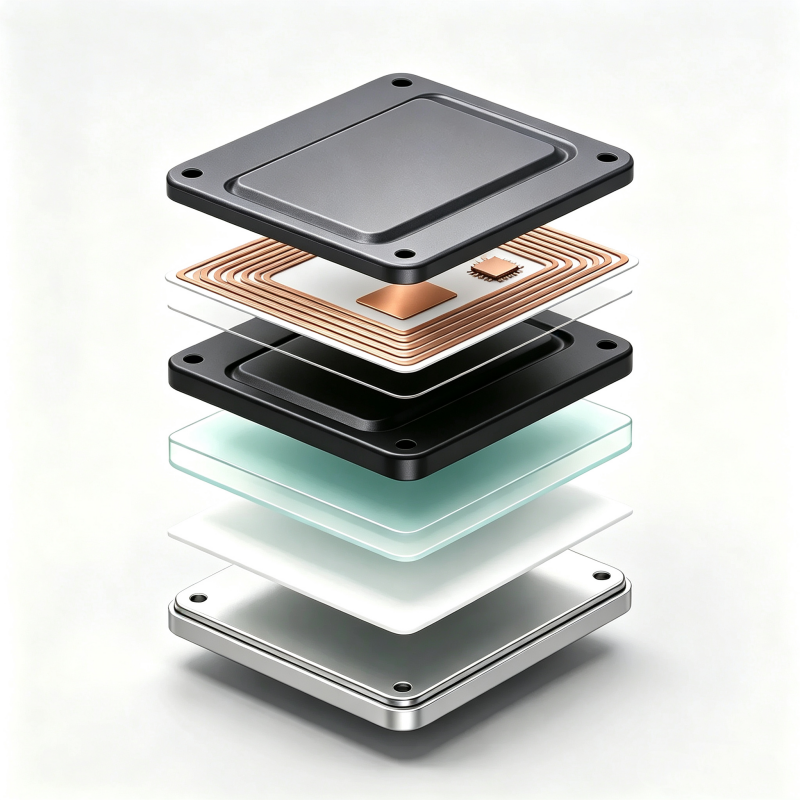
Exploded view of anti-metal RFID tag, showing multi-layer internal structure including housing, copper antenna, chip and dielectric isolation layer.
Why Do Standard RFID Tags Struggle on Metal?
Metal is electrically conductive and interacts with the electromagnetic fields used in RFID communication. When a conventional RFID tag is placed directly on a metal surface, the interaction can alter the tag antenna’s impedance and radiation characteristics.
The result may be reduced read range, inconsistent identification, or complete reading failure under certain conditions.
Common problems include:
- Reduced read range: The reader must move closer to the tag to establish communication.
- Unstable reading performance: Tag orientation and placement affect identification results.
- Missed reads: Tags may not respond consistently during automated inventory operations.
- Installation limitations: Conventional labels may not be suitable for direct attachment to metal assets.
- Inconsistent system performance: Different mounting positions and surrounding structures can affect the reading zone.
Increasing reader power is not always the right solution. The tag, reader, antenna, installation position, and surrounding environment must work together.
A properly selected on-metal RFID tag helps address the physical challenges of metal mounting and provides a more suitable starting point for reliable identification.
What Are RFID Tags for Metal Surfaces?
RFID tags for metal surfaces are specialized radio-frequency identification transponders designed to operate on or near conductive materials.
They contain an RFID chip and an antenna, with additional structural features depending on the intended frequency and application.
For example, some UHF on-metal tags use a carefully designed antenna and backing structure to manage the interaction with the metal surface. Certain HF or NFC designs use ferrite materials or other specialized constructions to support near-field communication in metal-mounted applications.
The appropriate design depends on the operating frequency, tag dimensions, available installation space, and expected reading performance.
On-metal RFID tags may be supplied as thin labels, compact rigid components, PCB-based designs, ceramic constructions, or rugged housed tags. Some products support adhesive mounting, while others are designed for screws, rivets, or mechanical brackets.
When evaluating a product, do not rely on the term “anti-metal” alone. Check the specified frequency, mounting requirements, dimensions, environmental ratings, and performance under representative operating conditions.
Types of RFID Tags for Metal Surfaces
Different on-metal RFID tags serve different identification tasks. Understanding their characteristics helps narrow down the options before requesting samples or a quotation.
1. UHF On-Metal RFID Tags
UHF RFID tags are commonly used in applications that require automated inventory, multiple-tag identification, or reading from a greater distance than a typical NFC interaction.
UHF on-metal tags are frequently considered for:
- Industrial equipment and machinery tracking
- Warehouse racks and metal containers
- Manufacturing tools and fixtures
- IT equipment and server assets
- Logistics and reusable transport assets
- Inventory management across industrial facilities
The actual read range depends on the tag design, reader power, antenna configuration, tag orientation, mounting conditions, surrounding materials, and regional frequency regulations.
For applications involving multiple tags, it is also important to evaluate anti-collision performance, reading speed, and the reliability of identification within the intended reading zone.
2. HF RFID Tags for Metal Applications
High-frequency RFID operates at 13.56 MHz and is commonly used for short-range identification and controlled reader interaction.
HF tags designed for metal mounting can be suitable for applications where the reading distance is relatively short and the system requires a compatible HF reader.
Potential applications include equipment identification, industrial workflow management, and certain access or maintenance processes.
The tag must be designed for the intended mounting conditions. An ordinary HF tag should not be assumed to work reliably when attached directly to metal.
3. Anti-Metal NFC Tags
NFC is a short-range technology operating at 13.56 MHz. Anti-metal NFC tags are designed to support NFC communication when installed on suitable metal surfaces.
They may be used for:
- Equipment information access
- Maintenance records
- Product identification
- Smartphone-based asset interactions
- Service instructions and digital information access
Compatibility should be checked against the intended smartphone, NFC reader, tag IC, and application. NFC tags also need to be evaluated for the actual mounting position and nearby conductive materials.
4. Flexible, Rigid, and Rugged On-Metal Tags
On-metal RFID tags are also available in different physical constructions.
Flexible tags may be suitable when a thin profile or a degree of flexibility is required. PCB-based or ceramic tags may be appropriate for particular compact or industrial applications. Rigid tags with protective housings may be considered where mechanical protection is important.
The best construction depends on the available mounting space, required durability, installation method, and operating environment.
The following table summarizes common options and their typical selection considerations.
| Tag type | Typical applications | Main selection considerations |
|---|---|---|
| UHF on-metal tag | Warehouse inventory, industrial assets, tools, containers | Required read range, antenna configuration, tag size |
| HF on-metal tag | Short-range identification, industrial workflows | Reader compatibility, mounting conditions, communication requirements |
| Anti-metal NFC tag | Smartphone interaction, equipment information, maintenance | NFC compatibility, tag IC, mounting position |
| Flexible on-metal tag | Space-constrained assets and selected curved surfaces | Flexibility, thickness, attachment method |
| Rigid or rugged on-metal tag | Machinery, industrial equipment, reusable assets | Mechanical strength, environmental ratings, fixing method |
| Custom on-metal RFID tag | Specialized equipment and application-specific systems | Dimensions, frequency, performance targets, customization requirements |
These are general product categories rather than specifications for a particular model. Actual capabilities vary by manufacturer and design.
How to Choose the Right RFID Tag for Metal Surfaces
Selecting the right tag requires more than choosing a frequency or a product labeled anti-metal. Start by defining how the tag will be used, where it will be installed, and how the reader will interact with it.
1. Identify the Metal Material and Surface
Determine whether the tag will be attached to steel, stainless steel, aluminum, or another conductive material.
Surface geometry is equally important. A flat panel, a curved pipe, and a small handheld tool provide different installation conditions.
Record the available mounting area, surface curvature, nearby edges, and any restrictions on tag thickness.
These details help determine which tag dimensions and constructions are practical for the application.
2. Select the Appropriate RFID Frequency
The frequency should match the intended identification task and the reader system.
UHF may be suitable for automated inventory and applications requiring reading from a greater distance. HF may be preferable for controlled short-range identification, while NFC is often considered when smartphone interaction is required.
The final decision should also account for regional frequency regulations, the supported tag IC, reader compatibility, and the required communication behavior.
3. Define the Required Read Range
Before purchasing, determine how the tag will be read in normal operation.
For example, will an operator scan a tool using a handheld reader? Will a smartphone interact with an NFC tag? Or will fixed readers automatically identify assets moving through a warehouse or production line?
These use cases have different performance requirements.
Specify the target reading distance, tag orientation, reading speed, and whether the system must identify multiple tags simultaneously.
A manufacturer’s maximum read-range figure should not be treated as a guaranteed result for every installation. Validate the tag using the intended reader, antenna, and mounting conditions.
4. Check Tag Size and Mounting Method
Tag dimensions influence installation options and may affect RF performance.
A small tag may fit a compact metal tool but offer different performance characteristics from a larger tag mounted on a machine or container.
Consider the following mounting options:
- Adhesive mounting for compatible surfaces and installation conditions
- Screws or rivets for suitable mechanical attachment
- Brackets or holders where direct attachment is unsuitable
- Custom mounting arrangements for specialized assets
Confirm the available length, width, and thickness, as well as whether the tag must be removable or permanently installed.
5. Evaluate the Operating Environment
Industrial assets may be exposed to temperature changes, moisture, dust, oil, chemicals, vibration, impact, abrasion, and outdoor conditions.
Not every on-metal RFID tag is designed to withstand all these factors.
Before selecting a product, verify the temperature range, ingress protection rating, chemical compatibility, mechanical durability, and any other relevant environmental specifications.
If the tag will be installed on machinery exposed to frequent cleaning or repeated impacts, environmental suitability should be a primary selection criterion rather than an afterthought.
6. Confirm the Required Identification and Customization Features
Some projects require more than a tag that can be read successfully.
Depending on the product and application, requirements may include printed identification, barcodes, QR codes, laser marking, encoded data, specific chip options, or customized dimensions.
Clarify which features are available for the selected product and whether they can be supported at the required order quantity.
For custom projects, discuss the requirements with the manufacturer before finalizing the design.
7. Test Samples Before Bulk Purchasing
Sample testing is one of the most important steps in selecting RFID tags for metal surfaces.
Install candidate tags on the actual asset using the intended mounting method. Test them with the reader and antenna configuration that will be used in production.
Evaluate reading performance at the required distance and orientation, and repeat the test under representative operating conditions.
For automated inventory systems, assess whether the system can identify the required number of tags consistently in the intended reading zone.
Document the results and compare the candidate products before placing a bulk order.
RFID Tag Selection Checklist
The following checklist can help purchasing teams, engineers, and system integrators prepare a clear product specification.
| Selection factor | Information to confirm | Why it matters |
|---|---|---|
| Asset and surface | Asset type, metal material, surface shape | Helps establish mounting compatibility |
| Frequency | UHF, HF, or NFC | Determines reader and tag compatibility |
| Reading requirements | Distance, orientation, reading speed | Establishes the required performance |
| Tag dimensions | Length, width, thickness | Ensures the tag fits the installation area |
| Attachment | Adhesive, screw, rivet, bracket, or other method | Supports secure and practical installation |
| Environment | Temperature, moisture, chemicals, impact, outdoor exposure | Helps determine durability requirements |
| Customization | Printing, marking, encoding, dimensions, or other options | Aligns the product with operational needs |
| Order quantity | Samples, pilot batch, or bulk order | Helps establish the appropriate quotation and validation process |
Providing this information when contacting a supplier can reduce unnecessary product comparisons and make the evaluation process more efficient.
Common Applications of RFID Tags for Metal Surfaces
On-metal RFID tags can support asset identification and tracking across multiple industries. The appropriate product depends on the asset, the reading process, and the environmental requirements.
Industrial Equipment and Machinery Tracking
Manufacturing plants and industrial facilities often need to identify machines, equipment, and individual components throughout their service life.
RFID tags mounted on suitable metal surfaces can link physical assets to digital records, supporting maintenance history, inspection schedules, and equipment management.
The tag should be selected according to the available mounting space, environmental exposure, and reading method.
Tool and Fixture Tracking
Metal tools, molds, fixtures, and reusable manufacturing equipment can be difficult to track using conventional labels when those labels are unsuitable for direct metal mounting.
On-metal RFID tags can support tool check-in and check-out, inventory verification, and asset allocation.
For small tools, tag dimensions and mounting security are particularly important. For frequently handled equipment, the selected tag should also meet the required mechanical durability.
Warehouse Racks and Metal Containers
Warehouse operators may use RFID to identify storage locations, track reusable containers, and automate selected inventory processes.
Metal racks and containers create specific mounting and reading conditions. Tag placement, antenna positioning, and the presence of neighboring assets should be evaluated during system testing.
IT Equipment and Server Cabinets
Servers, networking devices, and related assets often have metal enclosures.
Suitable on-metal RFID tags can support IT asset identification, inventory audits, and maintenance workflows.
For compact equipment, the available mounting area and the proximity of other metal surfaces may influence the tag design and installation position.
Logistics and Manufacturing Operations
RFID tags for metal surfaces can also support identification of metal components, work-in-process assets, reusable transport items, and industrial containers.
In these applications, reliable performance depends on matching the tag and reader system to the production process, required identification speed, and operating environment.
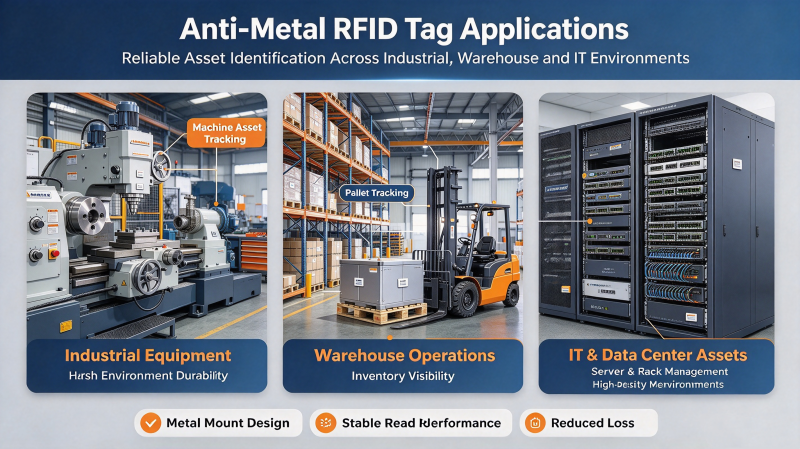
Anti-metal tags have a wide range of applications.
How to Install and Test RFID Tags on Metal
Correct installation helps improve the consistency of RFID performance. Follow the product’s mounting instructions and validate the installed tag under realistic conditions.
Step 1: Prepare the mounting surface.
Clean the installation area and confirm that the surface finish is compatible with the selected attachment method.
Step 2: Install the tag correctly.
Follow the specified orientation, spacing, adhesive requirements, and mechanical fixing instructions. Do not assume that all tag models use the same mounting procedure.
Step 3: Test with the intended reader.
Check whether the installed tag can be identified at the required distance and orientation. Use the reader and antenna configuration intended for the final application.
Step 4: Evaluate the real environment.
Test near relevant machinery, metal structures, containers, or other tags where applicable. Confirm that performance remains acceptable under representative operating conditions.
Step 5: Record and review the results.
Document tag placement, reader settings, identification consistency, and any installation limitations before approving the product for wider deployment.
If the tag does not perform as expected, review the tag model, mounting method, orientation, reader configuration, and surrounding RF environment before changing the system settings.
Common Problems with RFID Tags on Metal
Why Does My RFID Tag Stop Working After Installation on Metal?
The tag may not be designed for direct metal mounting. Metal can alter antenna performance and interfere with communication.
Consider a suitable on-metal RFID tag and validate it on the actual asset using the intended reader.
Why Is the RFID Read Range Shorter Than Expected?
Possible causes include tag dimensions, orientation, mounting conditions, reader and antenna configuration, nearby structures, and environmental interference.
Compare performance under controlled conditions before deciding whether a different tag design or reader configuration is needed.
Can I Use a Standard RFID Label on a Metal Surface?
A conventional RFID label may perform poorly when attached directly to metal. A label specifically designed for metal mounting or another compatible on-metal tag is generally a more appropriate starting point.
Does a Larger On-Metal RFID Tag Always Have a Longer Read Range?
No. Tag size is only one factor. Antenna design, frequency, reader configuration, orientation, mounting conditions, and the surrounding environment also influence performance.
Can On-Metal RFID Tags Be Used Outdoors?
Some products are designed for outdoor applications, but environmental capabilities vary. Check the specified temperature range, ingress protection rating, UV resistance, and other relevant product specifications.
Can On-Metal RFID Tags Be Customized?
Customization options depend on the manufacturer and the selected design. Depending on the product, options may include dimensions, materials, printing, marking, encoding, or mounting arrangements.
Provide your application requirements to determine which options are feasible.
Why Choose DO RFID Reader for RFID Solutions?
DO RFID Reader is a manufacturing business within D.O RFID Group, a China-based supplier of RFID-related products for applications including access control, vehicle identification, logistics, and inventory control.
With experience in RFID and smart card manufacturing, DO RFID Reader supports RFID product selection and customized solutions for different identification and tracking requirements.
When choosing a supplier for an RFID project involving metal assets, buyers should consider product compatibility, manufacturing quality, customization requirements, technical assistance, and long-term support.
DO RFID Reader offers the following service commitments for products it manufactures:
- 36-month warranty: Warranty coverage for manufactured products, subject to the applicable warranty terms.
- 24-hour technical support: Technical assistance to help customers address product and application questions.
- Customized RFID solutions: Support for product requirements tailored to different applications, subject to technical feasibility.
- RFID manufacturing experience: Experience in RFID and smart card products for a range of identification and tracking applications.
For projects involving metal surfaces, it is important to confirm the specific tag model, supported frequency, mounting conditions, and required performance before selecting a product.
Rather than choosing a tag based on its category alone, share your application requirements with the supplier so the available options can be evaluated against your needs.
Frequently Asked Questions About RFID Tags for Metal Surfaces
What Is the Best RFID Tag for Metal Surfaces?
The best option depends on the application. UHF on-metal tags may suit automated inventory and industrial asset tracking, while HF or NFC tags may be appropriate for short-range identification. Tag dimensions, mounting conditions, environmental requirements, and reader compatibility should also be considered.
What Is the Difference Between On-Metal RFID Tags and Anti-Metal RFID Tags?
The terms are commonly used to describe RFID tags designed to operate on or near metal surfaces. Specific antenna structures, materials, and performance characteristics vary by product.
Can UHF RFID Tags Work on Steel and Aluminum?
Yes, suitable UHF on-metal RFID tags can be designed for mounting on conductive materials such as steel and aluminum. Performance depends on the tag design, surface geometry, mounting conditions, and reader configuration. Testing on the intended asset is recommended.
How Do I Choose an RFID Tag for Metal Tools?
Start with the available mounting area, required reading distance, reader type, attachment method, and operating environment. Select a compatible on-metal tag and test it on the actual tool before ordering in bulk.
What Information Is Needed to Request a Quotation?
Provide the intended application, metal material, available mounting space, required frequency, target read distance, mounting preference, operating environment, estimated quantity, and customization requirements. Photos or drawings can help clarify the installation conditions.
Can DO RFID Reader Help With Customized RFID Requirements?
DO RFID Reader supports RFID product manufacturing and customized solutions for different application requirements. Contact the company with your project details to confirm product availability, technical feasibility, and suitable customization options.
Find the Right RFID Tags for Your Metal Assets
Selecting RFID tags for metal surfaces requires more than choosing a product labeled anti-metal. The tag must match the asset, operating frequency, reading requirements, mounting method, and environmental conditions.
DO RFID Reader supports RFID manufacturing and customized product solutions for identification and tracking applications.
If you are sourcing RFID tags for metal tools, industrial equipment, warehouse assets, or other metal-mounted applications, contact DO RFID Reader to discuss your requirements.
Share your asset type, metal surface, available mounting space, target read distance, and estimated order quantity. These details will help establish a suitable starting point for product evaluation and quotation.

Do RFID is a leading China-based manufacturer with over 15 years of experience. We specialize in customized RFID readers, tags, and cards, delivering high-quality, tailored solutions that meet your unique business needs and drive seamless, efficient identification.