November 3, 2026
PIT tagging gives a fish an electronic identity that can be recognized at later encounters. Measurements taken during handling and detections made at fixed antennas can then be associated with that individual. The tag supplies the identity; the study design determines what can be learned from the observations.
That distinction explains both the value and the limits of RFID fish tracking. A record of the same fish at two measurements can support a growth comparison. An ID detected at a passage point can support a movement observation. Neither result appears simply because a tag has been supplied.
Start with the question the project needs to answer
| Project question | Relevant observations | What must also be known |
|---|---|---|
| How has an individual grown? | ID matched to measurements at different times | Consistent measurement methods and a reliable match between animal and record |
| Which individuals were present at a reading point? | Tag detections with time and location | Where the detection area was and when the equipment was operating |
| How do fish use a passage or reach? | Sequences of observations at relevant sites | Site layout, possible routes and detection coverage |
| What can be inferred about survival? | Encounter histories within a suitable study design | The possibility of missed detection, movement away from the study and other explanations |
Writing the question first helps define the required tag, reader arrangement and records. It prevents a familiar error: buying an identification product and assuming that it automatically provides continuous location or a direct measurement of survival.
Growth and hatchery records: connect repeated measurements
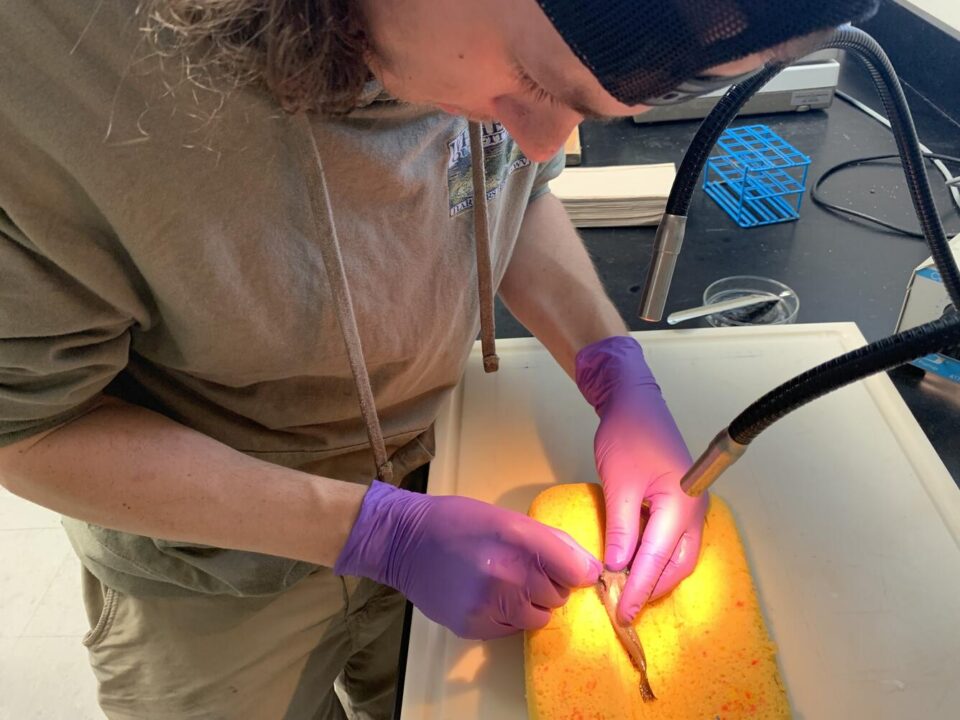
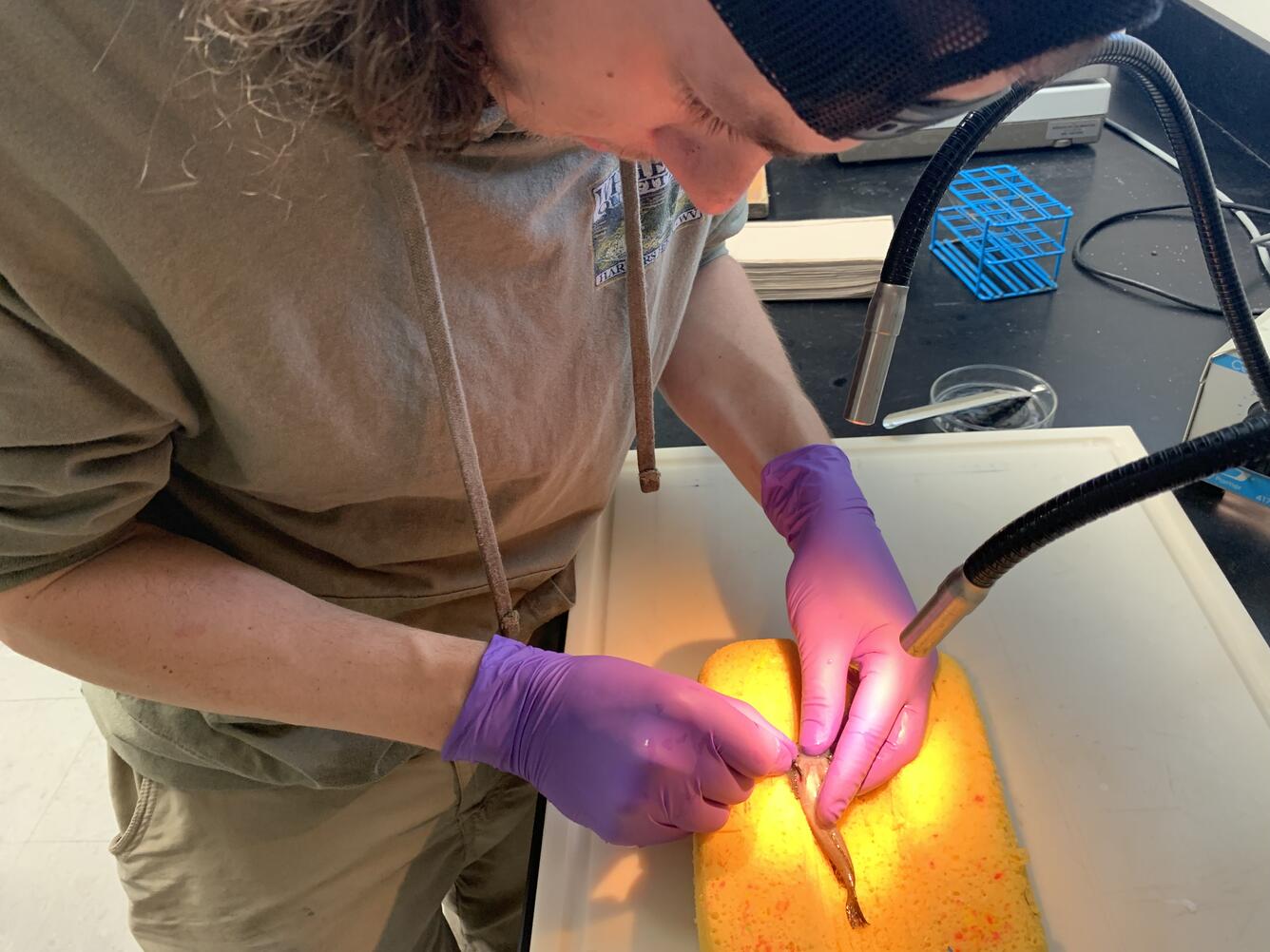
In a hypothetical growth study, an operator reads the tag during a scheduled examination and records a measurement against the ID. At the next examination, the same identity connects the new measurement to the earlier entry.
The project can then examine change for the individual, rather than treating every measured fish as unrelated. Group, origin or other project information can be held in the external record, provided those relationships are established and maintained.
The electronic identity does not correct a measurement entered against the wrong fish or an ID copied into the wrong row. A useful working arrangement keeps the scan and the observation together. Staff should be able to see which identity is active before committing the associated information.
For breeding or managed-stock work, the same principle can connect an individual with a project’s parentage or stock record. The identifier is a link to those records, not a genetic test or an automatic description of the animal.
A worked growth-record example
The following invented records show the calculation, not a biological result from a customer or experiment. “Fish A” stands for a complete tag ID that would be preserved as text in the real dataset.
| Identity | Measurement date | Fork length | Mass |
|---|---|---|---|
| Fish A | 1 April | 80 mm | 8 g |
| Fish A | 1 May | 95 mm | 12 g |
Across these 30 days, observed fork-length increase is 15 mm, averaging 0.5 mm per day over that interval. Observed mass increase is 4 g, or 50% of the first measurement. The ID makes the two rows an individual history; it does not measure the values, establish the cause of growth or prove that every day had the same growth rate.
For an aquaculture comparison, retain stock group, feed or treatment assignment and measurement method in separate fields. Keep the original measurement and its units when making corrections. A reliable ID match lets the analysis ask about individual change rather than simply comparing two unrelated group averages.
Movement: read the fish at useful places
A fixed antenna records compatible tags within its effective detection area. Positioning that area at an informative passage can connect an ID with a place and time. Several observation points can produce a sequence of recorded encounters.
A sequence should be read in the context of the site layout. If a fish can bypass one antenna, the absence of an event there does not mean it never moved through the wider area. If several antennas are close together, the project needs a clear interpretation of repeat detections and their timing.
NOAA’s salmon-restoration account describes PIT observations used to understand migration and identify reaches where restoration could be valuable. It is an external application example, published in 2014, rather than a DO RFID installation or a current total of all tagged fish.
Our read-range guide explains why a physically large antenna and complete detection coverage are not the same claim.
A passage record needs site context
Consider two hypothetical detections of the same ID: upstream antenna A at 13:05:20, followed by downstream antenna B at 13:05:32. With that documented layout, the sequence supports movement from A toward B. The twelve-second interval alone is not a swimming speed: distance, antenna coverage, clock agreement and the meaning of each event also matter.
| Keep with the ID | Example field | Reason |
|---|---|---|
| Observation type | Manual measurement or antenna detection | Separate a measured fish from a detected code. |
| Location and time | Site, antenna, timestamp and time zone | Interpret event order across locations. |
| Method and operation | Reader configuration, downtime and maintenance | Distinguish no observation from an operating detector with no events. |
| Record history | Original ID, correction and processing rule | Trace how raw detections became an encounter. |
If 80 of 100 released identities are later observed, 80% is the observed re-encounter fraction in that example. It is not automatically an 80% survival estimate. The study still has to address observation probability, emigration and tag retention.
Survival: an encounter history needs interpretation
Suppose a tagged fish is not seen after its first recorded encounter. Several explanations may be possible: the fish was not present in the monitored area, it passed without being detected, the equipment was not operating, the tag was lost, or the animal died. A missing event alone does not distinguish those outcomes.
Studies estimating survival therefore need an appropriate design and analysis, including the role of detection probability. Repeat encounters and information about observation coverage can be useful, but an ID list is not a survival estimate by itself.
The opposite inference also needs care. A detected tag is evidence that the code was read. Whether it represents a live fish at that site depends on the context. A recovered or displaced tag is a different kind of observation from a fish detected under a controlled passage arrangement.
The lifespan and retention article separates continued electronic function, tag retention and the ability to obtain later observations.
From a scan to a useful data record
IdentifyCapture the full tag code
ObserveCollect a measurement or a detection event
DescribeKeep time, place and method with the observation
InterpretUse the study design and equipment history
A project record should preserve enough context to understand the event later. For manually collected measurements, that may include time, operator, method and the observed values. For fixed detection, it may include the reading location and the equipment or antenna involved.
For a concrete regional example, the PTAGIS detection specification includes site, timestamp, tag message and reader/antenna identifiers. A different project does not need to copy that regional format to benefit from the principle: keep the identity and the observation context together.
Preserve original records when applying corrections or combining events. If a later analysis treats several rapid detections as one visit, retain the underlying data and the definition used. That makes it possible to revisit the interpretation when the research question changes.
Choose the configuration for the whole observation period
A tag should be evaluated for the animal and life stage at tagging as well as the later reading task. A configuration that works during a close handheld check has not automatically demonstrated the detection performance required at a fixed station.
Start with the intended infrastructure and any collaborating program’s tag requirements. Then compare suitable physical configurations and the approved animal protocol. The size-selection guide explains why an unqualified “smallest is best” rule is insufficient.
The project also needs to remain able to observe. Record relevant interruptions, installation changes and maintenance. A gap caused by equipment downtime should not silently become an apparent change in animal behavior.
When another tracking method may be useful
PIT identification is particularly useful when the intended observations can be made during handling or at suitable reading points. A study needing different spatial coverage or additional measurements may evaluate other tags and receivers, or combine methods.
That is a research-design choice. It does not make the PIT identity useless; the identity and another observation method can serve different parts of a project. The PIT-versus-acoustic comparison examines these decisions.
Turn the project question into a supply requirement
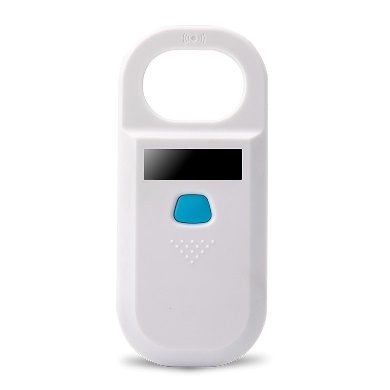
For manual FDX-B identification, our G-002 Ø1.4 × 8 mm and G-003 Ø2.12 × 12 mm glass tags are concrete configurations to evaluate with the fish and procedure. The 8 mm G-101/G-103 and 12 mm G-102/G-106/G-107 preloaded injector formats add an application device; W90A or W91A can be considered for the handheld format check. Biological suitability and final tag mass remain model- and project-specific.
For fixed monitoring, start from the station’s accepted protocol and tag configuration. G-105 offers a separately specified 15 mm HDX option, but its format alone does not demonstrate suitability for an existing network. Discuss these requirements through our PIT tag supply page, and use the kit guide to define tags, tools and equipment separately.
Frequently asked questions
Does a PIT tag measure fish growth?
The tag provides an identity. Growth is assessed from measurements collected and associated with that identity over time.
Does PIT tagging require recapture for every observation?
No. Suitable fixed systems can record passage detections. Physical measurements still need a method for collecting the measurement itself.
Can a missed detection be counted as mortality?
Not on its own. Absence from the observation area, missed reading, downtime and other explanations must be considered in the study design.
Can one tag work across different projects?
Potentially, but reader compatibility, accepted tag configurations and data arrangements must be checked. Sharing a general technology name is insufficient.

Do RFID is a leading China-based manufacturer with over 15 years of experience. We specialize in customized RFID readers, tags, and cards, delivering high-quality, tailored solutions that meet your unique business needs and drive seamless, efficient identification.