November 4, 2026
For a small-fish or juvenile study, start by comparing compact 7 mm and 8 mm PIT tags. For replenishing an established 12 mm FDX-B system, start with the original tag specification. For fish-passage monitoring, shortlist sizes that the fish can carry, then compare their detection performance with the intended antenna.
The tables below connect actual DO RFID models with their dimensions, protocol and supply format. They also separate our products from industry examples and published fish studies, so you can build a useful shortlist before ordering.
PIT tag sizes for fish: quick comparison
Our standard individual glass tags cover six capsule sizes. Dimensions below are nominal diameter × length; all six are listed as EM4305, 134.2 kHz FDX-B configurations.
| DO RFID model | Diameter × length | Approximate tag mass* | Protocol | Supply and tool options |
|---|---|---|---|---|
| G-001 · 7 mm | Ø1.25 × 7 mm | Approx. 0.1 g | FDX-B | Loose, 100/bag; separate matched applicator |
| G-002 · 8 mm | Ø1.4 × 8 mm | Approx. 0.2 g | FDX-B | Loose, 100/bag; 8 mm preloaded options: G-101/G-103 |
| G-003 · 12 mm | Ø2.12 × 12 mm | Approx. 0.2 g | FDX-B | Loose, 100/bag; 12 mm preloaded options: G-102/G-106/G-107 |
| G-004 · 13 mm | Ø3 × 13 mm | Approx. 0.2 g | FDX-B | Loose, 100/bag; separate matched applicator |
| G-005 · 15 mm | Ø3 × 15 mm | Approx. 0.2 g | FDX-B | Loose, 100/bag; G-105 preloaded option in this size |
| G-006 · 32 mm | Ø4 × 32 mm | Not listed | FDX-B | Loose, 100/bag; separate matched applicator |
*Mass values are approximate loose-tag catalog references; preloaded configurations may list different values. For a project-specific tag-burden calculation, use the mass of the selected tag.
For the 15 mm preloaded format, G-105 can use EM4305 FDX-B or SIC7999 HDX, both at 134.2 kHz. The HDX option belongs to that specified configuration; it does not turn the entire table into an HDX range.

7 mm, 8 mm, 9 mm, 12 mm and larger PIT tags
7 mm and 8 mm: start here when capsule size is the constraint
G-001 and G-002 are useful first candidates to discuss for small fish, early life stages or a restricted implantation space. The 7 mm option is shorter and narrower: Ø1.25 × 7 mm versus Ø1.4 × 8 mm. The 8 mm option also has identified preloaded injector choices, which can simplify purchasing for a project that needs a tag and applicator together.
This is a starting shortlist, not a species-specific implantation recommendation. The project’s animal protocol and relevant research determine biological suitability. Where the fish can accommodate either candidate, compare the complete reading and handling workflow rather than automatically selecting the shortest tag.
8 mm vs 12 mm PIT tags: the practical differences
Our G-002 is Ø1.4 × 8 mm; G-003 is Ø2.12 × 12 mm. Moving to the 12 mm model increases length by 50% and diameter by about 51%. Its cross-sectional area is about 2.3 times greater, calculated from those diameters. That helps explain why an applicator choice involves more than four extra millimetres of length.
Begin with the 8 mm configuration
When the earliest tagging stage has limited space and identification happens during handling, compare G-002 or the G-101/G-103 preloaded formats. Include any later fixed-antenna detection in the evaluation.
Begin with the 12 mm configuration
When replenishing a proven 12 mm FDX-B workflow, compare G-003 against the original model and consider G-102/G-106/G-107 when preloaded injectors are needed. Preserve the established code format and reader setup.
Where do 9 mm and 23 mm tags fit?
These are real industry size classes, but they are not interchangeable with a nearby DO RFID size. For example, Biomark’s manufacturer catalog specifies HPT9 at Ø2.1 × 9 mm and HPT23 at Ø3.85 × 23 mm. Its HDX23 is Ø3.85 × 23.1 mm. Those are named manufacturer examples, not DO RFID specifications.
A 9 mm tag can therefore be almost as wide as our 12 mm option, while our 8 mm tag is narrower. Within our range, the 13 and 15 mm tags both have a 3 mm diameter, and the 32 mm option is 4 mm wide. Larger fish may allow these additional candidates, but choose them for a defined reading or handling need rather than body size alone.
How tag size affects detection
A PIT tag’s coil receives energy from the reader field and returns the identification response. Available coil space, chip design and tuning can change with the tag model. This often makes larger transponders worth comparing for a fixed detection area, while compact tags can serve close handheld identification.
Across these models, our catalog gives approximate reference distances of about 5–35 cm. Actual working range varies with the reader, antenna, tag orientation and surroundings.
| Individual tag | Approximate reference distance |
|---|---|
| G-001 · 7 mm | Approx. 5 cm |
| G-002 · 8 mm | Approx. 7 cm |
| G-003 · 12 mm | Approx. 12 cm |
| G-004 · 13 mm | Approx. 15 cm |
| G-005 · 15 mm | Approx. 20 cm |
| G-006 · 32 mm | Approx. 35 cm |
Use these figures as supplier references, not a prediction of fish-passage coverage. A useful comparison runs the candidate tags through the same intended antenna, including relevant orientations and positions. Record successful reads against known passes: a clear scan at one favourable point answers a different question from reliable detection across a channel.
For manual recapture, prioritise a consistent scan at the handling position. For unattended passage, compare the usable detection area and missed passages. Our PIT tag read-range guide explains those measurements in more detail.
Choosing PIT tags for juvenile fish
A practical shortlist follows the observation method:
- Small fish measured by hand: start with 7 and 8 mm candidates, then compare the capsule dimensions, confirmed mass and operator’s scan position. The known 8 mm preloaded formats provide another handling choice.
- Juveniles entering an existing monitoring network: start with that network’s accepted formats. Compare a smaller candidate with the established 12 mm tag at the detection points the fish will encounter.
- A study following fish through growth: consider the first tagging stage and later detection together. A small tag can remain the individual’s identity as the fish grows; the later reader arrangement still needs to detect it.
Record the species and the distribution of fish lengths and weights, not just the average. That identifies the smallest individuals in the planned tagging group. Tag burden is calculated as tag mass ÷ fish mass × 100%, but the resulting percentage is one input alongside capsule geometry, placement and the study method.
What fish research says about tag size
The studies below show why the fish, procedure and observation period belong beside the tag length. FL means fork length; TL means total length. Their numerical thresholds should not be mixed.
| Study and fish | Tags, fish sizes and conditions | Reported findings |
|---|---|---|
| O’Donnell & Letcher, 2017 · Brook Trout | 8 mm tags; fish 35–50 mm FL and 0.35–1.266 g; laboratory observations at 29 and 64 days. | Survival was 100% and retention 96.7%. Fish size did not differ among treatments at the two observation dates. |
| Tiffan et al., 2015 · age-0 Chinook Salmon | 40–49 mm FL fish received 8 or 9 mm tags; 50–69 mm FL groups included 8, 9 and 12 mm tags. Laboratory trials lasted 28 days. | Across trials, survival was 97.8–100% and retention 93–99%. Early fork-length growth was reduced in the smaller groups during the first seven days; final fish sizes were similar. |
| Root et al., 2026 · age-0 Lake Sturgeon | 293 fish, 75–205 mm TL; 8 and 12 mm tags, with separate adhesive treatments; hatchery monitoring for 84–98 days. | Without adhesive, retention was 98.6% for 8 mm and 90.4% for 12 mm tags. All fish above 175 mm TL retained their tags. No growth differences were found among treatment and control groups. |
For a project, the useful lesson is to select relevant comparison conditions. The Chinook Salmon trial provides a direct small-tag comparison and shows why early recovery and the final endpoint are different observations. The Lake Sturgeon study shows that retention can vary with size and treatment, with losses continuing as late as day 63. Follow-up should therefore match the study period, not end after a successful first scan.
These results describe the tags and procedures used in those studies. They are not test results for our G-series products or universal minimum fish-length rules. For longer studies, see our tag retention and lifespan guide.
FDX-B / HDX compatibility and reader choices
Choose the communication format before finalising a size. Our G-001–G-006 individual configurations are FDX-B. G-105’s 15 mm preloaded configuration offers a separate HDX option. Both formats can operate at 134.2 kHz, so frequency alone does not identify a compatible pair.
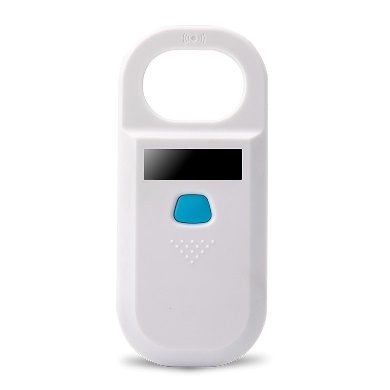
For handheld FDX-B identification, our W90A and W91A are concrete reader candidates. Our 2026 animal-reader catalog lists EMID, FDX-B and HDX support at 125/134.2 kHz for both. W90A has a Micro USB interface and weighs 110 g; W91A lists Type-C and 72 g. Choose the format required by the tags, then match the connection and recording workflow.
A fixed monitoring station also needs the appropriate antenna, power and recording arrangement. Explore our animal RFID reader range or the reader selection guide for the next equipment decision.
Loose tags, needles and preloaded injectors
A supply format determines what the operator has to prepare. A loose tag is separate from the applicator. A preloaded needle contains a tag but may still need a compatible handle or injector. A complete preloaded injector combines the tag with the single-use application device.
Our verified G-series preloaded options are complete injector sets. Each contains one glass tag, the injector, a barcode sticker and individual paper/plastic packaging; the catalog lists 20 injectors per pack.
| Tag size and models | Injector body dimensions | Format |
|---|---|---|
| 8 mm · G-101 / G-103 | 120 × 46 mm / 140 × 47 mm | Ø1.4 × 8 mm tag preloaded in single-use injector; FDX-B |
| 12 mm · G-102 / G-106 / G-107 | 120 × 46 mm / 133 × 43 mm / 138 × 43 mm | Ø2.12 × 12 mm tag preloaded in single-use injector; FDX-B |
| 15 mm · G-105 | 140 × 47 mm | Ø3 × 15 mm tag; specify FDX-B or HDX version |
Injector body dimensions are not needle gauges. For loose tags or a proposed needle-only format, specify the applicator model and its accepted capsule diameter and length. Our checked product entries do not establish a universal needle gauge for each tag length. The PIT tagging kit guide explains the parts to match.
DO RFID size and supply options: a 5,000-tag example
Consider a hypothetical first order of 5,000 tags at Ø1.4 × 8 mm, FDX-B. The following are two purchasing routes, not fixed bundles or price quotations.
| Route | Tag order | Equipment and preparation |
|---|---|---|
| Existing suitable implantation equipment | 5,000 G-002 individual tags = 50 bags of 100 | Retain the validated applicator; add a compatible FDX-B reader if required. Plan tag loading, preparation and records around the project procedure. |
| Tags and disposable injectors together | 5,000 G-101 or G-103 sets = 250 packs of 20 | Each tag comes in its injector. For a handheld identification station, evaluate W90A or W91A alongside the selected tag. Compare injector design, consumables and total cost. |
Keep the physical order and the identity records connected. State the tag model, dimensions, protocol, required code format and quantity on the specification. For injector sets, define how barcode stickers will be associated with the fish records. If a digital ID list is required, include its file format and matching requirements in the order rather than assuming it is included.
For an established project, provide the previous model and a reference read from the existing equipment. For a first deployment, evaluate a representative sample configuration before committing the full quantity. The project team supplies the species, size distribution and approved handling method; the supply discussion defines the tags, packaging and equipment to quote. Final tag mass and any network-specific coding requirement should be resolved in that specification.
Explore our PIT tags for fish and animal identification to discuss these configurations. For the wider budget, including reading equipment and consumables, use our PIT project cost guide.
Frequently asked questions
Which small PIT tag sizes should I compare first?
Start with 7 and 8 mm configurations when capsule size is the immediate constraint. In our range those are Ø1.25 × 7 mm and Ø1.4 × 8 mm. The 8 mm configuration also has identified preloaded injector choices.
Can an 8 mm tag work with my 12 mm reader?
Yes, it can be a candidate when both configurations use a supported format such as FDX-B. Compare the actual sample with your reader and retain the code format required by the records or network; changing size may change detection performance.
What is the minimum fish size for a PIT tag?
Use evidence for the species, body size, placement and procedure. The Brook Trout and Chinook Salmon results above support defined study conditions, while the Lake Sturgeon study demonstrates a different retention pattern. They do not establish one minimum size for every fish.
Is 23 mm the same as DO RFID’s 32 mm option?
No. The named 23 mm examples belong to other manufacturers. Our G-006 is Ø4 × 32 mm and should be evaluated as its own configuration.
Does an injector set include a reader?
The G-series injector sets described here contain a tag and application device, barcode sticker and packaging. Select reading equipment separately for the project’s protocol and workflow.

Do RFID is a leading China-based manufacturer with over 15 years of experience. We specialize in customized RFID readers, tags, and cards, delivering high-quality, tailored solutions that meet your unique business needs and drive seamless, efficient identification.