November 11, 2026
Choosing the right RFID tag supplier is an important step in building a reliable industrial identification and asset-tracking system. Industrial environments can expose RFID tags to metal interference, high temperatures, chemicals, moisture, vibration, abrasion and repeated mechanical impact. A tag that works well in a warehouse may not perform reliably on a metal tool, production component or outdoor container.
For this reason, buyers researching industrial rfid tags manufacturers should look beyond product prices and advertised read ranges. They should evaluate product construction, frequency options, environmental resistance, customization capabilities, technical support and the supplier’s ability to meet specific application requirements.
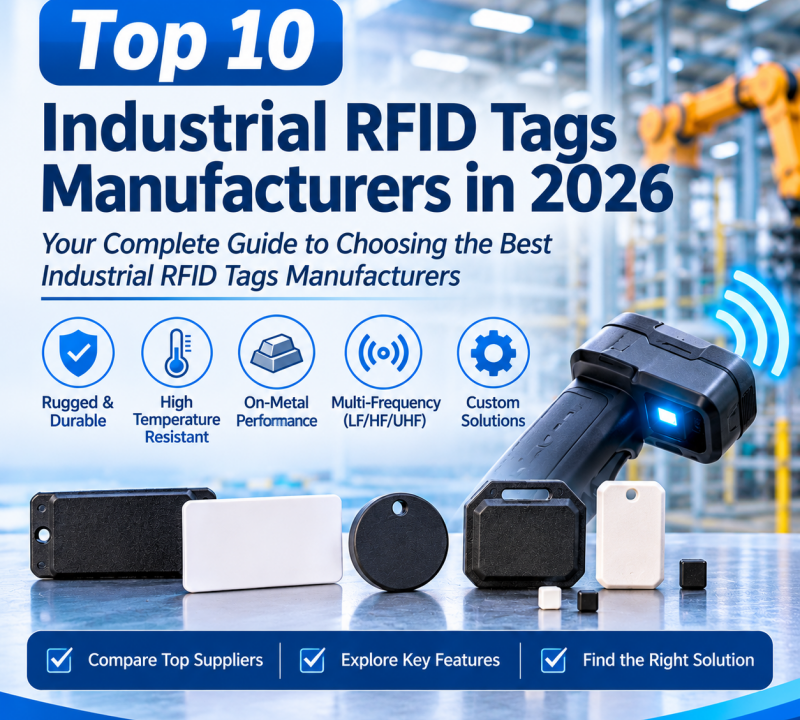
This guide introduces 10 companies offering industrial RFID tags or related industrial RFID hardware. DO RFID Reader is placed first, followed by nine other companies selected for their relevant product offerings. The order is an editorial selection for this guide, not an independently verified ranking by revenue, market share or production capacity.
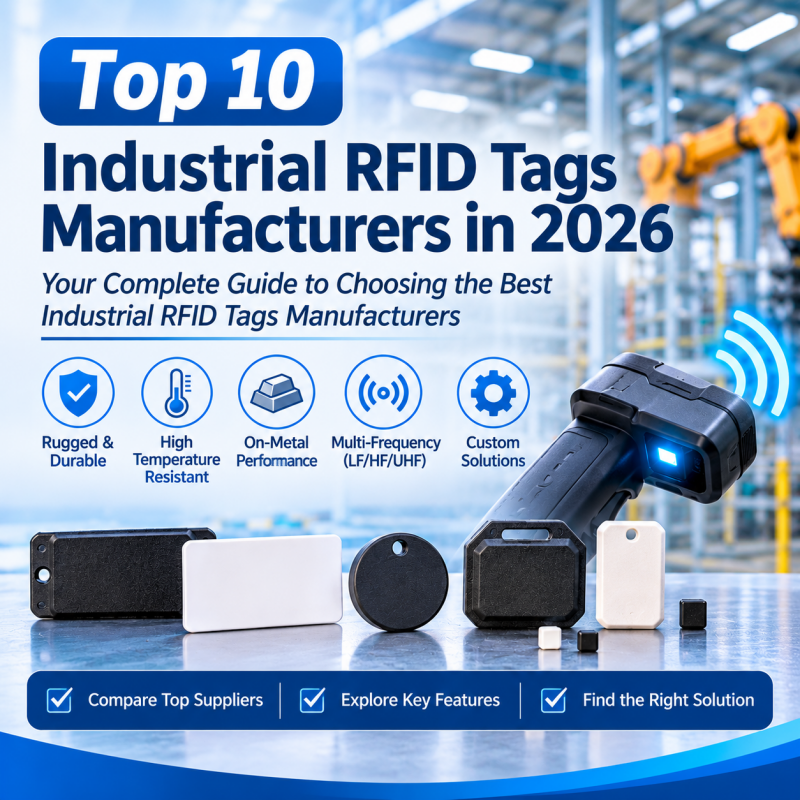
What Should Buyers Look for in Industrial RFID Tags Manufacturers?
Before comparing suppliers, it helps to understand what makes an industrial RFID tag suitable for a particular application.
1. On-Metal RFID Performance
Metal surfaces can interfere with RFID communication. Standard RFID labels may lose reading performance or become unreliable when attached directly to metal.
For metal tools, machinery, containers and industrial components, buyers should look for tags specifically designed for on-metal applications. These products may use specialized antenna structures, ceramic or engineered housings, shielding designs or other construction techniques to improve performance.
2. Temperature and Environmental Resistance
Industrial RFID tags may be exposed to heat, cold, water, oil, chemicals, dust and mechanical impact. The required resistance depends on the actual working environment.
For example, a tag used for ordinary warehouse inventory may have very different requirements from one installed on automotive production equipment or metal parts passing through a high-temperature process.
Always distinguish between operating temperature, storage temperature and short-term survival temperature. These specifications are not interchangeable.
3. Frequency and Reader Compatibility
Industrial RFID products commonly use LF, HF/NFC or UHF technologies.
- LF: Often used for specific identification and applications requiring short-range communication.
- HF/NFC: Common in close-range identification, access applications and certain industrial workflows.
- UHF: Widely used for inventory, logistics, manufacturing and longer-range asset identification.
The selected tag must match the reader, regional frequency regulations and required communication protocol.
4. Size, Mounting and Customization
Some industrial components have very limited installation space. Others require screw mounting, adhesive attachment, embedding or specialized housings.
A suitable supplier should be able to explain available dimensions, mounting options, chip configurations, printing, encoding and customization possibilities.
5. Sample Testing and Technical Support
A datasheet is a starting point, not a guarantee of performance in every installation.
Professional buyers should request samples and test them on actual assets using the intended reader, antenna, mounting method and operating workflow. This is particularly important when comparing industrial rfid tags manufacturers for demanding applications.
Top 10 Industrial RFID Tags Manufacturers in 2026
The following companies are presented in the requested order. Their product descriptions are based on their publicly presented product portfolios and company information. Buyers should confirm current specifications, manufacturing arrangements and availability directly with each supplier.
1. DO RFID Reader
Website: https://www.dorfidreader.com/
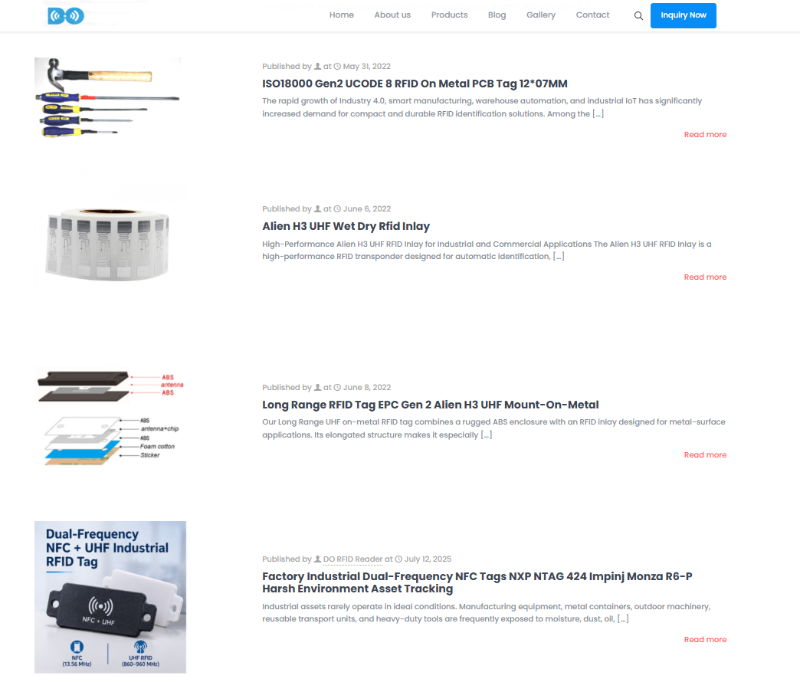
DO RFID Reader provides RFID tags and readers for industrial identification, asset tracking and specialized applications. Its product range includes solutions for projects that require compact dimensions, on-metal performance and customized RFID configurations.
One area of particular interest is its miniature ceramic UHF RFID tag range. The company presents compact 4 mm and 5 mm ceramic tags designed for identifying small metal components, tools and equipment where conventional RFID labels may be too large.
For example, the CER0404 measures 4 × 4 × 3 mm, while the CER0505 measures 5 × 5 × 3 mm. Both are designed for metal mounting and use EPC Class 1 Gen 2 / ISO 18000-6C UHF technology. Their published specifications include regional frequency options for the US and Europe.
These miniature products can be useful for manufacturers that need to identify small components, precision tools, fixtures or other metal assets with limited mounting space. Actual reading performance should still be tested on the intended metal object.
DO RFID Reader also presents products for industrial RFID applications involving high temperatures, metal surfaces and specialized identification requirements. Its product and reader categories provide buyers with a starting point for evaluating a complete RFID setup.
Key product and service areas:
- Miniature ceramic UHF RFID tags
- On-metal RFID tags
- Industrial RFID tags for specialized environments
- LF, HF and UHF RFID product options
- RFID readers and related hardware
- OEM and ODM customization inquiries
Why consider DO RFID Reader?
DO RFID Reader is worth evaluating when a project requires compact RFID tags, specialized industrial formats or a combination of tags and readers. Its 4 mm and 5 mm ceramic products are particularly relevant to applications where installation space is a major constraint.
Useful product pages:
- Industrial RFID Tags
- RFID Readers
- Smallest RFID Tags
- 4 mm Ceramic UHF RFID Tag – CER0404
- 5 mm Ceramic UHF RFID Tag – CER0505
- High-Temperature RFID Tags
Welcome contact DO RFID Reader.
2. Xerafy
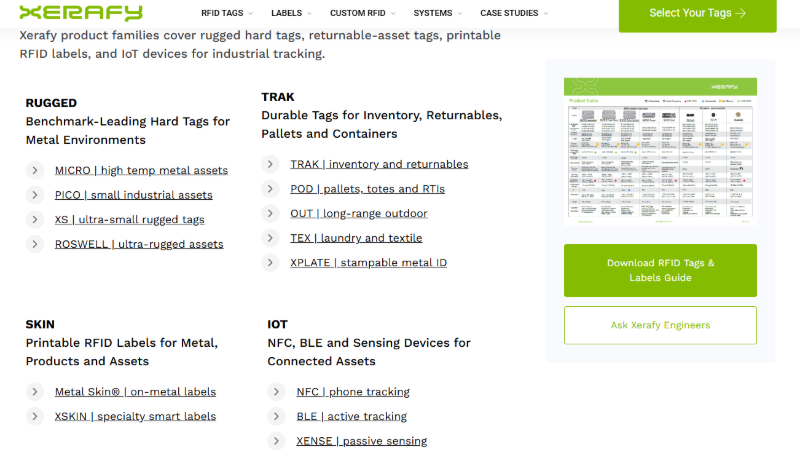
Xerafy focuses on rugged RFID tags and labels for industrial asset tracking. Its product portfolio covers applications involving metal assets, harsh environments, returnable containers, inventory and industrial equipment.
The company offers several product families, including MICRO, PICO, XS and ROSWELL. These product lines address different requirements for size, durability and industrial use. Xerafy also provides printable RFID labels, including solutions designed for metal surfaces.
Its MICRO series is positioned for high-temperature and rugged on-metal applications. Other product families target smaller industrial assets and applications requiring robust identification.
Key product and service areas:
- Rugged on-metal RFID tags
- High-temperature RFID tags
- Compact industrial RFID tags
- Printable RFID labels
- Tags for returnable assets and containers
- Customized RFID engineering
Why consider Xerafy?
Xerafy is a relevant option for companies that need established rugged tag families for industrial equipment, tools, manufacturing assets and returnable transport items. Buyers should compare the specifications of individual models rather than assuming all products offer the same temperature or environmental resistance.
3. HID Global
HID Global offers a broad portfolio of RFID technologies, including industrial tags, asset-tracking products and specialized transponders.
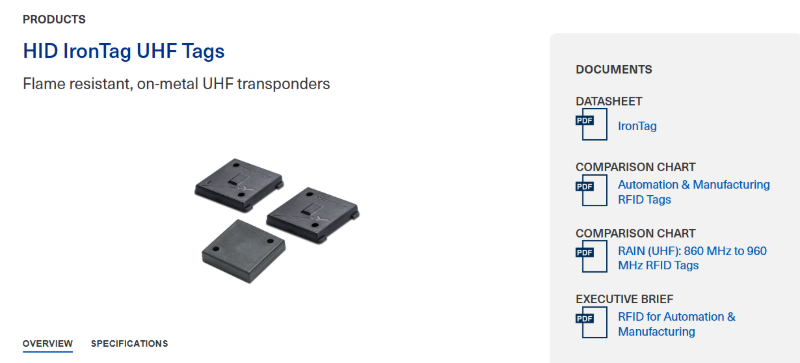
Its industrial RFID products include on-metal tags and rugged solutions for demanding environments. Product families such as HID Adept, IronTag and IN Tag address different industrial identification requirements.
For example, HID IronTag products are designed for metal asset tracking in challenging environments. HID IN Tag products provide durable disc-style RFID formats, with options covering different frequencies and mounting requirements.
HID also offers customized tag configurations for applications that require specific dimensions, chips, materials or attachment methods.
Key product and service areas:
- On-metal RFID tags
- Industrial asset-tracking tags
- Rugged RFID transponders
- LF and HF tag options
- Specialized UHF products
- Custom RFID tag configurations
Why consider HID Global?
HID is worth considering when buyers need a broad RFID technology portfolio and multiple product formats. Its industrial tag range can support applications in manufacturing, transportation, energy and equipment management.
4. Beontag (Confidex)
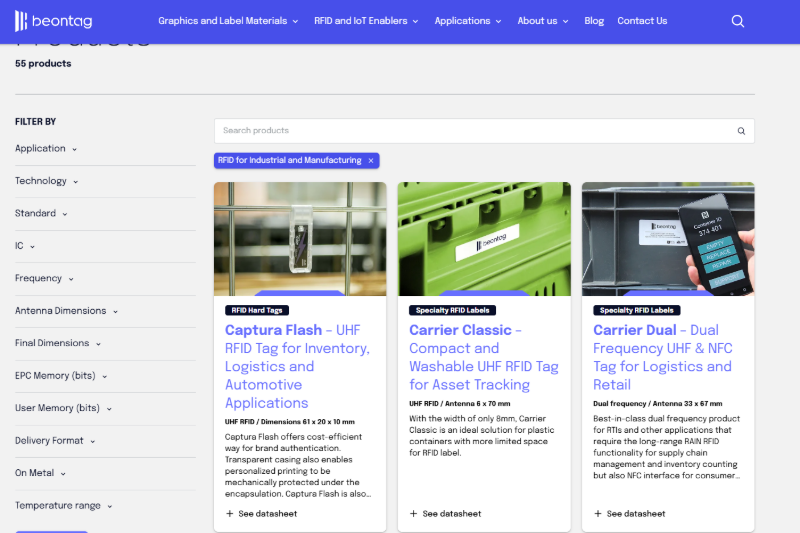
Beontag is a global company specializing in label materials and RFID technology solutions. Its acquisition of Confidex expanded its RFID and IoT portfolio.
The former Confidex product range includes industrial RFID products such as Ironside and Steelwave. These product families are associated with on-metal identification and industrial asset-tracking applications.
Industrial users may evaluate these products for tracking equipment, containers, tools and other assets in environments where ordinary RFID labels may not be suitable.
Beontag’s broader RFID portfolio also covers identification and tracking needs across logistics and industrial supply chains.
Key product and service areas:
- Industrial RFID tags
- On-metal RFID products
- Asset-tracking solutions
- RFID labels and inlays
- Logistics and supply-chain identification
- RFID and IoT technology solutions
Why consider Beontag?
Beontag is a useful supplier to evaluate when a project requires industrial RFID products alongside broader label and identification technologies. Buyers familiar with Confidex products should check the current Beontag product catalogue for product availability and successor models.
5. TROI RFID
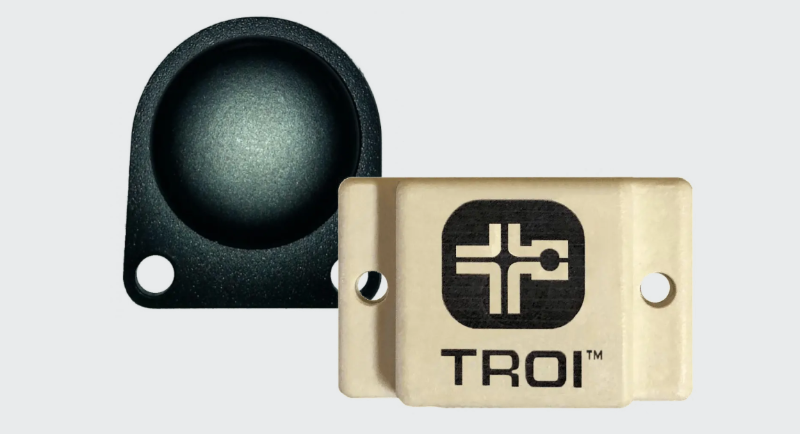
TROI RFID, also known as Technologies ROI, focuses on RFID tags designed for demanding and specialized environments.
Its product portfolio addresses applications involving high temperatures, corrosive chemicals, high pressure, underwater conditions and mechanical impact. These characteristics make TROI particularly relevant to certain oil and gas, construction and industrial inspection applications.
The company presents specialized RFID tags for down-hole and subsea environments, as well as tags that can be embedded into materials such as concrete, asphalt, wood, plastic and metal.
Key product and service areas:
- High-temperature RFID tags
- Impact-resistant RFID tags
- Embeddable RFID tags
- Tags for corrosive environments
- RFID solutions for oil and gas
- Specialized industrial identification
Why consider TROI RFID?
TROI is worth evaluating when standard industrial RFID tags are not suitable for the operating environment. Its specialized products are particularly relevant to applications involving extreme pressure, temperature or chemical exposure.
For demanding projects, buyers should request model-specific technical documentation and validate the tag under the actual operating conditions.
6. Wintag
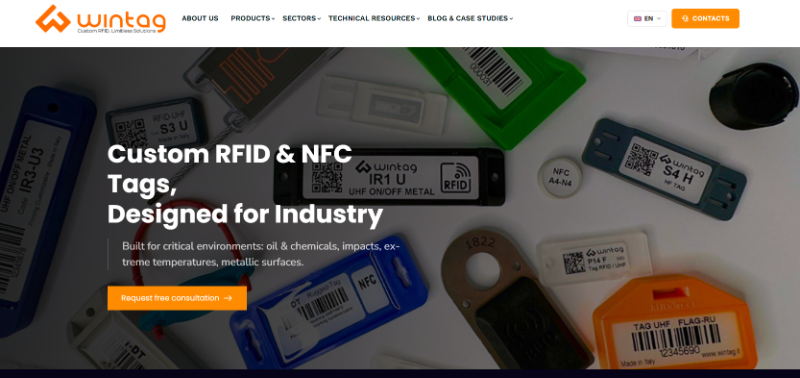
Wintag is an Italian supplier and manufacturer of customized RFID and NFC tags for industrial applications. Its RFID activities are connected with Astraplast’s experience in industrial plastics processing.
The company offers both standard and customized RFID products. Its range includes rugged hard tags, flexible RFID labels and tags designed for different surfaces and environmental conditions.
Wintag supports LF, HF/NFC and UHF technologies. Its products are used in areas such as waste management, logistics, manufacturing, industrial asset tracking and lifting-equipment identification.
The company also describes customization services involving chip selection, materials, dimensions, printing and resin encapsulation.
Key product and service areas:
- Custom RFID and NFC tags
- Rugged industrial hard tags
- UHF, HF/NFC and LF products
- On-metal RFID options
- RFID labels
- Customized printing and encoding
Why consider Wintag?
Wintag is a relevant option for European buyers looking for customized RFID products and direct technical consultation. Its experience in plastics processing is useful for projects that require specific tag housings, materials or physical configurations.
7. Spotag Electronics
Spotag Electronics focuses on the design and production of RFID tags across LF, HF and UHF product categories.
Its industrial RFID portfolio includes products for high-temperature applications and specialized identification requirements. The company also presents miniature chip-packed RFID products and solutions for industrial tracking.
Beyond industrial applications, Spotag serves markets such as textile laundry management, healthcare, hospitality and smart logistics.
Key product and service areas:
- Industrial RFID tags
- High-temperature RFID tags
- LF, HF and UHF products
- Miniature RFID tag formats
- RFID laundry tags
- RFID products for healthcare and logistics
Why consider Spotag Electronics?
Spotag is worth evaluating when a project requires multiple RFID frequency options or specialized tag formats. Buyers should identify the exact product model and confirm its temperature, mounting and reading specifications before selecting it for industrial deployment.
8. Proud Tek
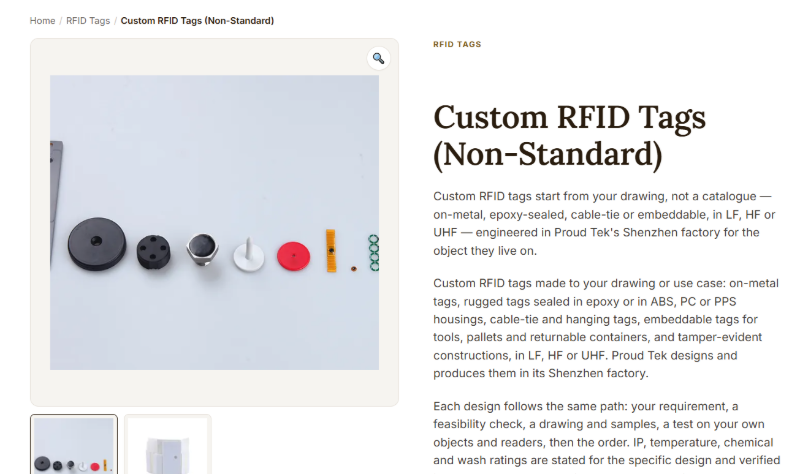
Proud Tek provides RFID and NFC products, including customized tags for specialized applications. Its custom RFID tag offering includes on-metal tags, rugged tags, embedded tags, cable-tie tags and tamper-evident designs.
The company describes customization options using different housing materials, including epoxy, ABS, PC and PPS. Products can be designed around LF, HF or UHF requirements.
Proud Tek also describes a development process that can include requirement evaluation, design, samples and testing on the customer’s actual objects and readers.
Key product and service areas:
- Custom industrial RFID tags
- On-metal RFID tags
- Rugged RFID tags
- Embedded RFID tags
- Cable-tie and hanging tags
- LF, HF and UHF customization
Why consider Proud Tek?
Proud Tek may be a suitable option for buyers who need non-standard RFID tag dimensions or housing designs. Its custom development approach is relevant when existing catalogue products do not fit the asset, mounting method or operating environment.
For new designs, buyers should confirm tooling requirements, sample schedules, production lead times and the final product specifications.
9. DurableTag
DurableTag presents itself as a manufacturer of industrial labels, RFID tags and identification products for demanding environments.
Its stated product portfolio includes RFID labels and tags, HardTag RFID, high-temperature labels, polyimide labels, polyester labels, aluminum labels and customized identification solutions.
The company’s product positioning focuses on industrial identification requirements involving heat, chemicals, abrasion and outdoor exposure.
These product categories may be relevant to manufacturers that need durable identification for equipment, components and industrial assets.
Key product and service areas:
- Industrial RFID labels and tags
- HardTag RFID products
- High-temperature identification labels
- Polyimide and polyester labels
- Aluminum identification labels
- Customized industrial identification solutions
Why consider DurableTag?
DurableTag is worth including in a supplier evaluation when the project involves both RFID identification and durable industrial labeling. Buyers should request current product datasheets, sample products and confirmation of manufacturing arrangements before making a purchasing decision.
10. Crepak
Crepak presents itself as an industrial RFID hardware products company serving solution providers, system integrators and OEM customers.
Its industrial RFID tag portfolio is organized around several application categories, including on-metal RFID tags, on-metal RFID labels, rugged RFID tags and high-temperature RFID tags.
The company also describes customization routes such as platform adaptation, new device development and build-to-print OEM manufacturing.
This positioning may be relevant to businesses that need industrial RFID hardware tailored to a particular asset, operating environment or integration requirement.
Key product and service areas:
- On-metal RFID tags
- On-metal RFID labels
- Rugged industrial RFID tags
- High-temperature RFID tags
- RFID hardware customization
- OEM and build-to-print services
Why consider Crepak?
Crepak may be worth evaluating for industrial RFID hardware sourcing and customized product projects. Buyers should confirm whether a particular product is manufactured in-house or supplied through a manufacturing partner, and should request product-level technical documentation before placing an order.
Comparison of the 10 Industrial RFID Tags Manufacturers
The following table provides a quick overview of the main product areas presented by each company. It is intended as an initial supplier-screening guide, not a substitute for checking individual product specifications.
| Company | Main industrial RFID focus | Potential application fit |
|---|---|---|
| DO RFID Reader | Miniature ceramic, on-metal and specialized RFID tags | Small metal parts, tools and industrial assets |
| Xerafy | Rugged, on-metal and high-temperature tags | Manufacturing, equipment and returnable assets |
| HID Global | Industrial, on-metal and specialized RFID tags | Asset tracking and industrial identification |
| Beontag (Confidex) | Industrial RFID and on-metal products | Logistics and metal asset tracking |
| TROI RFID | Extreme-environment and specialized RFID tags | Oil and gas, construction and harsh environments |
| Wintag | Customized RFID/NFC tags and rugged hard tags | Manufacturing, waste management and logistics |
| Spotag Electronics | Industrial, high-temperature and miniature RFID tags | Industrial tracking and specialized identification |
| Proud Tek | Custom, rugged, embedded and on-metal tags | OEM projects and non-standard applications |
| DurableTag | RFID labels, HardTag and industrial identification | Harsh-environment labeling and traceability |
| Crepak | On-metal, rugged and high-temperature RFID hardware | Industrial hardware sourcing and customization |
How to Choose the Right Industrial RFID Tags Manufacturer
A supplier’s product catalogue is only one part of the purchasing decision. The right choice depends on the asset, environment, reading workflow and total project requirements.
Here are seven practical steps to help evaluate industrial rfid tags manufacturers.
Step 1: Identify the Asset Material
Determine whether the tag will be attached to metal, plastic, wood, glass, fabric or another material.
If the tag will be installed directly on metal, prioritize products designed for on-metal performance. Do not assume that a standard UHF label will work reliably on a metal surface.
Step 2: Define the Environmental Conditions
List the conditions the tag will experience during its service life.
Consider:
- Minimum and maximum operating temperatures
- Water exposure and required ingress protection
- Chemical contact, including oils and cleaning agents
- Mechanical impact and vibration
- Outdoor UV exposure
- Abrasion and repeated handling
Use these requirements to narrow down suitable products.
Step 3: Select the RFID Frequency
Choose LF, HF/NFC or UHF based on the application and reader infrastructure.
For example, UHF is commonly considered for inventory management and industrial asset tracking that requires longer reading distances. HF/NFC may be more suitable for close-range identification and certain operator interaction workflows.
Check regional frequency requirements and reader compatibility before ordering.
Step 4: Confirm the Required Tag Dimensions
Measure the available installation area, including the space required for the tag thickness and attachment method.
This is particularly important for miniature industrial RFID tags. A tag may have a very small footprint but still require additional clearance for adhesive, protection or installation.
For small metal parts, compare the complete dimensions of the tag rather than looking only at the chip size.
Step 5: Evaluate Customization Capabilities
Some projects require more than a standard RFID tag.
Depending on the application, customization may include:
- Special dimensions and shapes
- Different chip configurations
- Customized housings
- Adhesive or mechanical mounting
- Laser marking or printed identification
- Pre-encoding and data programming
- OEM and ODM development
Ask potential suppliers which options are available for the required order quantity and whether custom tooling is necessary.
Step 6: Request Samples and Test Them
Sample testing is one of the most important stages when choosing between industrial rfid tags manufacturers.
Test the tag on the actual asset using the intended reader and antenna. Evaluate reading distance, orientation sensitivity, repeatability and performance under realistic operating conditions.
For harsh-environment applications, also test the tag after exposure to the relevant temperature, chemicals, moisture or mechanical stress.
Step 7: Compare Total Project Cost
The lowest unit price does not always represent the lowest project cost.
Consider product reliability, expected service life, installation expenses, encoding requirements, replacement costs, technical support and delivery schedules.
A more suitable industrial RFID tag may reduce maintenance work and avoid the cost of replacing failed tags after deployment.
Common Applications of Industrial RFID Tags
Industrial RFID technology is used in many sectors. The tag design should reflect the specific identification and tracking requirements of each application.
Manufacturing and Production Tracking
Manufacturers can use RFID tags to identify work-in-process items, production tools, fixtures, molds and components.
Tags attached to metal equipment should be selected for reliable on-metal performance.
Tool and Equipment Management
RFID can help companies identify tools, monitor equipment usage and improve inventory accuracy.
Compact tags may be useful when the available mounting area is limited.
Warehouse and Logistics Management
RFID tags can support the identification of pallets, containers, reusable transport items and warehouse assets.
The appropriate tag depends on the material, reading distance and handling conditions.
Automotive Industry
Automotive production environments may involve metal components, heat, oil, vibration and repeated handling.
Industrial RFID tags should be selected according to the actual production process and exposure conditions.
Oil and Gas
Oil and gas applications can involve high temperatures, pressure, chemicals and outdoor exposure.
Specialized tags designed for the relevant conditions should be evaluated carefully. Buyers should never assume that a general-purpose industrial tag is suitable for down-hole or subsea applications.
Waste Management
RFID tags can be installed on waste containers and reusable collection assets to support identification, collection records and asset management.
Both metal and plastic containers may require different tag constructions.
Frequently Asked Questions
1. What are industrial RFID tags?
Industrial RFID tags are identification devices designed for use in manufacturing, logistics, equipment management and other industrial environments. Depending on their construction, they may be designed to withstand metal interference, moisture, heat, chemicals, impact and other demanding conditions.
2. How do I choose among industrial rfid tags manufacturers?
Compare each supplier’s product range, technical specifications, customization capabilities, sample availability, quality documentation and technical support. Most importantly, test the selected tag on the actual asset and with the intended reader.
3. Can RFID tags work directly on metal?
Yes. Specialized on-metal RFID tags are designed to operate on metal surfaces. They use product-specific antenna and construction designs to address the interference caused by metal.
However, reading performance varies by tag model, mounting position, metal object and reader setup. Always conduct an application test.
4. What is the difference between LF, HF and UHF RFID tags?
LF, HF and UHF refer to different RFID frequency ranges and technologies.
LF is used in certain short-range identification applications. HF includes NFC-related technologies and is often used for close-range communication. UHF is widely used in inventory, logistics and industrial tracking applications that require longer reading distances.
The correct choice depends on the application, reader and required performance.
5. Are miniature RFID tags suitable for industrial applications?
Yes. Miniature RFID tags can be useful for identifying small tools, metal components and equipment with limited installation space.
However, reducing tag size can affect antenna design and reading performance. Buyers should compare complete tag dimensions and test the product on the actual asset.
6. Can industrial RFID tags be customized?
Many suppliers offer customization options such as dimensions, materials, chip selection, housing design, printing, encoding and mounting methods.
The available options depend on the supplier, product type, order quantity and engineering requirements.
7. Should I test RFID tag samples before bulk purchasing?
Yes. Sample testing is strongly recommended, especially for industrial applications.
Testing helps verify reading performance, mounting suitability, environmental resistance and compatibility with the intended RFID reader before a large-scale deployment.
8. Which company should I contact for miniature industrial RFID tags?
DO RFID Reader offers miniature ceramic UHF RFID tags, including the 4 × 4 × 3 mm CER0404 and 5 × 5 × 3 mm CER0505 models. These products are designed for on-metal identification of small components and tools.
Buyers should review the product specifications and request samples to verify performance on their actual assets.
Final Thoughts
Choosing among industrial rfid tags manufacturers requires a clear understanding of the application, operating environment and identification requirements.
Some suppliers focus on rugged on-metal products, while others offer customized RFID designs, extreme-environment tags, industrial labels or broader RFID hardware portfolios. There is no single product that is ideal for every industrial application.
DO RFID Reader is a useful starting point for buyers evaluating miniature ceramic UHF tags, on-metal identification products and RFID reader hardware. Xerafy, HID Global, Beontag, TROI RFID, Wintag, Spotag Electronics, Proud Tek, DurableTag and Crepak also offer product categories worth comparing for different industrial requirements.
Before making a final purchasing decision, review the latest datasheets, confirm the exact product specifications and test samples under real operating conditions. A well-matched RFID tag can help improve asset visibility, identification accuracy and the reliability of an industrial tracking system.

Do RFID is a leading China-based manufacturer with over 15 years of experience. We specialize in customized RFID readers, tags, and cards, delivering high-quality, tailored solutions that meet your unique business needs and drive seamless, efficient identification.