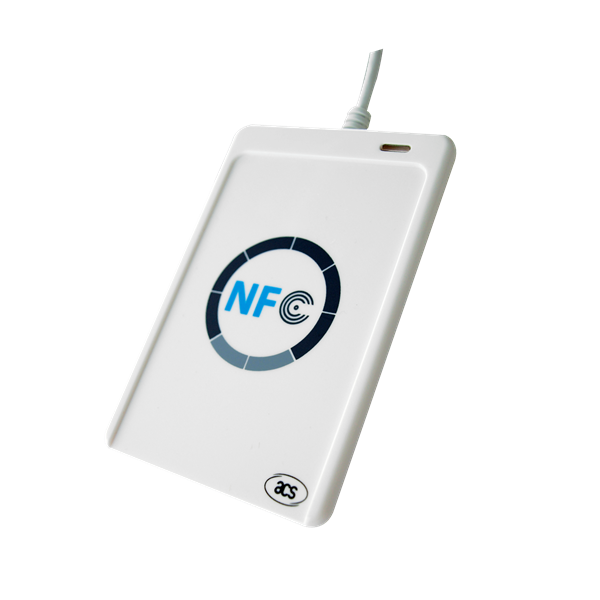
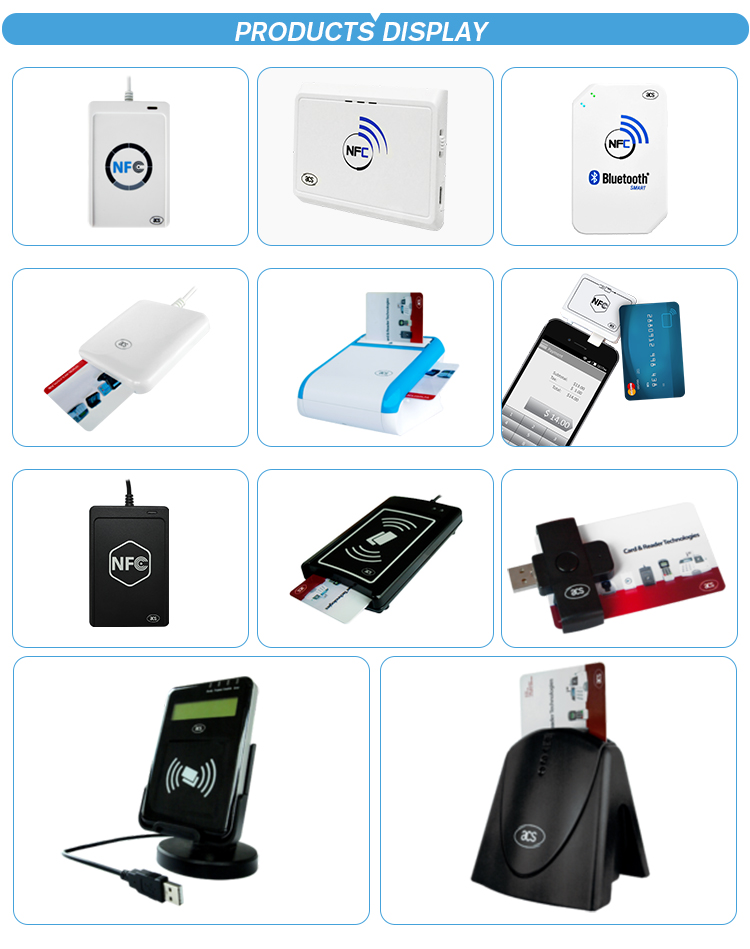
ACR122 nfc contactless smart card reader

The ACR122 NFC contactless smart card reader is a USB-connected NFC and contactless smart card reader designed for reliable card and tag communication at 13.56 MHz. With support for ISO 14443 Type A and Type B, MIFARE, FeliCa, and ISO/IEC 18092 NFC tags, it provides a practical solution for applications that need to read or write contactless cards from a computer or Android device.

Using a USB 2.0 Full Speed interface and USB CCID compliance, the reader can integrate with systems based on standard smart card interfaces. It also supports PC/SC and CT-API through a PC/SC wrapper, making it suitable for software developers, system integrators, access control projects, identification applications, NFC development, and other contactless card solutions.

The built-in antenna provides a card reading distance of up to 50 mm, depending on the card or tag type. A user-controllable dual-color LED and buzzer provide visual and audible feedback during operation.

ACR122 NFC Reader at a Glance

USB 2.0 Full Speed Interface
CCID Compliance
Smart Card Reader:
Read/write speed up to 424 kbps
Built-in antenna for contactless tag access, with card reading distance of up to 50 mm (depending on tag type)
Supports ISO 14443 Type A and B cards, MIFARE, FeliCa, and all 4 types of NFC (ISO/IEC 18092) tags
Built-in anti-collision feature (only 1 tag is accessed at any time)
Application Programming Interface:
Supports PC/SC
Supports CT-API (through wrapper on top of PC/SC)
Peripherals:
User-controllable bi-color LED
User-controllable buzzer
Supports Android™ OS 3.1 and above

Specifications

Physical Characteristics
Dimensions (mm) 98.0 mm (L) x 65.0 mm (W) x 12.8 mm (H)
Weight (g)70 g
USB Interface
Protocol USB CCID
Power SourceFrom USB port
SpeedUSB Full Speed (12 Mbps)
Cable Length1.0 m, Fixed
Contactless Smart Card Interface
Standard ISO/IEC 18092 NFC, ISO 14443 Type A & B, MIFARE®, FeliCa
Protocol ISO 14443-4 Compliant Card, T=CL
MIFARE® Classic Card, T=CL
ISO18092, NFC Tags
FeliCa
Built-in Peripherals
LED 1 bi-color: Red and Green
BuzzerMonotone
Certifications/Compliance
Certifications/ComplianceEN 60950/IEC 60950
ISO 18092
ISO 14443
USB Full Speed
PC/SC
CCID
VCCI (Japan)
KC (Korea)
Microsoft® WHQL
CE
FCC
RoHS 2
REACH
Device Driver Operating System Support
Device Driver Operating System SupportWindows® CE
Windows®
Linux®
MAC OS®
Solaris
Android™
acr122u_side2_副本
NFC RFID READERS

Designed for NFC and Contactless Smart Cards

The ACR122 supports several widely used contactless card technologies. This makes it more versatile than a reader designed for only one proprietary card type.

It supports ISO 14443 Type A and Type B cards as well as MIFARE, FeliCa, and NFC tags based on ISO/IEC 18092. The reader also supports ISO 14443-4 compliant cards and T=CL communication.

This broad compatibility can be useful when a project needs to work with different contactless media during development, testing, deployment, or system integration.

Supported Card and NFC Technologies

Technology / StandardSupportedTypical Use
ISO 14443 Type AYesContactless cards and NFC applications
ISO 14443 Type BYesContactless identification and smart cards
MIFAREYesAccess, identification, ticketing and other applications
FeliCaYesContactless card applications
ISO/IEC 18092 NFCYesNFC tag and device communication
ISO 14443-4YesAdvanced contactless smart card communication
T=CLYesContactless smart card protocol
NFC TagsYesNFC development and tag-based applications

Actual communication capabilities can depend on the card technology, card type, protocol, and application software. For project-specific requirements, testing the intended card or tag before deployment is recommended.

USB CCID Interface for Easy System Integration

The reader uses a USB 2.0 Full Speed interface and communicates using the USB CCID protocol. It receives its power directly from the USB port, so a separate power adapter is not required for normal operation.

The fixed 1-meter USB cable provides a straightforward connection between the reader and a host computer or compatible system. With a compact footprint of 98 × 65 × 12.8 mm, the reader can be placed on a desktop, counter, workstation, or service terminal without taking up much space.

For system integrators, using a standard USB smart card interface can simplify the hardware side of an NFC project. The host system can communicate with the reader through supported smart card software interfaces instead of requiring a proprietary connection method.

PC/SC Support for Software Development

One of the important advantages of the ACR122 is its support for PC/SC. PC/SC is widely used for communication between applications, smart card readers, and smart cards.

This makes the reader suitable for developers who want to build applications around contactless smart cards without creating a completely proprietary reader communication layer.

The reader also supports CT-API through a wrapper on top of PC/SC. This provides an additional interface option for software environments that use CT-API-based communication.

Software Interface Comparison

InterfaceACR122 SupportSuitable For
PC/SCYesSmart card and NFC application development
USB CCIDYesStandard USB smart card communication
CT-APIYes, through PC/SC wrapperApplications requiring CT-API
Proprietary USB protocolNot required for normal PC/SC use

Developers should select the appropriate software library and commands according to the card technology being used. The reader provides the hardware and standard interface layer, while the application determines how cards are identified, selected, authenticated, or accessed.

Reading Distance of Up to 50 mm

The built-in antenna provides a contactless reading distance of up to 50 mm. The actual operating distance is affected by the card or NFC tag, antenna design, card orientation, environmental conditions, and communication requirements.

For this reason, 50 mm should be treated as a maximum specified reading distance rather than a guaranteed distance for every card.

For desktop applications, the contactless interface allows users to place a compatible card or NFC tag near the reader rather than inserting the card into a physical slot. This can make card presentation faster and more convenient.

Built-In Anti-Collision Function

The ACR122 includes an anti-collision function. When multiple contactless tags are present in the reader’s operating field, the anti-collision mechanism allows the reader to select a tag so that only one tag is accessed at a time.

This is useful in environments where more than one NFC or contactless card may be close to the reader.

For applications that require controlled card presentation, the software should still define the desired card-selection and transaction workflow. Anti-collision helps manage the RF communication environment, but it does not replace application-level logic.

LED and Buzzer Feedback

The reader includes a user-controllable bi-color LED and a monotone buzzer.

The LED provides red and green visual feedback, while the buzzer can provide an audible indication when an operation occurs. These peripherals can be useful for kiosk, counter, workstation, identification, and access-related applications where the user needs immediate feedback.

Because the LED and buzzer are user-controllable, application developers can integrate reader feedback into the overall user experience.

For example, a system can use visual or audible feedback to indicate that a card has been detected, an operation has completed, or the user should remove or present a card.

ACR122 Compared with a Basic NFC Reader

Not every NFC reader provides the same combination of card compatibility, smart card interfaces, and system integration options. The ACR122 is positioned as a general-purpose contactless smart card reader rather than simply an NFC tag scanner.

CapabilityACR122Basic NFC Tag Reader
USB connectionYesUsually
USB CCIDYesNot always
PC/SCYesNot always
ISO 14443 Type AYesUsually
ISO 14443 Type BYesMay vary
MIFARE supportYesMay vary
FeliCa supportYesMay vary
ISO/IEC 18092 NFCYesMay vary
Anti-collisionYesDepends on model
LED feedbackYesDepends on model
BuzzerYesDepends on model
Smart card applicationsSuitableDepends on model

The main difference is not simply whether a device can detect NFC. For professional applications, the communication interface, supported card standards, software compatibility, and integration options can be equally important.

ACR122 Compared with Contact Smart Card Readers

A contact smart card reader requires a physical electrical connection between the card contacts and the reader. The ACR122 communicates wirelessly with compatible contactless cards and NFC tags.

FeatureACR122 Contactless ReaderContact Smart Card Reader
Card interfaceContactlessPhysical contacts
User actionTap or present cardInsert card
NFC supportYesNo
ISO 14443 supportYesNo
MIFARE supportYesNo
FeliCa supportYesNo
USB connectionYesCommon
PC/SCYesCommon
Mechanical card insertionNoYes

A contactless reader can be a better choice when fast card presentation and NFC compatibility are priorities. A contact reader may be more appropriate when the project specifically requires contact-based smart cards.

Some systems may require both technologies. In that situation, the appropriate reader should be selected according to the cards and protocols used by the application.

Operating System Compatibility

The ACR122 supports a range of operating systems, including Windows, Windows CE, Linux, macOS, Solaris, and Android.

This broad operating system support makes the reader suitable for different deployment environments, from conventional desktop computers to embedded or Android-based systems.

Operating SystemListed Support
WindowsYes
Windows CEYes
LinuxYes
macOSYes
SolarisYes
AndroidYes

Operating system support does not necessarily mean that every application will work without configuration. Developers should verify the required drivers, PC/SC stack, permissions, USB OTG requirements, and application libraries for the target platform.

Applications for the ACR122 NFC Reader

The reader can be used in a wide range of contactless card projects. Its combination of NFC compatibility and PC/SC support makes it suitable for both end-user applications and software development.

Potential applications include:

NFC Development

Developers can use the reader to build and test applications that interact with compatible NFC tags and contactless cards.

Smart Card Applications

PC/SC support makes the reader suitable for applications that need standardized smart card communication.

Access and Identification Systems

Compatible contactless cards can be presented to the reader for identification or system access workflows, subject to the card technology and application requirements.

Ticketing and Membership Systems

The contactless interface can be integrated into systems where users present cards or tags to identify an account, membership, ticket, or transaction.

Kiosks and Service Terminals

The compact USB reader can be integrated into a workstation or kiosk where users need to present contactless cards.

Testing and System Integration

Hardware developers and software engineers can use the reader as a development and testing interface when working with supported NFC and smart card technologies.

Key Benefits for System Integrators

For system integrators, the value of the ACR122 is its combination of standards support and straightforward connectivity.

Broad card compatibility: Support for ISO 14443 Type A and B, MIFARE, FeliCa, and ISO/IEC 18092 provides flexibility when selecting contactless media.

Standard USB connectivity: USB 2.0 Full Speed and USB CCID make it easier to connect the reader to compatible host systems.

PC/SC support: Developers can use established smart card communication frameworks rather than relying exclusively on a proprietary application interface.

Compact design: The 98 × 65 × 12.8 mm enclosure is suitable for desktop and embedded installation scenarios where space matters.

User feedback: The integrated red/green LED and buzzer provide simple feedback mechanisms for interactive applications.

USB powered: No separate power supply is needed when the host USB port provides sufficient power.

What Should You Check Before Choosing the Reader?

Before integrating an NFC reader into a project, confirm the exact card technology used by your application.

First, identify the card standard. ISO 14443 Type A, Type B, MIFARE, FeliCa, and NFC tags are not interchangeable simply because they all operate at 13.56 MHz.

Second, determine what data your application needs to access. Reading a card’s identifier, reading NDEF data, accessing application data, and performing secure transactions can require different card commands and software logic.

Third, verify the operating environment. ACR122 supports multiple operating systems, but the final system may require platform-specific drivers, PC/SC components, USB permissions, or Android OTG support.

Finally, test the actual cards and tags that will be used in production. RF performance can vary between card manufacturers, tag constructions, antenna sizes, and installation environments.

Why Choose the ACR122 NFC Contactless Smart Card Reader?

The ACR122 is a practical option for applications that need a versatile USB NFC and contactless smart card interface.

Instead of focusing on NFC tag detection alone, it combines support for several major contactless standards with USB CCID, PC/SC, anti-collision, LED and buzzer feedback, and broad operating system support.

Its compact size and USB-powered design also make it easy to deploy on desktops, counters, kiosks, and development workstations.

For developers and system integrators, PC/SC support is particularly useful because it provides a standardized software interface for compatible smart card applications. For end users, the contactless interface offers a simple tap-and-read experience.

The right choice ultimately depends on the card technology, communication protocol, software requirements, and physical environment of the application. When those requirements match the reader’s supported specifications, the ACR122 can provide a reliable foundation for NFC and contactless smart card projects.

Frequently Asked Questions

What is the ACR122 NFC reader?

The ACR122 is a USB NFC contactless smart card reader designed to communicate with compatible 13.56 MHz contactless cards and NFC tags. It supports ISO 14443 Type A and B, MIFARE, FeliCa, and ISO/IEC 18092 NFC technologies.

Does the ACR122 support PC/SC?

Yes. The ACR122 supports PC/SC and also supports CT-API through a wrapper on top of PC/SC.

What cards can the ACR122 read?

The reader supports ISO 14443 Type A and Type B cards, MIFARE, FeliCa, ISO/IEC 18092 NFC tags, and ISO 14443-4 compliant cards using T=CL.

How far can the ACR122 read a card?

The specified reading distance is up to 50 mm, depending on the type of card or NFC tag and other operating conditions.

Does the ACR122 require an external power supply?

No. The reader is powered through its USB interface.

Does the ACR122 work with Android?

Android is listed among the supported operating systems. The actual Android installation may depend on the host device, USB OTG capability, permissions, drivers, and application environment.

Does the reader support multiple cards at the same time?

The reader has a built-in anti-collision function, but only one tag is accessed at any given time. Application behavior should therefore be designed around the desired card-selection process.

Is the ACR122 suitable for software development?

Yes. USB CCID and PC/SC support make it suitable for developers building applications around compatible contactless smart cards and NFC tags.

Get the Right NFC Reader for Your Project

The ACR122 NFC contactless smart card reader is designed for projects that need reliable USB connectivity, broad contactless card compatibility, and standardized software integration.

Whether you are developing an NFC application, integrating a smart card system, building an identification terminal, or testing contactless cards, the reader provides a combination of ISO standards support, PC/SC compatibility, USB CCID communication, and built-in user feedback.

If you know the card or NFC tag type used in your project, the next step is to confirm its protocol and data requirements against the reader specifications. For larger deployments or customized systems, evaluating the target cards and operating environment before production integration is recommended.

We also welcome you to contact us to discuss your needs.