September 14, 2026
Our Android POS machine with printer is an integrated smart payment terminal designed for banks, payment service providers, retailers, restaurants, hospitality businesses, and other organizations that need a compact device for card transactions, QR code scanning, receipt printing, and mobile connectivity.
Built with an Android operating system, a 5.5-inch capacitive touchscreen, an integrated high-speed thermal printer, multiple card-reading options, 4G connectivity, Wi-Fi, Bluetooth, and a high-capacity battery, this smart POS terminal combines payment and business functions in one portable device.
The terminal supports magnetic stripe cards, IC cards, and contactless cards. Its 5MP rear camera can also be used for barcode and QR code scanning, making the device suitable for both traditional card payment environments and modern digital payment applications.
With customizable configurations and optional accessories such as fingerprint identification and a smart dock, the Android POS terminal can be adapted to different payment and business requirements.

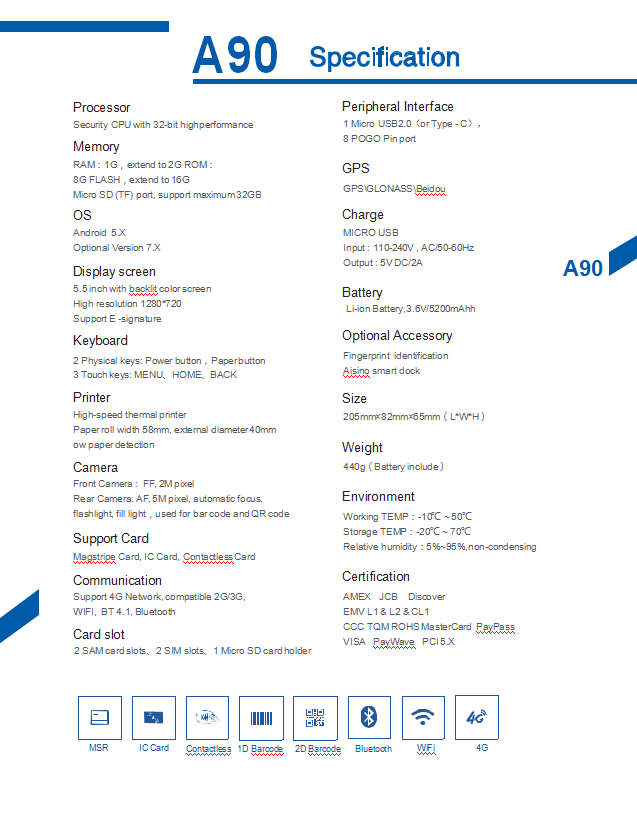
Specification
| After-sales Service Provided | Video technical support, Online support |
| Warranty | 1 YEAR |
| Operation System | Android 7.X |
| CPU | 32bit Quad-Core application high performance secure processor |
| Touch Screen Type | Capacitive Screen |
| Hard Disk Capacity | RAM: 1GB / 2GB; ROM: 2GB / 16GB; Flash: 32GB |
| Color | Personalizado / Customized |
| Display screen | 5.5 inch with backlit color screen High resolution 1280*720Support E -signature |
| Keyboard | 2 Physical keys: Power button, Paper button 3 Touch keys: MENU, HOME, BACK |
| Printer | High-speed thermal printer Paper roll width 58mm, external diameter 40mm ow paper detection |
| Camera | Front Camera : FF, 2M pixel Rear Camera: AF, 5M pixel, automatic focus, flashlight, fill light, used for bar code and QR code |
| Support Card | Magstripe Card, IC Card, Contactless Card |
| Communication | Support 4G Network, compatible 2G/3G, WIFI, BT 4.1, Bluetooth |
| Card slot | 2 SAM card slots, 2 SIM slots, 1 Micro SD card holder |
| GPS | GPSGLONASSBeidou |
| Charge | Type-CInput : 110-240V, AC/50-60HzOutput : 5V DC/2A |
| Battery | Li-ion Battery, 3.6V/5200mAhh |
| Optional Accessory | Fingerprint identification Aisino smart dock |
| Size | 205mm×82mm×65mm (L*W*H) |
| Weight | 440g |
| Certification | AMEX JCB Discover EMV L1 & L2 & CL1 CCC TQM ROHS MasterCard PayPass VISA PayWave PCI 5.X |
Integrated Payment, Printing, and Android Functions
A conventional payment terminal may require additional equipment for receipt printing, barcode scanning, or business applications. This Android POS machine integrates several functions into one handheld device.
The built-in thermal printer allows merchants to print transaction receipts immediately without connecting a separate printer. The touchscreen provides a more flexible interface for payment applications and business software, while the Android platform can support application-based workflows when compatible software and SDK access are provided.
This integrated design can help reduce the amount of equipment required at a checkout counter or mobile payment location.
For businesses that need more than card acceptance, the terminal can be used as a platform for applications such as order management, membership programs, inventory-related workflows, ticketing, customer identification, or other customized business functions, subject to software compatibility.
Card Payment and Contactless Acceptance
The smart POS terminal supports three major card-reading methods:
- Magnetic stripe cards
- IC cards
- Contactless cards
This combination allows payment providers and merchants to support different card technologies through a single terminal.
The product page lists EMV L1, EMV L2, and CL1 among its certification information, together with payment-related references including VISA PayWave, MasterCard PayPass, JCB, AMEX, and Discover. Certification and payment-network approval can depend on the exact hardware configuration, software, acquiring environment, and deployment market, so buyers should request the relevant certificates and approval documentation for the exact model before deployment.
For financial institutions and payment service providers, this verification step is especially important when selecting a terminal for a commercial acquiring project.
QR Code and Barcode Scanning
The rear camera features 5MP resolution, autofocus, and an integrated flashlight/fill light. According to the product specifications, it can be used for barcode and QR code scanning.
This makes the terminal suitable for payment environments where customers may pay through QR codes or where merchants need to scan product, ticket, membership, or transaction codes.
Compared with a payment terminal that only accepts cards, a camera-equipped Android POS machine can provide a broader interface for digital payment and business applications.
The actual scanning performance depends on the software, QR or barcode format, lighting conditions, camera configuration, and application implementation.
Built-In Thermal Receipt Printer
The integrated thermal printer is one of the main advantages of this Android POS terminal.
It supports 58mm-wide thermal paper with an external roll diameter of approximately 40mm. The compact printer design allows merchants to issue physical receipts directly from the same device used to process the transaction.
| Printing Requirement | Integrated POS Solution |
|---|---|
| Printer connection | Built into the terminal |
| Paper type | Thermal paper |
| Paper width | 58mm |
| Approx. roll diameter | 40mm |
| Paper detection | Supported |
| Separate printer required | No |
| Typical use | Receipts, transaction records, tickets, order slips |
The exact print speed, paper compatibility, printer mechanism, and long-term duty cycle should be confirmed with the manufacturer for high-volume applications.
Connectivity for Mobile Payment Applications
Reliable connectivity is important for payment terminals because transaction applications may need to communicate with remote payment platforms, acquiring systems, cloud services, or business software.
This Android POS machine supports 4G cellular connectivity and is compatible with 2G/3G networks. It also supports Wi-Fi and Bluetooth 4.1.
The two SIM slots provide additional flexibility for projects that require different SIM configurations or cellular network options.
| Connectivity | Potential Application |
|---|---|
| 4G | Mobile payment and cloud-connected applications |
| 2G/3G | Network compatibility where supported |
| Wi-Fi | Fixed or local wireless environments |
| Bluetooth 4.1 | Wireless peripherals and accessories |
| Dual SIM | Flexible cellular deployment |
| GPS / GLONASS / BeiDou | Location-based applications |
Supported cellular bands should be confirmed before purchasing, especially for deployment in different countries or regions.
Android Platform for Business Applications
The terminal uses Android 7.x and includes a 32-bit quad-core application processor. The Android environment makes the device suitable for applications that require a touchscreen interface and software-driven workflows.
For a customized project, buyers should confirm whether the manufacturer provides an SDK, API documentation, development support, APK installation access, system-level customization, and kiosk-mode capabilities.
These details can be more important than the hardware specification itself when the terminal is intended for a proprietary payment or business application.
For example, a payment service provider may need to integrate its own transaction application, while a retailer may want to combine payment with membership or order management. The software integration requirements should therefore be evaluated before selecting the final hardware configuration.
Android POS Machine vs. Traditional POS Terminal
An integrated Android POS machine can provide more flexibility than a traditional dedicated payment terminal, especially when the business requires additional applications.
| Comparison | Android POS Machine with Printer | Traditional Payment Terminal |
|---|---|---|
| Android applications | Yes, depending on system access | Usually limited |
| Touchscreen | 5.5-inch touchscreen | Depends on model |
| Card payment | Magnetic, IC, contactless | Depends on model |
| QR/barcode scanning | Rear camera supported | Often requires additional hardware |
| Receipt printer | Integrated | Depends on model |
| 4G connectivity | Supported | Depends on model |
| Wi-Fi | Supported | Depends on model |
| Business applications | More flexible | Usually more focused on payment |
| Portability | Designed for mobile use | Depends on model |
| Custom software | Subject to SDK/system access | Often more restricted |
The Android platform is particularly useful when a project requires payment and non-payment functions on the same device.
Designed for Different Business Environments
The compact design and integrated printer make this smart POS terminal suitable for a range of commercial environments.
| Industry | Example Use |
|---|---|
| Retail | Card payment, QR scanning, printed receipts |
| Restaurants | Table-side payment and order-related applications |
| Hospitality | Guest services, payment, receipts |
| Banks | Assisted payment and financial service applications |
| Payment Providers | Customized acquiring and payment applications |
| Transportation | Mobile ticketing and payment |
| Events | Ticket validation and transaction processing |
| Field Services | Mobile payment and printed transaction records |
| Wholesale | Customer transactions and barcode workflows |
The terminal can be especially useful in environments where a fixed checkout system is inconvenient and staff need to process transactions away from a traditional counter.
Compact Design for Mobile Operation
The device measures approximately 205 × 82 × 65mm and weighs around 440g. Its integrated battery is rated at 3.6V/5200mAh.
The handheld form factor allows the terminal to be carried between service points or used directly at a customer’s location. This can be useful for restaurants, delivery services, hospitality, events, transportation, and field-service businesses.
The USB Type-C charging interface provides a modern connection method, while the listed power input supports 110–240V AC at 50–60Hz through the supplied charging configuration.
Actual operating time will depend on network usage, screen brightness, printer frequency, payment processing, camera use, and application workload.
Memory and Storage Options
The product specifications list several memory configurations, including 1GB or 2GB RAM and 2GB or 16GB ROM, with 32GB Flash also listed.
Different applications have different memory requirements. A basic payment application may have different requirements from a multi-function Android POS application that stores transaction data, images, product information, or additional business software.
Before placing a bulk order, buyers should confirm the exact RAM, ROM, Flash configuration, Android version, and available storage for the selected model.
A Micro SD card slot is also listed, providing additional storage flexibility where supported by the system software and application.
Security and Payment Certification
Payment terminals require stronger security considerations than ordinary Android devices because they handle sensitive transaction data.
The product page lists PCI 5.X together with EMV L1, EMV L2, and CL1, as well as several international payment-related certifications and standards.
However, certification claims should always be matched against the exact hardware model and deployment configuration. Buyers should request official certification documents, certificate numbers, expiration information, and applicable scope before using the device in a regulated payment environment.
The availability of a certification does not by itself mean that a terminal can immediately process transactions through every bank, card network, or acquiring platform.
Optional Fingerprint and Smart Dock
For projects requiring additional identification or fixed-position operation, the manufacturer lists fingerprint identification and an Aisino smart dock as optional accessories.
Fingerprint functionality can be considered for applications involving user identification or staff authentication, subject to software support and local privacy requirements.
A smart dock can provide a more convenient setup when the terminal is frequently used at a fixed counter while still allowing the device to be removed for mobile operation.
The availability and compatibility of optional accessories should be confirmed for the selected hardware version.
Customization and OEM/ODM Opportunities
For payment companies, distributors, and system integrators, hardware customization can be an important part of a POS project.
Possible customization areas may include:
- Hardware configuration
- RAM and storage
- Exterior color
- Company branding
- Android software configuration
- Pre-installed applications
- Payment application integration
- Peripheral integration
- Packaging and accessories
Not every option is available for every production batch, so project-specific requirements should be discussed with the manufacturer before mass production.
For OEM or ODM projects, it is also important to define software ownership, SDK availability, update procedures, technical support, certification responsibility, and after-sales service before signing the final order.
What to Check Before Ordering an Android POS Terminal
Choosing a payment terminal should involve more than comparing processor speed or screen size. A suitable device needs to match the payment environment, network infrastructure, application requirements, and certification requirements of the target market.
Before ordering, consider the following:
| Item to Confirm | Why It Matters |
|---|---|
| Exact model number | Certification and specifications can vary by model |
| Android version | Determines application compatibility |
| SDK/API | Important for custom software integration |
| PCI certification | Important for payment security requirements |
| EMV certification | Important for EMV card acceptance |
| Contactless certification | Important for NFC/contactless deployments |
| 4G frequency bands | Determines cellular compatibility |
| SIM configuration | Affects mobile network deployment |
| Printer specifications | Important for receipt volume and paper supply |
| Battery performance | Important for mobile applications |
| Warranty | Defines after-sales support |
| Sample testing | Helps identify software and hardware issues before bulk orders |
For payment deployments, it is strongly recommended to test the exact production configuration rather than relying only on general product specifications.
Why Choose an Android POS Machine with Printer?
An integrated Android POS terminal can reduce the need for separate devices while providing a flexible platform for payment and business applications.
The combination of card acceptance, contactless payment support, QR/barcode scanning, 4G, Wi-Fi, Bluetooth, Android software, touchscreen operation, battery power, and thermal printing makes this device suitable for businesses that require mobile and multifunctional payment capabilities.
For payment providers and system integrators, the most important advantage is the possibility of building a customized software environment around the hardware, provided the required SDK and system access are available.
For merchants, the integrated printer and portable design can simplify daily transaction workflows and reduce equipment requirements at the point of service.
Frequently Asked Questions
What is an Android POS machine with a printer?
An Android POS machine with a printer is a payment terminal that combines an Android operating system, card-reading hardware, touchscreen, connectivity, and an integrated thermal printer in one device. It can support payment applications as well as additional business software.
Does this POS terminal support contactless cards?
Yes. The listed specifications state that the terminal supports contactless cards in addition to magnetic stripe and IC cards.
Can the terminal scan QR codes?
Yes. The product specifications list a 5MP autofocus rear camera with flashlight/fill light for barcode and QR code applications.
Does it have a built-in printer?
Yes. The device includes a high-speed thermal printer designed for 58mm-wide paper rolls with an approximately 40mm external diameter.
Does the POS machine support 4G?
Yes. The specifications list 4G connectivity with compatibility with 2G/3G networks. Supported cellular frequency bands should be confirmed for the target market.
Can I install my own Android application?
The device uses Android, but the availability of APK installation, SDK access, APIs, system customization, and application permissions should be confirmed with the manufacturer for the exact model.
Is this terminal suitable for bank or payment projects?
The product specifications list several payment-related certifications, including EMV L1/L2, CL1, and PCI 5.X. However, suitability for a specific bank, acquirer, payment network, or regulated market depends on the complete certification, software, security, and acquiring requirements. Buyers should verify the exact certification documents before deployment.
Can the POS terminal be customized?
Customization options may be available for hardware configurations, appearance, software, branding, and accessories. OEM/ODM requirements should be discussed with the manufacturer before production.
Request a Sample or Product Quote
If you are looking for an Android POS machine with a printer for payment, retail, hospitality, banking, or customized commercial applications, this model provides an integrated platform combining card acceptance, QR/barcode scanning, wireless communication, Android applications, and receipt printing.
For a new project, we recommend confirming the required card technology, cellular bands, Android configuration, memory, printer specifications, certification documents, SDK/API availability, and customization requirements before placing a bulk order.