July 16, 2026
As NFC technology becomes a standard for contactless communication, custom anti metal NFC stickers have become one of the fastest-growing products in industries such as smart marketing, asset management, industrial manufacturing, healthcare, logistics, and retail. Unlike ordinary NFC tags, anti metal NFC stickers are specifically engineered to operate reliably on metallic surfaces where conventional NFC tags often fail.
Whether you are launching smart products, creating digital business cards, enabling tap-to-connect marketing, or managing industrial assets, anti metal NFC stickers provide a dependable and durable solution.
This guide explains everything buyers need to know—from what anti metal NFC stickers are and how they work to their manufacturing process, customization options, and OEM purchasing considerations.
What Is a Custom Anti Metal NFC Sticker?
A custom anti metal NFC sticker is a contactless RFID label operating at 13.56 MHz that incorporates a special anti-metal shielding layer between the NFC antenna and the metal surface.
This shielding material prevents electromagnetic interference generated by metal, allowing the NFC chip to communicate normally with smartphones, NFC readers, and payment terminals.
Unlike standard NFC labels, anti metal versions maintain stable reading performance even when attached to:
- Stainless steel equipment
- Aluminum products
- Electronic devices
- Machinery
- Metal cabinets
- Medical instruments
- Industrial tools
- Vehicle components
The sticker can also be customized with company logos, QR codes, serial numbers, UID encoding, or promotional graphics.
Why Ordinary NFC Stickers Fail on Metal
Many first-time users discover that ordinary NFC stickers suddenly stop working once they are attached to metal.
The reason lies in electromagnetic physics.
An NFC antenna generates an electromagnetic field. When positioned directly on metal, the metal absorbs or distorts that field, significantly reducing signal strength or completely preventing communication between the chip and reader.
This results in:
- Extremely short reading distance
- Failed detection
- Unstable performance
- Complete communication loss
Anti metal NFC stickers eliminate this problem through specialized shielding technology.
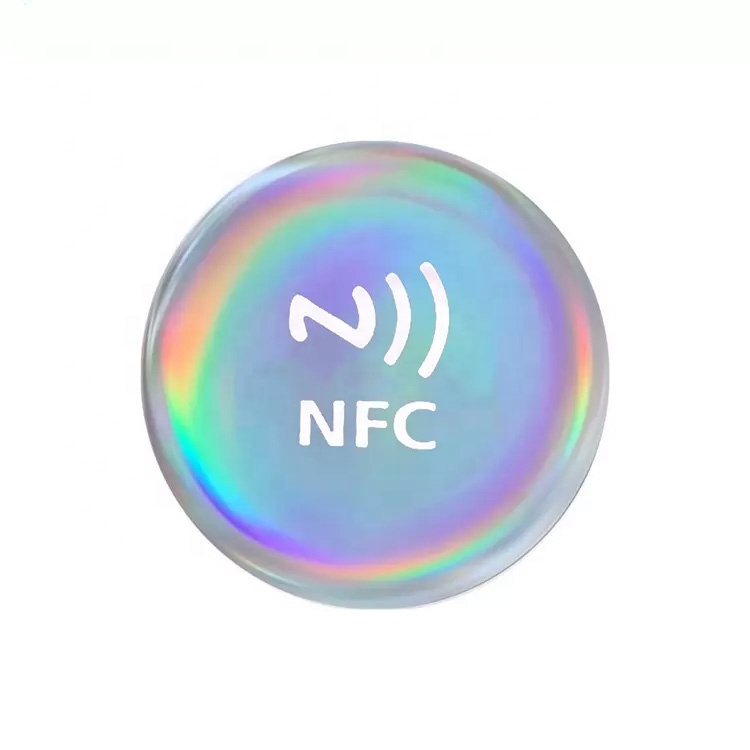
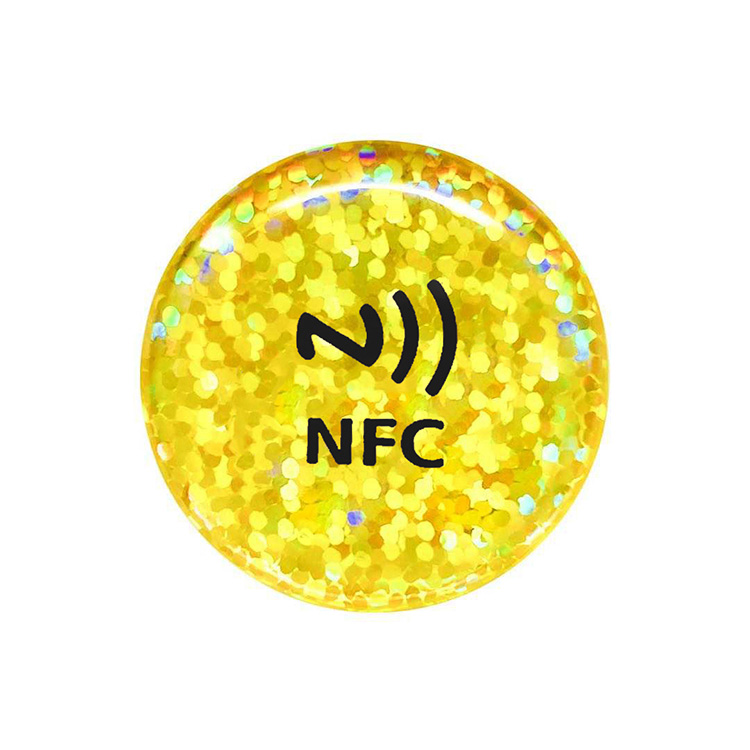
Custom anti-metal NFC sticker
On metal NFC Tag That Instantly Shares Social Media, Contact Info, Music, Payment Platforms etc.
Material | Coated paper,PVC,epoxy,ABS etc |
Printing | Double side CMYK offset printing |
Crafts | Number printing (Serial No & Chip UID etc), QR, Barcode, etc Chip program/encode/lock/encrption will be available as well (URL ,TEXT ,Number and Vcard) Epoxy, Hole punch, etc |
Size | Diameter 25mm,30mm,35mm,40mm,50mm stock mold size ,0.5-0.9mm thicknessOEM size,shape, and crafts according to your required |

Available Chips
| LF: 125KHz | EM4200 ,EM4305,T5577,HID,HITAG® S256; |
| HF: 13.56MHz | NTAG® 203, NTAG® 213, NTAG® 215, NTAG® 216; MIFARE Classic® 1K, MIFARE Classic® 4K; MIFARE Plus® 1K, MIFARE Plus® 2K, MIFARE Plus® 4K; MIFARE Ultralight® EV1, MIFARE Ultralight® C; MIFARE® DESFire® 2K, MIFARE® DESFire® 4K, MIFARE® DESFire® 8K;ICODE® SLIX, ICODE® SLIX-S, ICODE® SLIX-L, ICODE® SLIX 2 |
| UHF: 860-960MHz | UCODE® etc |
Remark:
NTAG are registered trademarks of NXP B.V. and are used under license.
ICODE are registered trademarks of NXP B.V. and are used under license.
MIFARE and MIFARE Classic are trademarks of NXP B.V.
MIFARE and MIFARE Ultralight have registered trademarks of NXP B.V. and are used under license.
MIFARE and MIFARE Plus have registered trademarks of NXP B.V. and are used under license.
MIFARE DESFire have registered trademarks of NXP B.V. and are used under license
HITAG is a registered trademark of NXP B.V.
How Does an Anti Metal NFC Sticker Work?
The core principle is electromagnetic isolation.
The anti metal layer acts as a ferrite shielding material positioned beneath the NFC antenna.
The working process follows these steps:
- A smartphone or NFC reader emits a 13.56 MHz electromagnetic field.
- The NFC antenna inside the sticker captures this energy.
- The ferrite layer blocks interference from the metal surface.
- The NFC chip receives sufficient power.
- The chip exchanges encrypted or stored data with the reader.
- Information is transferred within milliseconds.
Because the interference is minimized, communication remains stable even when the sticker is mounted directly on steel, aluminum, or iron.
Main Components of an Anti Metal NFC Sticker
A high-quality anti metal NFC sticker usually consists of several precision-engineered layers.
Surface Material
Depending on the application, manufacturers commonly use:
- PET
- PVC
- Epoxy resin
- Synthetic paper
- Polycarbonate
Epoxy-coated versions offer excellent waterproof performance and a premium appearance.
NFC Chip
Different chips serve different applications.
Popular options include:
- NTAG213
- NTAG215
- NTAG216
- MIFARE Ultralight
- MIFARE Classic
- MIFARE DESFire
- ICODE SLIX
- Fudan-compatible chips
Chip selection depends on memory capacity, encryption requirements, and compatibility.
Copper Antenna
The etched copper antenna collects energy from the reader and transmits data.
Its geometry directly affects reading distance and communication stability.
Ferrite Anti Metal Layer
This is the key component.
The ferrite sheet separates the antenna from the metal surface, preventing signal absorption.
Adhesive Layer
Industrial acrylic adhesive ensures secure attachment on:
- Metal
- Glass
- Plastic
- Painted surfaces
- Electronic housings
Problems Solved by Anti Metal NFC Stickers
Reliable Reading on Metal
The biggest advantage is dependable NFC performance on metallic objects.
Digital Product Identification
Manufacturers can uniquely identify every product with encoded UID or serial numbers.
Improved Asset Management
Companies can instantly retrieve maintenance history by tapping equipment with an NFC-enabled phone.
Faster Maintenance
Technicians access manuals, inspection reports, or repair instructions directly through NFC interaction.
Better Customer Engagement
Brands can connect customers to:
- Websites
- Product authentication
- Warranty registration
- User manuals
- Promotional campaigns
without requiring app installation.
Counterfeit Protection
Encrypted NFC chips provide an additional security layer for luxury goods, electronics, pharmaceuticals, and industrial products.
Common Application Scenarios
Because of their versatility, custom anti metal NFC stickers are widely used across many industries.
Smart Marketing
Businesses place NFC stickers on promotional displays to direct customers to:
- Company websites
- Social media profiles
- Product catalogs
- Online stores
- Google Reviews
- Digital business cards
Industrial Equipment
Factories attach NFC tags to machines for:
- Equipment identification
- Preventive maintenance
- Inspection records
- Spare part management
Medical Equipment
Hospitals use NFC stickers to manage:
- Medical instruments
- Maintenance schedules
- Sterilization history
- Equipment tracking
Consumer Electronics
Brands install anti metal NFC stickers on:
- Laptops
- Speakers
- Smart home devices
- Charging stations
Automotive Industry
Applications include:
- Vehicle identification
- Parts management
- Maintenance records
- Fleet management
Asset Tracking
Companies improve inventory accuracy by labeling:
- Tools
- Metal cabinets
- Office equipment
- Industrial assets
Manufacturing Process
Professional NFC manufacturers follow strict production procedures to ensure consistent quality.
Step 1: Chip Selection
Engineers select the appropriate NFC IC according to memory size, security level, and customer application.
Step 2: Antenna Manufacturing
Copper antennas are produced using precision etching or aluminum antenna technology.
Step 3: Ferrite Lamination
The anti metal shielding layer is laminated beneath the antenna with precise alignment.
Step 4: Chip Bonding
Automated equipment bonds the NFC chip onto the antenna.
Step 5: Printing
Depending on customer requirements, manufacturers print:
- Company logo
- QR code
- Variable barcode
- UID
- Product information
- Brand graphics
using UV, offset, silk-screen, or digital printing.
Step 6: Lamination
Multiple protective layers are laminated together for durability.
Step 7: Die Cutting
The finished sheets are cut into individual sticker sizes.
Step 8: Encoding and Testing
Each NFC tag can be encoded with:
- URL
- Digital business card
- Product ID
- Access credentials
- Encryption keys
- Customer-specific data
Every tag undergoes functional testing before packaging.
Customization Options
Professional OEM manufacturers offer extensive customization services.
Size
Popular sizes include:
- 20 mm
- 25 mm
- 30 mm
- 35 mm
- 40 mm
- 50 mm
Custom dimensions are also available.
Shape
Customers may choose:
- Round
- Square
- Rectangle
- Oval
- Custom die-cut designs
Material
Options include:
- PET
- PVC
- Epoxy
- Paper
- Transparent film
- Flexible ferrite
Printing
Manufacturers can customize:
- Company logo
- Full-color graphics
- QR codes
- Barcodes
- Variable data
- Serial numbers
Chip Type
Different NFC chips provide different memory capacities and security levels depending on project requirements.
Data Encoding
Tags may be pre-programmed with:
- Website URLs
- Wi-Fi credentials
- Contact information
- Product authentication
- Mobile applications
- Marketing campaigns
Why Choose an OEM NFC Sticker Manufacturer?
Working directly with an experienced OEM factory offers several advantages.
Manufacturers can provide:
- Lower production costs
- Consistent quality control
- Flexible MOQ
- Fast sampling
- Bulk production
- Customized packaging
- Worldwide export experience
- Technical support
- Chip sourcing expertise
- One-stop manufacturing service
For distributors and brand owners, OEM production also enables private labeling and long-term product consistency.
Tips for Choosing the Right Supplier
Before placing a bulk order, buyers should evaluate several factors:
- NFC chip authenticity
- Ferrite material quality
- Reading distance consistency
- Printing quality
- Waterproof performance
- Adhesive strength
- Encoding accuracy
- Quality certifications
- Production capacity
- After-sales support
Requesting functional samples before mass production helps verify compatibility with your intended application.
Conclusion
Custom anti metal NFC stickers combine advanced RFID technology with specialized shielding materials to deliver reliable contactless communication on metallic surfaces. They solve one of the biggest limitations of traditional NFC tags while enabling a wide range of smart applications, from industrial asset management and equipment maintenance to digital marketing and product authentication.
For businesses seeking a reliable OEM solution, partnering with an experienced manufacturer ensures high-quality materials, precise chip encoding, flexible customization, and cost-effective production. Whether you need branded NFC marketing stickers, industrial asset tags, or secure authentication labels, custom anti metal NFC stickers provide a durable, intelligent, and scalable solution for modern connected products.