October 21, 2026
What is RFID Blocking/Shield Card?
RFID Blocking Card/Shield Card is the size of a credit card that is designed to protect personal information stored on credit cards, debit cards, smart cards, RFID driver’s licenses and any other RFID Cards from e-pickpocket thieves using handheld RFID scanners.
| Specification | |
| Product name | RFID blocking card |
| Material | Plastic PVC+RFID blocking chip with or without LED light |
| Blocking Frenquency | HF 13.56mhz |
| Size | 85.5*54*1.2mm or 85.5*54*84mm |
| Printing | Custom LOGO Printing |
| Surface | Glossy/Matt/frosted finish |
| MOQ | 500PCS |
| Sample policy | Free testing sample |
In an era where contactless payments are the norm, the convenience of tap‑and‑go technology comes with a hidden risk: unauthorized RFID skimming. Criminals equipped with handheld RFID readers can capture credit card data from wallets or bags without any physical contact. The most effective, elegant countermeasure is the RFID blocking card – a thin, credit‑card‑sized passive shield that interrupts electromagnetic fields. When customized with branding, designs, or security features, a custom protective RFID blocking card becomes both a powerful security tool and a promotional asset. This comprehensive guide explores how these cards work, the materials and technology behind them, the customization process, and why they are essential for anyone using contactless payment cards, passports, or ID badges.
1. What Is a Custom RFID Blocking Card for Credit Cards?
A custom RFID blocking card is a passive, wallet‑sized card (typically 0.8–1.2mm thick, the same dimensions as a standard credit card) that is placed next to contactless payment cards, NFC‑enabled IDs, or e‑passports. Its purpose is to create a protective “shield” that blocks or attenuates the radio frequency signals used by RFID readers (13.56 MHz for most payment cards, and also 125 kHz for some proximity cards). When the blocking card is in close proximity (within 1–2 cm), it prevents an unauthorized reader from communicating with your legitimate cards.
“Custom” means the card can be personalized with:
- Company logos, slogans, or contact information.
- Artwork, patterns, or safety messages (e.g., “RFID Protected”).
- Serial numbers, QR codes, or holographic stickers for authentication.
- Unique colours and finishes (matte, gloss, metallic, wood grain, etc.).
These cards are not electronic devices – they contain no battery, chip, or active components. Instead, they use conductive materials (metals, special alloys) to create a Faraday cage effect or to detune the reader’s antenna. Once produced, they last indefinitely and require no maintenance.
2. How RFID Blocking Works: The Science
RFID readers (including the ones in payment terminals and skimmers) operate by emitting a low‑power radio frequency field. When a passive card enters this field, it harvests energy from the signal, powers up its microchip, and transmits its data (card number, expiration, etc.). An RFID blocking card disrupts this process in one of two ways:
2.1 Continuous Metal Layer (Faraday Cage)
A solid conductive layer – typically copper, aluminum, or a proprietary metal alloy – creates a conductive shield. The alternating magnetic field induces eddy currents in the metal, which generate an opposing magnetic field. This cancels the incident field, preventing the legitimate card from receiving enough power to respond. The card must be positioned between the reader and the cards you want to protect. Most blocking cards use this method for 13.56 MHz (HF) signals.
2.2 Resonant Absorber / Detuning
Some blocking cards contain a resonant circuit (a coil and capacitor) tuned to the same frequency as RFID readers (e.g., 13.56 MHz). This circuit absorbs energy from the reader’s field and re‑radiates it out of phase, effectively “confusing” the reader and preventing it from establishing a stable link with a target card. This method can be more effective at shorter ranges but is frequency‑specific.
For contactless payment cards (ISO 14443, 13.56 MHz), a continuous metal layer is the industry standard. High‑quality blocking cards also block lower frequencies (125 kHz) used by some older access control cards and immobilizers.
3. Key Materials and Construction
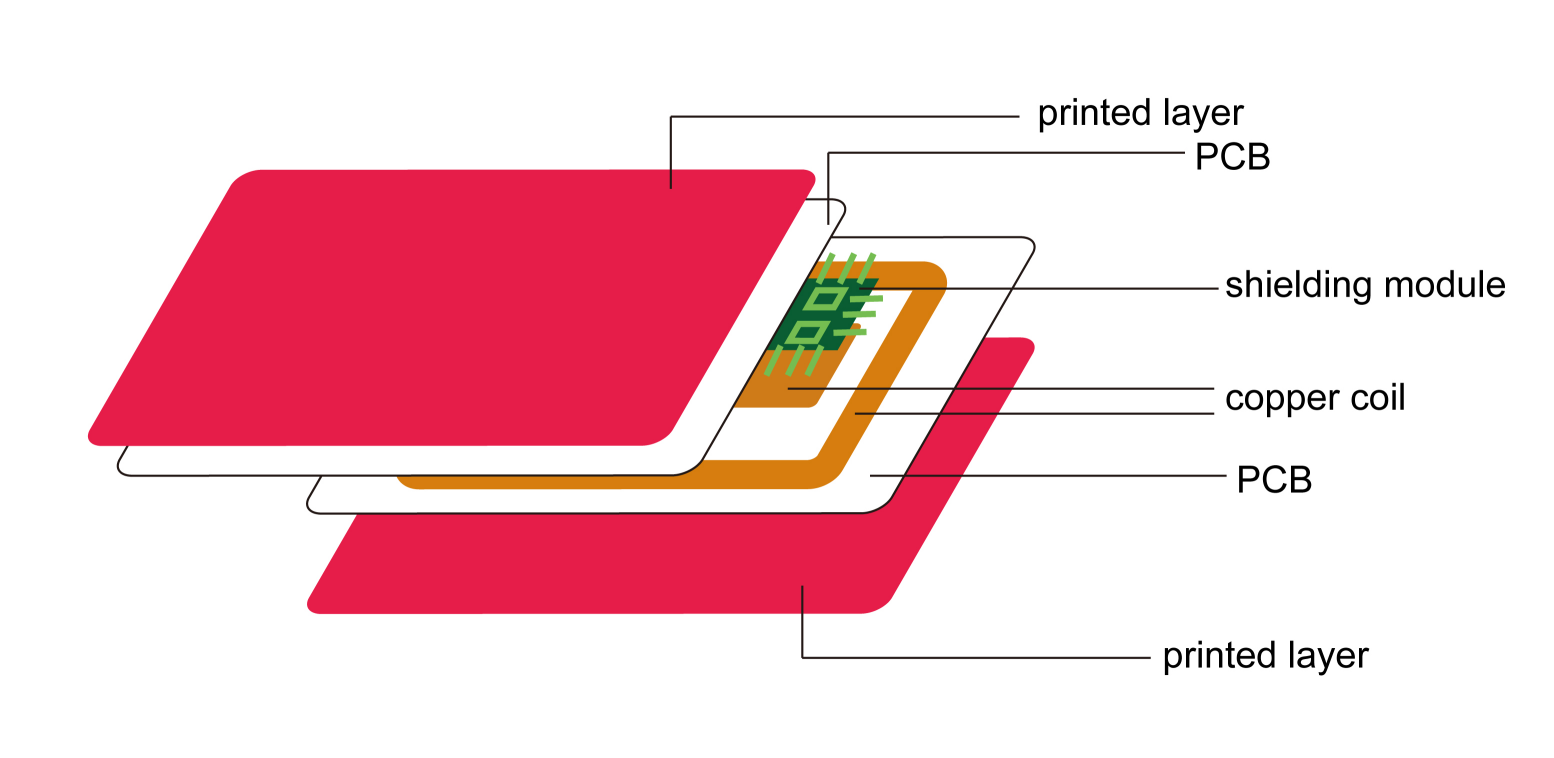
A custom RFID blocking card is a multi‑layer composite. Typical layers from top to bottom:
| Layer | Material | Function |
|---|---|---|
| Overlaminate | Clear PET or polycarbonate | Protects printing, adds scratch resistance |
| Top printed layer | PVC, PET, or paper | Displays custom design (logo, text, graphics) |
| Conductive blocking layer | Copper, aluminum, or alloy foil | The actual RFID shield (50–100 µm thick) |
| Core / substrate | PVC, PET, or metal sheet | Provides rigidity and thickness (0.5–0.8 mm) |
| Bottom printed layer | PVC, PET, or paper | Optional back‑side design (e.g., instructions) |
| Bottom overlaminate | Clear PET | Protection |
Some cards use a “metal core” – a solid sheet of stainless steel or copper surrounded by plastic layers. Others embed a fine metal mesh. The best performance comes from continuous, non‑perforated metal with high conductivity (copper > aluminum > steel). Multi‑layer cards often combine an aluminum shield with a ferrite layer to block both HF and LF frequencies.
Thickness is critical: the card must fit comfortably in a wallet slot alongside other cards. Standard thickness is 0.8–1.2 mm, which is slightly thicker than a standard credit card (0.76 mm). Manufacturers achieve this by using thin (0.05 mm) metal foils and thin plastic laminates.
4. Effectiveness: What Does an RFID Blocking Card Actually Block?
| Type of Card / Device | Frequency | Blocked by Standard RFID Blocking Card? |
|---|---|---|
| Contactless credit/debit card (Visa payWave, Mastercard PayPass, Amex ExpressPay) | 13.56 MHz | Yes |
| NFC‑enabled smartphone payment (Apple Pay, Google Pay – when not powered) | 13.56 MHz | Partially (phone may still be readable if powered on) |
| ePassport (biometric passport) | 13.56 MHz | Yes |
| Employee access badge (HID, Mifare) | 13.56 MHz (or 125 kHz) | Yes for 13.56; check for dual‑frequency |
| Proximity card (125 kHz) | 125 kHz | Only if card is specifically designed for LF |
| UHF RFID (e.g., toll tags, inventory labels) | 860–960 MHz | No – different frequency band |
For everyday credit card protection against skimmers operating at 13.56 MHz, a properly designed custom blocking card provides 99%+ attenuation. Independent tests show that with a copper‑layer card, the read distance of a contactless card is reduced from 5–10 cm to less than 1 mm – effectively zero.
5. Why Customize? Benefits of Personalised RFID Blocking Cards
Organizations and individuals choose custom RFID blocking cards for several reasons:
5.1 Branding and Marketing
Companies issue custom blocking cards to customers as a security‑focused promotional giveaway. A financial institution, for example, can print its logo and a security tip on the card, then mail it to clients. It reinforces the brand’s commitment to fraud prevention and keeps the company name in the wallet.
5.2 Employee ID and Accessory
Corporations can issue a dual‑function card: one side is an RFID-blocking shield, and the other side is a visual employee ID badge (without an RFID chip). This reduces the number of cards an employee carries.
5.3 Event and Trade Show Giveaways
Conference organizers print their event logo and a QR code linking to the event app. Attendees keep the card as a useful security tool, extending brand exposure long after the event.
5.4 Personalisation for Families
Parents can have cards printed with emergency contact information, allergy alerts, or a child’s photo. The card protects the parents’ payment cards and also serves as a safety ID.
5.5 Security Awareness Campaigns
Banks, police departments, and consumer protection groups distribute custom RFID blocking cards as part of fraud prevention campaigns. The card carries a message like “Stop Skimming – Keep This Card Against Your Wallet.”
6. Customization Options and Printing Methods
| Option | Available Choices |
|---|---|
| Card size | CR80 (85.6 × 54 mm) – standard; also CR79 (smaller) or custom |
| Thickness | 0.8 mm, 0.9 mm, 1.0 mm, 1.2 mm (must fit wallet) |
| Core material | PVC, PET, metal core (copper or steel) |
| Blocking frequency | 13.56 MHz only, or dual‑band (13.56 + 125 kHz) |
| Printing (front) | Offset (CMYK + Pantone), digital (variable data), screen print |
| Printing (back) | Same options – can be blank, solid colour, or full design |
| Finishing | Glossy, matte, holographic overlay, soft‑touch (velvet) |
| Variable data | Serial numbers, QR codes, barcodes, names, expiry dates |
| Security features | Microtext, UV‑fluorescent ink (visible under black light), hologram stickers |
| Edge colour | Usually white or black; custom edge printing available (higher cost) |
For small runs (100–500 cards), digital printing with variable data is cost‑effective. For large runs (5,000+), offset printing delivers lower per‑unit cost and sharper graphics. The blocking layer is unaffected by printing – it is a separate internal layer.
7. The Custom Manufacturing Process: Step by Step
Producing a custom RFID blocking card involves a defined workflow similar to standard ID card manufacturing, with the addition of a metal shielding layer.
Step 1 – Design and Artwork
Create print‑ready files (Adobe Illustrator, PDF) using a template provided by the manufacturer. Include front and back designs with bleed (3 mm). For variable data (e.g., unique serial numbers), define the field position and data format.
Step 2 – Material Selection
Choose the core material (PVC or metal), shielding foil material (copper or aluminum), and overlay materials. For standard 13.56 MHz protection, a 0.05 mm copper foil laminated between 0.3 mm PVC layers is typical. For dual‑frequency, a ferrite‑loaded layer is added.
Step 3 – Lamination
The layers are stacked in a heated hydraulic press: bottom overlay, bottom printed layer, adhesive, metal foil, adhesive, core, adhesive, top printed layer, top overlay. Heat and pressure fuse the layers into a solid sheet (called a “card sheet”). Lamination temperature and pressure are precisely controlled to avoid warping or delamination.
Step 4 – Printing (If Not Pre‑printed)
Some manufacturers print directly onto the laminated sheet using UV‑curable inkjet or offset. Others print the face layers before lamination. For variable data (serial numbers, QR codes), digital printing is done after lamination.
Step 5 – Die Cutting and Punching
The large card sheet is fed into a die‑cutter that punches out individual cards with precise dimensions and rounded corners.
Step 6 – Quality Control
- Visual inspection : Check print alignment, colour consistency, surface blemishes.
- Thickness measurement : Use a micrometer to ensure each card is within ±0.05 mm of target.
- RFID blocking test : Place a working contactless payment card on a reader; then place the blocking card between them. The reader should fail to read the payment card. A test jig measures attenuation in dB.
- Durability test : Bend test (ISO/IEC 7810) and scratch resistance.
Step 7 – Personalization and Encoding (Optional)
For cards that also contain an NFC chip (e.g., for digital business card functionality), an inlay with an NTAG 213 chip is embedded during lamination, and then encoded. However, a pure blocking card has no chip.
Step 8 – Packaging
Cards are counted, stacked, and wrapped in cellophane or shrink‑wrapped packs. For high‑volume orders, they are boxed with desiccant to avoid moisture damage.
Step 9 – Delivery and Verification
Final quality assurance certificates and a sample card are sent to the customer.
8. Testing and Certification Standards
A reputable custom RFID blocking card should meet or exceed:
- ISO/IEC 7810 (ID‑1) – Physical dimensions and bending resilience.
- ISO/IEC 7811 – For magnetic stripe (if present – not typical for blocking cards).
- RF blocking attenuation : Industry standard is >30 dB reduction at 13.56 MHz (i.e., the reader signal is reduced by a factor of 1000). Many high‑end cards achieve >50 dB.
- RoHS – Compliance with hazardous substance restrictions.
Look for manufacturers that provide independent lab test reports or use recognized testing equipment (e.g., a calibrated RFID skimmer simulator).
9. Applications Beyond Credit Cards
While primarily used for credit card protection, custom RFID blocking cards have other uses:
- Passport protectors – Place the card against the passport’s data page.
- Hotel key card wallets – Prevent cloning of hotel room cards.
- Medical ID cards – Protect patient health information stored on contactless medical cards.
- Corporate building access – Protect employee badges from being skimmed in crowded elevators.
- Gift card security – Prevent balance checking or cloning of unactivated gift cards.
10. Limitations and Misconceptions
- Does not block actively powered devices : A powered‑on smartphone with NFC can still communicate because the phone generates its own field. The blocking card will reduce, but not eliminate, the signal.
- Not a Faraday bag : A single card shields only cards directly behind it. For full wallet protection, you need a blocking wallet (multiple layers) or a blocking card at each side of your stack.
- Ineffective against UHF skimmers : UHF RFID (e.g., some inventory trackers) operate at 860‑960 MHz. A standard 13.56 MHz blocking card does not block UHF. If you are concerned about UHF skimming (rare for credit cards), look for a multi‑band blocker.
- No battery, no log : The card does not record or alert when skimming is attempted. It is purely passive.
11. Cost and Lead Time
| Order Quantity | Typical Price per Card (full colour, dual‑side, 13.56 MHz shield) | Lead Time |
|---|---|---|
| 100 – 500 | $1.50 – $2.50 | 10–14 days |
| 500 – 2,000 | $0.80 – $1.20 | 14–18 days |
| 2,000 – 10,000 | $0.50 – $0.80 | 18–25 days |
| 10,000+ | $0.30 – $0.50 | 20–30 days |
Additional costs: artwork setup ($50–$100), variable data encoding ($0.10–$0.30 per card), dual‑frequency shielding (+$0.20–$0.40), hologram stickers (+$0.15). For premium custom designs (metallic inks, embossing), expect higher prices.
12. Choosing the Right Manufacturer
Look for a supplier with:
- Experience in card lamination – Not just printing. The metal layer must be bonded without wrinkles or delamination.
- Testing equipment – They should demonstrate their blocking effectiveness with real RFID readers.
- Certifications – ISO 9001, ISO 14001, and ideally ISO 27001 for data security (since they handle your artwork).
- Sample policy – Order a small batch (10‑20 cards) with your design to test fit and functionality before full production.
- Customer reviews – Especially from banks or security companies.
Leading manufacturers include: CPI Card Group, IDEMIA, HID Global (for high‑security), and specialized Chinese factories like Shenzhen Goldbridge or Jinco Universal.
13. Conclusion
A custom protective RFID blocking card for credit cards is a small, inexpensive, yet highly effective security measure that belongs in every wallet. By placing a passive metal shield or resonant absorber between your contactless cards and potential skimmers, you neutralize the most common form of RFID fraud. The ability to customize these cards with logos, safety messages, or variable data transforms them from a commodity security tool into a powerful branding and awareness vehicle.
When selecting a custom blocking card, prioritize proven shielding effectiveness (verified attenuation >30 dB at 13.56 MHz), proper thickness (0.8–1.2 mm) to fit wallets, and durable construction with lamination that resists peeling. Work with a reputable manufacturer that can provide physical samples and test reports.
Whether you are a bank seeking to protect customers, a corporation enhancing employee security, or an individual wanting peace of mind, a custom RFID blocking card delivers passive, maintenance‑free protection. It will not drain batteries, require updates, or slow you down – simply slide it into your wallet alongside your cards, and tap with confidence. In a world where skimmers are getting smaller and more accessible, this tiny piece of personalized technology is your silent bodyguard.