November 8, 2026
Industrial assets rarely operate in ideal conditions. Manufacturing equipment, metal containers, outdoor machinery, reusable transport units, and heavy-duty tools are frequently exposed to moisture, dust, oil, vibration, temperature fluctuations, and electromagnetic interference.
For businesses managing thousands of valuable assets, traditional barcode identification and conventional RFID labels may not provide the flexibility or durability required for long-term tracking.
This is where industrial dual-frequency RFID technology becomes valuable.
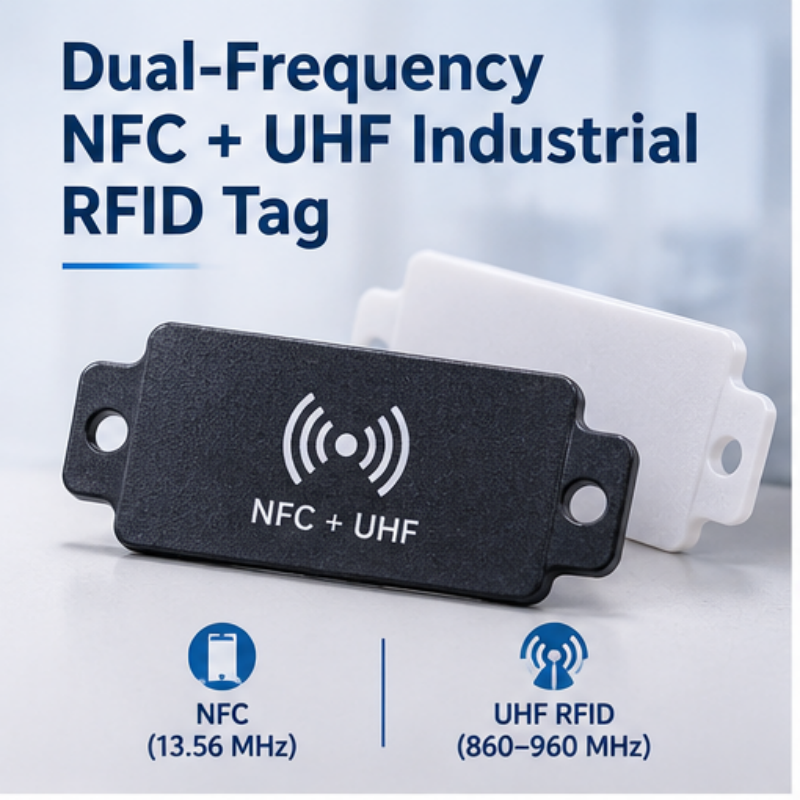
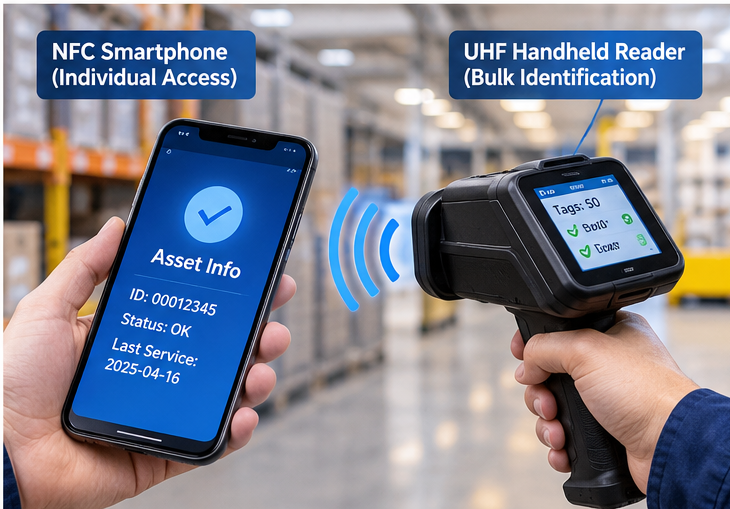
By combining Near Field Communication (NFC) at 13.56 MHz with Ultra-High Frequency (UHF) RFID, a dual-frequency tag can support two different identification workflows within one physical tag. Employees can use NFC-enabled smartphones for close-range inspection and maintenance, while industrial UHF readers can identify multiple assets efficiently during inventory operations.
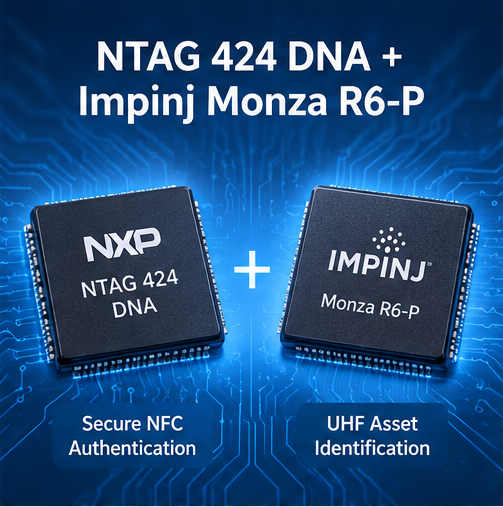
For projects requiring secure NFC authentication and automated UHF identification, NXP NTAG 424 DNA and Impinj Monza R6-P are two chip models worth understanding.
As an experienced RFID manufacturer, DO RFID Reader provides customized RFID tags, NFC products, UHF solutions, and industrial identification products for different application requirements.
1. What Are Industrial Dual-Frequency NFC and UHF RFID Tags?
An industrial dual-frequency RFID tag combines two communication technologies:
- NFC / HF: Operating at 13.56 MHz for short-range communication.
- UHF RFID: Operating within regional frequency bands, commonly between 860 and 960 MHz, for longer-range identification.
Unlike conventional single-frequency RFID products, a dual-frequency tag allows different users and devices to interact with the same physical asset through different reading methods.
For example, a maintenance technician can tap an NFC-enabled smartphone against a machine tag to access its maintenance information. Meanwhile, warehouse personnel can use a UHF handheld reader to identify hundreds of tagged machines, tools, or containers during an inventory inspection.
Depending on the design, dual-frequency products may use two separate RFID ICs or a specialized dual-interface IC.
When combining NXP NTAG 424 DNA and Impinj Monza R6-P, the design generally requires separate NFC and UHF chip functions, antennas, and RF interfaces integrated into one tag assembly.
This distinction matters because not every NFC tag can communicate with a UHF reader, and not every UHF RFID tag can be read by a standard smartphone.
Why Do Industrial Applications Need Two Frequencies?
Each frequency addresses a different operational requirement.
| Feature | NFC / HF | UHF RFID |
|---|---|---|
| Frequency | 13.56 MHz | 860–960 MHz |
| Typical reading method | Smartphone or NFC reader | Fixed or handheld UHF reader |
| Reading distance | Close-range | Medium to long-range |
| Multiple-tag identification | Limited individual interactions | Efficient bulk identification |
| Main purpose | Authentication and maintenance | Inventory and asset tracking |
| User experience | Simple smartphone tap | Automated scanning |
The biggest advantage is workflow flexibility.
A single asset can have a unique digital identity accessible to both automated industrial systems and employees carrying NFC-enabled mobile devices.
2. NXP NTAG 424 DNA: Secure NFC Identification for Industrial Assets
NXP NTAG 424 DNA is a secure NFC integrated circuit designed for applications requiring authentication, privacy protection, and secure data exchange.
It follows ISO/IEC 14443-A and NFC Forum Type 4 specifications, making it suitable for compatible NFC smartphones and readers.
Its security architecture makes it particularly interesting for industrial applications where simply reading a static identification number is not enough.
Key NTAG 424 DNA Features
AES-128 cryptographic security
NTAG 424 DNA supports AES-128 cryptographic operations for authentication and secure messaging.
This allows system designers to implement stronger identification processes and protect sensitive information against unauthorized access.
Secure Unique NFC (SUN)
SUN technology enables the generation of dynamic authentication information during NFC read operations.
Instead of relying entirely on a permanent static identifier, the system can verify dynamic information through a backend authentication process.
Protected memory
The chip provides 416 bytes of memory, including protected data storage and NDEF functionality.
This supports applications requiring secure configuration, authentication information, and product identification.
Mobile phone compatibility
Authorized users can interact with compatible NTAG 424 DNA tags using NFC-enabled smartphones, reducing the need for specialized equipment during routine inspections.
Industrial Applications of NTAG 424 DNA
NTAG 424 DNA can support:
- Secure machine identification.
- Industrial equipment authentication.
- Maintenance verification.
- Anti-counterfeit identification.
- Digital product identity.
- Restricted access to asset information.
- Smartphone-based equipment inspection.
For example, an industrial equipment manufacturer can install an NFC tag on a machine housing. When an authorized technician taps the tag, the system can verify its authenticity and retrieve the relevant maintenance information.
For smaller embedded NFC formats and secure identification projects, explore DO RFID’s NFC tag solutions.
3. Impinj Monza R6-P: UHF RFID for Automated Asset Identification
Impinj Monza R6-P is a UHF RFID endpoint IC developed for applications requiring efficient item-level identification, encoding, and inventory operations.
Unlike NFC, UHF RFID is designed for longer-range communication and rapid identification of multiple tags.
This makes it suitable for industrial environments where workers need to scan equipment, tools, containers, and inventory items without manually touching each tag.
Key Monza R6-P Capabilities
EPC identification
The chip supports EPC-based item identification through EPC Gen2-compatible RFID systems.
A unique EPC number can connect a physical asset with a corresponding record in an enterprise asset management platform.
Serialized identification
The chip supports a serialized TID structure, helping systems distinguish individual RFID devices.
Fast inventory workflows
UHF RFID readers can identify multiple tags within a reading zone, making the technology useful for warehouse operations, manufacturing lines, and equipment audits.
Memory and data integrity
The Monza R6-P architecture includes EPC and user memory, together with features designed to support reliable encoding and identification.
Industrial Applications
Potential applications include:
- Industrial tool tracking.
- Metal equipment identification.
- Warehouse inventory management.
- Reusable transport container tracking.
- Manufacturing asset management.
- Production line identification.
- Equipment inspection and maintenance.
Important sourcing consideration: Impinj currently marks Monza R6-P as not recommended for new designs. Buyers specifying this chip should confirm genuine chip availability, production continuity, and future replacement requirements before approving a long-term project.
For new product development, alternative UHF ICs should also be evaluated according to required memory, read sensitivity, encoding performance, and reader compatibility.
Explore DO RFID’s UHF RFID tag product range for different UHF identification requirements.
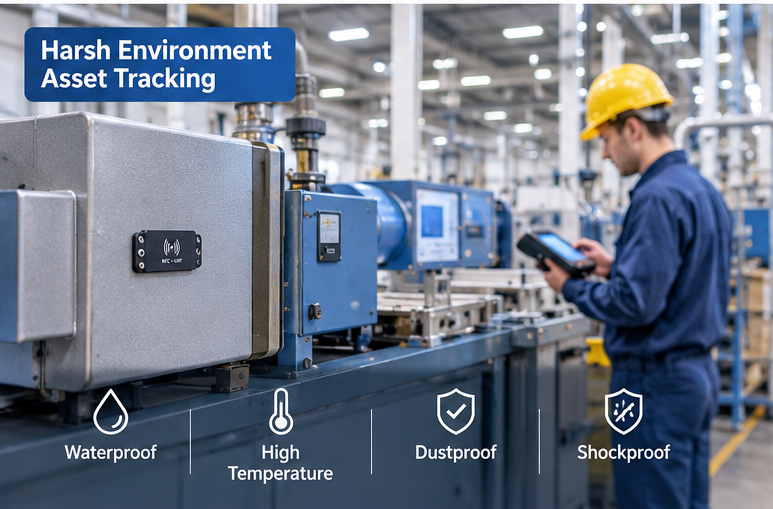
4. How Dual-Frequency Technology Improves Harsh Environment Asset Tracking
The real value of dual-frequency RFID is not simply having two frequencies inside one tag. It is the ability to connect automated identification with practical human interaction.
Consider an industrial equipment management project involving hundreds of machines distributed across several production areas.
A conventional UHF solution can identify equipment during scheduled inventory operations. However, maintenance employees may still need a dedicated reader to access individual asset information.
A dual-frequency solution creates a more flexible workflow.
Workflow 1: Automated UHF Inventory
Fixed readers or handheld UHF scanners identify tagged assets during warehouse inspections and production operations.
This helps companies:
- Reduce manual inventory work.
- Improve asset visibility.
- Identify missing equipment.
- Track reusable containers.
- Improve inventory accuracy.
Workflow 2: NFC-Based Maintenance
Technicians use compatible smartphones to interact with individual tags.
Depending on the software configuration, NFC can provide access to:
- Equipment identification.
- Maintenance instructions.
- Inspection records.
- Service history.
- Authentication information.
- Digital asset documentation.
Workflow 3: Combined Asset Lifecycle Management
The two interfaces can support different stages of an asset’s lifecycle.
For example:
- An asset receives a unique identification code during manufacturing.
- UHF readers identify it during warehouse storage and transportation.
- NFC provides access to maintenance information after installation.
- UHF readers perform periodic inventory checks.
- Authorized NFC interactions support inspection and servicing.
The backend system connects both workflows to the same asset record.
One important design consideration is whether the NFC and UHF interfaces share memory or use separate memory structures. In a two-chip implementation, software must maintain a reliable mapping between the two identifiers.
This is why tag architecture should be determined before mass production.
5. Why Industrial RFID Tags Need Specialized On-Metal Design
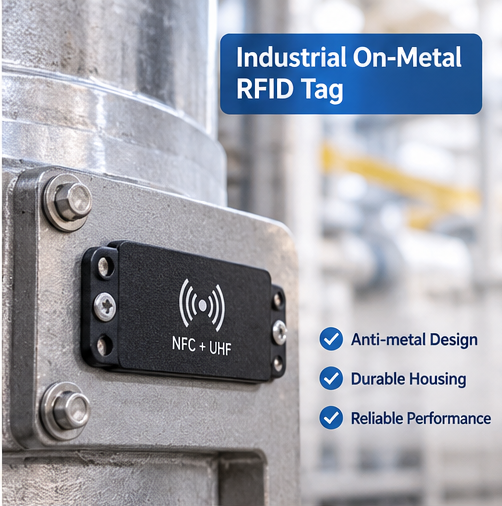
Metal surfaces are one of the most challenging installation environments for passive RFID technology.
When a conventional RFID tag is attached directly to metal, the conductive surface can change the antenna’s electromagnetic characteristics, resulting in reduced reading performance or communication failure.
Industrial on-metal RFID tags solve this problem through specialized antenna and material structures.
Important Design Considerations
Anti-metal antenna construction
An optimized antenna structure helps maintain communication performance when the tag is mounted on metal equipment.
Dielectric spacing
A suitable separation layer can help control the electromagnetic interaction between the tag antenna and the conductive surface.
Protective housing
Industrial applications may require ABS, PC, PCB, ceramic, epoxy, or other suitable materials depending on mechanical and environmental conditions.
Installation flexibility
Different assets require different mounting methods:
- Industrial adhesive.
- Screws and mechanical fixing.
- Rivets.
- Custom brackets.
- Embedded installation.
For demanding industrial applications, the mounting method should be tested together with the complete tag assembly.
DO RFID also offers UHF anti-metal RFID tags designed for metal asset identification and industrial tracking projects.
6. Essential Environmental Requirements for Industrial RFID Tags
A tag’s chip specifications do not automatically determine its environmental durability.
The antenna, substrate, protective housing, adhesive, sealing structure, and installation method all influence the final product’s performance.
When selecting industrial RFID tags for harsh environments, buyers should evaluate the following factors.
Waterproof and Dustproof Protection
Industrial tags may encounter rain, water splashes, dust, mud, cleaning processes, and outdoor exposure.
An IP rating provides a standardized indication of protection against solid particles and water under specified test conditions.
However, an IP68 or IP69K designation should not automatically be interpreted as proof of resistance to every chemical, solvent, pressure-washing process, or long-term immersion condition.
Always confirm the exact product’s test conditions.
Temperature Resistance
Industrial equipment may operate near engines, furnaces, production machinery, and other heat-generating components.
The required temperature specification should distinguish between:
- Continuous operating temperature.
- Short-term temperature peaks.
- Storage temperature.
- Processing temperature during manufacturing.
These are different conditions and should not be treated as interchangeable.
For applications involving elevated temperatures, explore DO RFID’s high-temperature RFID tags.
Chemical and Oil Resistance
Oil, lubricants, cleaning agents, industrial chemicals, and saltwater can affect the tag housing and adhesive.
For these applications, material compatibility testing is important.
Mechanical Durability
Industrial tags may experience vibration, abrasion, impact, pressure, and repeated handling.
A thin RFID label may work well for indoor inventory, while a rigid industrial housing may be more appropriate for exposed outdoor machinery.
The correct construction depends on the actual operating environment.
7. Dual-Frequency RFID vs. Conventional Industrial RFID Tags
Not every asset tracking project requires dual-frequency technology.
A suitable product should be selected according to the identification workflow rather than the number of features available.
| Selection Factor | UHF-Only Tag | NFC-Only Tag | Dual-Frequency Tag |
|---|---|---|---|
| Automated bulk inventory | Excellent | Limited | Excellent with UHF |
| Smartphone interaction | Generally unavailable natively | Excellent | Excellent with NFC |
| Individual maintenance access | Requires compatible UHF device | Convenient | Convenient |
| Long-range identification | Yes | No | Yes |
| Secure NFC authentication | No | Possible with suitable chip | Possible with suitable chip |
| System complexity | Lower | Lower | Higher |
| Typical cost structure | Usually lower | Usually lower | Depends on chip and construction |
A dual-frequency solution is particularly valuable when businesses need both automated inventory and smartphone-based identification.
However, adding a second RF interface increases design complexity and may increase the tag’s dimensions and manufacturing cost.
For large-scale deployments, buyers should compare the additional operational benefits against the total system cost.
8. How to Choose the Right Industrial Dual-Frequency RFID Tag Manufacturer
Selecting a factory is as important as choosing the RFID chip.
A technically suitable IC can still produce an unreliable tracking system if the antenna design, protective materials, assembly quality, or reader configuration are inappropriate.
Before placing a production order, consider these seven factors.
1. Chip Authenticity and Availability
Confirm the exact chip model, manufacturer, and memory configuration.
For legacy ICs such as Monza R6-P, verify sourcing arrangements and long-term availability.
2. Frequency Compatibility
UHF frequency requirements vary by destination market.
Confirm whether the product supports the relevant regional band and whether the reader configuration is compatible.
3. Antenna and Housing Design
The antenna should be designed for the intended tag dimensions, mounting position, and operating environment.
Metal-mounted products require particular attention to antenna tuning and physical construction.
4. Environmental Testing
Request relevant test information for:
- Temperature resistance.
- Water and dust protection.
- Chemical exposure.
- Mechanical impact.
- Adhesive performance.
- Long-term operating stability.
5. Encoding and Customization
For industrial projects, suppliers may need to support:
- EPC encoding.
- NFC configuration.
- Serial number printing.
- QR code integration.
- Logo printing.
- Custom dimensions.
- Customized housings.
For complex dual-frequency products, ask how the NFC identifier and UHF EPC will be associated during production.
6. Reader and Software Compatibility
A dual-frequency tag needs compatible NFC and UHF reading equipment.
Confirm the required reader protocols, communication interfaces, encoding process, and database integration.
7. Sample Testing Before Mass Production
Never rely exclusively on catalogue specifications.
Test samples on the actual assets using the intended readers, installation methods, and environmental conditions.
A successful pilot test is an important step before approving large-scale manufacturing.
9. Why Choose DO RFID Reader for Customized Industrial RFID Solutions?
DO RFID Reader is a professional RFID manufacturer and supplier providing RFID tags, RFID readers, smart cards, and NFC products for industrial and commercial applications.
With manufacturing experience, dedicated production facilities, and customization capabilities, DO RFID supports different RFID identification requirements.
Rather than offering only standard tag formats, DO RFID focuses on matching the product structure and technical configuration to the customer’s application.
Industrial RFID Product Capabilities
DO RFID’s product range includes:
- UHF RFID tags.
- On-metal RFID tags.
- High-temperature RFID tags.
- NFC tags and inlays.
- Industrial asset identification products.
- RFID readers and handheld devices.
- Customized RFID cards and transponders.
OEM and ODM Customization
Different industrial assets require different RFID structures.
DO RFID can evaluate customization requirements involving:
- RFID chip selection.
- NFC and UHF frequency configurations.
- Antenna dimensions and design.
- ABS, PCB, ceramic, FPC, and other suitable materials.
- Product dimensions and protective housing.
- Logo and serial number printing.
- RFID encoding and data configuration.
- Customized mounting solutions.
The final configuration depends on the project’s technical requirements and product validation.
Manufacturing and Quality Control
DO RFID’s manufacturing operations include RFID chip bonding, assembly, lamination, molding, and testing capabilities.
The company also provides technical consultation and sample evaluation to help customers confirm product suitability before production.
For projects involving industrial equipment, metal assets, and outdoor tracking, DO RFID can assess the required chip, antenna, material, and installation method as part of the customization process.
Visit the DO RFID Reader official website to explore its RFID manufacturing capabilities and product categories.
10. Frequently Asked Questions About Industrial Dual-Frequency RFID Tags
Q1. What is a dual-frequency NFC UHF RFID tag?
A dual-frequency RFID tag combines NFC/HF communication at 13.56 MHz and UHF RFID communication within the applicable regional UHF band.
It enables smartphone-based close-range interaction and longer-range automated asset identification through one physical tag.
Q2. Can NTAG 424 DNA and Impinj Monza R6-P work in the same RFID tag?
Yes, a properly engineered tag assembly can integrate an NTAG 424 DNA NFC chip and a Monza R6-P UHF chip.
However, this generally requires two separate RF interfaces and antenna structures. Their physical arrangement and electromagnetic compatibility must be validated.
Q3. Can a dual-frequency RFID tag be installed directly on metal?
Yes, provided the tag is specifically designed for metal mounting.
An anti-metal antenna structure and appropriate material construction are necessary to maintain reliable communication.
Q4. Can smartphones read UHF RFID tags?
Most standard smartphones support NFC but do not natively support conventional UHF RFID communication.
A compatible UHF accessory or specialized reader is generally required.
Q5. Are dual-frequency RFID tags suitable for outdoor applications?
They can be suitable when the complete tag assembly is designed and tested for the intended outdoor conditions.
Waterproofing, UV exposure, temperature variation, mechanical protection, and chemical resistance should all be evaluated.
Q6. What is the difference between IP67, IP68, and IP69K?
These ratings describe different levels or types of ingress protection under specified testing conditions.
The appropriate rating depends on the actual environmental exposure. Buyers should check the exact certification or test report for the selected tag rather than assuming all products with similar labels offer identical protection.
Q7. Is Impinj Monza R6-P still suitable for new industrial RFID projects?
Impinj currently identifies Monza R6-P as not recommended for new designs.
It may still be considered for existing systems or projects with confirmed sourcing, but new product development should evaluate current-generation alternatives.
Q8. Can DO RFID customize industrial NFC and UHF RFID tags?
DO RFID supports customized RFID products according to application requirements and technical feasibility.
Customers can discuss chip selection, antenna design, tag dimensions, materials, printing, encoding, and mounting requirements with the technical team.
Conclusion: Build a More Flexible Industrial Asset Tracking System
Industrial asset tracking requires more than a chip with a long reading distance.
A reliable solution depends on the relationship between chip technology, antenna design, mounting structure, environmental protection, reader compatibility, and software integration.
NXP NTAG 424 DNA offers secure NFC identification and smartphone interaction, while Impinj Monza R6-P provides UHF-based identification capabilities for automated inventory and tracking applications.
When engineered into a suitable dual-frequency assembly, these technologies can support more flexible industrial asset management workflows.
For companies developing customized RFID solutions for metal equipment, outdoor machinery, manufacturing facilities, and harsh operating environments, choosing an experienced manufacturing partner is essential.
DO RFID Reader provides customized RFID tags, NFC products, UHF solutions, and industrial identification support to help businesses develop RFID products that match their real-world applications.

Au is an RFID and NFC manufacturer based in Shenzhen, China, with over 10 years of experience.