September 14, 2026
RFID Animal Microchips tube Glass PET tag is widely used for small animal identification. This glass tag can be used to identify any pet like cat, dog, furret, horse, fish and exotic animal. All products conform to ISO standards and are available with parylene coating to prevent migration of the tag once implanted.
RFID Animal Microchips tube Glass PET tag is a easy solution for animal identification and tracking. Made of high quality biocompatible glass, comply with ISO11784/785 FDX A/B, HDX; Our RFID Animal Microchips tube Glass PET tag are safety and could work with excellent performance, 5-8cm with our readers, or even longer upon readers’ antenna and power.
Features
1). Unique identity for every livestock and pet.
2). Import and export control.
3). Lost pet can be easily traced back to it’s owner.
4). Veterinarians are able to keep the animal’s heath record.
5). Easily implanted and no impact on the animal.
6). Suitable for use in extreme conditions.
7). Coupled with software, the RFID tag is a must inmanagement of animals, either livestock or household pet.


Specifications
| Frequency | Standard: 134.2KHz, Optional: LF 125KHz, HF 13.56MHz/NFC |
| Material: | Bioglass with Parylene coating |
| Size | Standard: 2.12*12mm, 1.25*7mm, 1.4*8mm, Optional: 2.12*8mm, 3*15mm, 4*32mm |
| Chip | EM4305 |
| Protocol | ISO11784/11785, FDX-B, FDX-A, HDX, NFC HF ISO14443A are available for option |
| Work tem | -20 ℃~50℃ |
| Store Tem. | -40 ℃~70℃ |
| Read and write times | >100000 |
| Sryinge material | Polypropylene |
| Sryinge color | Green, White, Blue, Red for selection |
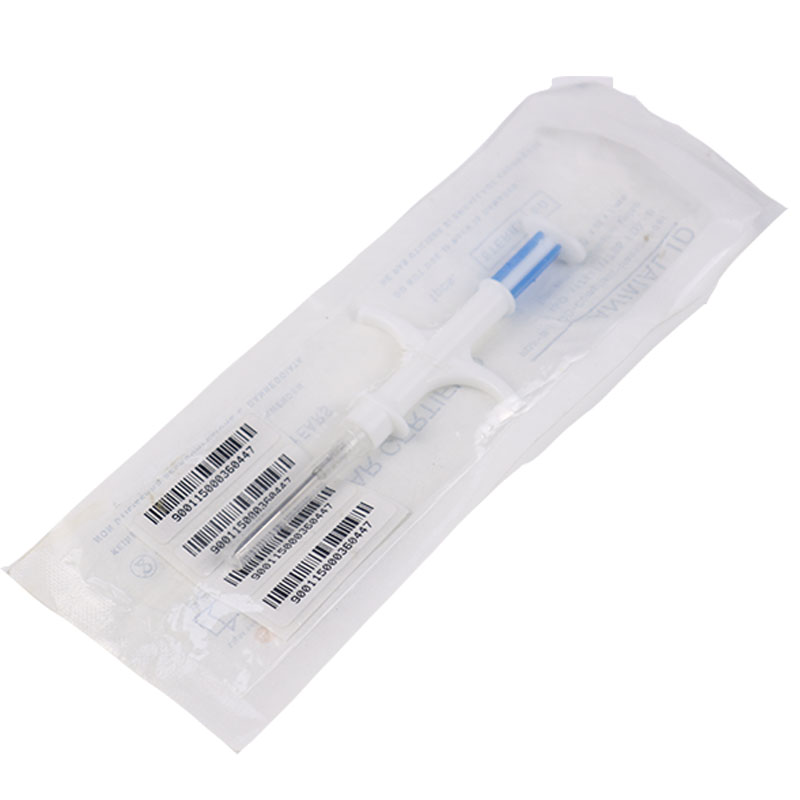
| Packing material | 1 syringe with 1 pre-loaded microchip, then packed in 1 Medical-grade sterilization pouch Microchip with needle or microchip without syringe or needle are for option too. |
| Application | animal pet Identification |

134.2 kHz Animal RFID Technology
The 134.2 kHz frequency is widely used for electronic animal identification. It provides a practical solution for reading implanted transponders with compatible animal RFID readers.
Our standard animal microchip configuration is based on the LF 134.2 kHz frequency range and can be supplied for systems using ISO 11784/11785-compatible animal identification technologies.
The actual reading distance depends on several factors, including reader output power, antenna design, tag orientation, implantation location, glass capsule size, and the surrounding environment.
For this reason, the stated 5–8 cm reading distance should be considered a typical reference rather than a guaranteed distance for every reader and installation condition.
FDX-B, FDX-A and HDX Options
Different animal identification systems may use different RFID communication technologies. Selecting the appropriate configuration is therefore important when integrating the microchip with an existing reader or animal management platform.
| Technology | Typical Application | Key Consideration |
|---|---|---|
| FDX-B | Pet and livestock identification | Common choice for animal microchip systems |
| FDX-A | Animal identification applications | Reader compatibility should be confirmed |
| HDX | Livestock and animal identification | Requires compatible HDX reader/system |
| HF / NFC | Specialized applications | Different frequency and reader requirements |
The selected RFID chip and protocol should always be matched with the RFID reader used by the customer. If you already have a reader model, we can help determine the appropriate microchip configuration.
RFID Microchip Size Comparison
Animal size and implantation requirements can vary significantly between applications. Different glass capsule dimensions can therefore be selected according to the target animal and application.
| Size | Suggested Application | Characteristics |
|---|---|---|
| 1.25 × 7 mm | Small animals and specialized applications | Very compact form factor |
| 1.4 × 8 mm | Small pets and animals | Compact identification tag |
| 2.12 × 8 mm | Small and medium animals | Shorter capsule option |
| 2.12 × 12 mm | Dogs, cats and general applications | Standard configuration |
| 3 × 15 mm | Larger animals | Larger capsule format |
| 4 × 32 mm | Specialized livestock applications | Extended form factor |
The appropriate size should be selected according to the animal, implantation method, reader requirements, and applicable veterinary procedures.
Biocompatible Glass Capsule with Parylene Coating
The RFID transponder is enclosed in biocompatible glass designed for implantation applications. Glass provides a protective enclosure for the electronic components while maintaining a compact capsule structure.
Parylene coating is available as an additional protective layer. One of its important purposes is to help reduce migration of the implanted microchip within the animal’s tissue.
The capsule construction is particularly important for long-term animal identification because the RFID tag is intended to remain implanted for an extended period.
For professional veterinary and regulated applications, customers should verify that the selected product configuration meets all local requirements for animal implantation, sterilization, materials, and product registration.
Pre-Loaded Sterile Syringe
For convenient implantation, the RFID microchip can be supplied pre-loaded inside a polypropylene syringe.
Each unit can be packaged in a medical-grade sterilization pouch, helping simplify handling and preparation before veterinary use.
Available configurations include:
- RFID microchip pre-loaded in a syringe
- RFID microchip with needle
- RFID microchip without syringe
- Microchip and needle configurations for customized requirements
Syringe colors can be selected from green, white, blue, and red options, subject to production requirements.
How Does an Injectable RFID Microchip Work?
The identification process is simple and does not require a battery inside the implanted tag.
Step 1: Implantation
A qualified veterinary professional implants the microchip according to the applicable veterinary procedure.
Step 2: RFID Scanning
A compatible 134.2 kHz animal RFID reader is placed near the implantation area.
Step 3: Wireless Activation
The passive RFID transponder receives energy from the reader’s electromagnetic field.
Step 4: ID Transmission
The microchip communicates its stored identification number to the reader.
Step 5: Database Matching
The identification number can be associated with the animal’s owner information, veterinary records, breeding data, or livestock management information.
The microchip itself is primarily an electronic identification device. It does not independently store or transmit GPS location data.
RFID Microchip vs. Other Animal Identification Methods
Different identification methods provide different benefits. RFID microchips are particularly useful when permanent electronic identification is required.
| Identification Method | Permanent | Electronic ID | Requires Battery | Remote GPS Tracking |
|---|---|---|---|---|
| Injectable RFID microchip | Yes | Yes | No | No |
| Collar tag | No | Optional | No | No |
| Ear tag | Long-term | Optional | No | No |
| Tattoo | Long-term | No | No | No |
| GPS tracker | Usually device-dependent | Yes | Usually | Yes |
An RFID microchip should therefore not be considered a replacement for a GPS tracker when continuous location tracking is required. Its primary function is reliable animal identification.
Applications of Animal RFID Microchips
Pet Identification
The microchip can be used for electronic identification of dogs, cats, ferrets, and other companion animals. A registered ID can help connect the animal with its owner information and veterinary records.
Livestock Management
RFID identification can support individual animal management in farms, breeding programs, and livestock operations. Each animal can be assigned a unique electronic identity for record keeping and management.
Veterinary Records
A unique RFID number can be associated with veterinary information such as examination records, vaccination history, treatment information, and other animal records.
Animal Import and Export
Electronic identification can support animal identification and traceability requirements in international animal transportation and trade. Specific regulatory requirements vary by country and animal category.
Breeding Management
RFID identification can help maintain individual records for breeding animals, including lineage, breeding history, and related management information.
Fish and Aquatic Animals
Compact RFID glass capsules can also be used in selected fish identification and research applications. The appropriate tag size, reader, implantation method, and operating environment should be evaluated before deployment.
Why Use RFID for Animal Identification?
Traditional visual identification methods can be difficult to manage when animals move between farms, veterinary clinics, shelters, owners, or other locations.
RFID provides an electronic identification method that can be scanned without directly reading a printed number or visually inspecting a tattoo.
Key advantages include:
- Unique electronic identification
- Fast RFID scanning
- No internal battery
- Compact implanted format
- Compatibility with animal management software
- Suitable for long-term identification
- Multiple capsule sizes
- Multiple protocol options
- Sterile syringe configurations available
The RFID microchip does not replace a registration database. To achieve effective traceability, the unique chip ID must be correctly recorded and associated with the relevant animal information.
Choosing the Right Animal RFID Microchip
The best configuration depends on the animal and the identification system in which the tag will be used.
For most standard pet identification applications, the 134.2 kHz configuration with a compact glass capsule is a practical starting point. For larger animals, a different capsule size may be more suitable.
Before placing an order, we recommend confirming the following:
| Requirement | What to Confirm |
|---|---|
| Animal type | Dog, cat, livestock, fish, horse, etc. |
| Animal size | Helps determine suitable capsule dimensions |
| Existing reader | Confirm RFID frequency and protocol compatibility |
| Identification standard | ISO 11784/11785 or other required standard |
| Protocol | FDX-B, FDX-A, HDX, NFC, etc. |
| Packaging | Syringe, needle, or microchip only |
| Sterilization | Required sterilization and packaging configuration |
| Registration | Local animal identification requirements |
Providing the reader model or RFID system specification before ordering can help reduce compatibility problems.
RFID Reader Compatibility
The performance of an implanted RFID microchip depends not only on the tag but also on the reader.
Important reader characteristics include:
- Operating frequency
- Supported RFID protocol
- Antenna design
- Output power
- Reading sensitivity
- Antenna size
- Reading environment
A 134.2 kHz animal microchip should be used with a compatible animal RFID reader. A conventional 13.56 MHz NFC reader, for example, should not be expected to read a standard 134.2 kHz animal microchip.
For customized projects, testing the complete combination of microchip + reader + antenna + implantation environment is recommended before mass production.
Frequently Asked Questions
Is the RFID animal microchip rechargeable?
No. The standard animal microchip is a passive RFID transponder and does not require a rechargeable or replaceable battery.
Can the microchip track a pet’s location?
No. The RFID microchip provides identification rather than GPS tracking. A compatible RFID reader must be close enough to the implanted tag to retrieve its ID.
What frequency does the standard animal microchip use?
The standard configuration operates at 134.2 kHz, which is commonly used for animal identification systems.
Does the microchip support ISO 11784/11785?
Compatible configurations are available for ISO 11784/11785 animal identification applications. The exact protocol and chip configuration should be confirmed for the intended reader and market.
What is the typical RFID reading distance?
The stated reference range is approximately 5–8 cm with compatible readers. Actual performance can vary depending on reader power, antenna design, tag size, orientation, and installation conditions.
Is Parylene coating necessary?
Parylene coating can be supplied to help reduce movement or migration of the implanted tag. The required coating and product configuration should be determined according to the intended application and applicable requirements.
Can the RFID microchip be supplied with a syringe?
Yes. The microchip can be supplied pre-loaded in a polypropylene syringe and packaged in a medical-grade sterilization pouch. Other configurations can also be discussed.
Can the product be customized?
Yes. Depending on the project, options may include capsule size, RFID configuration, protocol, syringe configuration, packaging, labeling, and color.
Quality and Compliance Considerations
For an implanted animal identification product, RFID performance is only one part of product quality. The glass capsule, coating, sterilization, packaging, chip programming, and manufacturing consistency are also important.
For projects intended for regulated markets, customers should confirm the applicable national or regional requirements before commercialization.
We can provide product information and technical specifications for evaluation and help customers select a suitable RFID configuration based on their application and existing reader system.
Get the Right RFID Animal Microchip for Your Application
Whether you need an injectable RFID microchip for dogs and cats, an identification tag for livestock, or a compact RFID glass capsule for specialized animal research, selecting the correct frequency, protocol, capsule size, and packaging configuration is essential.
Our animal RFID microchips are available in multiple sizes and configurations, with 134.2 kHz as the standard animal identification frequency. FDX-B, FDX-A, HDX, and other RFID options can be considered according to system requirements.
Contact us with the following information:
- Animal type and approximate size
- Required microchip dimensions
- RFID reader model or specification
- Required frequency and protocol
- Required quantity
- Syringe and sterilization requirements
- Target market or application
We can then recommend a suitable injectable RFID glass capsule tag configuration for your project.