November 3, 2026
Introduction: Why Industrial Assets Need More Than Standard NFC Tags
Industrial assets are rarely used in clean, controlled environments. Manufacturing equipment is exposed to oil, vibration, dust, and repeated cleaning. Outdoor infrastructure faces rain, sunlight, temperature fluctuations, and mechanical wear. Logistics containers and reusable transport equipment are frequently moved, stacked, and handled under demanding conditions.
In these situations, conventional NFC stickers may not provide the durability or security required for long-term asset identification.
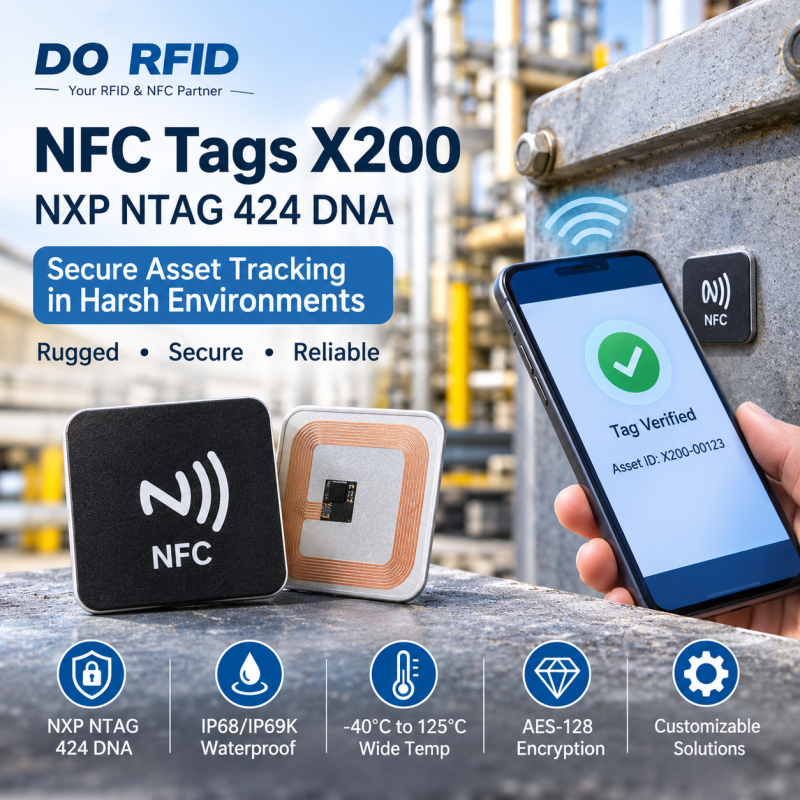
NFC Tags X200 with NXP NTAG 424 DNA technology are designed to address two important requirements of modern industrial asset tracking: physical durability and secure digital identification.
Unlike basic NFC tags that rely primarily on static identification data, NTAG 424 DNA incorporates AES-128 cryptographic capabilities and Secure Unique NFC (SUN) authentication. These features help organizations verify tag authenticity and protect sensitive asset information.
Combined with an appropriately engineered protective housing, antenna, and attachment structure, X200 provides a platform for connecting physical equipment with digital asset records.
For manufacturers, logistics operators, equipment rental companies, and industrial maintenance teams, this approach creates a more reliable way to identify, authenticate, inspect, and manage valuable assets throughout their operational life cycles.
1. What Are NFC Tags X200?
NFC Tags X200 are industrial NFC identification tags developed for asset tracking applications where environmental resistance and data security are important.
The product combines an NXP NTAG 424 DNA NFC chip with a ruggedized tag construction. Its purpose is not simply to store an equipment number, but to establish a secure connection between a physical asset and its corresponding digital information.
When an NFC-enabled smartphone or compatible reader approaches the tag, the device can retrieve the programmed information and communicate with an asset management platform.
Depending on the system configuration, this interaction can provide access to:
- Equipment identification numbers and serial numbers.
- Manufacturing and installation information.
- Maintenance and inspection records.
- Service history and repair documentation.
- Ownership and asset location records.
- Authentication and verification results.
- Operational instructions and technical documents.
This makes X200 particularly relevant for industrial environments where equipment must remain identifiable over extended periods.
How X200 Differs from Standard NFC Stickers
A conventional NFC sticker is often designed for indoor applications, product information sharing, marketing, or simple identification.
An industrial asset tracking tag has different requirements.
It must maintain reliable attachment, withstand the expected environmental exposure, and support consistent identification during repeated inspections and maintenance operations.
The X200 concept combines three functional layers:
1. Identification Layer
The NFC chip provides a unique digital identity that can be associated with a specific physical asset.
2. Security Layer
NTAG 424 DNA supports cryptographic authentication, helping systems distinguish genuine tags from unauthorized copies.
3. Protection Layer
The selected enclosure, substrate, antenna construction, and adhesive system protect the electronic components against the environmental conditions defined for the application.
These three layers work together to support dependable industrial identification.
2. NXP NTAG 424 DNA: Advanced Security for Industrial Asset Identification
One of the most important advantages of NFC Tags X200 is the use of the NXP NTAG 424 DNA chip.
Standard NFC tags can store static URLs, identification numbers, or other information. However, if a system depends entirely on static data, copied information may be used to imitate an original tag.
NTAG 424 DNA addresses this challenge through hardware-based cryptographic security.
AES-128 Encryption
NTAG 424 DNA supports AES-128 cryptography for authentication and secure messaging.
AES-128 uses a 128-bit cryptographic key to protect sensitive information and support secure communication between the tag and an authorized system.
For industrial applications, this is useful when organizations need to verify asset identities rather than simply read an identification number.
For example, a maintenance technician can tap an NFC-enabled smartphone against an equipment tag. The system can validate the tag’s cryptographic response before displaying the associated maintenance information.
This provides an additional layer of protection for high-value equipment and sensitive operational records.
Secure Unique NFC (SUN) Authentication
SUN is one of the key security features of NTAG 424 DNA.
When configured with Secure Dynamic Messaging (SDM), the tag can generate a dynamic authentication message during an NFC read operation.
Unlike a fixed URL or static identifier, the resulting message can include changing, cryptographically protected information.
A backend server can validate the authentication data using the corresponding secret key and verify whether the interaction came from a legitimate tag.
This is especially valuable for:
- High-value industrial equipment.
- Authorized maintenance access.
- Secure inventory verification.
- Equipment rental management.
- Supply chain authentication.
- Protection against unauthorized tag duplication.
The authentication process requires proper key management and backend configuration. The chip alone does not automatically provide a complete asset tracking platform.
Mutual Authentication and Protected Data Access
NTAG 424 DNA also supports three-pass mutual authentication.
This allows an authorized reader and the tag to authenticate each other before accessing protected information.
Secure communication helps protect sensitive data exchanged through the NFC interface.
For businesses managing valuable equipment, this can support a more controlled information access strategy.
NFC Forum Type 4 and ISO/IEC 14443-A Compatibility
NTAG 424 DNA complies with ISO/IEC 14443-A and NFC Forum Type 4 Tag specifications.
This makes it suitable for applications using compatible NFC-enabled smartphones, tablets, and industrial NFC readers.
It also provides flexibility when integrating secure NFC identification into existing digital workflows.
3. Designed for Harsh Environments: What Makes an Industrial NFC Tag Rugged?
Security is only one part of industrial asset identification.
A tag that provides excellent encryption but fails after repeated exposure to moisture, heat, chemicals, or mechanical impact cannot deliver reliable long-term tracking.
For this reason, environmental engineering is an equally important part of the X200 design.
Water and Dust Protection
Industrial equipment is frequently exposed to water, dust, and cleaning procedures.
Applications such as manufacturing plants, outdoor equipment yards, and logistics facilities may require tags with high ingress protection.
The X200 product specification currently presents IP68/IP69K protection.
These ratings address different environmental exposure conditions:
- IP68: Protection against dust and immersion under specified testing conditions.
- IP69K: Protection against high-pressure and high-temperature water jets under the applicable testing conditions.
The exact performance must be confirmed against the finished tag’s test reports and specified installation conditions.
Temperature Resistance
Temperature changes can affect the antenna, chip connections, adhesive, and protective materials.
Industrial environments may include:
- Cold storage facilities.
- Outdoor equipment exposed to seasonal temperature changes.
- Manufacturing machinery generating heat.
- Industrial cleaning and processing areas.
The X200 product specification lists an operating temperature range of -40°C to 125°C.
For projects involving prolonged exposure near either temperature limit, the complete tag assembly should be tested under the actual operating conditions.
Chemical and Oil Resistance
Industrial equipment often comes into contact with lubricants, hydraulic fluids, detergents, cleaning agents, and other chemicals.
These substances may damage conventional label materials or weaken adhesive performance.
An industrial NFC tag should therefore be selected according to the actual chemicals present in the working environment.
Important evaluation factors include:
- Resistance of the outer housing.
- Chemical compatibility of the adhesive.
- Protection of the antenna and chip connections.
- Long-term material stability.
- Resistance to repeated cleaning procedures.
Chemical resistance should be validated using the specific substances and exposure periods expected in the application.
Mechanical Durability and Long-Term Attachment
Physical damage is another common reason for industrial identification failures.
Equipment may experience vibration, friction, impact, abrasion, and repeated handling.
The mounting structure of an industrial NFC tag is therefore just as important as its electronic components.
Depending on the equipment surface and application, suitable attachment methods may include industrial adhesive, mechanical fastening, or a customized mounting structure.
The correct selection helps reduce tag loss, replacement costs, and identification interruptions.
4. Industrial Applications of NFC Tags X200
NFC Tags X200 are particularly suitable for applications where assets require individual identification and secure information access.
Manufacturing Equipment and Machinery Tracking
Manufacturing companies manage a wide range of valuable assets, including production machines, molds, tools, motors, pumps, and inspection equipment.
Traditional identification labels may become unreadable because of oil, heat, dust, or repeated cleaning.
With X200, each asset can receive a dedicated NFC identity linked to its digital equipment record.
Employees can tap the tag to access:
- Equipment specifications.
- Maintenance schedules.
- Repair history.
- Inspection checklists.
- Operating instructions.
- Responsible department information.
This improves information accessibility and helps maintenance teams reduce manual record searching.
Outdoor Infrastructure and Utility Asset Management
Outdoor assets are exposed to environmental conditions that are difficult to control.
Examples include electrical cabinets, utility equipment, communication infrastructure, outdoor machinery, and construction equipment.
An appropriately specified rugged NFC tag allows technicians to identify assets directly in the field.
During routine inspections, workers can access equipment records and submit updated maintenance information through a connected mobile application.
This creates a more structured relationship between physical infrastructure and digital maintenance records.
Logistics Containers and Reusable Transport Equipment
Reusable containers, industrial bins, transport cases, and logistics equipment move between warehouses, factories, and distribution centers.
Their identification needs to remain consistent throughout repeated handling cycles.
X200 can provide an NFC-based identification point for individual containers and reusable assets.
When combined with an asset management platform, the system can support:
- Container identification.
- Receiving and dispatch verification.
- Inspection records.
- Ownership identification.
- Maintenance tracking.
- Reuse history.
For high-volume logistics operations requiring simultaneous reading of many assets over several meters, UHF RFID may be a more suitable complementary technology.
Healthcare and Medical Equipment Management
Healthcare organizations must maintain accurate identification records for medical devices and reusable equipment.
NFC-based identification can help staff retrieve equipment information, service records, inspection status, and usage documentation.
For equipment exposed to frequent cleaning or disinfection, the tag enclosure and surface materials must be selected according to the cleaning agents and procedures involved.
Importantly, compatibility with sterilization or autoclave processes should never be assumed from the presence of an industrial NFC chip alone. The complete tag assembly requires application-specific validation.
Construction, Mining, and Field Service Equipment
Construction sites and mining operations expose tools and equipment to dust, vibration, moisture, mud, and mechanical wear.
An industrial NFC tag can provide a convenient identification point for portable equipment, generators, power tools, and service components.
Field technicians can access equipment records without searching through paper documents or manually entering serial numbers.
This is especially useful for organizations managing equipment across multiple sites and service teams.
5. How NFC Tags X200 Improve Asset Tracking Workflows
An NFC tag becomes much more valuable when it is connected to a structured asset management process.
The following workflow illustrates how X200 can be deployed.
Step 1: Assign a Unique Asset Identity
Each tag is associated with a specific equipment record in the organization’s asset management database.
Step 2: Configure Security Credentials
The NTAG 424 DNA chip is personalized with the required cryptographic keys and authentication settings.
Each tag should have appropriately managed credentials rather than relying on a shared, publicly accessible secret.
Step 3: Attach the Tag to the Asset
The X200 is installed at a suitable position on the equipment.
The mounting location should be selected after evaluating surface material, nearby metal, exposure conditions, and NFC reading performance.
Step 4: Perform NFC Identification
An authorized employee uses a compatible smartphone or NFC reader to interact with the tag.
Step 5: Authenticate and Retrieve Information
The backend validates the dynamic authentication data when the application uses SUN/SDM verification.
After successful verification, the system can retrieve the corresponding asset record.
Step 6: Update Operational Records
Maintenance personnel can submit inspection results, repair details, service dates, and other authorized updates.
Step 7: Build a Long-Term Asset History
Over time, the system accumulates asset-related information that supports maintenance planning, accountability, and operational analysis.
The result is more than a digital label. It becomes an accessible identification point within a connected industrial asset management system.
6. NFC vs. UHF RFID: Which Technology Is Better for Industrial Asset Tracking?
NFC and UHF RFID are both useful technologies for industrial identification, but they solve different operational problems.
Choosing between them depends on the required reading distance, scanning volume, security requirements, and existing infrastructure.
| Comparison | NFC (X200) | UHF RFID |
|---|---|---|
| Operating Frequency | 13.56 MHz | Typically 860–960 MHz |
| Reading Method | Close-range tap | Long-range radio scanning |
| Typical Interaction | Individual asset verification | Multiple asset identification |
| Smartphone Compatibility | Supported by compatible NFC phones | Requires compatible UHF hardware |
| Security | AES-128 and SUN support with NTAG 424 DNA | Depends on selected chip and system |
| Typical Applications | Secure asset identification and inspection | Warehouse and bulk inventory tracking |
When Should You Choose NFC?
NFC is a strong choice when employees need to interact with individual assets intentionally.
Examples include:
- Verifying equipment authenticity.
- Accessing maintenance records.
- Performing scheduled inspections.
- Checking individual tools and machinery.
- Authenticating valuable reusable equipment.
Its close-range interaction also reduces accidental readings from nearby tags.
When Should You Choose UHF RFID?
UHF RFID is generally more suitable when businesses need to identify many items without touching each individual tag.
Examples include:
- Warehouse inventory counting.
- Pallet identification.
- Conveyor-based product tracking.
- Large-scale logistics operations.
- Bulk asset identification.
Can NFC and UHF RFID Work Together?
Yes.
Many industrial organizations benefit from combining both technologies.
UHF RFID can handle high-volume identification across warehouses and logistics operations, while secure NFC tags provide individual asset verification and convenient access to digital information.
This hybrid approach allows businesses to select the most appropriate identification method for each operational stage.
7. Technical Specifications of NFC Tags X200
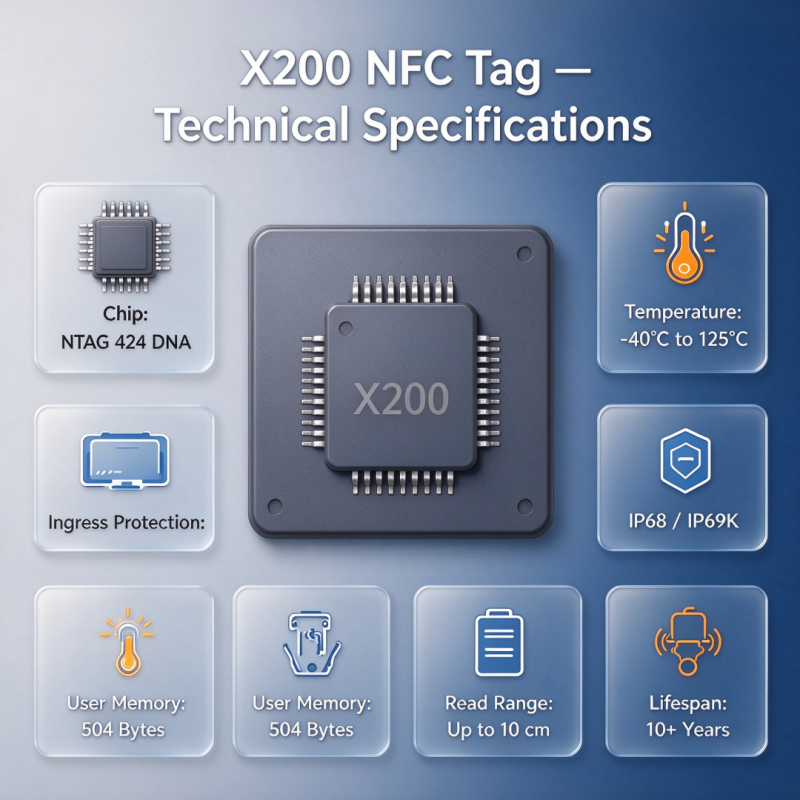
The following table summarizes the currently published X200 product configuration. Final specifications should be confirmed against the selected production configuration and corresponding test documentation.
| Parameter | Specification |
|---|---|
| Product Model | NFC Tags X200 |
| NFC Chip | NXP NTAG 424 DNA |
| Operating Frequency | 13.56 MHz |
| Communication Standard | ISO/IEC 14443-A |
| NFC Standard | NFC Forum Type 4 |
| Security | AES-128 cryptography |
| Authentication | SUN / SDM support |
| Chip Memory | 416 bytes total memory structure |
| Tag Dimensions | 25 × 25 mm (listed configuration) |
| Operating Temperature | -40°C to 125°C (listed specification) |
| Protection Rating | IP68 / IP69K (listed specification; confirm test reports) |
| Reading Distance | Up to approximately 10 cm under suitable conditions |
| Customization | Custom size, printing, encoding, and configuration subject to project requirements |
| Application | Industrial asset identification and secure tracking |
Important: The 416-byte figure refers to the NTAG 424 DNA memory organization, including its capability container, NDEF file, and protected data file. It should not be described as 416 bytes of freely writable user memory.
Actual NFC reading distance depends on the antenna design, reader or smartphone, mounting surface, and surrounding electromagnetic environment.
8. Customization Options for Industrial NFC Asset Tracking Projects
Industrial asset tracking requirements vary significantly between industries.
A tag designed for a plastic equipment housing may not be suitable for direct installation on a steel machine or an outdoor metal cabinet.
DO RFID provides customized RFID and NFC manufacturing solutions, allowing product configurations to be evaluated according to specific application requirements.
Potential customization options include:
Custom Dimensions and Antenna Design
Tag dimensions and antenna geometry can be evaluated according to available installation space and required reading performance.
For metal-mounted applications, an appropriate ferrite layer or specialized antenna construction may be necessary.
Surface Printing and Identification
The tag surface can be configured with relevant visual information, depending on the selected construction.
Possible options include:
- Company logos.
- Asset identification numbers.
- Serial numbers.
- QR codes.
- Barcodes.
- Warning or inspection labels.
Combining NFC with visual identification provides an alternative identification method when electronic reading is unavailable.
Pre-Programming and Secure Personalization
Tags can be prepared according to project-specific encoding requirements.
Depending on the selected configuration, this may include:
- Unique asset identifiers.
- NDEF records.
- Dynamic URL configuration.
- Cryptographic key personalization.
- Serial number association.
- Batch-level encoding records.
For NTAG 424 DNA applications, secure key provisioning and backend verification should be planned before mass production.
Mounting and Material Selection
The choice of adhesive, substrate, housing, and protective materials should be based on the target installation environment.
For demanding applications, sample evaluation and environmental testing are recommended before confirming a large production order.
9. How to Choose the Right Industrial NFC Tag for Your Project
Selecting an industrial NFC tag involves more than comparing chip models or advertised protection ratings.
Before placing an order, purchasing teams and engineers should evaluate the following factors.
1. Environmental Conditions
Identify the operating temperature range, humidity, chemical exposure, UV exposure, washing procedures, and expected mechanical stress.
2. Installation Surface
Determine whether the tag will be installed on metal, plastic, glass, painted surfaces, or curved equipment housings.
Metal surfaces require particular attention because they can detune conventional NFC antennas and reduce reading performance.
3. Security Requirements
Decide whether basic identification is sufficient or whether cryptographic authentication, protected data access, and dynamic verification are required.
NTAG 424 DNA is particularly relevant when asset identity verification is a priority.
4. Reading Method
Consider whether employees will use smartphones, handheld NFC readers, or fixed industrial equipment.
The actual reader and antenna combination should be tested with the finished tag.
5. Integration Requirements
Determine how the tag will connect with the organization’s ERP, CMMS, inventory platform, or custom asset management software.
6. Long-Term Reliability
Evaluate attachment strength, material aging, environmental test reports, batch consistency, and replacement procedures.
A practical pilot deployment is often the best way to validate the complete solution before scaling it across an entire facility.
10. Why Work with DO RFID for Industrial NFC Solutions?
Choosing an industrial NFC supplier involves more than selecting a chip from a datasheet.
The finished product must match the actual installation environment, reading requirements, and system architecture.
DO RFID specializes in RFID tags, NFC products, readers, and customized identification solutions.
Its manufacturing and customization capabilities support projects involving industrial identification, logistics management, asset tracking, and other RFID/NFC applications.
For customers evaluating NFC Tags X200, the project discussion can focus on:
- Selecting the appropriate tag construction.
- Evaluating antenna and installation requirements.
- Customizing dimensions and printing.
- Planning secure chip personalization.
- Preparing samples for application testing.
- Supporting project-specific product development.
Rather than assuming one tag configuration fits every industrial environment, customers can discuss the actual application conditions before finalizing the product specification.
Explore more NFC products and identification solutions or browse our NFC tag product range.
Frequently Asked Questions About NFC Tags X200
1. What is the main advantage of NFC Tags X200?
X200 combines NXP NTAG 424 DNA security capabilities with an industrial-oriented tag construction. It is designed for applications requiring secure asset identification and environmental protection.
2. What makes NTAG 424 DNA different from standard NFC chips?
NTAG 424 DNA supports AES-128 cryptography, SUN authentication, mutual authentication, and protected data access. These features provide stronger protection against unauthorized copying and manipulation than basic static-data NFC tags.
3. Can NFC Tags X200 be used outdoors?
The X200 product specification lists IP68/IP69K protection and a temperature range of -40°C to 125°C. Outdoor suitability should be confirmed using the finished product’s test documentation and the specific installation conditions, including UV exposure, moisture, and temperature cycling.
4. Can X200 be installed directly on metal surfaces?
Metal can interfere with NFC antenna performance. A suitable anti-metal structure or customized antenna design may be required. The finished tag should be tested on the actual equipment surface before deployment.
5. Can smartphones read NFC Tags X200?
Yes. NTAG 424 DNA supports NFC Forum Type 4 and ISO/IEC 14443-A communication. Compatible NFC-enabled smartphones can interact with the tag. Secure verification requires the appropriate backend configuration.
6. Does NTAG 424 DNA prevent NFC tag cloning?
Its AES-128 cryptography and SUN/SDM authentication features make simple copying of static tag data insufficient for successful authentication. However, overall security depends on proper key management, backend verification, and system implementation.
7. Can X200 store equipment maintenance records?
The tag can provide an identifier or secure link to a digital asset record. For extensive maintenance histories, it is generally better to store the information in a connected database rather than attempting to write the entire history into the NFC chip.
8. Can DO RFID customize X200 for different industrial applications?
Customization requirements can be discussed according to project needs, including dimensions, antenna configuration, surface printing, encoding, and protective construction. The final available options should be confirmed with the engineering team.
9. Is NFC better than UHF RFID for asset tracking?
Neither technology is universally better. NFC is particularly suitable for individual asset interaction, secure verification, and smartphone-based inspection. UHF RFID is generally better for long-range identification and bulk inventory operations.
10. How can I request samples or a quotation for NFC Tags X200?
Contact DO RFID with your required quantity, installation surface, environmental conditions, security requirements, and intended reader type.
The technical team can help evaluate a suitable configuration and discuss sample testing before mass production.
Conclusion: Build a More Secure and Reliable Industrial Asset Tracking System
Industrial asset tracking requires more than attaching an identification label to a piece of equipment.
Tags must withstand their operating environments, provide dependable identification, and connect physical assets with accurate digital information.
NFC Tags X200 combine NXP NTAG 424 DNA security capabilities with an industrial-oriented product design to address these requirements.
With AES-128 cryptography, SUN authentication, and a customizable tag construction, X200 offers a practical option for organizations looking to improve secure asset identification, equipment inspections, maintenance workflows, and industrial traceability.
For businesses operating in manufacturing, logistics, utilities, healthcare, and field services, selecting the right NFC tag is an important step toward building a more connected asset management system.
Looking for a customized NFC Tags X200 solution?
Website: https://www.dorfidreader.com/

Au is an RFID and NFC manufacturer based in Shenzhen, China, with over 10 years of experience.