
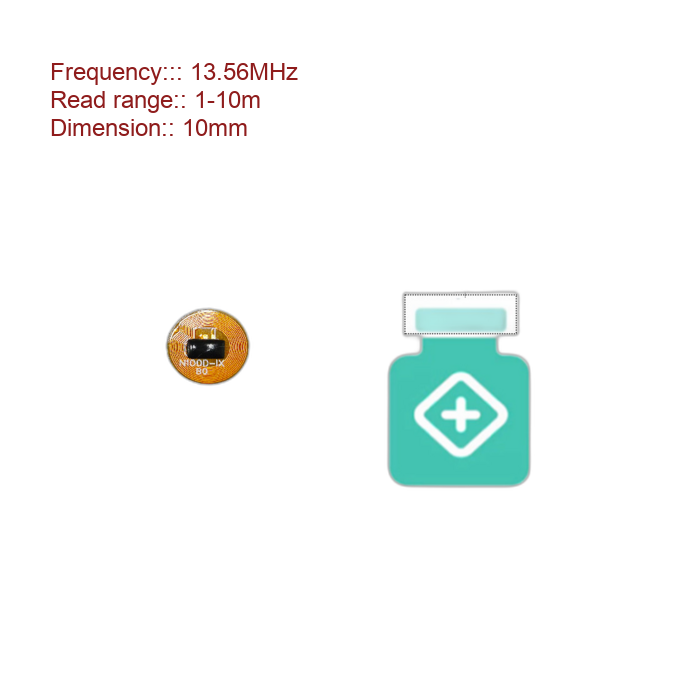
As the Internet of Things (IoT), smart manufacturing, wearable electronics, and industrial automation continue to evolve, RFID and NFC technologies are becoming increasingly smaller, smarter, and more durable. Traditional RFID labels are often too large or too fragile for compact electronic devices, medical equipment, metal components, and high-temperature manufacturing processes. This has created a growing demand for miniature, flexible, and heat-resistant RFID tags.
One of the most innovative solutions is the 10mm NFC FPC RFID Tag 13.56MHz N215 High Temperature Resistant. Combining an ultra-small footprint, flexible printed circuit (FPC) technology, and the popular NTAG215 (N215) NFC chip, this RFID tag offers excellent performance in applications where conventional paper or PET NFC labels cannot operate reliably.
Its compact size, flexible construction, strong durability, and compatibility with NFC-enabled smartphones make it an ideal choice for manufacturers, system integrators, OEMs, and IoT solution providers.
This guide explains what a 10mm NFC FPC RFID Tag is, how it works, its technical specifications, key advantages, problems it solves, application scenarios, and how it compares with competing RFID technologies.
What Is a 10mm NFC FPC RFID Tag 13.56MHz N215 High Temperature Resistant?
A 10mm NFC FPC RFID Tag is an ultra-miniature passive NFC tag built on a Flexible Printed Circuit (FPC) substrate instead of traditional paper or PET materials.
The tag integrates:
- 13.56 MHz NFC antenna
- NTAG215 RFID chip
- Flexible copper circuit
- Heat-resistant adhesive
- Protective coating
Unlike standard NFC stickers, the FPC structure allows the antenna to bend without breaking while maintaining excellent electrical performance.
With a diameter or width of only approximately 10 mm, the tag can fit inside products where space is extremely limited.
Because it uses the NTAG215 chip, it is compatible with nearly all NFC-enabled Android smartphones and most modern NFC devices.
Product Overview
The 10mm NFC FPC Small Tag from a do RFID reader manufacturer is a compact, high-temperature-resistant RFID solution designed for space-constrained industrial and commercial deployments. Operating at 13.56 MHz and built around the NTAG216 chip, this tag delivers reliable contactless data transmission with 888 bytes of user-accessible memory. Its small footprint, combined with compatibility with injection molding, makes it suitable for integration into products, labels, and enclosures where standard tags cannot fit. System integrators and project contractors choose this tag when they need a durable, heat-resistant NFC component for automated workflows, product authentication, and smart pairing applications.
Key Features
- Compact 10mm diameter form factor for embedding into tight spaces
- High temperature resistance: 200°C for 2 hours, 260°C for 10–30 seconds
- NTAG216 chip with 924 bytes total memory, 888 bytes user Read/Write area
- 7-byte serial number with UID ASCII mirror for automatic NDEF serialization
- Automatic NFC counter triggered on read command with ASCII mirror
- ECC-based originality signature for anti-counterfeiting verification
- Field programmable read-only locking per page and per double-page blocks
- Configurable password protection with optional failed attempt limit
- Anti-tearing support for capability container and lock bits
- Data retention of 10 years and write endurance of 100,000 cycles
- True anti-collision handling for multi-tag environments
- Compliant with ISO/IEC 14443-3 standard
Technical Specifications
| Product Model | DO-NFC10 |
| Size (Diameter) | 10 mm |
| Thickness | 0.05–0.07 mm |
| Operating Frequency | 13.56 MHz |
| Protocol Standard | ISO/IEC 14443A |
| Chip Type | NTAG216 |
| Data Transfer Rate | 106 kbit/s |
| Data Integrity | 16-bit CRC, parity, bit coding, bit counting |
| Memory | 924 bytes organized in 231 pages, 4 bytes per page |
| User Memory | 888 bytes (222 pages) |
| Temperature Resistance | 200°C for 2 hours / 260°C for 10–30 seconds |
| Operating Temperature | −30°C to +85°C |
| Reading Distance | 1–10 cm (reader and environment dependent) |
| Data Retention | 10 years |
| Write Endurance | 100,000 cycles |
| Certifications | ROHS, REACH, CE |
| FOB Port | Shenzhen |
| Payment Terms | T/T |
What Is the NTAG215 (N215) Chip?
The NTAG215 is one of the most widely used NFC chips in the high-frequency RFID market.
Operating frequency:
13.56 MHz
Standard:
- ISO/IEC 14443 Type A
- NFC Forum Type 2 Tag
Typical features include:
- 504 Bytes usable memory
- Unique UID
- Password protection
- Fast read/write speed
- Smartphone compatibility
- Passive operation (no battery required)
The chip stores URLs, serial numbers, product information, authentication data, or custom application data.
Its popularity comes from its excellent balance between cost, compatibility, and performance.
How Does the 10mm NFC FPC RFID Tag Work?
Like all passive NFC tags, the 10mm FPC RFID tag operates without an internal power source.
Step 1: Reader Generates an RF Field
An NFC reader or smartphone creates a 13.56 MHz electromagnetic field.
Step 2: Electromagnetic Induction
The copper antenna inside the FPC tag captures energy from the RF field.
This harvested energy powers the NTAG215 chip.
Step 3: Chip Activation
Once powered, the chip wakes up and exchanges data with the reader.
The communication process occurs wirelessly within milliseconds.
Step 4: Data Transmission
Depending on system programming, the tag may transmit:
- Product ID
- URL
- Authentication code
- Asset number
- Device information
- Configuration parameters
- Manufacturing data
Because communication follows international NFC standards, smartphones can read the information directly without additional batteries or wiring.
Technical Specifications
Typical specifications include:
| Feature | Specification |
|---|---|
| Chip | NTAG215 |
| Frequency | 13.56 MHz |
| Standard | ISO14443A |
| Protocol | NFC Forum Type 2 |
| Memory | 504 Bytes |
| Size | 10 mm |
| Material | Flexible Printed Circuit (FPC) |
| Reading Distance | 5–30 mm (depending on reader) |
| Operating Temperature | -40°C to +105°C (varies by model) |
| Waterproof | Optional |
| Adhesive | High-temperature industrial adhesive |
| Read/Write Cycles | 100,000+ |
| Data Retention | Up to 10 years |
These specifications make the tag suitable for industrial-grade applications where conventional NFC labels may fail.
Why Choose an FPC RFID Tag Instead of a PET NFC Sticker?
The substrate material significantly affects RFID performance and durability.
Traditional PET NFC Labels
Advantages:
- Low cost
- Easy printing
- Suitable for disposable applications
Limitations:
- Poor heat resistance
- Easily damaged by bending
- Lower mechanical strength
- Limited industrial applications
Flexible Printed Circuit (FPC)
Advantages:
- Excellent flexibility
- Superior durability
- Better signal stability
- Heat resistance
- Compact antenna design
- Longer service life
These characteristics make FPC tags ideal for demanding environments.
Key Features of the 10mm NFC FPC RFID Tag
Ultra-Small Size
At only about 10 mm, the tag fits into:
- Smart watches
- Earbuds
- Medical instruments
- Electronic components
- Small plastic housings
- Jewelry
- Industrial sensors
Miniaturization enables product designers to integrate NFC into devices without sacrificing aesthetics.
High Temperature Resistance
One of the biggest advantages is heat resistance.
Many industrial production processes involve temperatures that exceed the tolerance of ordinary NFC stickers.
High-temperature FPC tags can survive applications such as:
- Injection molding
- Plastic overmolding
- Industrial assembly
- Electronic manufacturing
- Automotive production
- Sterilization processes
This significantly expands deployment possibilities.
Flexible Structure
Unlike rigid PCB antennas, FPC antennas can bend and conform to curved surfaces.
Applications include:
- Medical devices
- Wearables
- Cylindrical products
- Plastic housings
- Curved equipment
The flexible structure also improves installation reliability.
Smartphone Compatibility
Because the tag follows NFC Forum standards, users can read it directly using NFC-enabled smartphones.
Typical interactions include:
- Opening websites
- Product authentication
- Device pairing
- Accessing manuals
- Warranty registration
- Digital marketing
No dedicated RFID reader is required.
Passive Operation
The tag contains no battery.
Advantages include:
- Maintenance-free
- Unlimited standby time
- Small size
- Low cost
- High reliability
This makes passive NFC ideal for long-term deployment.
Problems This RFID Tag Solves
Problem 1: Limited Installation Space
Many electronic devices leave very little room for RFID labels.
The 10 mm form factor allows installation where larger tags simply cannot fit.
Typical examples include:
- Bluetooth earbuds
- Smart rings
- Miniature sensors
- Medical instruments
- Consumer electronics
Problem 2: High Manufacturing Temperatures
Paper labels and PET stickers often fail during high-temperature processing.
FPC construction withstands much higher temperatures, enabling direct integration into production lines.
Problem 3: Fragile NFC Labels
Repeated bending or vibration can damage conventional antennas.
Flexible copper circuits dramatically improve mechanical durability.
Problem 4: Product Authentication
Manufacturers increasingly fight counterfeit products.
Each NTAG215 chip contains a unique UID that enables:
- Product verification
- Anti-counterfeiting
- Digital certificates
- Warranty activation
Consumers simply tap the product with their smartphone to verify authenticity.
Problem 5: Digital Product Information
Traditional printed manuals are expensive and easily lost.
NFC tags can instantly provide:
- User manuals
- Installation videos
- Firmware downloads
- Maintenance instructions
- Product registration
- Customer support
This improves customer experience while reducing printing costs.
Industrial Applications
The DO-NFC10 tag is designed for commercial and industrial use cases that demand a small footprint and thermal resilience. Common deployment scenarios include:
- SoLoMo NFC campaigns – social-local-mobile advertising with embedded tags in print media and point-of-sale displays
- Smart advertisement NFC – interactive posters and signage that trigger digital content on tap
- Product authentication – brand protection via ECC-based originality verification, preventing counterfeiting in retail and supply chain
- Mobile companion tags – pairing accessories or consumables with smartphones via NDEF messages
- Bluetooth and Wi-Fi pairing – replacing manual setup with a single tap for device association
- Electronic shelf labels – updating pricing and product information in retail environments
- Business cards and identity tokens – sharing contact details or credentials securely
- Industrial asset tracking – attaching to small tools, components, or consumables where space is limited
Wholesale buyers and distributors supply this tag to system integrators who deploy NFC solutions across retail, logistics, healthcare, and smart building projects. Its small size and high temperature rating make it suitable for overmolding and embedding into plastic or rubber enclosures.
OEM / ODM Manufacturing Support
do rfid reader manufacturer offers full OEM and ODM customization for the DO-NFC10 tag. Buyers can request custom antenna tuning, specific chip encoding, personalized NDEF payloads, and printed branding on the tag surface. For large-scale deployments, the factory supports batch consistency across millions of units, ensuring each tag performs identically in field conditions. OEM partners receive technical documentation, sample validation support, and direct communication with the engineering team to align the tag design with the end-product requirements. Whether you need a unique UID range, custom locking configuration, or specific packaging format, the production line is configured to accommodate project-specific requirements without delaying delivery.
Factory & Production Advantages
As a do rfid reader manufacturer, the production facility is equipped for stable, high-volume manufacturing of NFC FPC tags. The factory maintains controlled processes for etching, chip bonding, lamination, and final testing. Each production batch undergoes reading distance verification, frequency calibration, and memory integrity checks before shipment. This ensures that distributors and project contractors receive tags that perform consistently from the first unit to the last. The production line supports fast lead times: samples ship within 1–7 days, and mass production orders are completed in 7–20 days depending on volume and customization complexity. For wholesale partners requiring recurring supply, the factory can reserve production capacity and coordinate inventory buffers to prevent supply gaps during peak project cycles.
Bulk Supply & Project Deployment Support
do rfid reader manufacturer serves system integrators, distributors, and commercial buyers who need reliable long-term supply for ongoing projects. Bulk purchasing is supported with tiered pricing, consolidated shipping, and flexible payment terms via T/T or trade assurance. For large-scale deployments, the factory provides pre-encoding services, custom data formatting, and compatibility validation against common NFC readers and mobile devices. Project contractors benefit from the factory’s experience in delivering tags for retail rollouts, logistics tracking programs, and smart building installations across multiple countries. The supply chain is managed to maintain batch traceability, so replacement orders match the original specifications exactly. Export documentation and compliance certifications (ROHS, REACH, CE) are provided with every shipment to streamline customs clearance for international buyers.
FAQ
Q: How can I get the DO-NFC10 price?
Send your inquiry details including quantity, customization requirements, and delivery destination. A quotation will be provided within one business day.
Q: Can you offer free samples?
Stock samples are available free of charge; the buyer pays shipping. Customized samples require a reasonable production cost, which is refunded after the order is confirmed.
Q: What is the lead time?
Samples ship in 1–7 days. Mass production takes 7–20 days depending on volume and customization.
Q: What payment methods do you accept?
T/T and Ali Trade Assurance for mass production orders. PayPal is accepted for sample payments.
Q: How do I choose the right chip?
Review the chip specifications on the product page or contact the factory with your application details. The engineering team will recommend the optimal chip for your reading distance, memory, and environmental requirements.
Q: Is the tag compatible with existing NFC readers?
Yes. The DO-NFC10 follows the ISO/IEC 14443A standard and works with standard NFC-enabled smartphones and industrial RFID readers operating at 13.56 MHz.
Q: Can I get custom encoding or data locking?
Yes. OEM and ODM orders support custom NDEF messages, UID ranges, password protection, and page locking. Specify your requirements during the inquiry stage.
Q: Do you support long-term wholesale cooperation?
Yes. The factory offers bulk pricing, production capacity reservation, and consistent batch quality for distributors and project partners requiring recurring supply.
For technical specifications, customization options, and pricing, contact do rfid reader manufacturer at info@dorfidreader.com.