September 14, 2026
Dual frequency RFID card has two chips. One card can work in 2 different frequency, such as LF(125KHz) and HF(13.56MHz), LF(125KHz) and UHF(860~960MHz), HF(13.56MHz) and UHF(860~960MHz). It is produced for meeting mixed application for customers. This card is very cost-effective. Mainly used in banks, schools, governments, and other institutions.
LF+HF:
EM4200/ TK4100/ T5577/ HITAG® + MIFARE Classic® 1K/ 4K
EM4200/ TK4100/ T5577/ HITAG® + MIFARE® Desfire® 2K/ 4K/ 8K
EM4200/ TK4100/ T5577/ HITAG® + MIFARE® Plus 2K/ 4K
Product Name | Dual frequency Chip RFID card |
Material | PVC, PET |
Size | 85.5*54*0.84mm or customized |
Surface | Glossy, Matte, Frosted |
Craft | QR code, DOD barcode, Encoding, UV, Silver/Gold background |
Printing | White or Customized printing |
Chip | Any LF+HF, LF+UHF, HF+UHF chips are all available |
Frequency | LF/125KHz; HF/13.56MHz; UHF/860~960MHz |
Protocol | ISO7815; ISO 14443A; ISO18000-6C |
MOQ | 500pcs |
Sample | Free sample for testing |
Packaging Details | 200 pcs/box, 10 boxes/carton |
Lead Time | Lead Time: 6-10 working days |
TK4100 MIFARE Dual Frequency Chip RFID Card: The Complete Guide to Working Principles, Applications, Buying Tips, and Industry Insights
RFID technology has transformed modern identification, access control, attendance management, and cashless payment systems. However, many organizations still operate legacy Low Frequency (LF) systems while gradually upgrading to High Frequency (HF) infrastructure. Replacing all readers and cards at once is often expensive and disruptive.
This is where the TK4100 MIFARE Dual Frequency Chip RFID Card becomes an ideal solution. By integrating both a 125 kHz TK4100 chip and a 13.56 MHz MIFARE chip into a single PVC card, users can access two independent RFID systems with one credential. The dual-frequency design simplifies system migration, reduces costs, and improves user convenience.
Whether you are an access control integrator, hotel supplier, university administrator, or RFID distributor, understanding how dual-frequency RFID cards work will help you choose the right solution for your project.
What Is a TK4100 MIFARE Dual Frequency RFID Card?
A TK4100 MIFARE Dual Frequency RFID Card is a smart PVC card containing two independent RFID chips:
- TK4100 (125 kHz Low Frequency)
- MIFARE (13.56 MHz High Frequency)
Each chip has its own antenna and functions independently. Although both chips are embedded in the same card body, they do not interfere with each other. The card can communicate with two completely different RFID readers depending on the operating frequency.
This allows one card to support both legacy LF systems and modern HF applications, eliminating the need to carry multiple cards.
How Does a Dual Frequency RFID Card Work?
The card contains two complete RFID systems:
TK4100 Low Frequency Module (125 kHz)
The TK4100 chip is a read-only RFID chip commonly used for simple identification. When placed near a 125 kHz reader, the reader emits a low-frequency electromagnetic field that powers the chip. The chip then transmits its unique identification number back to the reader.
Typical reading distance:
- 2–10 cm
Common uses include:
- Employee attendance
- Door access
- Parking management
- Elevator access
MIFARE High Frequency Module (13.56 MHz)
The MIFARE chip communicates using ISO/IEC 14443 standards. It supports secure authentication, data storage, and multiple sectors for different applications. The reader energizes the chip, authenticates it, and exchanges encrypted data when required.
Typical reading distance:
- 2–5 cm
Common uses include:
- Campus cards
- Hotel key cards
- Cashless payment
- Membership management
- Library systems
Because the two chips operate on different frequencies, they can coexist in one card without signal conflicts.
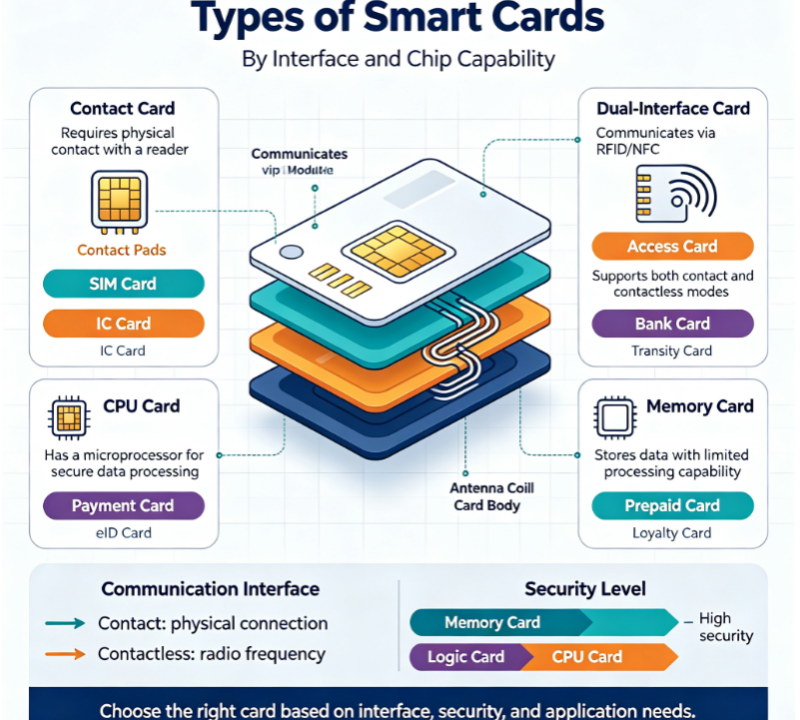
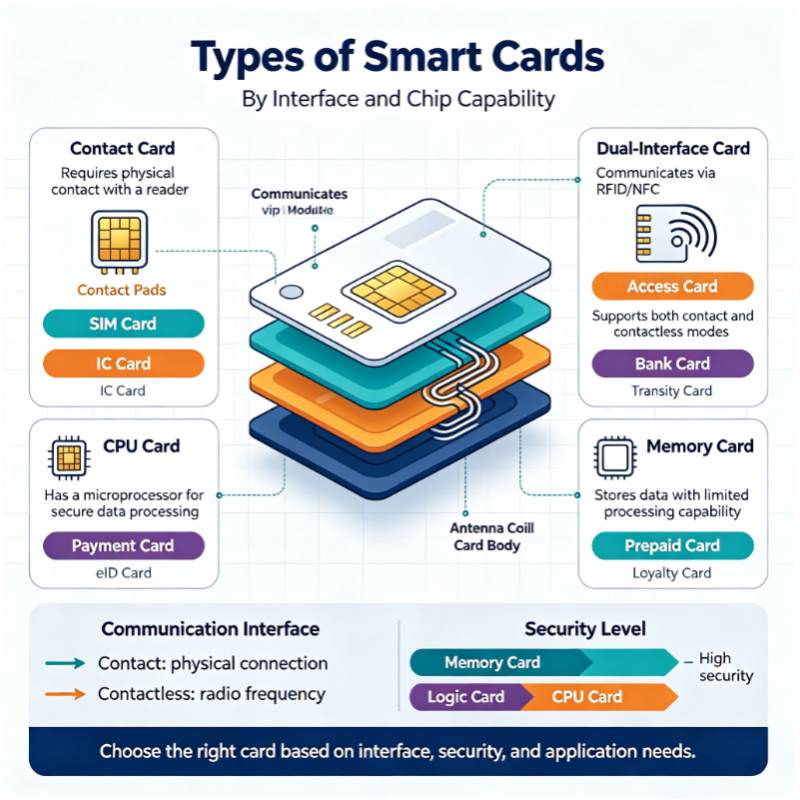
Card Structure
A standard dual-frequency card typically includes:
- Premium PVC layers
- TK4100 chip
- LF copper antenna
- MIFARE chip
- HF copper antenna
- Lamination layer
- Printable surface
- Optional magnetic stripe
- Optional signature panel
The finished card usually conforms to the ISO CR80 standard size:
- 85.6 × 54 mm
- Thickness: 0.76 mm (standard), with custom options available
Advantages of TK4100 MIFARE Dual Frequency Cards
One Card for Multiple Systems
Users no longer need separate LF and HF cards. One credential can support multiple systems, reducing inconvenience and improving operational efficiency.
Smooth System Upgrades
Many organizations migrate from 125 kHz systems to 13.56 MHz systems in stages. Dual-frequency cards allow both infrastructures to operate simultaneously during the transition.
Lower Hardware Replacement Costs
Instead of replacing every reader immediately, organizations can upgrade gradually while continuing to use existing LF devices.
Better User Experience
Employees, students, residents, and hotel guests only need to carry one card for multiple applications.
Flexible Customization
Chinese manufacturers can customize:
- UID numbering
- Chip encoding
- Variable QR codes
- Barcodes
- Photo ID printing
- Laser engraving
- Magnetic stripes
- Signature panels
- Holograms
- OEM branding
Typical Application Scenarios
Corporate Access Control
Many office buildings still use 125 kHz readers at entrances while newer facilities use MIFARE readers for secure access. A dual-frequency card works seamlessly across both systems.
Universities
A single card can provide:
- Classroom access
- Dormitory entry
- Library borrowing
- Student attendance
- Cafeteria payments
- Printing services
Hotels
Hotels often combine:
- Elevator access
- Guest room entry
- Spa membership
- Swimming pool access
- Restaurant payments
Dual-frequency cards simplify these services.
Residential Communities
Residents can use one card for:
- Main entrance gates
- Parking barriers
- Elevators
- Clubhouse facilities
- Visitor management
Factories
Manufacturing facilities commonly integrate:
- Employee attendance
- Workshop access
- Cafeteria payments
- Tool management
- Parking systems
Healthcare Facilities
Hospitals use dual-frequency cards for:
- Staff identification
- Department access
- Medical record authentication
- Time attendance
Problems Dual Frequency Cards Solve
Organizations often face compatibility issues when different departments use different RFID technologies. Dual-frequency cards address these challenges by:
- Eliminating the need for multiple cards
- Supporting legacy and modern systems simultaneously
- Reducing replacement costs during upgrades
- Simplifying user management
- Improving operational efficiency
- Minimizing training requirements for staff
- Lowering the risk of users carrying the wrong credential
Dual Frequency Card vs Single Frequency Card
| Feature | Dual Frequency Card | Single Frequency Card |
|---|---|---|
| Number of Chips | Two | One |
| Reader Compatibility | LF + HF | LF or HF only |
| Upgrade Flexibility | Excellent | Limited |
| Cost | Higher | Lower |
| Convenience | Excellent | Moderate |
| Multi-System Support | Yes | No |
| Future Expansion | Easy | Limited |
For organizations managing mixed RFID environments, the dual-frequency card offers greater long-term value despite its higher initial cost.
TK4100 vs Other RFID Chips
| Chip | Frequency | Read/Write | Security | Typical Use |
| TK4100 | 125 kHz | Read Only | Basic | Access control |
| EM4200 | 125 kHz | Read Only | Basic | Legacy systems |
| T5577 | 125 kHz | Read/Write | Medium | Custom applications |
| MIFARE Classic 1K | 13.56 MHz | Read/Write | Medium | Campus and hotel cards |
| MIFARE DESFire EV3 | 13.56 MHz | Read/Write | Very High | Banking, transportation, government IDs |
| NTAG213 | 13.56 MHz | Read/Write | Good | NFC marketing |
If your application requires encrypted transactions or high-security authentication, MIFARE DESFire is generally a better choice than MIFARE Classic. For simple identification, TK4100 remains a cost-effective solution.
Manufacturing Process
Professional RFID card manufacturers typically follow these steps:
- Source genuine RFID chips.
- Produce and test LF and HF antennas.
- Embed both chips into the card structure.
- Laminate multiple PVC layers under heat and pressure.
- Cut cards to ISO dimensions.
- Print graphics using offset, digital, or UV printing.
- Personalize cards with serial numbers, QR codes, or photos.
- Encode chip data if required.
- Perform quality and frequency testing.
- Package cards according to customer specifications.
Strict quality control ensures both chips operate independently and reliably before shipment.
Personalization Options
Modern RFID factories can provide:
- Full-color printing
- Company logos
- Employee photos
- Variable data printing
- Laser engraving
- QR codes
- Barcodes
- Signature panels
- Magnetic stripes
- UV printing
- Holographic security labels
- UID printing
- Chip pre-encoding
- OEM and private-label packaging
These options allow organizations to create cards that meet both branding and security requirements.
Purchasing Guide
Choosing the right dual-frequency RFID card involves more than selecting a chip combination. Consider the following factors:
Confirm Reader Compatibility
Verify that your existing LF and HF readers support the intended chip types. Not all 13.56 MHz readers are compatible with every MIFARE variant.
Select the Appropriate MIFARE Chip
- MIFARE Classic: Suitable for standard access control and campus systems.
- MIFARE DESFire EV2/EV3: Recommended for applications requiring advanced encryption and high security.
- NTAG Series: Best for NFC marketing and smartphone interaction.
Check Card Material
PVC is the most common choice, while PETG and ABS offer enhanced durability for demanding environments. Eco-friendly recycled materials are also available for sustainability-focused projects.
Ask About Encoding Services
Many projects require cards to be pre-programmed with IDs, sector keys, or application data before delivery. Confirm whether the supplier can provide these services.
Evaluate Manufacturing Capabilities
Choose a manufacturer with:
- ISO 9001 quality management
- RoHS and REACH compliance
- Automated production lines
- Reliable chip sourcing
- Experience with international OEM projects
Wholesale Pricing
Pricing depends on chip configuration, printing requirements, and order quantity.
| Quantity | Estimated Factory Price (USD/Card) |
| 100 pcs | $1.20–$2.50 |
| 500 pcs | $0.90–$1.80 |
| 1,000 pcs | $0.75–$1.50 |
| 5,000 pcs | $0.60–$1.20 |
| 10,000+ pcs | $0.50–$1.00 |
Cards using higher-security MIFARE DESFire chips generally cost more than those using MIFARE Classic.
My Practical Sourcing Experience
After working with RFID manufacturing projects, several patterns consistently emerge:
- Buyers often focus only on price and overlook reader compatibility, which can result in expensive integration issues.
- Genuine chips from reputable suppliers provide better consistency, longer service life, and improved reliability compared with low-cost alternatives.
- Requesting pre-encoded cards from the factory can significantly reduce installation time and minimize deployment errors.
- Ordering production samples before placing a large order is highly recommended to verify compatibility with your readers and software.
- For projects expected to expand in the future, selecting a higher-security MIFARE chip at the beginning can avoid costly upgrades later.
In most cases, investing slightly more in quality cards and experienced manufacturing partners leads to lower total ownership costs over the product lifecycle.
Future Trends
Dual-frequency RFID technology continues to evolve alongside smart buildings and digital identity systems. Emerging trends include:
- Mobile credential integration
- NFC smartphone authentication
- Cloud-based access management
- Multi-application smart campus cards
- IoT-enabled building management
- Digital identity ecosystems
- Enhanced encryption for secure transactions
As organizations modernize their infrastructure, dual-frequency cards will remain a practical bridge between legacy systems and next-generation RFID applications.
Conclusion
The TK4100 MIFARE Dual Frequency Chip RFID Card combines the reliability of 125 kHz identification with the versatility and security of 13.56 MHz technology. By supporting two independent RFID frequencies in a single card, it enables smooth system migration, reduces operational complexity, and improves the user experience.
For organizations managing mixed RFID environments, investing in high-quality dual-frequency cards from an experienced manufacturer provides a cost-effective solution that supports current needs while preparing for future technological upgrades. Whether used in offices, campuses, hotels, factories, or residential communities, these cards offer an ideal balance of compatibility, flexibility, and long-term value.