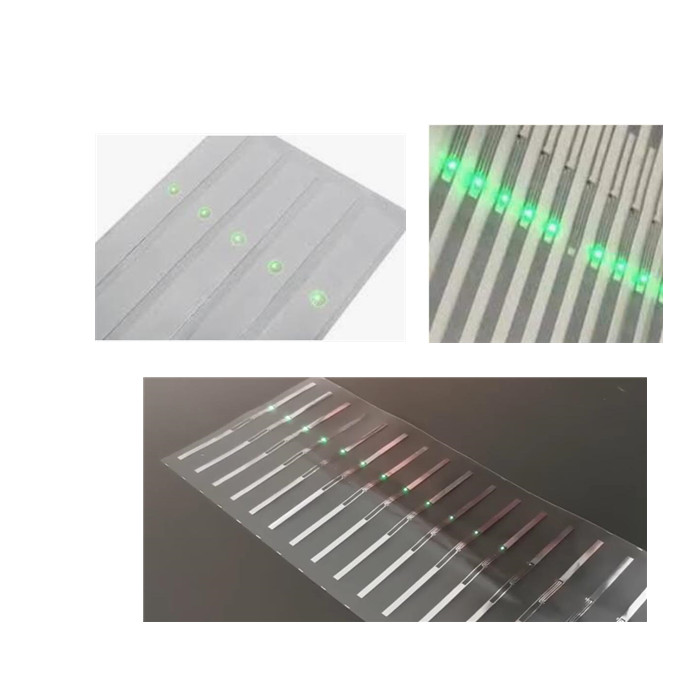
November 5, 2026
If the grid detection work is not in place, can not grasp the specific information related to power facilities in a timely manner, which for the power grid-related departments management, repair and recovery of the work is a very big impact. Therefore, it is necessary to establish a perfect power monitoring system.
Power utilities manage a large number of assets distributed across transmission lines, substations, and remote operating sites. Keeping accurate equipment records, conducting regular inspections, and accessing maintenance history can be challenging when asset information is recorded manually.
RFID (Radio Frequency Identification) technology offers a practical way to improve power equipment identification, inspection data collection, and asset management. By attaching RFID tags to selected equipment and using compatible RFID readers, utilities can identify assets quickly and associate them with digital maintenance records.
In power systems, RFID can support transmission tower inspection, substation equipment identification, cable asset management, and maintenance tool tracking. However, selecting the right RFID tag requires careful consideration of the installation environment, reading distance, metal interference, and system compatibility.
In this guide, we explain why RFID tags are used in power systems, how they work, and what to consider when selecting RFID tags for electrical infrastructure.
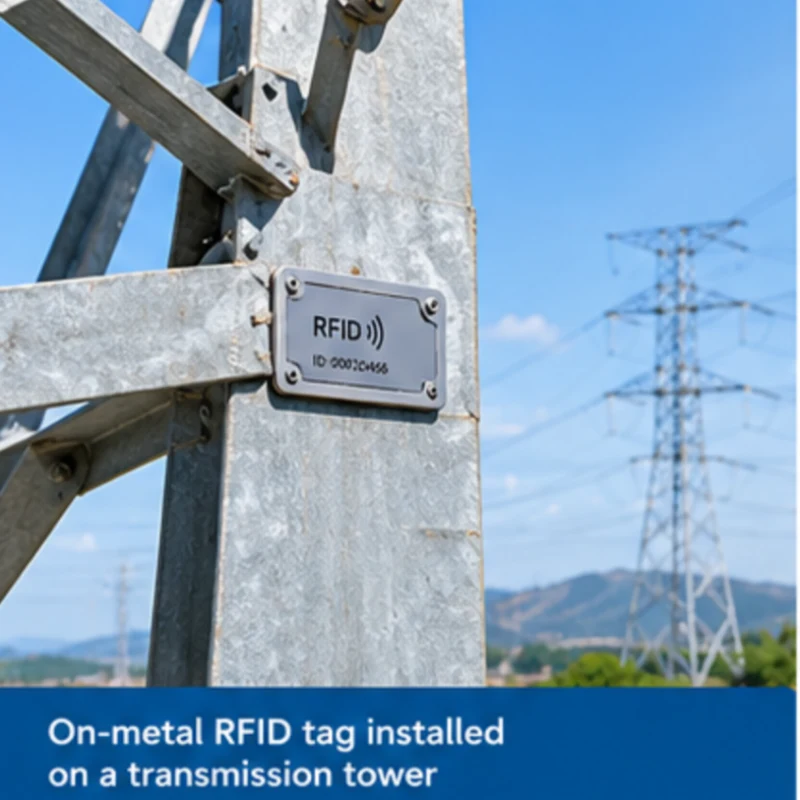
On-metal RFID tag installed on a power transmission tower
What Is RFID in Power Systems?
RFID is a wireless identification technology that uses radio waves to exchange information between an RFID reader and an RFID tag.
A typical RFID asset management system includes three main components:
- RFID tags: Attached to equipment to provide a unique identification number or store selected data.
- RFID readers: Handheld, fixed, or integrated devices used to read tag information.
- Asset management software: Associates tag IDs with equipment specifications, inspection records, maintenance history, and other business data.
When an inspector approaches a tagged asset with a compatible reader, the system can retrieve its identification information and display the associated equipment record.
For example, an RFID tag installed on a transmission tower can identify the tower within a utility’s asset database. The database may then display the tower number, installation information, previous inspections, and outstanding maintenance tasks.
The amount of information stored directly on a tag depends on its memory capacity and type. In many deployments, the tag stores only an identifier, while detailed records remain in the asset management system.
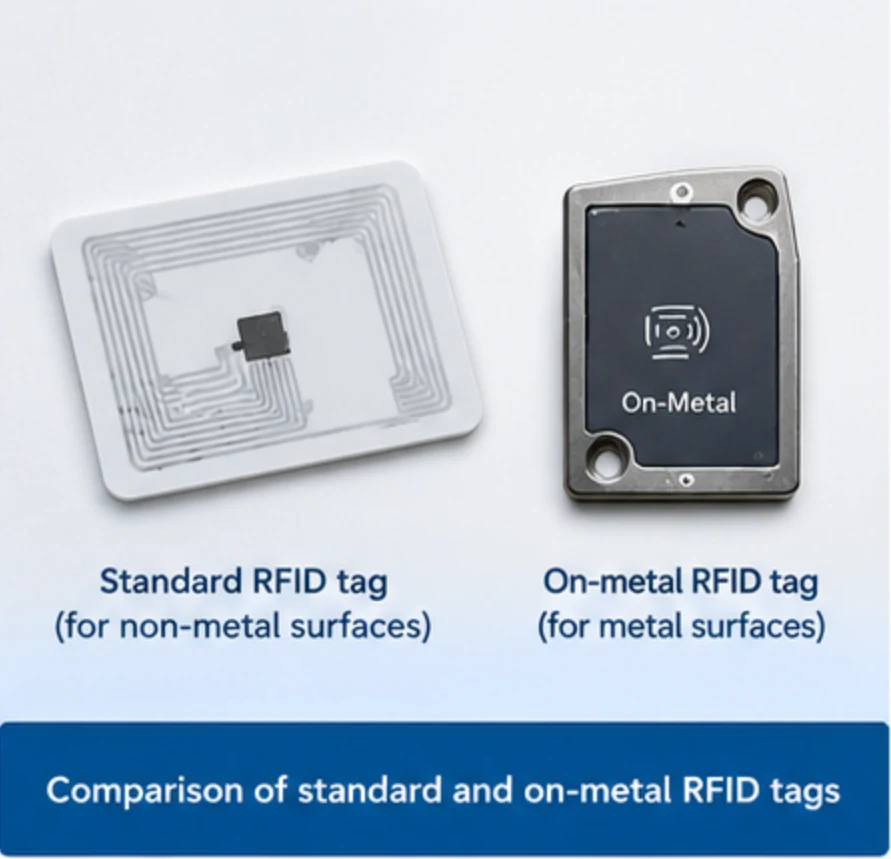
standard RFID tag vs on-metal RFID tag
Why Are RFID Tags Useful in the Power Industry?
Faster Equipment Identification
Power infrastructure includes many similar-looking assets spread across large geographic areas. Manual identification can be time-consuming, particularly when equipment labels are difficult to read or access.
RFID allows authorized personnel to identify tagged assets without requiring direct optical line-of-sight scanning. This can simplify equipment identification during routine inspections and maintenance activities.
More Accurate Inspection Records
RFID can link inspection activities to a specific equipment ID. When integrated with inspection software, the system can help personnel record inspection results against the correct asset and reduce errors associated with manual data entry.
Better Maintenance History Management
By linking RFID identifiers to a centralized database, utilities can retrieve previous inspection results, maintenance records, repair history, and planned service tasks.
This improves access to asset information and supports more consistent maintenance planning.
Improved Field Inspection Efficiency
Compatible handheld RFID readers can help inspectors identify assets in the field and collect data electronically.
When combined with mobile applications and wireless connectivity, inspection records can be synchronized with a central platform, reducing paperwork and simplifying reporting.
Support for Asset Lifecycle Management
RFID identification can be used throughout an asset’s lifecycle, from installation and commissioning to inspection, repair, replacement, and retirement.
A consistent identification system makes it easier to associate maintenance records with individual assets and maintain reliable equipment histories.
How to use RFID tag to monitor power facilities?
RFID tags This technology actually emerged in the 1980s and has been used in specific areas, such as factory automation lines, warehouse goods management, or station ticketing. But this technology is becoming more and more mature, in smaller and smaller forms, at lower and lower costs, and increasingly suitable as an information carrier.
For example, it is difficult to restore the power grid after a snowstorm, so it is difficult because at the beginning of the construction of the power grid, in order to save drug costs, and did not use RFID or related technologies, resulting in problems after the inability to accurately grasp the relevant information about the damaged towers. Therefore, the post-disaster repair plan cannot be proposed in time, which delays the repair time. The power monitoring system using RFID tag identification technology can help solve this substantial problem.
RFID tags are attached to the power tower. From the first day of tower construction to scrapping, RFID tags record all its information like an ID card, including number, completion time, daily maintenance, repair process and times. In addition, they can also record the tower’s relevant geographical location and latitude and longitude coordinates, so as to build a GPS-based power network distribution map. The helicopter with RFID terminal interrogation RFID reader can read the status information of the tower from the air, and determine whether the tower is damaged, rusted, and its detailed address. The terminal rfid reader antenna is installed in the belly of the helicopter, leading downward.
RFID vs. Barcode for Power Equipment Management
RFID electronic tag technology compared to bar code (Bacrde) technology has the following advantages.
- No light source is required, and data can even be read through external materials.
- long service life and the ability to work in harsh environments.
- readable over greater distances.
- writable, accessible data and fast write times.
- the content of the tag can be dynamically changed
- multiple tags can be handled simultaneously.
- tag data access is password protected for higher security
- Objects attached to the RFID tag can be tracked and located.
Both RFID and barcode systems can support equipment identification, but their operating methods differ.
| Feature | RFID | Barcode |
|---|---|---|
| Identification method | Radio-frequency communication | Optical scanning |
| Direct line of sight | Generally not required | Usually required |
| Reading multiple items | Possible with suitable systems | Usually scanned individually |
| Environmental considerations | Metal and RF conditions can affect performance | Label damage, dirt, and visibility can affect scanning |
| Initial system cost | Depends on tags, readers, and integration | Often lower for basic implementations |
| Suitable applications | Automated identification and selected field workflows | Simple identification and low-cost labeling |
RFID is not automatically better for every application. Barcode labels may be sufficient when assets are easily accessible and individual scanning is practical. RFID may be more appropriate when contactless identification, faster inventory operations, or integration with electronic inspection workflows provides meaningful value.
The RFID TAG reader mainly includes radio transceiver antenna, data communication and the corresponding control circuit. Electronic RFID tags mainly include radio wave receiving and transmitting circuits, power supply and data storage circuits. The equipment that performs data processing and storage is often a PC, which is generally installed with the corresponding system software and database management software.
After understanding some of the functions of RFID tags, let’s talk about the practice
Common RFID Applications in Power Systems
Transmission Tower Inspection
Transmission towers are distributed across extensive networks and often operate in remote or difficult-to-access environments.
RFID tags can be attached to suitable locations on towers to provide unique asset identification. Inspectors can use handheld readers to retrieve tower information and associate inspection results with the correct asset.
A typical implementation may include:
- A unique RFID identifier for each tower.
- Tower information and maintenance history in an asset database.
- Handheld RFID readers for field identification.
- GPS-enabled mobile devices for recording inspector or inspection-point locations.
- Inspection software for recording defects, photographs, and maintenance actions.
RFID helps identify the asset being inspected, while GPS and other data sources provide additional location and inspection context.
RFID identification alone does not automatically detect structural damage, corrosion, or deformation. These conditions require appropriate visual inspections, image analysis, sensors, or other inspection methods.
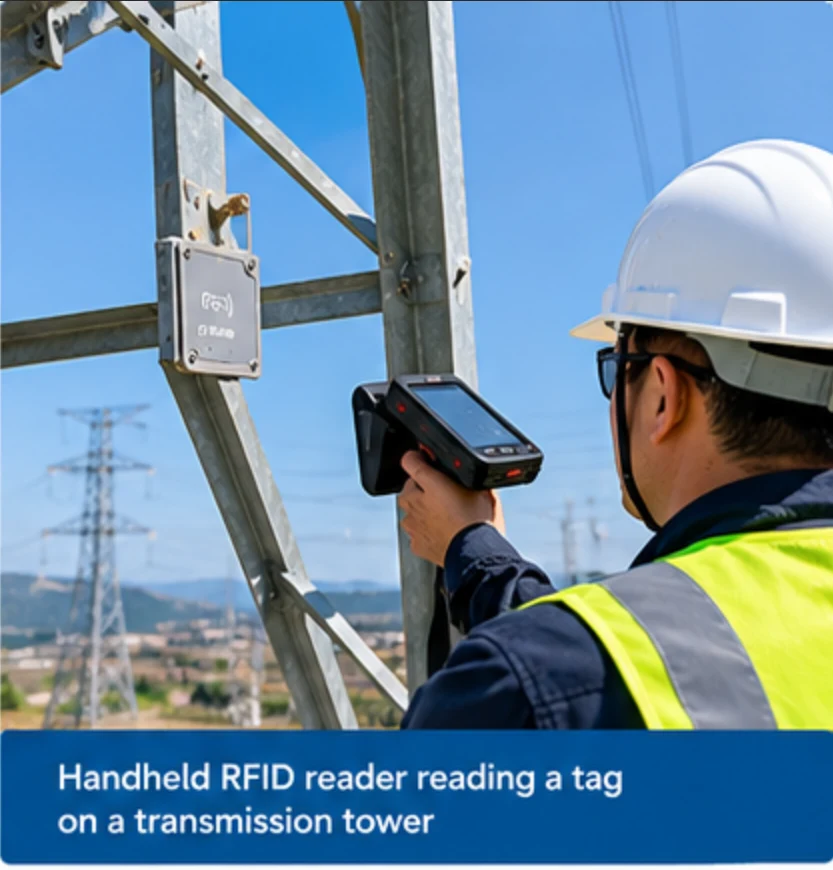
Handheld RFID reader reading a tag on a transmission tower
Substation Equipment Identification
Substations contain transformers, circuit breakers, switchgear, protection equipment, and other critical assets.
RFID can help identify individual components and associate them with equipment specifications, inspection schedules, and maintenance records.
When selecting tags for substations, engineers should evaluate electromagnetic conditions, mounting materials, required reading distance, and any restrictions imposed by electrical safety procedures.
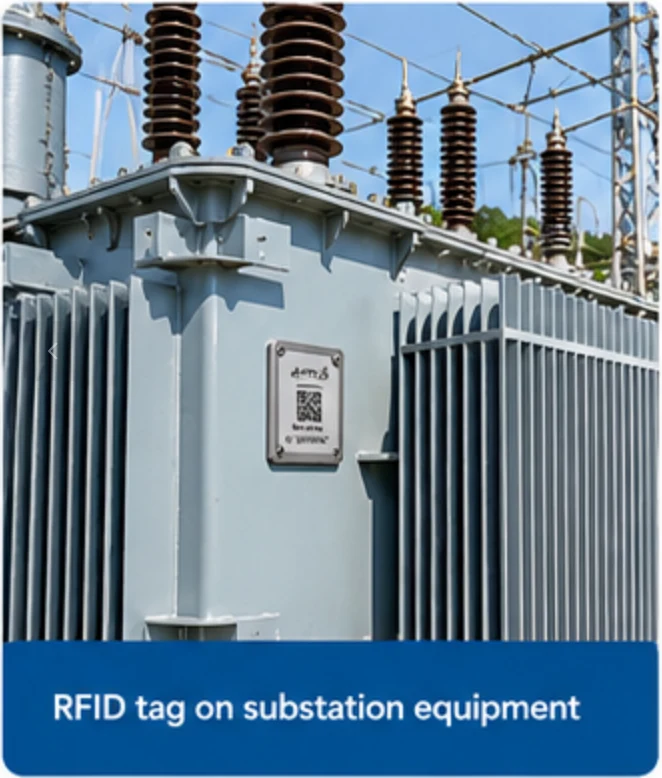
RFID tag on substation equipment
Cable and Electrical Infrastructure Identification
Electrical cables, cable joints, access points, and distribution assets may be difficult to distinguish when installed in dense or complex infrastructure.
Where appropriate, RFID tags can provide identification at accessible inspection points. This can help maintenance teams retrieve cable or component information before performing authorized maintenance work.
The tag’s location and environmental protection should be selected according to the installation conditions.
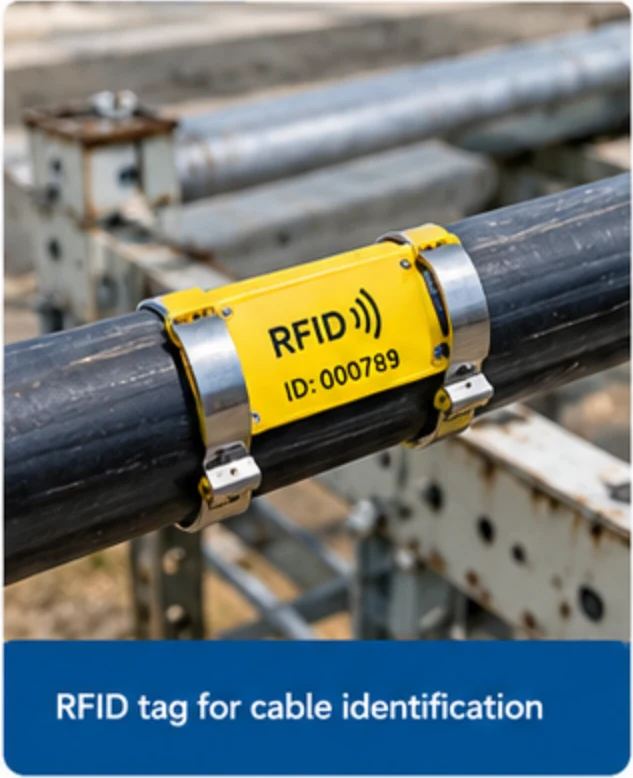
RFID tag for cable identification
Maintenance Tool and Spare Parts Tracking
RFID can also support the management of maintenance tools, testing equipment, spare parts, and other reusable assets.
Depending on the workflow, RFID readers can help identify items during check-in, check-out, inventory counting, and equipment audits.
This application can improve inventory visibility and help organizations maintain records of equipment assigned to field teams.
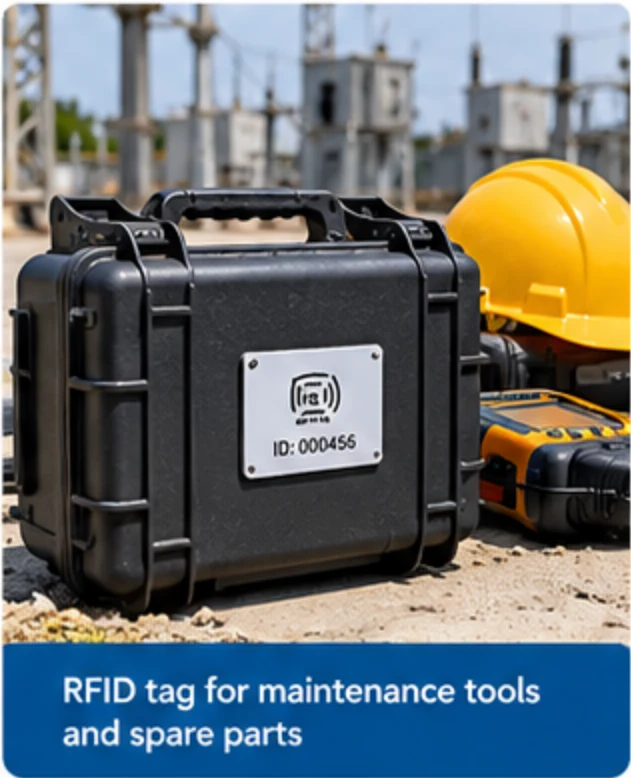
RFID tag for maintenance tools and spare parts
RFID tags in the system of practical applications.
When the tower is built, some fixed attributes of the tower are written into the RFID tag in advance, such as the completion time, the number of towers, etc. At the same time, GPS positioning equipment can be used to record the latitude and longitude information of the tower, which can also be written into the RFID tag as a fixed attribute.
After each maintenance of the tower, the staff carries a handheld reader (usually a handheld computer with embedded RFID read-write module, the composition principle is basically the same as the reader) to write the relevant maintenance information into the RFID tag, including the location of the tower’s latitude and longitude, the current situation, the existence of problems and other information. According to the GPS-based grid distribution map to view the distribution of towers, quickly determine the geographic location of the problem tower. Provide effective repair solutions for emergency repairers. Arrange helicopter patrol of towers on time.
Especially in the case of very poor land conditions after major disasters such as snowstorms, aerial monitoring is an unavoidable measure. The reader on the aircraft identifies the tower. After obtaining the specific information of the pole tower, returns the common reader to connect with the computer, transmits the read tag information to the computer management center for further processing.
In order to make the information more intuitive, we can establish the GPS-based electric power network distribution map on the management platform, integrating map visual effect, geographical information of electric power facilities and database operation. After entering the latitude and longitude information in the electronic tag into the computer, the specific geographic location of the tower is directly displayed on the distribution map through database search, and a complete monitoring system is realized with the help of on-site photos.
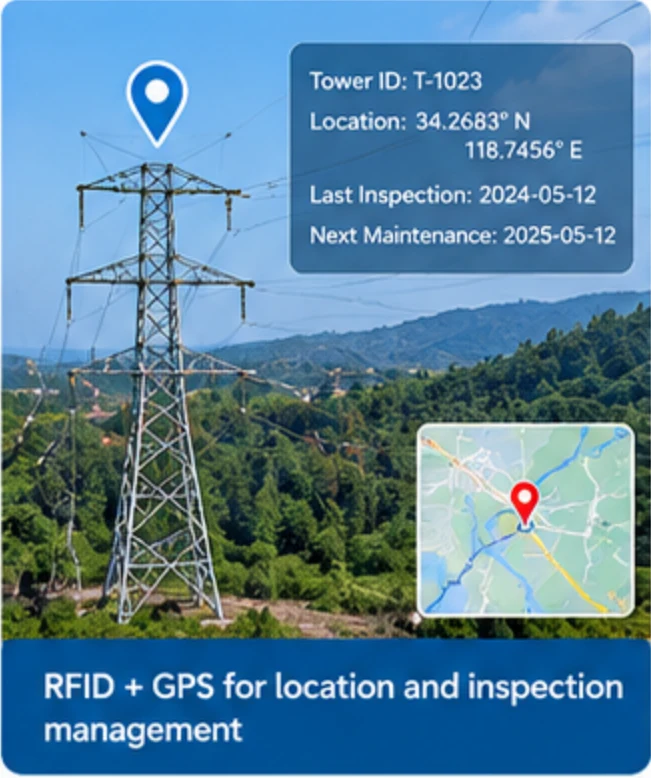
RFID and GPS for power asset inspection management
How Does an RFID-Based Power Inspection System Work?
A typical RFID-based inspection workflow includes the following steps.
Step 1: Register each asset.
Assign a unique asset ID to each transmission tower, electrical component, or other item that requires identification.
Step 2: Install and encode the RFID tags.
Select a tag suited to the installation surface and operating environment. Associate its identifier with the corresponding asset record.
Step 3: Inspect assets using compatible readers.
Field personnel use handheld or other suitable RFID readers to identify tagged equipment.
Step 4: Record inspection results.
The inspection application associates the asset ID with inspection findings, photographs, timestamps, and maintenance actions, as applicable.
Step 5: Synchronize records with the management platform.
Collected data is uploaded or synchronized with the asset database according to the system’s connectivity and offline-operation requirements.
Step 6: Review and manage maintenance tasks.
Supervisors review inspection records, prioritize corrective actions, and maintain the asset’s inspection history.
This workflow can be adapted to different utility operations and integrated with existing asset management systems.
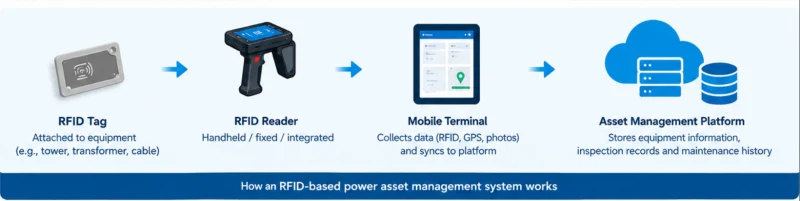
RFID asset management system workflow for power utilities
How to Choose RFID Tags for Power Equipment
The right RFID tag depends on the equipment, installation environment, reader, and intended application.
Choose the Appropriate RFID Frequency
Low Frequency (LF) is used in certain short-range identification applications where its specific operating characteristics are suitable.
High Frequency (HF) is commonly used for close-range identification and applications requiring compatible HF systems.
Ultra-High Frequency (UHF) is often considered for applications that require longer reading distances or the identification of multiple tags within a reader’s field.
The actual reading distance depends on the tag, reader, antenna, local regulations, installation conditions, and surrounding materials. No frequency guarantees a particular reading distance in every power system.
Consider On-Metal RFID Tags
Metal surfaces can detune conventional RFID antennas and affect reading performance.
For tags installed directly on steel towers, metal enclosures, or other conductive surfaces, on-metal RFID tags may be more suitable than conventional labels.
Before deployment, verify the tag’s specified mounting conditions and test its performance on the actual equipment or a representative metal surface.
Evaluate Outdoor Durability
RFID tags used on outdoor power infrastructure may be exposed to rain, sunlight, temperature changes, dust, vibration, and corrosion.
Consider the following factors:
- Operating temperature range.
- Resistance to water, dust, and ultraviolet exposure.
- Housing and mounting material.
- Mechanical strength and attachment method.
- Expected service life and maintenance requirements.
Select environmental ratings based on the actual installation conditions rather than assuming that every industrial RFID tag is suitable for outdoor use.
Check Reader and Software Compatibility
An RFID tag must be compatible with the intended reader in terms of frequency, protocol, and relevant technical requirements.
Also confirm how the reader will connect to the inspection application and asset management platform. Bluetooth, USB, Wi-Fi, cellular connectivity, and offline data synchronization may be relevant depending on the system design.
What issues do we need to address?
So what problems do we need to deal with when using rfid tags and related systems?
1, RFID tags are not uniform standards. Electronic tags are divided into high frequency, UHF and other frequency bands, there are passive and active;
2. Communication. In fact, the metal parts of the helicopter, power towers and cables will interfere with the antenna of the tag and reader to some extent, and even shield the signal, directly affecting the normal communication between the reader and the tag. In addition, the high bit error rate is also an area where RFID technology needs to be improved. These need to be further improved, but with the growing popularity of RFID tags, RFID technology will gradually solve these problems, which is the way to any new technology.
In the future electric power monitoring system, RFID electronic label’s excellent characteristics and intelligent management will help people more timely and more prepared to grasp all kinds of related information. Once the electric power facility is damaged, it will guide the correct maintenance plan and save the valuable maintenance time. Thus, the whole power grid will improve the ability to cope with various natural disasters and make the power grid stronger.
Challenges of Using RFID in Power Systems
Metal Interference
Metal surfaces can affect RFID antenna performance, particularly when a tag is not designed for metal mounting.
Potential solutions include selecting on-metal tags, following the recommended mounting method, and testing reading performance under representative conditions.
Reading Distance and Orientation
Reading performance varies with reader power, antenna design, tag orientation, polarization, nearby materials, and the installation environment.
A system intended for close-range handheld inspection may require different specifications from one designed for fixed-point inventory or remote reading.
Electrical and Environmental Conditions
Power infrastructure may expose RFID equipment to electromagnetic interference, weather, vibration, and temperature extremes.
The entire system should be evaluated under the intended operating conditions, including the reader, tag, antenna, communication link, and mounting arrangement.
Integration with Existing Systems
RFID identification creates the most value when tag IDs are consistently associated with accurate asset records.
Before deployment, define asset numbering rules, inspection data fields, user permissions, synchronization procedures, and how the RFID system will integrate with existing maintenance software.
Best Practices for RFID Deployment in Power Infrastructure
To improve reliability and avoid unnecessary implementation costs, consider the following practices:
- Define the use case first. Determine whether the primary goal is asset identification, inventory, inspection traceability, or maintenance management.
- Survey the installation environment. Identify metal surfaces, environmental exposure, mounting limitations, and reader access.
- Test representative tags and readers. Verify reading distance, orientation, and consistency before selecting equipment for large-scale deployment.
- Standardize asset records. Ensure each tag ID corresponds to the correct asset in the management database.
- Plan for installation and maintenance. Choose suitable attachment methods and account for tag inspection or replacement.
- Validate electrical safety requirements. Installation and inspection near energized equipment must follow the utility’s approved safety procedures and applicable regulations.
- Measure results after deployment. Evaluate inspection time, record completeness, identification accuracy, and maintenance workflow efficiency against a documented baseline.
Frequently Asked Questions About RFID Tags in Power Systems
What are RFID tags used for in the power industry?
RFID tags can identify transmission towers, substation equipment, cables, tools, and other assets. When integrated with suitable software, they can support inventory management, inspection records, and maintenance history tracking.
Can RFID tags be installed directly on metal power equipment?
Yes, if the tag is designed and specified for the intended metal mounting conditions. On-metal RFID tags are commonly considered for steel structures and metal enclosures. Actual performance should be validated on the installation surface.
Can RFID tags detect damage to transmission towers?
A standard RFID identification tag does not inherently detect structural damage or corrosion. It identifies an asset or provides access to associated information. Damage detection requires appropriate inspection methods or additional sensing technologies.
Can RFID replace GPS in power line inspection?
No. RFID identifies tagged assets, while GPS provides geographic location information. Combining RFID with GPS-enabled inspection devices can help associate inspection records with both an asset identity and a geographic location.
How far can an RFID reader read a tag?
Reading distance depends on the frequency, tag design, reader and antenna specifications, mounting conditions, surrounding materials, and applicable radio regulations. The required distance should be defined and tested for the intended application.
What should buyers consider when sourcing RFID tags for power systems?
Buyers should confirm the operating frequency, tag protocol, mounting surface, required reading distance, outdoor durability, memory requirements, reader compatibility, and expected service life. For metal or outdoor installations, representative testing is especially important.
Conclusion
RFID tags can help power utilities improve equipment identification, inspection traceability, and asset information management. Applications range from transmission tower inspection and substation equipment identification to cable labeling and maintenance tool tracking.
Successful implementation depends on choosing suitable tags, validating reading performance in the intended environment, and integrating RFID identification with reliable asset management processes.
For power equipment applications, start by defining the inspection workflow and installation conditions, then evaluate compatible RFID tags and readers through representative testing before expanding deployment.
Looking for RFID tags or readers for power equipment inspection? Contact an RFID supplier with your target asset type, mounting surface, required reading distance, environmental conditions, and reader specifications to identify a suitable solution.

Do RFID is a leading China-based manufacturer with over 15 years of experience. We specialize in customized RFID readers, tags, and cards, delivering high-quality, tailored solutions that meet your unique business needs and drive seamless, efficient identification.