October 21, 2026
The global laundry, hospitality, healthcare, and textile rental industries are rapidly embracing RFID technology to improve efficiency, reduce losses, and achieve real-time inventory visibility. Among the most important innovations driving this transformation is the 860-960MHz UHF Fabric Laundry Textile Washable RFID Tag.
Designed specifically for textile tracking applications, these RFID tags can withstand hundreds of industrial washing cycles while providing accurate identification and lifecycle management of linens, uniforms, garments, towels, and medical textiles. Unlike traditional barcode labels, washable RFID tags allow automated bulk reading without requiring line-of-sight scanning, significantly improving operational efficiency.
As labor costs continue to rise and inventory accuracy becomes increasingly important, UHF washable RFID tags have become an essential component of modern smart laundry management systems.
This comprehensive guide explores the features, specifications, working principles, applications, advantages, pain points solved, comparison with older technologies, and competitive analysis of 860-960MHz UHF Fabric Laundry Textile Washable RFID Tags.
What Is an 860-960MHz UHF Fabric Laundry Textile Washable RFID Tag?
An 860-960MHz UHF Fabric Laundry Textile Washable RFID Tag is a flexible RFID transponder designed to be permanently attached to textile products such as:
- Hotel linens
- Hospital bedding
- Towels
- Staff uniforms
- Workwear
- Healthcare garments
- Textile rental products
- Military uniforms
The tag contains:
- UHF RFID microchip
- Specialized textile antenna
- Protective fabric encapsulation
Operating within the global UHF frequency range of 860-960MHz, these tags provide long reading distances and high-speed identification capabilities.
Unlike disposable RFID labels, washable textile RFID tags are engineered to survive industrial laundry environments involving heat, moisture, chemicals, pressure, and repeated washing cycles.
Product Feature:
flexible washing label, especially suitable for clothing and fabric washing; install it on the linen; withstands high-temperature ironing up to 180 degrees; withstands industrial washing more than 200 times.
The label has passed the consistency Test, and the EPC and User regional write test before leaving the factory. The label has excellent reliability and performance consistency.
Products Specification:
Protocol | EPC Class1 Gen2;ISO18000-6C |
Operation frequency | 902-928MHZ(US, compatible with Chinese standard)(Or customize) |
Chip | Ucode NXP 7 |
Memory | EPC 128bit,User 32bit,Access Password 32bit |
TID | TID 96bit, TID unique ID in the world, can’t change |
Read/write performance | Can read and write(Erase time:100,000times) |
Data storage | 10 years |
Warranty | 1year or 200times washing |
Material(surface) | Flexible textile |
Weight | 1.1g/pc |
Product type | Unit |
Packing details | 4200pcs/ctn,430*210*270mm |
RoHs | Yes |
Color | White(or customized) |
SIZE | 70*10MM |


How UHF Washable RFID Tags Work
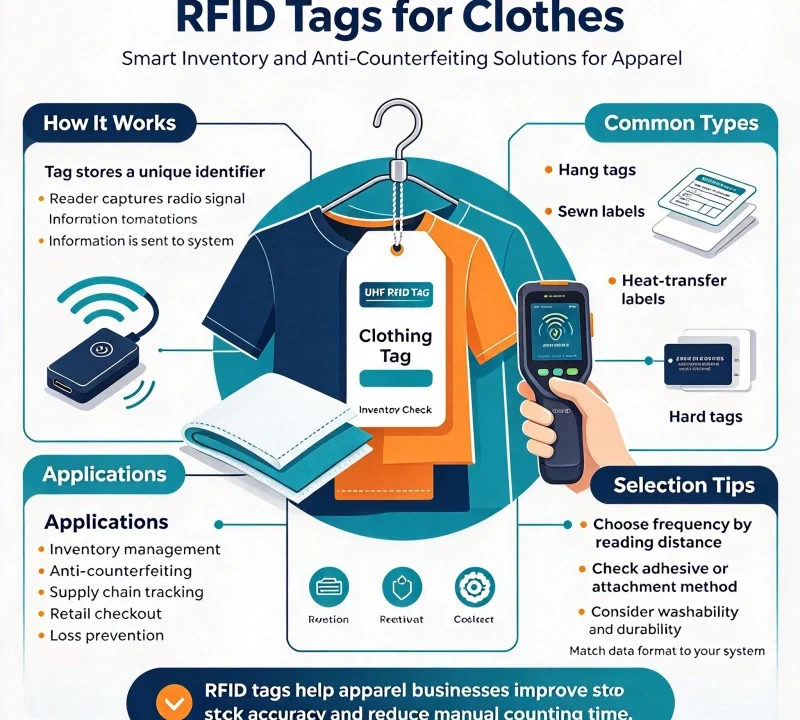
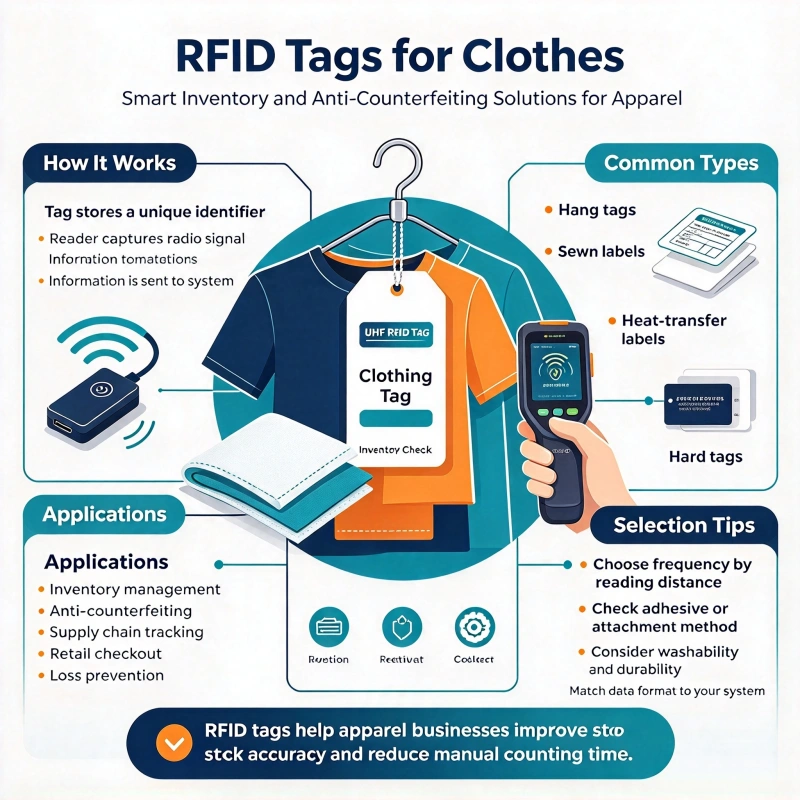
The RFID laundry tag operates through passive UHF RFID technology.
The process includes:
- An RFID reader emits radio frequency energy.
- The textile RFID tag absorbs RF energy.
- The RFID chip activates without requiring a battery.
- The chip transmits its unique identification code.
- The RFID reader captures the data.
- Information is uploaded to laundry management software.
Because passive RFID tags require no internal power source, they remain maintenance-free throughout their lifespan.
This technology enables organizations to automatically identify thousands of textile items in real time.
Why the 860-960MHz Frequency Range Is Important
The 860-960MHz UHF frequency band is globally recognized for industrial RFID applications.
Advantages include:
Longer Reading Distance
Compared with HF RFID systems, UHF technology offers significantly greater read ranges.
Faster Data Collection
Large volumes of tagged items can be identified simultaneously.
Better Automation
RFID readers can automatically process textiles without manual intervention.
Global Compatibility
The 860-960MHz range supports international RFID deployments.
This makes UHF RFID ideal for multinational hospitality chains, healthcare networks, and industrial laundry operations.
Major Pain Points Solved by Washable RFID Laundry Tags
Pain Point 1: Manual Inventory Counting
Traditional laundry management often relies on manual counting.
Problems include:
- Human error
- Slow processing
- Labor-intensive workflows
- Inaccurate inventory records
RFID technology automates counting and dramatically improves efficiency.
Pain Point 2: Linen Loss
Hotels and hospitals lose thousands of textile items annually.
Common losses include:
- Towels
- Sheets
- Uniforms
- Medical garments
RFID tracking improves accountability and reduces losses.
Pain Point 3: Lack of Visibility
Many organizations struggle to determine:
- Current inventory levels
- Garment locations
- Laundry status
- Textile utilization rates
RFID provides real-time inventory visibility.
Pain Point 4: Textile Lifecycle Management
Without tracking systems, organizations cannot accurately determine:
- Number of wash cycles
- Garment age
- Replacement schedules
RFID enables complete lifecycle monitoring.
Pain Point 5: High Labor Costs
Manual sorting and counting require significant labor resources.
RFID automation reduces workforce requirements while improving productivity.

Key Features of Fabric Laundry RFID Tags
Flexible Textile Construction
Unlike hard RFID tags, fabric RFID tags are soft and comfortable.
Benefits include:
- User comfort
- Easy garment integration
- Minimal impact on appearance
High Durability
Designed for industrial laundry environments, these tags withstand:
- Washing
- Drying
- Pressing
- Sterilization
- Chemical cleaning
Waterproof Design
Specialized encapsulation protects RFID components from moisture and detergents.
Bulk Reading Capability
Hundreds of tagged garments can be identified simultaneously.
This dramatically improves inventory efficiency.
Unique Identification
Each RFID tag contains a unique EPC code.
This enables item-level tracking throughout the garment lifecycle.
Major Applications
Hotel Linen Management
Hotels use RFID laundry tags to manage:
- Bed sheets
- Pillowcases
- Towels
- Bathrobes
- Table linens
Benefits include:
- Reduced losses
- Improved housekeeping efficiency
- Better inventory control
Hospital Textile Tracking
Healthcare facilities track:
- Patient garments
- Medical linens
- Surgical textiles
- Staff uniforms
RFID improves operational visibility and regulatory compliance.
Commercial Laundry Services
Industrial laundries process thousands of textile items daily.
RFID enables:
- Automated sorting
- Real-time inventory tracking
- Faster processing
- Improved billing accuracy
Uniform Rental Management
Uniform rental providers track:
- Employee uniforms
- Safety apparel
- Industrial workwear
- Service garments
RFID improves accountability and garment utilization.
Military Textile Management
Military organizations use RFID systems for:
- Uniform tracking
- Equipment accountability
- Inventory management
Textile Manufacturing
Manufacturers use RFID to monitor:
- Production flow
- Inventory status
- Distribution processes
Benefits of RFID Laundry Management Systems
Organizations implementing washable RFID tags achieve:
Improved Inventory Accuracy
Inventory accuracy can exceed 99%.
Faster Processing
Bulk RFID scanning dramatically reduces handling times.
Reduced Operating Costs
Automation lowers labor expenses.
Better Asset Utilization
Organizations maximize textile lifespan.
Lower Textile Replacement Costs
Improved visibility reduces unnecessary purchases.
Enhanced Customer Service
Real-time inventory information improves operational responsiveness.


Comparison with Traditional Textile Tracking Technologies
RFID vs Barcode Labels
| Feature | Barcode | RFID |
|---|---|---|
| Line-of-Sight Required | Yes | No |
| Simultaneous Reading | No | Yes |
| Read Speed | Slow | Fast |
| Durability | Moderate | Excellent |
| Automation Level | Low | High |
RFID significantly outperforms barcode systems in laundry environments.
RFID vs Manual Tracking
| Feature | Manual Tracking | RFID |
|---|---|---|
| Accuracy | Moderate | Excellent |
| Labor Requirement | High | Low |
| Speed | Slow | Fast |
| Visibility | Limited | Real-Time |
RFID transforms textile management through automation.
UHF RFID vs HF RFID Laundry Tags
| Feature | UHF RFID | HF RFID |
|---|---|---|
| Read Distance | Long | Short |
| Bulk Reading | Excellent | Moderate |
| Processing Speed | Fast | Slower |
| Large-Scale Deployment | Excellent | Good |
UHF technology is preferred for industrial laundry operations.
Competitive Analysis
Fabric RFID Tags vs NFC Textile Tags
| Feature | UHF RFID | NFC |
|---|---|---|
| Reading Distance | Long | Very Short |
| Bulk Reading | Yes | No |
| Industrial Automation | Excellent | Limited |
| Inventory Efficiency | High | Moderate |
UHF RFID is superior for large-scale textile management.
Fabric RFID Tags vs Hard Laundry RFID Tags
| Feature | Fabric RFID Tag | Hard RFID Tag |
|---|---|---|
| Flexibility | Excellent | Poor |
| Wearing Comfort | Excellent | Moderate |
| Textile Integration | Excellent | Limited |
| Appearance | Discreet | Visible |
Fabric tags are preferred for garments and linens.
RFID Tags vs QR Codes
| Feature | RFID | QR Code |
|---|---|---|
| Automatic Reading | Yes | No |
| Bulk Identification | Yes | No |
| Labor Requirements | Low | High |
| Scalability | Excellent | Moderate |
RFID provides significantly greater operational efficiency.
RFID Tags vs Bluetooth Tracking Devices
| Feature | RFID | Bluetooth |
|---|---|---|
| Cost Per Item | Low | High |
| Battery Required | No | Yes |
| Maintenance | Minimal | Regular |
| Large Inventory Tracking | Excellent | Moderate |
RFID remains the most economical solution for tracking thousands of textile assets.
Popular RFID Chip Options
Several RFID chips are commonly used in washable textile tags:
Impinj M730
- High sensitivity
- Long reading distance
- Excellent laundry performance
Impinj M750
- Enhanced memory options
- Improved security features
NXP UCODE 8
- Excellent inventory performance
- Reliable industrial operation
NXP UCODE 9
- Advanced anti-collision capabilities
- High-speed reading performance
Alien Higgs-4
- Proven performance
- Widely adopted in industrial RFID applications
Future Trends
The future of textile RFID management is closely connected to:
- Smart hospitals
- Intelligent hotels
- Industrial IoT
- Cloud-based inventory platforms
- AI-powered analytics
- Automated sorting systems
- Digital twin technology
As organizations increasingly prioritize automation and operational efficiency, RFID-enabled textile management systems will become standard across the laundry industry.
Conclusion
The 860-960MHz UHF Fabric Laundry Textile Washable RFID Tag is one of the most effective technologies available for modern textile tracking and laundry management. Designed to withstand harsh industrial washing environments while providing reliable long-range identification, these RFID tags help organizations solve critical challenges related to inventory accuracy, textile loss, labor costs, and operational visibility.
Compared with barcode labels, manual inventory methods, NFC tags, and QR code systems, UHF washable RFID tags deliver superior automation, scalability, and return on investment. Whether deployed in hotels, hospitals, commercial laundries, uniform rental services, or textile manufacturing facilities, they provide a future-proof solution for intelligent textile lifecycle management.
For organizations seeking to modernize laundry operations and improve asset visibility, the 860-960MHz UHF Fabric Laundry Textile Washable RFID Tag remains one of the most valuable investments in RFID technology today.

Do RFID is a leading China-based manufacturer with over 15 years of experience. We specialize in customized RFID readers, tags, and cards, delivering high-quality, tailored solutions that meet your unique business needs and drive seamless, efficient identification.