October 19, 2026
The UHF H3 anti-metal RFID tag is a rugged on-metal RFID tag designed for warehouse management, IT asset tracking, logistics, industrial equipment, and other applications where RFID tags need to be installed directly on metal surfaces. With an ABS housing, IP67 protection, and a UHF operating frequency of 860–960 MHz, this RFID tag provides a reliable identification solution for metal assets and equipment.
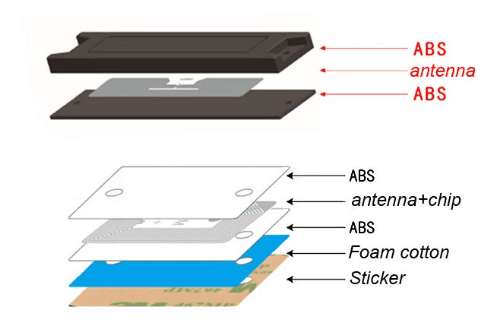
Unlike standard RFID tags, this anti-metal RFID tag is specifically designed for installation on metal objects. Its RFID chip and ferrite-based structure help reduce the detuning effect caused by metal surfaces, making it suitable for tracking servers, computer equipment, metal shelves, vehicles, construction equipment, and other assets.
The tag supports ISO 18000-6C / EPC Class 1 Gen 2 compatible UHF RFID systems and can be supplied with different RFID chips, including Alien H3, NXP U Code G2, and Impinj M4. Other chip options are available upon request.
UHF RFID tags can work in high-temperature environments, have stable performance, very suitable for IT assets requiring narrow RFID metal tags, such as computer host, switch, server chassis, aluminum strip, shelf identification, vehicle( logistic), and other asset management.
Technical Specification
– Material: ABS
– Dimension: 155mm (L) *32mm (W)* 10mm (Th)
– Protective Rating: IP67
– Frequency: ISO18000-6C 860-960MHZ
– Chips available: Alien H3 or NXP U Code G2, Impinj M4 ( Other chips available on request)
Key Features of the UHF Anti-Metal RFID Tag
This RFID anti-metal tag combines a rugged enclosure with a UHF RFID inlay designed for metal mounting. It is suitable for environments where tags may be exposed to dust, water, mechanical impact, or frequent handling.
Key product features
- Designed for direct mounting on metal surfaces
- UHF RFID frequency of 860–960 MHz
- ISO 18000-6C RFID protocol
- Alien H3, NXP U Code G2, and Impinj M4 chip options
- ABS housing for improved durability
- IP67-rated protection
- Ferrite material for anti-metal performance
- Multiple mounting options
- Suitable for screws or 3M adhesive
- Suitable for warehouse and asset management systems
- Custom RFID chip options available
The robust construction makes the tag suitable for both indoor and selected outdoor asset tracking applications.
| ● Robust ● waterproof / dust-proof | ● mounted on metal available |
| ● multi-mounting options (screwing / 3M adhesive layer) | ● RFIchips + ferrite material |
Industrial and Construction Applications
Industrial equipment and construction assets are often exposed to demanding working conditions. Tags may encounter dust, water, impacts, handling, and repeated movement.
The ABS enclosure and IP67 protection of this RFID tag provide a rugged housing for applications where a simple paper RFID label may not be appropriate.
Potential applications include:
- Construction equipment
- Electrical equipment
- Industrial machinery
- Maintenance tools
- Power inspection equipment
- Metal components
- Building service equipment
- Equipment used at construction sites
For outdoor or harsh industrial installations, the final tag performance should be evaluated under the actual environmental conditions of the project.
More Applications
● IT Asset Management ● logistics management ● power patrol inspection management
● Housing building service ● managing construction sites
When you’re mounting RFID tags on metal surfaces or metal products, you should be aware that if you use non metal mount RFID tags, your system will not function as desired as the metal will detune any passive RFID tag that is not designed to be placed on metal. Using tags that are specifically calibrated to the materials you need to track makes reading, tracking, and inventorying them easier and provides for greater read range.
Metal mount RFID tags are typically rugged, difficult to damage, and easy to weld, screw or otherwise attach.

Why Use an Anti-Metal RFID Tag?
Metal can significantly affect the performance of conventional passive RFID tags. When a standard RFID tag is attached directly to a metal surface, the metal can interfere with the tag antenna and change its electrical characteristics. This may result in shorter read distances, unstable communication, or failure to read the tag.
An on-metal RFID tag is designed specifically for this type of application. Its structure separates and protects the RFID antenna from the conductive metal surface, helping the tag maintain more stable RFID performance.
For example, a warehouse may need to identify metal shelving, server cabinets, electrical equipment, tools, or industrial machinery. Instead of trying to place a conventional label on a non-metal area, an anti-metal RFID tag can be mounted directly onto the asset.
This makes the identification process more flexible and can simplify asset registration, inventory, and tracking.
Anti-Metal RFID Tag vs. Standard RFID Tag
Choosing the correct RFID tag is particularly important when the tracked asset contains metal.
| Feature | Standard RFID Tag | Anti-Metal RFID Tag |
|---|---|---|
| Direct installation on metal | Not recommended | Designed for metal |
| Metal asset tracking | Limited | Suitable |
| Antenna structure | General RFID antenna | Anti-metal design |
| Ferrite layer | Usually not included | Included in this product |
| Warehouse shelves | Limited on metal | Suitable |
| IT equipment | Limited | Suitable |
| Metal machinery | Limited | Suitable |
| Mounting options | Usually adhesive | Screw / adhesive |
| Rugged enclosure | Depends on model | ABS housing |
| IP67 protection | Model dependent | Yes |
A standard RFID label may be suitable for cardboard boxes, plastic containers, and other non-metal products. For metal assets, however, an anti-metal RFID tag is generally the more appropriate choice.
How Does an On-Metal RFID Tag Work?
An anti-metal RFID tag uses a specially designed RFID antenna structure and a ferrite layer between the antenna and the metal surface.
When the tag is installed on a metal object, the ferrite material helps isolate the RFID antenna from the conductive surface. This allows the antenna to operate more effectively than a conventional RFID inlay directly attached to metal.
The basic RFID process remains the same:
- The RFID reader sends a UHF radio signal.
- The passive RFID tag receives energy from the reader.
- The RFID chip processes the reader’s command.
- The tag sends its stored identification data back to the reader.
- The RFID software associates the tag ID with the corresponding asset or inventory record.
This enables automated identification without requiring direct line-of-sight scanning.
RFID Warehouse Management Applications
The UHF anti-metal RFID tag is well suited to warehouse environments where many assets need to be identified quickly and repeatedly.
Metal shelving, pallets, containers, machinery, tools, and storage equipment can all create challenges for conventional RFID labels. An anti-metal tag provides a practical option for identifying these assets.
Common warehouse applications
| Application | RFID Tracking Example |
|---|---|
| Metal shelving | Shelf identification and location management |
| Warehouse equipment | Equipment registration and inspection |
| Metal containers | Container identification and movement tracking |
| Industrial tools | Tool inventory and check-in/check-out |
| Pallets | Pallet identification and logistics tracking |
| IT equipment | Server and hardware asset management |
| Machinery | Equipment identification and maintenance |
| Logistics assets | Asset movement and transfer records |
By linking each RFID tag’s unique identifier with warehouse software, companies can create a digital record for each physical asset.
IT Asset Management
One of the key applications for this RFID tag is IT asset management.
Servers, computer hosts, network switches, server chassis, racks, and other IT infrastructure commonly contain significant amounts of metal. These assets can be difficult to label with standard RFID tags.
An anti-metal RFID tag can be mounted on suitable metal surfaces and associated with an asset record in an IT asset management system.
A typical workflow may include:
- Assigning an RFID tag to an IT asset
- Recording the RFID ID in the asset database
- Installing the tag on the equipment
- Scanning assets during inventory checks
- Recording asset location and movement
- Supporting periodic audits
- Updating maintenance or service records
This can reduce the amount of manual barcode scanning required during large-scale inventory operations.
Logistics and Supply Chain Tracking
RFID is widely used to improve visibility throughout logistics operations. However, many reusable transport assets are made from or contain metal.
Examples include metal containers, equipment cases, transport racks, cages, carts, and logistics equipment.
An anti-metal RFID tag can provide a durable identification method for these reusable assets.
| Logistics Asset | Possible RFID Use |
|---|---|
| Transport containers | Asset identification |
| Metal carts | Location tracking |
| Storage cages | Inventory control |
| Reusable equipment | Return and movement management |
| Logistics racks | Warehouse location management |
| Industrial cases | Shipment and asset identification |
When RFID readers are installed at warehouse entrances, exits, workstations, or inspection points, tagged assets can be identified automatically as they pass through the reading area.
Mounting Options
The RFID tag supports multiple installation methods, helping users select the most suitable mounting solution for different assets.
Screw mounting
Screw mounting provides a mechanical attachment method for assets where a permanent and secure installation is required. It can be particularly useful for equipment, machinery, racks, and other durable assets.
3M adhesive mounting
A 3M adhesive layer can provide a faster installation method when drilling or modifying the asset is undesirable.
Before applying adhesive, the mounting surface should be clean, dry, and free of oil or dust. For outdoor or demanding applications, the selected adhesive should also be evaluated against temperature, humidity, vibration, and surface conditions.
IP67 Protection for Demanding Environments
The tag has an IP67 protection rating, making it suitable for applications where protection against dust and temporary water immersion is required under the applicable IP testing conditions.
This makes the tag more suitable for demanding environments than an exposed paper RFID label.
However, IP protection does not mean that every installation environment will have identical RFID performance. Extreme temperatures, metal structures, liquids, other RF sources, and tag orientation can all influence actual RFID read performance.
For this reason, application-specific testing is recommended for large deployments.
Available RFID Chips
The tag can be configured with different RFID chips depending on project requirements.
| Chip Option | Typical Consideration |
|---|---|
| Alien H3 | Widely used UHF RFID chip option |
| NXP U Code G2 | Suitable for UHF RFID identification applications |
| Impinj M4 | Suitable for UHF RFID asset and inventory applications |
| Other chips | Available on request |
Chip selection can depend on memory requirements, reader compatibility, application software, supply requirements, and project specifications.
If a particular RFID chip is required by an existing RFID system, customers can confirm the chip model before production.
RFID Frequency and Compatibility
This anti-metal RFID tag operates across the 860–960 MHz UHF RFID frequency range and uses the ISO 18000-6C protocol.
UHF RFID is commonly selected for warehouse and asset management because it can identify multiple tags without requiring the reader to physically contact each asset.
The actual operating frequency may be configured according to the target market and applicable regional RFID regulations.
Before deployment, the complete RFID system should be evaluated, including:
- RFID reader
- Reader antenna
- Tag orientation
- Mounting surface
- Reader output power
- Software
- Environmental conditions
- Required read zone
The tag should therefore be evaluated as part of the complete RFID system rather than as an isolated component.
RFID Tag Selection Guide
Different assets require different RFID tag designs. The following guide can help determine whether an anti-metal tag is appropriate.
| Asset Type | Recommended RFID Tag |
|---|---|
| Cardboard boxes | Standard UHF RFID label |
| Plastic containers | Standard UHF RFID tag |
| Metal shelves | Anti-metal RFID tag |
| Server cabinets | Anti-metal RFID tag |
| Metal machinery | Anti-metal RFID tag |
| Industrial tools | Anti-metal RFID tag |
| Metal logistics containers | Anti-metal RFID tag |
| Construction equipment | Rugged anti-metal RFID tag |
If the asset is primarily non-metallic, a conventional UHF RFID label may be more economical. If the tag must be attached directly to metal, an anti-metal design should generally be considered.
Benefits for RFID Warehouse Management Systems
An RFID warehouse management system can use RFID tag IDs to associate physical assets with digital records.
Compared with manual identification processes, RFID can support faster inventory operations and more automated asset identification.
Typical system architecture includes:
RFID Tag → RFID Reader → RFID Antenna → RFID Middleware → Warehouse Management Software
The RFID tag stores the unique identification information. Readers capture the tag data, while middleware and warehouse software process the information and connect it to inventory records.
For example, when a tagged asset enters a designated RFID reading zone, the system can record the asset ID and update its movement or inventory status.
Key Benefits at a Glance
| Benefit | Value for Users |
|---|---|
| On-metal design | Suitable for direct metal installation |
| ABS housing | Provides a robust tag enclosure |
| IP67 rating | Suitable for demanding environments |
| UHF technology | Supports automated RFID identification |
| Multiple chip options | Flexible system integration |
| Screw mounting | Secure mechanical installation |
| Adhesive mounting | Fast and convenient installation |
| Custom options | Supports project-specific requirements |
Frequently Asked Questions
Can this RFID tag be installed directly on metal?
Yes. The tag is specifically designed as an anti-metal or on-metal RFID tag and uses an RFID chip and ferrite material structure for metal mounting.
What frequency does the tag use?
The tag operates at 860–960 MHz and supports the ISO 18000-6C UHF RFID standard.
Which RFID chips are available?
The current product supports Alien H3, NXP U Code G2, and Impinj M4. Other RFID chip options can be discussed according to project requirements.
Is the tag waterproof?
The product has an IP67 protection rating, providing protection against dust and water under the relevant IP testing conditions.
How can the tag be mounted?
The available mounting methods include screw mounting and a 3M adhesive layer.
Can the dimensions be customized?
Customization should be confirmed according to the project requirements, including the required dimensions, RFID chip, mounting method, and application environment.
Is this tag suitable for warehouse management?
Yes. It is designed for applications including warehouse management, logistics management, IT asset management, equipment identification, and industrial asset tracking.
Can it be used on servers and network equipment?
Yes. Metal IT equipment such as server chassis, computer hosts, switches, and related infrastructure are suitable application scenarios for an anti-metal RFID tag.
Choosing the Right RFID Tag for Your Application
The best RFID tag depends on the material, environment, reading distance, installation method, and RFID system being used.
For non-metal products, a standard UHF RFID label may be sufficient. For metal assets, an anti-metal RFID tag provides a more appropriate antenna structure for direct installation.
If the application involves outdoor equipment, industrial machinery, logistics assets, or frequent handling, a rugged enclosure and suitable mounting method should also be considered.
Before placing a large production order, it is recommended to test samples on the actual assets and under the intended RFID reader configuration. This helps verify read performance, mounting reliability, and system compatibility before full deployment.
Custom UHF Anti-Metal RFID Tags
Different RFID projects may have different requirements for chip type, dimensions, mounting method, housing, and application environment.
The tag can therefore be evaluated according to the customer’s project specifications. Custom requirements may include:
- RFID chip selection
- Tag dimensions
- Mounting method
- Adhesive configuration
- Printing or identification requirements
- Application environment
- RFID reader compatibility
Providing information about the target asset, material, reader model, required reading distance, installation position, and operating environment can help determine the most suitable RFID tag configuration.
Get a Suitable RFID Tag for Your Project
The UHF H3 anti-metal RFID tag provides a practical solution for identifying and tracking metal assets in warehouses, IT environments, logistics operations, construction sites, and industrial applications.
With an ABS enclosure, IP67 protection, 860–960 MHz UHF operation, ISO 18000-6C compatibility, multiple chip options, and flexible mounting methods, the tag can be integrated into a wide range of RFID asset management systems.
For a new RFID deployment, customers can provide the asset material, tag size requirements, RFID reader model, expected reading distance, installation method, and operating environment. These details can be used to evaluate the appropriate tag configuration and arrange samples for testing.
Feel free to leave us a message.