A Practical Guide to Ultra-Compact, High-Performance NFC Solutions
As wearable technology and IoT devices continue to shrink, every millimeter matters. Smart rings, fitness bands, medical sensors, asset trackers, and connected labels all demand components that are smaller, thinner, and more power-efficient than ever before. This is where the smallest NFC tags become essential.
Tiny NFC tags enable contactless interaction, identification, and data exchange without batteries, cables, or complex user interfaces. Despite their size, these tags play a big role in usability, security, and product differentiation.
This article explains what the smallest NFC tags are, how they work, where they are used, how to select the right one, and how to integrate them effectively into wearable and IoT products.
What Are NFC Tags?
NFC (Near Field Communication) tags are small electronic components that store data and communicate wirelessly with NFC-enabled devices, such as smartphones and readers, over very short distances—typically less than 4 cm.
An NFC tag consists of:
Most NFC tags used in wearables and IoT are passive, meaning they do not contain a battery. Instead, they draw power from the electromagnetic field generated by the reader device.
Why Size Matters in Wearables and IoT
In traditional applications like cards or labels, NFC tag size is rarely a constraint. In wearables and IoT devices, size becomes critical for several reasons:
Limited internal space
Curved or irregular form factors
Lightweight requirements
Aesthetic design constraints
Comfort for continuous wear
The smallest NFC tags allow designers to add connectivity without compromising ergonomics or industrial design.
How Small Can NFC Tags Be?
Modern NFC technology has advanced to the point where functional tags can be extremely compact.
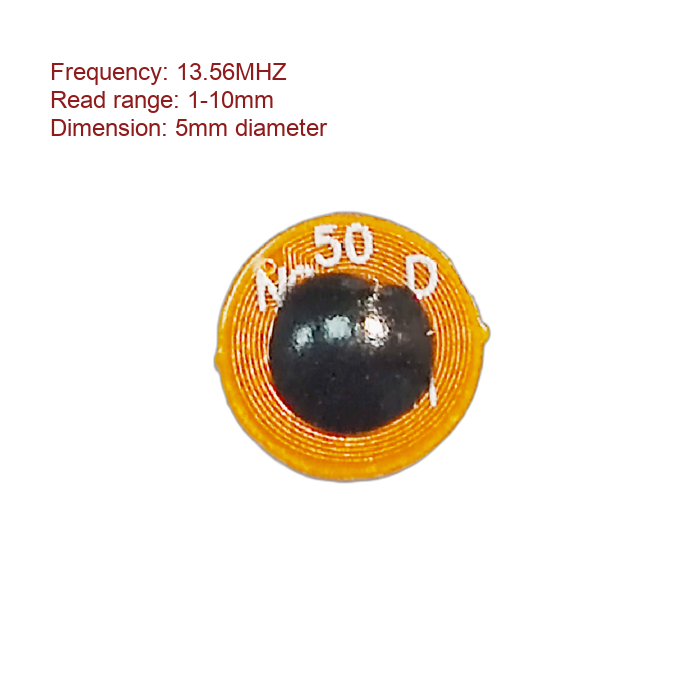
Typical dimensions of ultra-small NFC tags include:
Select a compatible NFC-enabled phone and application for the chip and intended operation, then test the integrated tag on those target devices.
Common Chip Types Used in the Smallest NFC Tags
Not all NFC chips are suitable for miniaturization. The smallest NFC tags usually rely on highly integrated, low-power chips optimized for short antennas.
NTAG Series (Miniaturized Versions)
Widely used for consumer electronics and smart products. Offers good smartphone compatibility and moderate memory capacity.
NFC Forum Type 2 / Type 5 Chips
Designed for simple data exchange, identification, and automation tasks with minimal power requirements.
Secure NFC Chips
Used in medical devices, authentication wearables, and access control. These chips prioritize security over memory size.
Memory Capacity vs Physical Size
Physical size alone does not determine memory capacity. Memory follows the selected chip, while the antenna and finished construction determine much of the tag outline. Our Ø5 mm NTAG216 example combines a small footprint with a chip offering 888 bytes of user memory; that capacity does not promise a particular reading distance.
Choose enough space for the intended record, including its formatting overhead. A short product-information URL usually needs less space than a longer multi-field record. Check the encoded result in the chosen application rather than judging capacity from the number of visible characters alone.
When the tag points to an online product or service record, keep the detailed content in that system. More memory does not by itself add stronger authentication or change which reader protocols the chip supports.
Key Advantages of Ultra-Small NFC Tags
Battery-Free Operation
No onboard battery is required for the passive tag; the reader field supplies its operating energy. This does not power the wearable or its other functions.
Instant Interaction
A simple tap enables pairing, authentication, or data access.
Low Cost at Scale
Even advanced miniature NFC tags are affordable when produced in volume.
High Durability
Encapsulated tags resist moisture, vibration, and temperature changes.
Seamless Smartphone Integration
An NFC-enabled phone can provide the reader hardware for a supported chip and operation. Check the intended record and application on the target devices.
Applications in Wearables
Smart Rings and Bracelets
Small NFC tags can carry a link or a compatible credential in a ring or bracelet. Access control and payment require the appropriate chip, credentials and supporting system; a general-purpose NFC tag does not provide these functions on its own.
Fitness and Health Wearables
NFC tags store device IDs, user profiles, or medical information for quick access by healthcare staff or apps.
Medical Wearables
NFC can provide a device identifier or link to a device record during pairing and service. Monitoring functions and compliance depend on the complete device and supporting system.
Fashion Tech
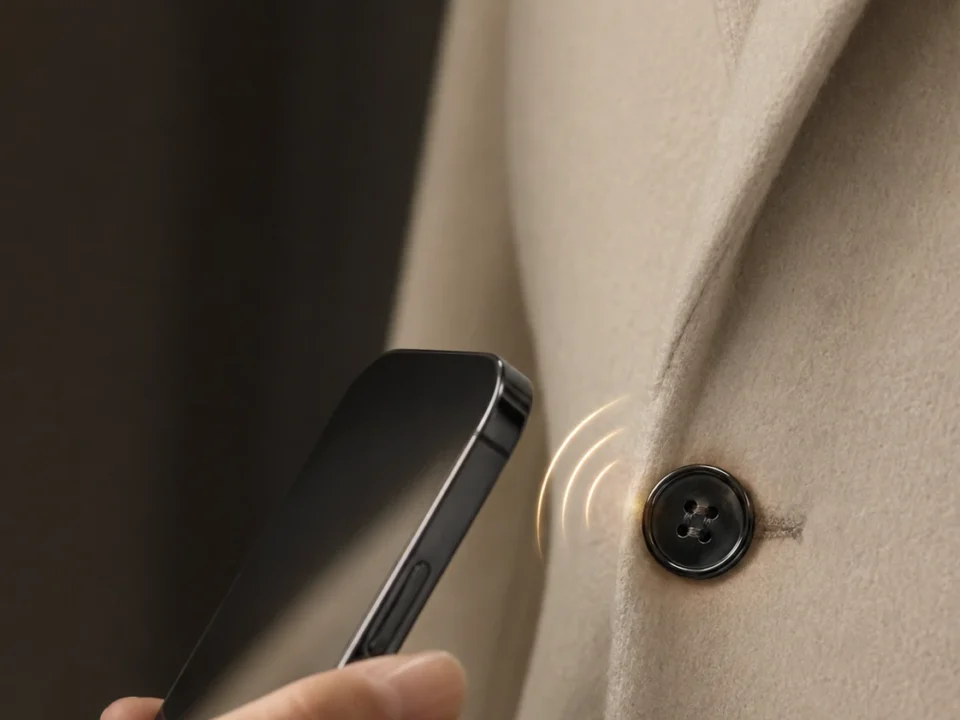
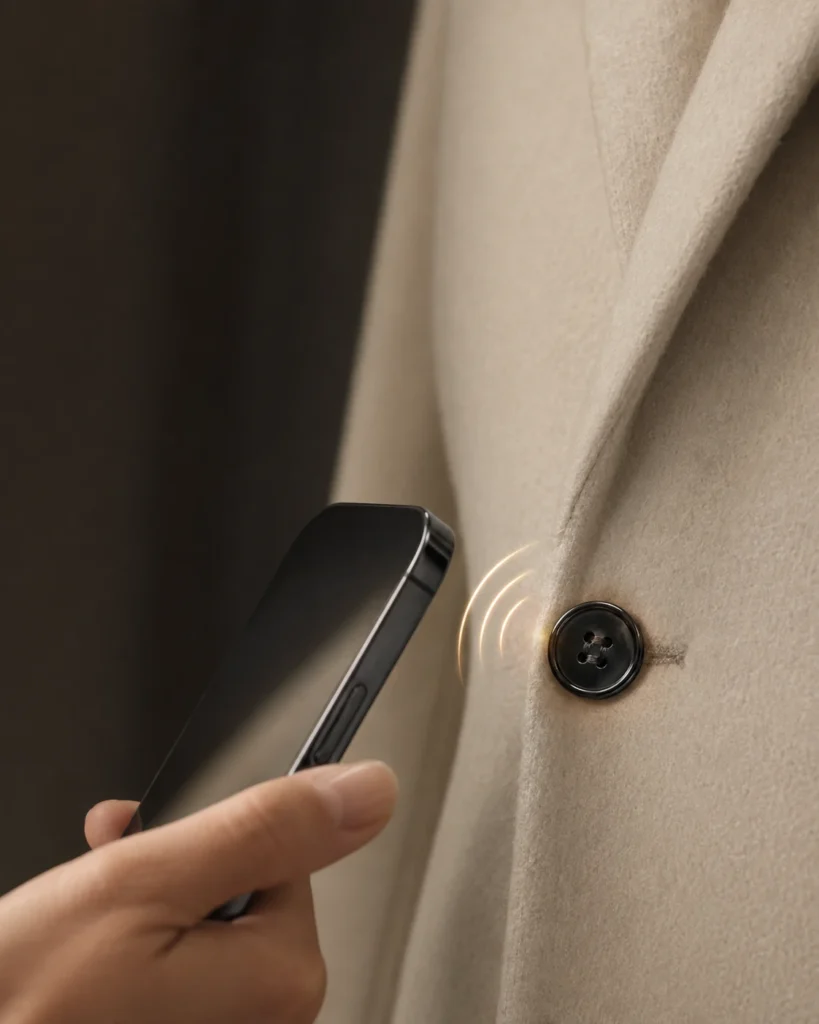
NFC tags embedded in clothing or accessories provide authentication, digital content, and brand interaction without affecting comfort.
Applications in IoT Devices
Smart Asset Trackers
NFC tags provide a simple way to identify and configure devices during installation and maintenance.
Smart Labels and Sensors
Used in logistics, cold-chain monitoring, and industrial automation for quick data access.
Device Pairing and Setup
NFC simplifies onboarding by enabling tap-to-pair functionality for smart home and industrial IoT devices.
Authentication and Security
NFC tags can identify machines, tools and connected equipment. If the task is to authenticate the item rather than read an identifier, select a suitable security chip and implement the corresponding verification system.
Antenna Design: The Real Challenge
In small NFC tags, the antenna design is often more critical than the chip itself.
Smaller antennas:
For wearables and IoT devices, antenna performance must be optimized based on:
Device housing material (plastic, metal, ceramic)
Placement location
Orientation relative to the reader
Operating environment
This is why many ultra-small NFC tags are custom-designed rather than off-the-shelf.
NFC Tags on Metal and Curved Surfaces
The space that fits a tag mechanically may be a poor place to read it. A metal backplate, battery or conductive coating close to the antenna can change its behaviour. A tag that works on the bench can become difficult to read after the housing is closed.
Start by moving the sample away from nearby metal, then repeat the same read test. If the product needs the tag directly against metal, use a construction designed for that installation, often with a suitable ferrite layer. Adding a spacer or ferrite changes the finished thickness and the RF environment, so test the complete stack rather than assuming that an extra layer will solve every installation.
FPC and PCB describe the construction, not an on-metal guarantee. Our FPC NFC range includes compact flexible formats; our PCB NFC range provides rigid board formats. Neither name alone tells you that a model can be placed directly on metal.
On a curved part, compare the available flat area with the whole tag outline, including the antenna. A flexible substrate does not make the chip area or antenna traces safe to crease. Hold a sample at the intended curve, without forcing a sharp fold, and test it before fixing it in place. A rigid PCB tag needs a flat pocket or another mounting arrangement that does not bend the board. Avoid pressing the enclosure or an adhesive joint directly onto the chip.
For wearables, repeat the test in the way the item will actually be worn. Keep the intended tap area reachable: a working tag hidden behind a difficult phone position can still be an awkward product to use.
Programming and Integration
For small NFC tag integration, a successful write is only the first result. The finished product also needs to be readable at the intended tap position. With our miniature FPC and PCB formats, choose the reader and mounting arrangement together; a smaller outline does not promise the same reading behaviour as a larger label.
Test the sample before closing the product
- Define what the reader must do.
Reading a tag identifier in a reader application is different from opening a web link on a phone. Use a phone or reader that supports the selected chip and protocol. For a phone link, prepare a valid NDEF URI record on a sample you are free to rewrite. For a reader-based identification project, verify the identifier or data that the application actually uses.
- Establish a baseline with the tag outside the housing.
Place the sample on a non-metallic support. Use the same device, phone case, reader settings and approach direction that you will use for the assembled test. Find the device’s active NFC area by moving it slowly across the tag. Write the test record if required, then read it back and try the intended action.
- Check the proposed mounting position without permanent fixing.
Use a reversible non-metallic fixture to hold the tag where it will sit. Include the parts that will be nearby: for example the battery, PCB, backplate and cover. Change one thing at a time—position, orientation or clearance—so the result tells you what helped.
- Repeat with the product fully assembled.
Close the enclosure, then present and remove the same reader repeatedly. A practical comparison is ten separate attempts before assembly and ten after it; this is a trial method, not a certification or a universal acceptance threshold. Count successful reads and check that the correct record or action appears. For a wearable, also try the normal wearing position.
- Keep the record editable until the result is stable.
After the mounting position and stored data work, repeat with the other phones or production readers the project needs to support. Decide on write protection only after the final record has been checked. Some lock settings are irreversible; password protection and permanent read-only locking are different choices.
A useful test note: model and sample ID; device and application; record written; phone case or reader settings; tag position and orientation; housing and nearby metal; successful reads out of attempts. Add a photo of the placement. These details let you reproduce a result instead of recording only “reads well” or one best-case distance.
If it reads outside the product but not inside
Return to the working baseline before changing the data. The following comparisons help separate an installation problem from a record or reader problem.
| What you observe | What to compare next |
|---|
| Works before assembly, becomes unreliable after closing | Open the cover and repeat at the same orientation. Then compare clearance from metal and batteries, tag position and any bending or pressure introduced during assembly. |
| The application sees a tag ID, but the phone does not open the intended page | Read back the NDEF record and URL. Check that the intended phone interaction is supported. Detecting the chip does not prove that the stored record or link action is correct. |
| Works with one device but not another | Check support for the chip/protocol, the device’s NFC antenna position and the application used. Repeat the physical placement test before judging the second device from one failed tap. |
| It works only when the phone is held in an awkward position | Move the tag or the visible tap mark so the reader antenna can approach it naturally. Test that position with the finished housing, rather than relying on the bare-tag result. |
There is no single read distance that applies to every miniature tag, phone and finished product. Use the assembled test to choose the workable position. If you send us the intended tag location and the comparison results, we can discuss a format or placement change against that specific arrangement.
Security Considerations
Choose the security function separately from the physical size. A UID identifies a chip; it does not by itself prove that the item carrying it is genuine. Password protection can restrict configured memory access, while a read-only lock protects the stored record against later rewriting. Neither is the same as an application performing a fresh cryptographic authenticity check.
For example, NTAG216 includes password and locking functions and an originality signature. That signature can help verify the chip’s NXP origin; it is a different question from proving that a finished branded product and every tap are genuine. A design using a security chip such as NTAG424 DNA can use AES-based features and Secure Unique NFC messaging, but the application still needs the appropriate configuration, keys and verification service.
Keep passwords and secret keys out of a public NDEF record. For a simple product-information link, the immediate requirement may be a verified URL and the right write-protection choice. For authentication, specify what is being verified and how the receiving system will verify it before choosing the chip.
Chip details: NXP NTAG213/215/216 and NXP NTAG424 DNA.
How to Choose the Right Small NFC Tag
When selecting the smallest NFC tag for wearables or IoT devices, consider:
Physical size constraints
Required read range
Memory needs
Environment (heat, moisture, metal)
Security level
Production volume
Testing in real-world conditions is essential before mass production.
For available product formats, compare our Micro NFC tags and follow the links to the individual product specifications.
Manufacturing and Customization
Manufacturers can offer:
For wearable and IoT brands, working with an experienced NFC supplier reduces development time and risk.
Cost Considerations
Ultra-small NFC tags are slightly more expensive than standard labels, but costs decrease rapidly with scale.
Factors affecting price include:
In most cases, the added value far outweighs the incremental cost.
Future Trends
As IoT devices and wearables continue to miniaturize, NFC tags will become:
NFC will increasingly act as a bridge between physical products and digital ecosystems.
Conclusion
The smallest NFC tags enable powerful functionality in the smallest possible space. For wearables and IoT devices, they provide battery-free connectivity, secure identification, and seamless user interaction without compromising design or comfort.
By understanding size limitations, antenna design, and application requirements, developers and buyers can confidently integrate ultra-small NFC tags into next-generation products. In a world of shrinking devices and expanding connectivity, these tiny components play an outsized role.
Au is an RFID and NFC manufacturer based in Shenzhen, China, with over 10 years of experience.