September 14, 2026
Smart cards are widely used for identification, authentication, access control, payment, public transportation, employee identification, and many other applications. Depending on how they communicate with a reader and what type of chip they contain, smart cards can be divided into several different types.
The most common types of smart cards include contact smart cards, contactless smart cards, dual-interface smart cards, hybrid smart cards, memory-based smart cards, and microprocessor-based smart cards.
Understanding the differences between these smart card types is important when selecting a card for an RFID, NFC, access control, payment, transportation, or identification system.
In this guide, we explain the major types of smart cards, how they work, their applications, and how to choose the right smart card for your project.
What Is a Smart Card?
A smart card is a card containing an integrated circuit (IC) that can store data and, depending on the chip type, process information and perform security functions.
Smart cards are commonly manufactured in a standard card format similar to a credit card. The card can contain a contact chip, contactless chip and antenna, or both technologies.
Unlike traditional magnetic stripe cards, smart cards can provide more advanced data storage, authentication, encryption, and application capabilities.
Smart cards are used in many industries, including:
- Access control
- Payment
- Public transportation
- Employee identification
- Government identification
- Healthcare
- Education
- Membership and loyalty programs
- Hotel access
- Event management
- Logistics and asset tracking
The best type of smart card depends on the application, reader technology, required security level, communication method, operating environment, and budget.
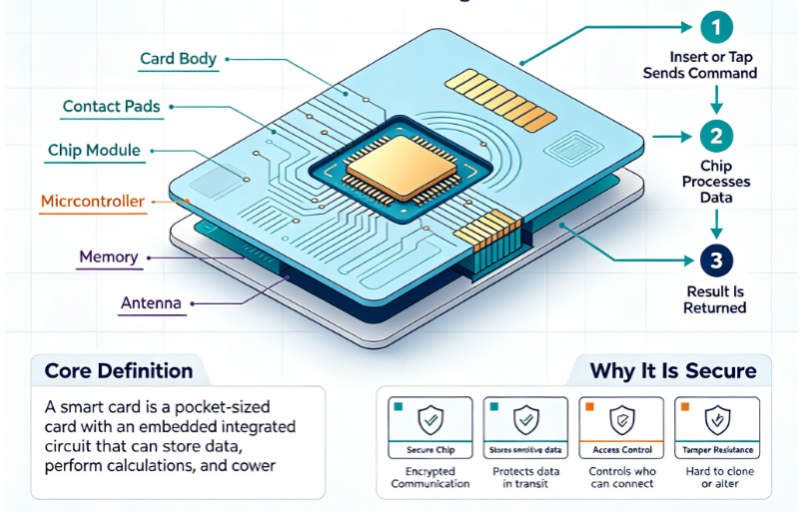
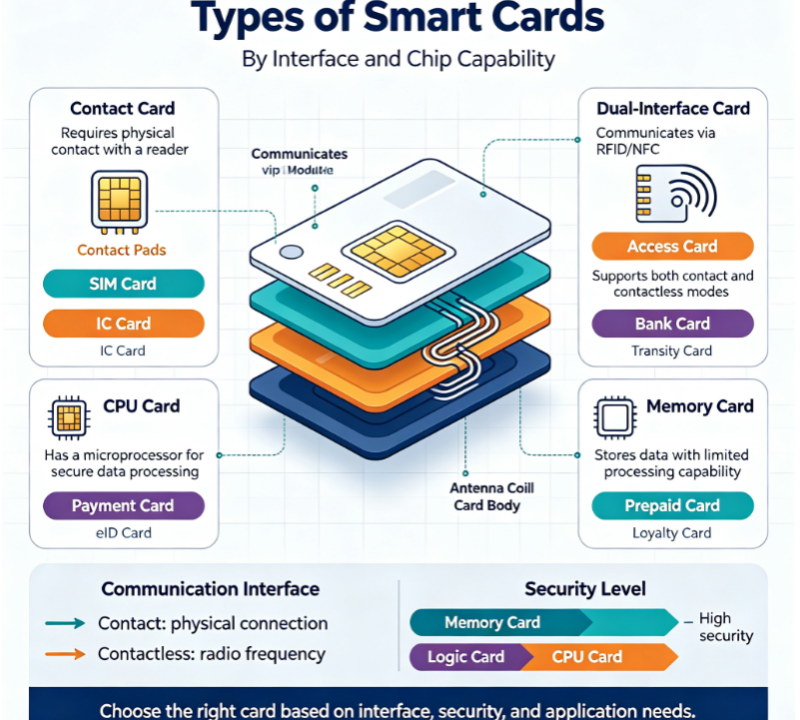
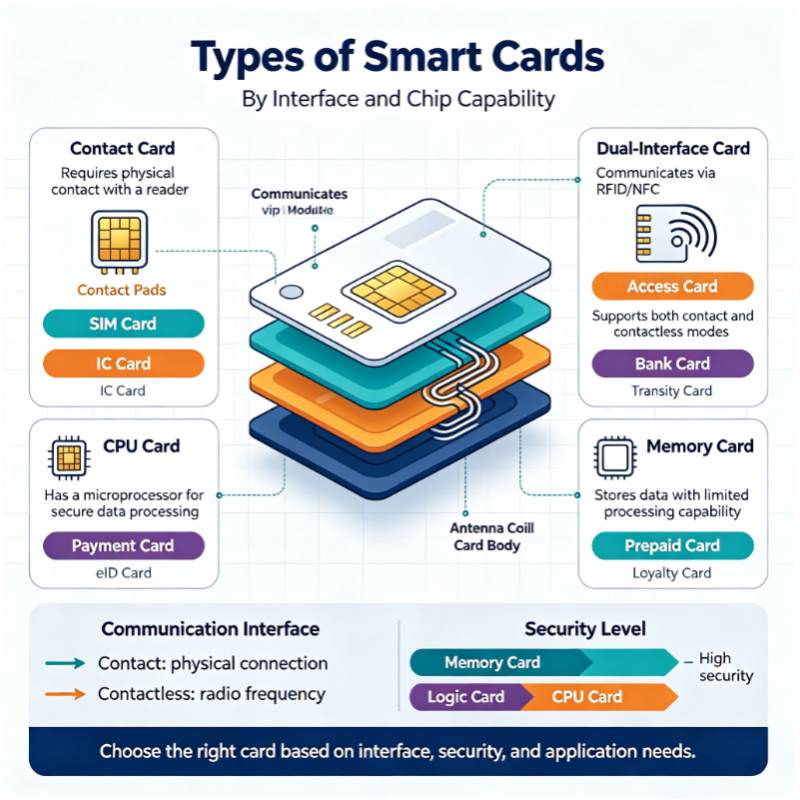
Internal structure and working principle of a smart card. This diagram illustrates core hardware components, operation workflow, and key security features of embedded‑chip smart cards.
How Are Smart Cards Classified?
There are two common ways to classify smart cards.
1. Smart Cards by Interface
The interface describes how the card communicates with the reader.
The main types are:
- Contact smart cards
- Contactless smart cards
- Dual-interface smart cards
- Hybrid smart cards
2. Smart Cards by Chip Capability
Smart cards can also be classified according to what the embedded chip can do.
The two major categories are:
- Memory-based smart cards
- Microprocessor-based smart cards
These two classification systems are not mutually exclusive. For example, a microprocessor-based card can be either a contact or contactless card.
Types of Smart Cards by Interface
1. Contact Smart Cards
Contact smart cards communicate with a reader through physical electrical contacts on the surface of the card.
When the card is inserted into a compatible reader, the metal contacts on the card connect with the reader. The reader supplies power and exchanges data with the integrated circuit.
Contact smart cards are commonly associated with standards such as ISO/IEC 7816.
Advantages of Contact Smart Cards
- Reliable physical communication
- Suitable for secure applications
- Established technology
- Widely supported by existing infrastructure
- Suitable for applications requiring controlled card-reader interaction
Common Applications
Contact smart cards can be used for:
- Payment cards
- Identification cards
- SIM-related applications
- Secure authentication
- Government ID systems
- Healthcare cards
- Enterprise security
One limitation is that the user needs to insert the card into the reader. This can make contact cards less convenient than contactless cards in high-throughput environments.
2. Contactless Smart Cards
Contactless smart cards communicate with a reader without requiring physical contact.
A contactless smart card normally contains an IC and an embedded antenna. When the card is placed near a compatible reader, electromagnetic energy enables communication between the card and reader.
RFID and NFC technologies are commonly used in contactless card applications.
Contactless cards are especially useful when users need to quickly present a card to a reader.
Advantages of Contactless Smart Cards
- Fast and convenient
- No physical insertion required
- Reduced mechanical wear
- Suitable for high-volume transactions
- Easy to use for access control and transportation
- Can be integrated with RFID or NFC technologies
Common Applications
Contactless smart cards are widely used for:
- Door access control
- Employee ID cards
- Public transportation
- Hotel key cards
- Event access
- Campus cards
- Membership cards
- Contactless payment
- Identification systems
For access control applications, for example, a user can simply present the card near the reader instead of inserting it.
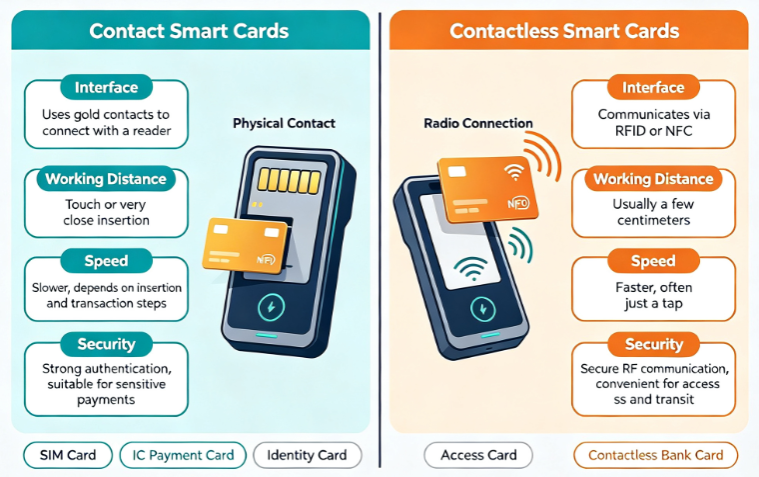
Comparison between contact smart cards and contactless smart cards. Side‑by‑side comparison of interface mode, working distance, transaction speed, security performance and typical real‑world application examples.
3. Dual-Interface Smart Cards
A dual-interface smart card supports both contact and contactless communication.
This means the same card can be used with:
- A contact smart card reader
- A contactless smart card reader
A typical dual-interface card integrates a chip and antenna system that supports both communication methods.
Why Use a Dual-Interface Smart Card?
Dual-interface cards are useful when an organization needs to support different reader infrastructures or wants to provide users with multiple ways to interact with the same card.
For example, a card could be inserted into a traditional chip reader or presented to a contactless terminal.
Common Applications
Dual-interface smart cards are often used in:
- Banking
- Payment
- Transportation
- Government identification
- Multi-application cards
- Enterprise identification
The main advantage is flexibility.
Instead of issuing separate cards for different environments, one dual-interface card can support multiple communication methods.
4. Hybrid Smart Cards
Hybrid smart cards are different from dual-interface cards.
A hybrid card generally contains two separate chips, with each chip operating independently. For example, one chip may support a contact application while another chip supports a contactless application.
This is different from a dual-interface card, where one chip can typically be accessed through both contact and contactless interfaces.
Hybrid Smart Card Applications
Hybrid smart cards may be used when different applications require separate chip technologies or independent security environments.
Potential applications include:
- Employee identification
- Physical access control
- Computer authentication
- Multi-purpose identification
- Enterprise security
When designing a smart card system, it is important to distinguish between a hybrid card and a dual-interface card, because their internal architectures are different.
Types of Smart Cards by Chip Capability
1. Memory-Based Smart Cards
Memory-based smart cards are designed primarily to store information.
They contain memory for storing data but generally do not have the same processing capabilities as microprocessor-based smart cards.
Memory cards can be suitable when an application mainly requires data storage and controlled access to stored information.
Advantages of Memory Smart Cards
- Simple architecture
- Cost-effective
- Suitable for basic applications
- Easy to integrate into certain card systems
Common Applications
Memory-based cards can be used in:
- Loyalty programs
- Stored-value systems
- Basic identification
- Prepaid applications
- Simple access systems
For applications requiring advanced cryptographic processing or complex authentication, a microprocessor-based smart card may be more appropriate.
2. Microprocessor-Based Smart Cards
Microprocessor-based smart cards contain a microprocessor as well as memory.
Instead of simply storing information, the chip can process data and perform more advanced operations.
This makes microprocessor smart cards suitable for applications where security, authentication, data processing, and multiple applications are important.
Advantages of Microprocessor Smart Cards
- Advanced data processing
- Stronger security capabilities
- Support for authentication
- Ability to manage multiple applications
- Suitable for complex card systems
- Can support cryptographic operations
Common Applications
Microprocessor-based smart cards are commonly used in:
- Payment cards
- Secure identification
- Government ID
- Healthcare
- Enterprise authentication
- Transportation
- Multi-application cards
For high-security applications, the choice of chip architecture can be just as important as the card’s communication interface.
RFID Smart Cards vs. NFC Smart Cards
RFID and NFC are closely related technologies, but they are not exactly the same.
RFID Smart Cards
RFID stands for Radio Frequency Identification.
RFID cards use radio-frequency communication between the card and reader. Different RFID technologies operate at different frequencies and are designed for different read ranges and applications.
RFID smart cards are widely used in:
- Access control
- Employee identification
- Public transportation
- Asset identification
- Membership systems
- Vehicle identification
NFC Smart Cards
NFC stands for Near Field Communication.
NFC is a short-range wireless communication technology that operates at 13.56 MHz and is closely related to high-frequency RFID technologies.
NFC cards are commonly used for:
- Contactless identification
- Access control
- Digital interaction
- Marketing
- Membership
- Smart business cards
- Payment-related applications
The right choice between RFID and NFC depends on the reader, operating frequency, required communication protocol, application, and system architecture.
Smart Card Types Comparison
| Smart Card Type | Communication | Main Feature | Typical Applications |
|---|---|---|---|
| Contact Smart Card | Physical contact | Direct electrical connection | Payment, ID, authentication |
| Contactless Smart Card | Wireless/RF | Fast tap or proximity operation | Access control, transit, payment |
| Dual-Interface Smart Card | Contact + contactless | Two interfaces | Payment, ID, transportation |
| Hybrid Smart Card | Multiple chips/interfaces | Independent chip functions | Multi-application systems |
| Memory Smart Card | Contact or contactless | Data storage | Loyalty, prepaid, basic ID |
| Microprocessor Smart Card | Contact or contactless | Data processing and security | Payment, authentication, secure ID |
Common Applications of Smart Cards
Smart cards are used in a wide range of industries.
Access Control
Contactless RFID and NFC smart cards are commonly used as credentials for doors, gates, offices, campuses, hotels, and restricted areas.
The card communicates with an access control reader, allowing the system to verify the user’s credentials before granting access.
Public Transportation
Transportation systems can use contactless smart cards for buses, trains, subways, and other public transit services.
Fast contactless communication is particularly useful when large numbers of passengers need to pass through gates quickly.
Payment
Smart cards can be used in payment systems where secure chip-based authentication and transaction processing are required.
Both contact and contactless interfaces can be used depending on the payment infrastructure.
Employee Identification
Companies can combine employee identification with access control using RFID or NFC smart cards.
A single card can potentially be used for:
- Employee identification
- Door access
- Time attendance
- Cafeteria systems
- Parking access
- Membership functions
Government and National Identification
Smart cards can support secure identification applications where data protection and authentication are important.
Depending on the system design, cards may use contact, contactless, or dual-interface technologies.
Hotel and Hospitality
Contactless cards can be used for hotel room access, guest identification, loyalty programs, and other hospitality applications.
Education and Campus Management
Universities and schools can use smart cards as multi-purpose credentials.
One card may support:
- Campus access
- Library services
- Student identification
- Meal payments
- Attendance
- Transportation
How to Choose the Right Type of Smart Card
Choosing a smart card should start with the application rather than the card itself.
Consider the following factors.
1. What Reader Do You Use?
First determine whether your system uses:
- Contact readers
- RFID readers
- NFC readers
- Dual-interface readers
The card and reader must be compatible.
2. What Is the Required Read Distance?
If the card needs to be presented close to a reader, contactless technology may be appropriate.
For applications requiring longer read distances, a different RFID technology or credential format may be required.
3. What Security Level Is Required?
Basic identification applications may require only simple data storage.
Payment, government identification, enterprise authentication, and other high-security applications may require a microprocessor-based secure chip.
4. Do You Need Contactless Operation?
If users need fast and convenient card presentation, a contactless smart card may be a better option than a contact card.
5. Do You Need Multiple Applications?
If one card needs to support several functions, consider a multi-application, dual-interface, or appropriately configured microprocessor smart card.
6. What Frequency or Protocol Is Required?
RFID and NFC cards are not interchangeable simply because both use wireless communication.
The card technology should match the reader’s frequency, protocol, chip type, and system requirements.
7. Do You Need Custom Printing?
For employee cards, membership cards, hotel cards, transportation cards, and branded credentials, customization can include:
- Logo
- Serial number
- QR code
- Barcode
- UID
- Variable data
- Full-color printing
- Magnetic stripe
- Signature panel
- Custom card design
Which Type of Smart Card Is Best for Access Control?
For many access control systems, contactless RFID or NFC smart cards are a practical choice because users can present the card directly to a reader without inserting it.
However, the best card depends on the access control reader and security requirements.
For basic systems, a suitable RFID card may be sufficient.
For systems requiring stronger authentication and more advanced security, a secure contactless smart card with an appropriate chip may be a better solution.
For organizations that need both contact and contactless compatibility, a dual-interface card can provide additional flexibility.
Why Choose DO RFID Reader for Smart Card Manufacturing?
Choosing the right smart card is only one part of a successful RFID or NFC project. Card quality, chip consistency, printing quality, programming, customization, and compatibility with the reader can all affect the performance of the final system.
DO RFID Reader is a China-based RFID and smart card manufacturer with extensive experience in RFID, NFC, smart card, and RFID reader products.
Our product range includes:
- RFID smart cards
- NFC cards
- RFID tags
- NFC tags
- RFID readers
- Custom RFID products
- Smart cards for access control
- Cards for transportation and identification applications
With more than 15 years of manufacturing experience, DO RFID Reader supports customers with customized RFID and NFC products for different applications and markets.
Our manufacturing capabilities can support different customer requirements, including custom card designs, embedded RFID/NFC technologies, printing, programming, and different card constructions.
We focus on:
Source Quality Products and Enjoy Efficient Service
We also provide:
- 36-month warranty for products we manufacture
- 24-hour technical support
- Custom RFID and NFC product development
- Short lead times
- High-quality card printing
- OEM and customized solutions
- Support for different market requirements
If you are developing an access control, transportation, identification, logistics, inventory, or NFC/RFID project, our team can help you select the appropriate smart card technology based on your reader, application, security requirements, and project volume.
Frequently Asked Questions About Smart Card Types
What are the main types of smart cards?
The main types include contact smart cards, contactless smart cards, dual-interface smart cards, hybrid smart cards, memory-based smart cards, and microprocessor-based smart cards.
These categories describe different characteristics, so one card can belong to more than one category.
What is the difference between contact and contactless smart cards?
A contact smart card communicates through physical electrical contacts when inserted into a reader.
A contactless smart card communicates wirelessly with a compatible reader using radio-frequency technology, so physical insertion is not required.
What is a dual-interface smart card?
A dual-interface smart card supports both contact and contactless communication.
It can be used with compatible contact and contactless readers, making it suitable for systems that require both interfaces.
Are RFID cards smart cards?
Some RFID cards can be considered smart cards when they contain an integrated circuit capable of storing or processing information and are designed for smart card applications.
However, not every RFID tag or RFID card is a smart card. The chip capabilities and system architecture matter.
What is the difference between an RFID card and an NFC card?
RFID is a broader family of radio-frequency identification technologies. NFC is a specific short-range wireless technology closely associated with HF RFID at 13.56 MHz.
The correct choice depends on the reader, protocol, operating range, security requirements, and application.
Which smart card is best for access control?
For many access control applications, contactless RFID or NFC smart cards are suitable because they provide convenient tap or proximity operation.
The appropriate chip and technology should be selected according to the access control reader, required security level, operating frequency, and system requirements.
Can smart cards be customized?
Yes. Smart cards can be customized in terms of card material, dimensions, printing, chip technology, memory capacity, encoding, UID or serial-number management, antenna design, and other specifications depending on the card type.
Conclusion
There is no single smart card type that is best for every application.
The right choice depends on several factors, including the communication interface, chip capability, security requirements, reader technology, operating environment, application, and budget.
The major smart card types include contact, contactless, dual-interface, hybrid, memory-based, and microprocessor-based smart cards.
For RFID and NFC projects, it is especially important to select a card that is compatible with the reader and system architecture.
As an experienced RFID and smart card manufacturer, DO RFID Reader can support customized RFID cards, NFC cards, smart cards, RFID tags, NFC tags, and readers for different applications.
If you are not sure which smart card technology is suitable for your project, contact DO RFID Reader with your reader model, application, required read distance, chip requirements, and estimated quantity. Our team can help you select and customize the right solution.

Do RFID is a leading China-based manufacturer with over 15 years of experience. We specialize in customized RFID readers, tags, and cards, delivering high-quality, tailored solutions that meet your unique business needs and drive seamless, efficient identification.