October 21, 2026
Contactless Blank NFC MIFARE Ultralight EV1 Card: The Complete 2026 Guide to Features, Working Principle, Customization, Applications, and Buying Tips
The rapid adoption of contactless technology has transformed the way people travel, access buildings, attend events, and interact with digital services. From public transportation systems and smart ticketing to event management and visitor identification, RFID and NFC cards have become an essential part of modern life.
Among the many high-frequency RFID chips available today, the NXP MIFARE Ultralight EV1 has become one of the most widely used solutions for cost-sensitive, high-volume applications. It offers faster communication, improved security compared to earlier Ultralight versions, excellent compatibility with ISO/IEC 14443 Type A readers, and a low manufacturing cost, making it ideal for disposable or short-term contactless cards.
Having worked with RFID card manufacturers and international importers for many years, I’ve found that buyers often focus only on chip prices. However, successful RFID projects depend equally on chip authenticity, antenna performance, printing quality, encoding accuracy, and manufacturing consistency. Choosing the right supplier often saves much more money than simply choosing the lowest quotation.
This guide explains everything you need to know about Contactless Blank NFC MIFARE Ultralight EV1 Cards, including their working principle, customization process, advantages, applications, comparisons with competing RFID chips, practical purchasing advice, and answers to the most common questions.
What Is a Contactless Blank NFC MIFARE Ultralight EV1 Card?
A Contactless Blank NFC MIFARE Ultralight EV1 Card is a passive RFID smart card equipped with the NXP MIFARE Ultralight EV1 integrated circuit. Operating at 13.56 MHz, it complies with the ISO/IEC 14443 Type A standard and communicates wirelessly with compatible NFC smartphones and RFID readers.
Unlike magnetic stripe cards, which require physical contact, or barcode cards that rely on optical scanning, a MIFARE Ultralight EV1 card exchanges data through radio frequency (RF) technology. Users simply bring the card within a few centimeters of a reader to complete authentication or data transfer.
Because the card is delivered blank, system integrators and businesses can encode it with their own data, making it suitable for customized ticketing, transportation, access control, and visitor management systems.
Typical specifications include:
| Specification | Typical Value |
|---|---|
| Chip | NXP MIFARE Ultralight EV1 |
| Frequency | 13.56 MHz |
| Standard | ISO/IEC 14443 Type A |
| Memory Options | 48 Bytes or 128 Bytes User Memory |
| Reading Distance | 2–10 cm |
| Data Retention | 10 Years |
| Read/Write Cycles | Over 100,000 |
| Material | PVC, PET, ABS, Eco-friendly PVC |
| Card Size | CR80 (85.6 × 54 mm) |
The card contains no battery and requires no maintenance during its service life.
Contactless Blank NFC MIFARE Ultralight EV1 card
1.PVC,ABS,PET,PETG etc
2. Available Chips:NXP NTAG213, NTAG215 and NTAG216, NXP MIFARE Ultralight® EV1,etc
3. SGS approved
| Key card Types | LOCO or HICO magnetic stripe hotel key card |
| RFID hotel key card | |
| Encoded RFID hotel keycard for most of RFID hotel locking system | |
| Material | 100% new PVC,ABS, PET,PETG etc |
| Printing | Heidelberg offset printing / Pantone Screen printing: 100% match customer required color or sample |
| Technic support | We supply chip encoding service for both magnetic stripe and rfid chip hotel key cards |
| Hotel Partner: | Most worldwide famous hotel like: Hilton, Marriott, Crown plaza,Sheraton, Holiday Inn, Four seasons, Ibis etc. |
| Crafts | Gloss/ Varnish/ UV / Spot UV / Glittering / Gold or silver foil stamping |
| Production time | normally7-10 days for quantity 1-50,000pcs for both encoding or no-encoding cards |
| Packing Details | 200pcs/Ctn with OPP business card, Packing in the OPP bags, with strong corrugated box outside or as customer’s requirement. |

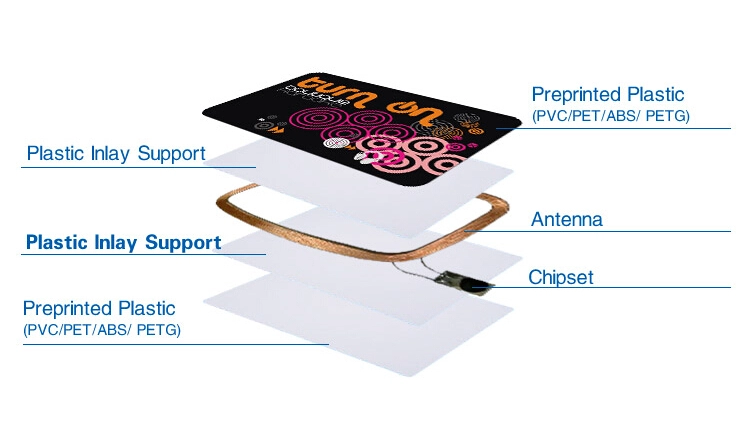
Standard size: 85.5*54*0.86 mm
Frequently used RFID chip for hotel key card: NXP MIFARE Classic® 1K (for guest) NXP MIFARE Classic® 4K (for staff) NXP MIFARE Ultralight® EV1,

Packing & Delivery
Normal package :
200pcs rfid cards into white box .
5 boxes /10boxes /15boxes into one carton.
Customized Package based on your request.
For example below package picture:


How Does a MIFARE Ultralight EV1 Card Work?
The MIFARE Ultralight EV1 card is a passive contactless smart card, meaning it draws power from the electromagnetic field generated by an RFID reader.
The communication process includes four simple steps.
Step 1: Reader Generates a 13.56 MHz RF Field
An NFC reader, access terminal, or ticket validator continuously emits a high-frequency electromagnetic field.
Step 2: Card Receives Energy
When the card enters the reader’s field, its internal copper antenna harvests energy through electromagnetic induction, providing enough power for the chip to operate.
Step 3: Authentication
The reader and card establish communication using the ISO14443 Type A protocol. Depending on the application, authentication may include password protection or originality verification.
Step 4: Data Exchange
Once communication is established, the reader retrieves or updates the stored data.
Typical stored information includes:
- Ticket numbers
- Passenger IDs
- Event credentials
- Visitor information
- Product identifiers
- Access permissions
- Promotional campaign data
The entire process generally completes in less than half a second, allowing smooth user flow in busy environments.
Key Features of MIFARE Ultralight EV1
Several characteristics make this chip popular for large-scale deployments.
High-Speed Contactless Communication
Fast transaction times reduce queues at transportation gates, stadium entrances, and exhibition halls.
Low Manufacturing Cost
Compared with higher-security smart cards, MIFARE Ultralight EV1 provides excellent performance at a very competitive price, making it ideal for disposable or short-term use.
Long Service Life
The chip supports more than 100,000 write cycles and retains stored data for approximately 10 years.
Excellent Compatibility
It works with most ISO14443 Type A readers and many NFC-enabled mobile devices.
Small Power Consumption
Because the card is passive, it never requires charging or battery replacement.
Why Customize MIFARE Ultralight EV1 Cards?
Although blank cards can be encoded after purchase, most organizations choose custom printing and personalization to improve branding, security, and operational efficiency.
Strengthen Brand Identity
Custom printing allows businesses to include:
- Company logos
- Corporate colors
- Promotional graphics
- Event branding
- Product images
Professional cards create a stronger first impression and reinforce brand recognition.
Improve Security
Visual security features can include:
- Holograms
- UV printing
- Microtext
- Laser engraving
- Sequential numbering
- Anti-counterfeit graphics
These features make unauthorized duplication more difficult.
Simplify Identification
Variable printing enables each card to display:
- Employee names
- Visitor IDs
- Membership numbers
- QR codes
- Barcodes
- Expiration dates
This improves both usability and administration.
Support Multiple Business Needs
Customized cards can be tailored for:
- Public transportation
- Events
- Hotels
- Tourism
- Museums
- Universities
- Corporate offices
One card design can support both branding and operational requirements.
Custom MIFARE Ultralight EV1 Card Manufacturing Process
Experienced RFID card manufacturers typically follow a standardized production workflow.
1. Requirement Analysis
The manufacturer confirms:
- Card quantity
- Chip version
- Printing requirements
- Encoding requirements
- Surface finish
- Packaging
Detailed planning helps reduce production errors.
2. Graphic Design
Customers submit artwork or request design assistance.
Optional printing includes:
- Full-color offset printing
- UV printing
- Metallic foil
- Matte finish
- Gloss finish
- Frosted surface
Digital proofs are normally approved before production begins.
3. Chip Embedding
The RFID chip and antenna are embedded between multiple PVC layers using high-temperature lamination.
Quality lamination improves durability, water resistance, and reading consistency.
4. Card Printing
Modern production lines use:
- Heidelberg offset printing
- UV digital printing
- Silk-screen printing
High-resolution printing ensures consistent color accuracy even in large production runs.
5. Personalization
Optional personalization includes:
- UID printing
- Variable serial numbers
- QR codes
- Barcodes
- Signature panels
- Laser engraving
- Photo printing
Every card can contain unique visual information.
6. RFID Encoding
Manufacturers can pre-program cards with:
- Ticket IDs
- System keys
- Access credentials
- Customer information
- Event data
Every encoded card should be verified before shipment.
7. Quality Inspection
Professional factories test:
- Chip functionality
- Reading distance
- Print quality
- Card dimensions
- Surface appearance
- Packaging
Many manufacturers perform 100% chip verification before delivery.
Typical Application Environments
MIFARE Ultralight EV1 cards are widely deployed across numerous industries.
Public Transportation
Perhaps the most common application.
Cards are used for:
- Metro tickets
- Bus tickets
- Ferry systems
- Light rail
- Subway access
Fast transactions help reduce passenger congestion.
Event Ticketing
Concerts, sports venues, exhibitions, and conferences use RFID cards for:
- Admission
- VIP access
- Session management
- Visitor tracking
Contactless validation significantly speeds up entry.
Tourist Attractions
Museums, amusement parks, and historical sites use RFID cards for:
- Entrance tickets
- Multi-day passes
- Visitor management
- Cashless payments
Hotel Services
Hotels issue RFID cards for:
- Guest identification
- Temporary access
- Promotional programs
- Visitor management
Campus Management
Schools and universities use them for:
- Student IDs
- Attendance
- Library borrowing
- Temporary visitor passes
Marketing Campaigns
Companies distribute NFC-enabled promotional cards linking customers to:
- Product websites
- Videos
- Digital coupons
- Registration pages
Pain Points Solved by MIFARE Ultralight EV1 Cards
Traditional ticketing and identification systems create several operational challenges.
Faster Entry
Paper tickets often require manual inspection or barcode scanning.
Contactless RFID cards allow users to tap and go, reducing waiting times.
Lower Operating Costs
Reusable RFID cards minimize paper waste and reduce long-term printing expenses.
Better Durability
Unlike paper tickets, PVC RFID cards resist water, bending, and frequent handling.
Improved Security
Each chip contains a unique identifier, making duplication much more difficult than ordinary printed tickets.
Better Data Management
Digital systems automatically record:
- Entry time
- Visitor numbers
- Usage statistics
- Ticket validation
This provides valuable operational insights.
MIFARE Ultralight EV1 vs Competing RFID Chips
MIFARE Ultralight EV1 vs MIFARE Classic 1K
MIFARE Classic provides larger memory and is commonly used for access control and stored-value systems.
Ultralight EV1 focuses on affordable ticketing and disposable applications where lower memory is sufficient.
MIFARE Ultralight EV1 vs NTAG216
Both operate at 13.56 MHz, but their intended uses differ.
NTAG216 is optimized for NFC smartphone interaction, digital business cards, and marketing campaigns.
Ultralight EV1 is better suited to transportation, ticketing, and event management systems.
MIFARE Ultralight EV1 vs DESFire EV3
DESFire EV3 offers significantly higher security, larger memory, and advanced encryption.
However, it also comes at a much higher cost.
For transportation tickets and visitor credentials, Ultralight EV1 often provides the best balance between functionality and affordability.
MIFARE Ultralight EV1 vs EM4200 (125 kHz)
EM4200 is a low-frequency card that primarily stores identification numbers.
MIFARE Ultralight EV1 supports faster communication, larger memory, and compatibility with modern NFC infrastructure, making it the better choice for most contactless ticketing applications.
Practical Experience from RFID Projects
After working with international RFID buyers, several practical lessons consistently stand out.
First, always confirm that the cards use genuine NXP MIFARE Ultralight EV1 chips. Low-cost alternatives or recycled chips may work initially but often suffer from inconsistent performance, reduced durability, or compatibility issues.
Second, request production samples before placing large orders. Test them with your existing readers, ticketing software, and NFC-enabled devices under real operating conditions to verify reading distance and reliability.
Third, consider the complete card solution rather than focusing only on the chip. High-quality printing, precise antenna alignment, durable lamination, and accurate encoding contribute significantly to long-term performance.
Finally, choose a manufacturer that can provide integrated services—including design, personalization, encoding, quality testing, and export support. This simplifies procurement, shortens lead times, and reduces the risk of production problems.
How to Choose a Reliable RFID Card Manufacturer
When evaluating suppliers, consider these important factors:
- Genuine NXP chip sourcing
- ISO-certified manufacturing facilities
- Advanced offset printing equipment
- In-house RFID encoding capabilities
- Strict quality management procedures
- 100% functional chip testing
- OEM and ODM customization services
- Fast sampling and mass production
- Export experience
- Responsive technical and after-sales support
Working with an experienced manufacturer ensures better product consistency and long-term project success.
Frequently Asked Questions
1. What is the operating frequency of a MIFARE Ultralight EV1 card?
It operates at 13.56 MHz and complies with the ISO/IEC 14443 Type A standard.
2. Is MIFARE Ultralight EV1 compatible with NFC smartphones?
Many NFC-enabled Android devices and compatible NFC readers can communicate with MIFARE Ultralight EV1 cards. Compatibility depends on the application’s security configuration and the mobile operating system.
3. Can the card be rewritten?
Yes. The chip supports more than 100,000 read/write cycles, allowing data to be updated repeatedly unless specific memory areas are permanently locked.
4. Is the card waterproof?
Yes. Standard PVC cards are water-resistant and suitable for everyday use. PET and ABS materials are also available for applications requiring greater durability.
5. What is the typical reading distance?
The reading distance is generally 2–10 cm, depending on the reader, antenna design, and surrounding environment.
6. Can every card contain different information?
Yes. Manufacturers can personalize each card with unique serial numbers, ticket IDs, QR codes, or encoded data.
7. What industries use MIFARE Ultralight EV1 cards?
They are widely used in public transportation, event ticketing, tourism, education, hospitality, visitor management, and promotional campaigns.
8. How long does the stored data last?
Under normal operating conditions, the chip retains stored data for approximately 10 years.
9. Can I print my company logo on the card?
Absolutely. Professional manufacturers support full-color offset printing, UV printing, metallic foil, matte finishes, laser engraving, and many other customization options.
10. How do I choose a reliable supplier?
Look for manufacturers that use genuine NXP chips, provide ISO-certified production, perform 100% functional testing, offer in-house encoding and personalization, and have proven experience serving international OEM and ODM customers.
Conclusion
The Contactless Blank NFC MIFARE Ultralight EV1 Card is a cost-effective, reliable, and highly versatile RFID solution for modern ticketing, transportation, event management, visitor identification, and promotional applications. Its fast communication speed, passive operation, long service life, and compatibility with ISO/IEC 14443 Type A infrastructure make it an excellent choice for high-volume contactless projects.
While selecting the right chip is important, the overall success of an RFID deployment depends just as much on manufacturing quality, accurate encoding, professional customization, and dependable technical support. By partnering with an experienced RFID card manufacturer that offers genuine NXP components, advanced printing capabilities, rigorous quality control, and flexible OEM/ODM services, businesses can deploy secure, durable, and professional RFID cards that deliver reliable performance and long-term value.