October 21, 2026
Dual Frequency Chip RFID Card: Complete Guide to Features, Working Principle, Manufacturing Process, Competitive Comparison, and Procurement Strategy
As modern identification systems evolve toward higher security, better convenience, and multi-application integration, Dual Frequency Chip RFID Cards have become one of the most important innovations in smart card technology. These cards combine two different radio frequency technologies into a single card, typically High Frequency (HF, 13.56 MHz) and Ultra-High Frequency (UHF, 860–960 MHz), or sometimes HF + LF (125 kHz).
This dual-interface design allows a single card to support multiple systems such as access control, payment, parking, attendance, logistics tracking, and identity verification—all at the same time. Instead of carrying multiple cards for different systems, users can rely on one unified credential.
This article provides a complete guide to Dual-Frequency Chip RFID Cards, including definitions, structure, working principle, workflow, manufacturing process, applications, competitive analysis, and procurement strategy for global buyers.
What is a dual-frequency chip, RFID Card?
A Dual Frequency RFID Card is a smart card embedded with two independent RFID chips or a single dual-interface chip that supports two frequency bands:
- HF (High Frequency 13.56 MHz) – ISO 14443 / ISO 15693 (used in NFC, access control, payment systems)
- UHF (Ultra High Frequency 860–960 MHz) – EPC Gen2 / ISO 18000-6C (used in logistics and tracking systems)
In some configurations, the card may also combine:
- HF + LF (125 kHz proximity access systems)
- HF + UHF (most advanced dual-frequency cards)
Each chip operates independently, meaning the card can communicate with different systems depending on the reader type.
A dual-frequency chip RFID card has two chips. One card can work in 2 different frequencies, such as LF (125 kHz) and HF (13.56 MHz), LF (125 kHz) and UHF(860- 960 MHz), HF (13.56 MHz) and UHF(860- 960 MHz). It is designed to meet a range of customer applications. This card is very cost-effective. Mainly used in banks, schools, governments, and other institutions.
LF+HF:
EM4200/ TK4100/ T5577/ HITAG® + MIFARE Classic® 1K/ 4K
EM4200/ TK4100/ T5577/ HITAG® + MIFARE® DESFire® 2K/ 4K/ 8K
EM4200/ TK4100/ T5577/ HITAG® + MIFARE® Plus 2K/ 4K

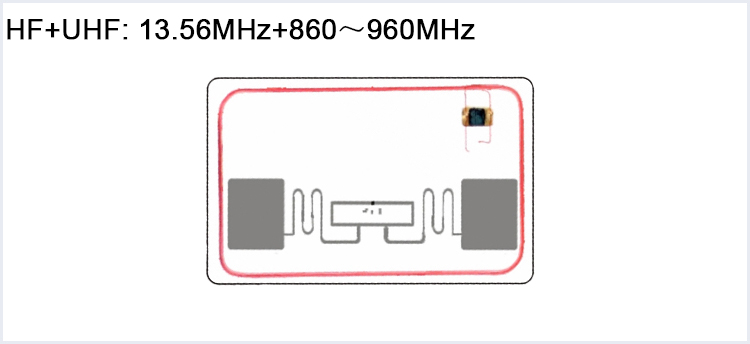
HF+UHF:
MIFARE Classic® 1K/ 4K + Alien Higgs 3/ Monza 4D/ Monza 4QT/ UCODE® 7
MIFARE® DESFire® 2K/ 4K/ 8K + Alien Higgs 3/ Monza 4D/ Monza 4QT/ UCODE® 7
LF+UHF:
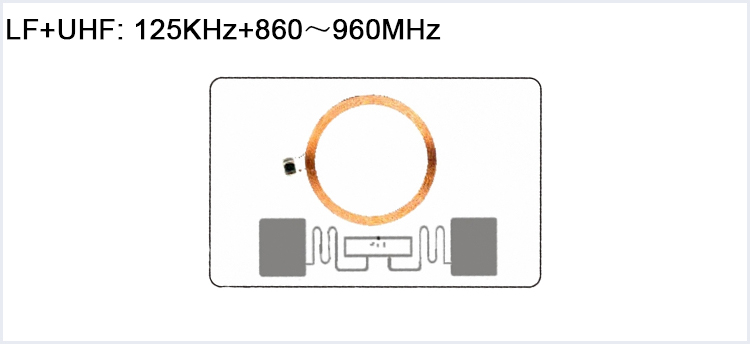
TK4100/ EM4200 + Alien Higgs 3
TK4100/ EM4200 + Monza 4QT
T5577 + Alien Higgs 3/ Monza 4QT
Structure of a Dual Frequency RFID Card
A dual frequency RFID card has a more complex internal architecture than a standard RFID card.
PVC / PET Card Body
The outer layer is made of durable PVC or PET material.
Features include:
- Waterproof and heat-resistant structure
- Printable surface
- Scratch resistance
- Long service life
HF RFID Chip Layer
The HF chip (13.56 MHz) is used for:
- Access control
- NFC communication
- Payment systems
- Identification systems
Common HF chips include:
- MIFARE Classic
- MIFARE DESFire
- NTAG series
- SLE5542-compatible HF modules
UHF RFID Chip Layer
The UHF chip operates at 860–960 MHz and is used for:
- Logistics tracking
- Warehouse management
- Inventory systems
- Long-distance identification
Common UHF chips include:
- Impinj Monza series
- Alien Higgs series
- NXP UCODE series
Dual Antenna System
The most important technical feature is the dual antenna structure:
- HF coil antenna (copper or aluminum etched coil)
- UHF dipole antenna (aluminum or copper etched structure)
These two antennas are carefully designed to avoid interference while coexisting in a single card.
Lamination Layers
Multiple layers are laminated under high temperature and pressure to ensure durability and RF performance stability.
Technical Specifications
Typical dual frequency RFID card specifications include:
| Item | Specification |
|---|---|
| Frequency | HF 13.56 MHz + UHF 860–960 MHz |
| Protocol | ISO 14443 / ISO 18000-6C |
| Material | PVC / PET / Composite |
| Size | CR80 (85.6 × 54 mm) |
| Thickness | 0.76–0.9 mm |
| Memory | HF + EPC UHF memory |
| Read Distance | HF: 0–10 cm / UHF: 3–10 m |
| Data Retention | 10+ years |
| Rewrite Cycles | 100,000+ |
How Does a Dual Frequency RFID Card Work?
The working principle is based on two independent communication systems operating in parallel.
Step 1: Card Enters Reader Field
The card is presented to either:
- HF reader (access control terminal)
- UHF reader (warehouse system)
Step 2: Frequency-Specific Activation
Each system activates only its corresponding chip:
- HF reader activates HF antenna
- UHF reader activates UHF antenna
No interference occurs between the two systems.
Step 3: Energy Harvesting
Both chips are passive and powered by electromagnetic fields from their respective readers.
Step 4: Data Communication
- HF chip performs secure authentication, encryption, and access control
- UHF chip performs long-range identification and tracking
Step 5: System Processing
Each system independently sends data to backend platforms:
- Access control system (HF)
- Warehouse management system (UHF)
Step 6: Event Logging
The system records:
- User identity
- Time of access
- Location
- Inventory movement
Dual Frequency RFID Card Workflow Summary
- HF or UHF reader emits RF signal
- The corresponding antenna activates
- Chip harvests energy
- Data transmission begins
- The reader decodes information
- The backend system processes data
- Dual systems operate independently
Manufacturing Process of Dual Frequency RFID Cards
Manufacturing dual frequency cards is more complex than single RFID cards due to dual antenna integration.
Step 1: Chip Selection and Testing
Manufacturers select:
- HF chip
- UHF chip
Each chip is tested for frequency stability and memory integrity.
Step 2: Antenna Design
Engineers design two antennas:
- HF coil antenna (inductive coupling)
- UHF dipole antenna (electromagnetic radiation)
Simulation tools ensure no signal interference occurs.
Step 3: RFID Inlay Production
Two separate inlays are produced:
- HF inlay layer
- UHF inlay layer
Each undergoes RF tuning and impedance matching.
Step 4: Layer Alignment
Precise alignment is critical. The HF coil must not overlap UHF antenna areas incorrectly.
Step 5: Lamination Process
Layers are laminated using:
- High temperature
- High pressure
- Vacuum pressing technology
This ensures structural stability.
Step 6: Die Cutting
Cards are cut into CR80 standard size with precision molds.
Step 7: Encoding and Personalization
Depending on project requirements:
- HF chip encoding (UID, encryption keys)
- UHF EPC programming
- Serial number printing
- QR code or barcode printing
Step 8: Quality Control Testing
Testing includes:
- HF read/write test
- UHF long-range reading test
- Dual frequency interference check
- Drop test
- Heat resistance test
- Adhesion test
Applications of Dual Frequency RFID Cards
Smart Access Control Systems
HF chip used for secure building access.
Warehouse & Logistics Management
UHF chip used for real-time tracking of goods and pallets.
Corporate Identity Cards
One card used for:
- Entry control
- Attendance
- Asset tracking
Campus Systems
Universities use dual cards for:
- Dormitory access (HF)
- Library and asset tracking (UHF)
Transportation Systems
Used in integrated smart transport cards for:
- Ticketing
- Vehicle tracking
- Fleet management
Industrial IoT
Used in smart factories for:
- Worker identification
- Equipment tracking
- Production monitoring
Advantages of Dual Frequency RFID Cards
- One card for multiple systems
- HF + UHF integration
- High security (HF encryption)
- Long-range tracking (UHF)
- Reduced operational cost
- Improved user convenience
- High scalability
- Enterprise-level compatibility
Competitive Comparison
Dual Frequency vs Single HF Card
| Feature | Dual Frequency | HF Only |
| Functionality | Multi-system | Single system |
| Tracking | Limited | No |
| Access Control | Excellent | Excellent |
| Logistics Use | Yes | No |
Winner: Dual Frequency
Dual Frequency vs UHF Only Card
| Feature | Dual Frequency | UHF Only |
| Access Control Security | High (HF) | Moderate |
| Tracking Ability | Excellent | Excellent |
| Multi-System Use | Yes | No |
Winner: Dual Frequency
Dual Frequency vs NFC Card
| Feature | Dual Frequency | NFC |
| Mobile Compatibility | Medium | High |
| Logistics Use | High | Low |
| System Integration | Excellent | Limited |
Dual Frequency vs QR Code System
| Feature | Dual Frequency | QR Code |
| Automation | High | Low |
| Security | High | Low |
| Speed | Fast | Slow |
Winner: RFID Dual Frequency
Procurement Strategy
Small Orders (100–1,000 pcs)
- Standard HF + UHF cards
- Pre-programmed EPC optional
- Fast delivery
Medium Orders (1,000–10,000 pcs)
- Custom printing
- Dual encoding services
- System integration testing
Large Orders (10,000+ pcs)
- OEM production
- Custom antenna design
- Security key management
- Dedicated frequency tuning
- Long-term supply contracts
What Buyers Should Consider
Before purchasing, evaluate:
- Chip compatibility (HF + UHF types)
- Reader system compatibility
- Required read distance
- Security level of HF system
- EPC encoding requirements
- Environmental conditions
- Printing customization needs
Future Trends of Dual Frequency RFID Cards
Future development includes:
- Integration with mobile NFC wallets
- Cloud-based identity systems
- AI-driven logistics tracking
- Hybrid RFID + BLE solutions
- Ultra-thin dual antenna designs
- Eco-friendly PET materials
- Blockchain-based identity verification
Dual frequency cards are expected to become a key bridge technology between physical access control and digital IoT systems.
Conclusion
Dual Frequency Chip RFID Cards represent a powerful evolution in smart card technology, combining HF secure access control with UHF long-range tracking in a single unified solution. This dual functionality makes them ideal for modern enterprises that require both security and logistics visibility.
Through advanced manufacturing techniques—such as dual antenna design, precision lamination, chip encoding, and rigorous RF testing—these cards deliver stable performance across complex environments.
For businesses seeking efficiency, system integration, and cost reduction, dual frequency RFID cards provide a future-ready solution that connects security systems and supply chain intelligence into one smart ecosystem.