November 3, 2026
Industrial identification is no longer limited to printed labels and traditional barcodes. Manufacturers, warehouses, equipment operators, and logistics companies increasingly need reliable ways to identify products, access digital records, and manage physical assets throughout their lifecycle.
This is where factory industrial NFC tags with NXP NTAG216 technology offer a practical solution.
Unlike ordinary paper NFC stickers designed mainly for marketing and consumer applications, industrial NFC tags require more than a reliable chip. Their housings, antenna structures, mounting methods, adhesives, and environmental resistance all influence long-term performance.
As a professional RFID and NFC manufacturer, DO RFID provides customized NFC tag solutions for industrial identification, asset tracking, equipment management, and other business applications. With NXP NTAG216 technology, customers can select different tag structures and configurations according to their actual operating environments.
This guide explains the technical characteristics of NTAG216, industrial tag construction, material selection, manufacturing considerations, and how to choose the right NFC tag supplier for your project.
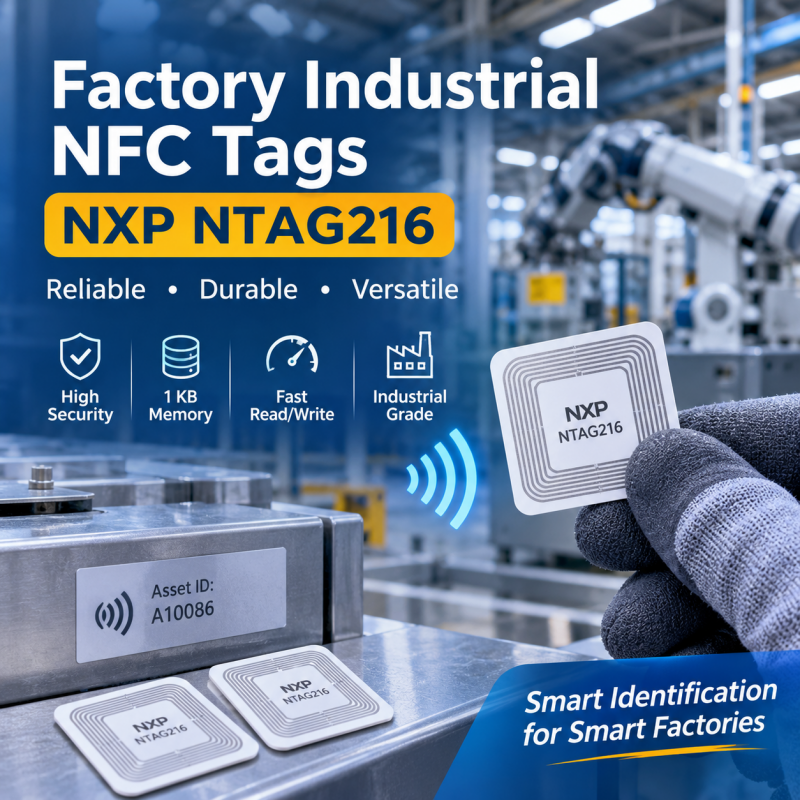
1. What Are Factory Industrial NFC Tags with NXP NTAG216?
Factory industrial NFC tags are contactless identification devices manufactured for applications that require consistent identification and data access in industrial environments.
They integrate an NFC chip, an antenna, and a protective structure into one finished product. Depending on the application, the tag may be manufactured as a compact disc, rugged plastic housing, PPS tag, flexible FPC inlay, or custom NFC label.
The NXP NTAG216 is one of the popular NFC chip options for these applications.
It operates at 13.56 MHz and complies with ISO/IEC 14443 Type A and NFC Forum Type 2 specifications. Its 888-byte user memory provides sufficient capacity for many identification and information-sharing applications.
For industrial users, this means a single NFC tag can provide access to information such as:
- Equipment identification numbers
- Product serial numbers
- Maintenance and inspection records
- Manufacturing batch information
- Digital product documentation
- Asset management URLs
- Inventory identification data
An important distinction is that the NTAG216 chip itself does not determine whether a finished tag is waterproof, chemical-resistant, or suitable for high-temperature applications. Those properties depend on the complete tag construction.
Therefore, selecting an industrial NFC tag should always begin with the intended application and installation environment.
2. NXP NTAG216 Technical Specifications
Understanding the chip specifications is essential before selecting a customized industrial NFC tag.
The NTAG216 belongs to the NXP NTAG21x family, alongside NTAG213 and NTAG215. Among these three options, NTAG216 offers the largest user memory capacity.
NTAG216 Technical Specification Table
| Parameter | NTAG216 Specification |
|---|---|
| Chip Manufacturer | NXP Semiconductors |
| Chip Model | NTAG216 |
| NFC Frequency | 13.56 MHz |
| Communication Standard | ISO/IEC 14443 Type A |
| NFC Forum Standard | Type 2 |
| Total EEPROM Capacity | 924 bytes |
| Available User Memory | 888 bytes |
| Data Transfer Rate | 106 kbit/s |
| Unique Identifier | 7-byte UID |
| Write Endurance | 100,000 cycles |
| Data Retention | 10 years |
| Password Protection | 32-bit password |
| Originality Signature | ECC-based originality signature |
| Communication | Contactless |
| Power Supply | Passive, no battery required |
Note: These are IC-level specifications. Finished tag performance depends on antenna design, housing materials, installation conditions, and product configuration.
Why Does 888 Bytes of User Memory Matter?
One common misunderstanding in the NFC industry is the difference between total memory and available user memory.
NTAG216 contains 924 bytes of EEPROM in total, but 888 bytes are freely available for user data. The remaining memory is used for manufacturer information, configuration, access control, and other system functions.
Compared with other NTAG21x chips:
| Chip | Available User Memory |
|---|---|
| NTAG213 | 144 bytes |
| NTAG215 | 504 bytes |
| NTAG216 | 888 bytes |
For industrial applications, the additional memory can be useful when a project needs to store longer URLs, identification information, or structured NDEF records.
However, an NFC tag should not be treated as a complete database. For large maintenance histories, production records, or inventory databases, it is generally better to store a unique asset identifier or database URL on the tag and maintain detailed records in an ERP, MES, or asset management platform.
This approach keeps the tag data simple while allowing the digital system to handle more complex information.
3. What Makes an NFC Tag Suitable for Industrial Environments?
An industrial NFC tag is not simply a standard NFC sticker with a different name.
The finished product must be designed around the actual conditions in which it will operate.
Several factors determine whether an NFC tag is suitable for industrial deployment.
3.1 Protective Housing and Mechanical Strength
Industrial tags may be installed on machines, tools, containers, reusable equipment, or production components.
These environments can expose tags to:
- Repeated physical contact
- Scratches and abrasion
- Vibration
- Pressure washing
- Dust and moisture
- Temperature changes
- Frequent handling
A protective housing helps shield the internal antenna and chip from environmental damage.
Depending on the application, ABS, PPS, epoxy, and other suitable materials can be considered.
3.2 Waterproof and Dustproof Construction
Manufacturing facilities, outdoor equipment areas, and industrial cleaning environments may expose NFC tags to water, dust, and cleaning procedures.
A sealed enclosure or suitable protective coating can improve resistance to these conditions.
However, waterproof performance must be verified on the finished product rather than assumed from the material name.
If your application requires IP67 or IP68 protection, specify the required standard and request corresponding test documentation.
3.3 Reliable NFC Antenna Performance
The antenna is just as important as the chip.
NTAG216 requires an antenna to communicate with an NFC reader or smartphone. Antenna dimensions, coil geometry, tuning, and surrounding materials influence the reading performance.
For example, installing a conventional NFC sticker directly on metal may reduce its reading performance significantly.
An anti-metal structure, often incorporating a suitable ferrite layer, can help isolate the NFC antenna from the metal surface.
This is particularly important for industrial equipment identification and metal asset tracking.
3.4 Environmental Temperature Resistance
Temperature requirements vary considerably between applications.
A standard NFC inlay, an ABS housing, and a high-temperature PPS tag do not have identical thermal characteristics.
When evaluating an industrial NFC tag, buyers should distinguish between:
- Chip operating temperature
- Housing material temperature resistance
- Adhesive temperature resistance
- Storage temperature
- Short-term exposure temperature
- Continuous operating temperature
The NTAG21x IC datasheet specifies an ambient operating range of -25°C to +70°C.
Some specially constructed finished tags may have different material or exposure ratings. These should be verified through product-specific testing and technical documentation.
For high-temperature production environments, selecting the housing alone is not enough. The antenna, chip attachment, and complete assembly must also be evaluated.
4. Available Industrial NFC Tag Materials and Structures
Choosing the right material is one of the most important decisions when ordering custom industrial NFC tags.
Different materials offer different advantages, and there is no single construction suitable for every industrial application.
ABS Industrial NFC Tags
ABS is a practical material for general-purpose industrial NFC products.
Its advantages include:
- Good mechanical strength
- Lightweight construction
- Flexible molding options
- Suitable for different tag shapes and sizes
- Practical for bulk manufacturing
ABS NFC tags are commonly considered for equipment identification, reusable containers, warehouse assets, and industrial product tracking.
For applications involving direct metal mounting, an anti-metal structure should be evaluated.
PPS Industrial NFC Tags
PPS (Polyphenylene Sulfide) is an engineering thermoplastic used in applications requiring higher thermal and chemical resistance.
Compared with conventional plastic housings, PPS can be a better choice for demanding industrial processes.
Typical applications include:
- Commercial laundry management
- Textile tracking
- Industrial washing systems
- Reusable equipment identification
- Selected high-temperature applications
DO RFID offers a 20 mm PPS NFC tag configuration integrating the NXP NTAG216 chip.
For more information, visit our NTAG216 PPS industrial tags.
Epoxy NFC Tags
Epoxy-coated NFC tags provide a sealed surface and can offer improved protection against moisture, scratches, and everyday handling.
They are suitable for applications such as:
- Equipment identification
- Product identification
- Reusable asset labels
- Custom branded NFC products
The final waterproof rating depends on the complete encapsulation process and should be confirmed for the selected model.
Anti-Metal NFC Tags
Metal surfaces create challenges for conventional NFC antennas because they can interfere with electromagnetic coupling.
Anti-metal NFC tags are designed with additional isolation structures to improve performance when mounted on metal.
Typical applications include:
- Industrial machinery
- Metal equipment cabinets
- Tools and instruments
- Metal storage containers
- Factory production equipment
When specifying an anti-metal tag, buyers should provide the metal surface type, available installation space, and required reading distance.
Flexible FPC NFC Tags
For applications where installation space is extremely limited, flexible printed circuit (FPC) NFC tags can provide a compact alternative.
They are useful for integration into electronic products, embedded assemblies, and space-constrained devices.
Explore our custom 5mm FPC NFC tags for compact NFC integration projects.
5. Main Industrial Applications of NXP NTAG216 NFC Tags
The NTAG216 chip combines contactless communication, rewritable memory, and a compact antenna design.
These features make it suitable for many identification and data-access applications.
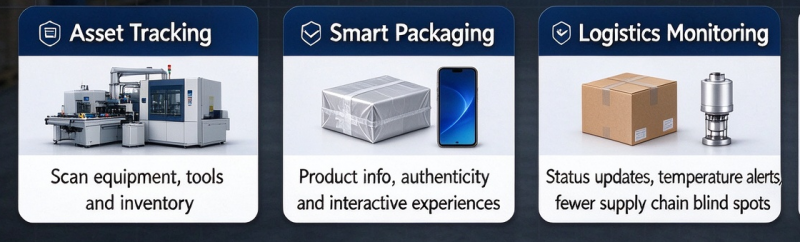
5.1 Industrial Asset Tracking
Industrial companies manage large numbers of machines, tools, instruments, and reusable assets.
Traditional labels can become damaged, unreadable, or difficult to update.
An NTAG216 NFC tag can provide each asset with a unique identification point.
When an employee taps the tag with an NFC-enabled device, the system can open the corresponding asset record.
Possible information includes:
- Asset ID
- Equipment model
- Maintenance history
- Inspection instructions
- Responsible department
- Service documentation
This makes asset identification more convenient and helps reduce manual data-entry errors.
5.2 Manufacturing Process Management
In manufacturing facilities, NFC tags can be attached to workstations, reusable fixtures, production containers, or individual products.
Workers can scan the tag to access process instructions, production information, or quality inspection records.
For example, a production fixture may carry an NFC tag containing its unique ID and a URL linking to its maintenance history.
This supports digital manufacturing workflows without requiring employees to manually search for equipment records.
5.3 Industrial Laundry and Textile Management
Industrial laundry operations involve repeated washing, drying, handling, and sorting.
Standard paper labels and ordinary stickers may not survive these conditions.
A properly engineered PPS NFC tag can offer a more suitable construction for reusable textile identification.
Applications include:
- Hotel linen tracking
- Hospital textile management
- Uniform identification
- Laundry sorting
- Reusable textile inventory
The tag’s thermal and chemical resistance should be matched to the actual washing and processing conditions.
5.4 Warehouse and Logistics Management
Warehouses need accurate identification of storage containers, reusable transport units, and inventory assets.
Industrial NFC tags can simplify access to item information through contactless scanning.
For example, a warehouse employee can scan an NFC tag to retrieve:
- Container identification
- Product information
- Storage instructions
- Inventory references
- Shipment documentation
NFC is particularly useful for close-range identification and manual verification.
For applications requiring simultaneous reading of many items or long-range identification, UHF RFID may be a more appropriate technology.
5.5 Equipment Maintenance and Inspection
Maintenance teams often need fast access to equipment documentation.
An NFC tag attached to a machine can link employees to:
- Maintenance instructions
- Equipment manuals
- Inspection checklists
- Service records
- Technical support information
Instead of searching through paper documents, technicians can use an NFC-enabled smartphone or reader to access the relevant digital information.
This can improve maintenance efficiency and simplify equipment management.
6. NTAG216 vs. NTAG215 vs. NTAG213: Which Chip Should You Choose?
Selecting the right chip can influence product cost, available memory, and project functionality.
Although NTAG213, NTAG215, and NTAG216 belong to the same NFC chip family, their user memory capacities are different.
| Feature | NTAG213 | NTAG215 | NTAG216 |
|---|---|---|---|
| User Memory | 144 bytes | 504 bytes | 888 bytes |
| Frequency | 13.56 MHz | 13.56 MHz | 13.56 MHz |
| NFC Standard | Type 2 | Type 2 | Type 2 |
| ISO Standard | 14443A | 14443A | 14443A |
| Write Endurance | 100,000 cycles | 100,000 cycles | 100,000 cycles |
| Data Retention | 10 years | 10 years | 10 years |
| Typical Positioning | Basic identification | Medium data requirements | Larger memory requirements |
When Should You Choose NTAG213?
NTAG213 is suitable for simple applications such as website links, basic product identification, and short NDEF messages.
If your project only needs a small amount of data, choosing NTAG216 may not provide meaningful additional value.
When Should You Choose NTAG215?
NTAG215 provides a middle ground between memory capacity and application requirements.
It is suitable for projects requiring more data than NTAG213 but not the full 888 bytes available with NTAG216.
When Should You Choose NTAG216?
NTAG216 is a practical choice when your application requires greater user memory capacity.
It is particularly suitable for industrial identification projects involving longer URLs, multiple NDEF records, or more detailed identification information.
For buyers developing custom NFC products, DO RFID can help evaluate the appropriate chip according to the intended application and budget.
7. Custom Industrial NFC Tags from a Professional Factory
For industrial buyers, purchasing a standard NFC tag is not always enough.
Many projects require customized dimensions, materials, printing, encoding, or installation structures.
A manufacturer with in-house production capabilities can help adapt the finished tag to the application.
At DO RFID, customization can be discussed around several important factors.
7.1 Custom Size and Shape
Industrial NFC tags can be developed in different dimensions depending on the available mounting space.
Possible formats include:
- Round NFC discs
- Square NFC tags
- Rectangular NFC labels
- Compact embedded NFC tags
- Customized molded housings
The size of the antenna should also be considered because reducing the overall dimensions may affect RF performance.
7.2 Custom Material Selection
Depending on the project, material options can include ABS, PPS, epoxy, PET, and other suitable structures.
For metal mounting applications, anti-metal configurations can also be evaluated.
Our industrial NFC tags and labels provide additional options for different installation requirements.
7.3 Logo Printing and Product Identification
For OEM and ODM customers, customized surface identification can improve product management and branding.
Available options may include:
- Company logo printing
- Serial number printing
- QR code integration
- Barcode printing
- Custom colors
- Product model identification
The appropriate printing process depends on the selected tag material and product construction.
7.4 Pre-Programming and Data Encoding
Tags can be supplied blank or programmed according to project requirements.
Common encoding options include:
- Website URLs
- NDEF text records
- Unique identification references
- Asset management links
- Custom data structures
For larger projects, buyers should provide the encoding format and data file before production.
It is also important to clarify whether tags should remain rewritable or be permanently locked after programming.
7.5 Flexible OEM and ODM Manufacturing
A customized NFC project generally involves more than selecting a chip.
The factory needs to understand the actual installation environment, expected product lifespan, data requirements, and reader configuration.
DO RFID supports customized RFID and NFC manufacturing, including custom NFC stickers and other NFC product formats.
8. How Does a Factory Manufacture and Test Industrial NFC Tags?
Manufacturing quality is an important consideration when purchasing NFC tags in bulk.
Even when two products use the same NTAG216 chip, differences in antenna construction, assembly, encapsulation, and testing can influence their performance.
A professional manufacturing process should include several key stages.
Step 1: Project Requirement Evaluation
Before production, the manufacturer should understand:
- Application environment
- Installation surface
- Required dimensions
- Chip selection
- Reading requirements
- Temperature conditions
- Waterproof requirements
- Expected order quantity
This information helps determine the correct tag construction.
Step 2: Antenna and Chip Integration
The NTAG216 chip must be properly connected to the NFC antenna.
Antenna design and assembly quality directly influence communication performance.
Step 3: Housing and Encapsulation
The inlay is integrated into the selected protective structure.
Depending on the product, this may involve molding, lamination, bonding, or encapsulation.
Step 4: NFC Functional Testing
Finished products should be checked for:
- Chip recognition
- UID reading
- NDEF data writing
- Data reading
- Memory locking functionality
- Communication stability
Step 5: Environmental and Mechanical Verification
Where required, the finished tag should undergo tests appropriate to the target application.
These may include:
- Temperature testing
- Waterproof testing
- Dust resistance testing
- Adhesion testing
- Mechanical impact testing
- Chemical exposure testing
Not every tag requires every test. The inspection plan should match the product specification.
Step 6: Batch Inspection and Packaging
Before shipment, products should undergo the agreed final inspection process.
For large-volume orders, buyers should confirm the sampling plan, acceptance criteria, traceability requirements, and packaging method before production begins.
9. How to Choose the Right Industrial NFC Tag Manufacturer?
Choosing a factory is not simply about finding the lowest unit price.
For industrial projects, the quality of the finished product and the manufacturer’s ability to meet technical requirements are equally important.
Here are six factors worth evaluating.
1. Genuine NXP Chip Selection
Confirm that the supplier can provide the requested NXP NTAG216 chip and relevant product specifications.
For projects with strict traceability requirements, discuss chip sourcing and verification procedures.
2. Custom Manufacturing Capabilities
Check whether the factory can support different materials, sizes, antenna structures, and installation methods.
A supplier offering multiple configurations is often better positioned to support changing project requirements.
3. Technical Testing
Ask how the supplier verifies NFC functionality, reading performance, waterproofing, and other application-specific requirements.
Request test documentation where relevant.
4. Sample Availability
Always evaluate samples before committing to a large production order.
Test the tags using your actual readers, smartphones, mounting surfaces, and operating environment.
5. Production and Delivery Capacity
Confirm production lead time, batch consistency, packaging requirements, and delivery arrangements.
6. Communication and After-Sales Support
A responsive supplier can make a significant difference during product development and large-scale deployment.
DO RFID Group has its own RFID and NFC manufacturing facilities and provides customized manufacturing services for international business customers.
To explore additional products, visit our NXP NTAG series NFC tags and micro NFC tags product categories.
10. Frequently Asked Questions About Industrial NTAG216 NFC Tags
Q1. What is the memory capacity of an NXP NTAG216 NFC tag?
NTAG216 has 924 bytes of total EEPROM capacity, including 888 bytes of freely available user memory.
This is more than NTAG215, which offers 504 bytes, and NTAG213, which offers 144 bytes.
Q2. Can NTAG216 NFC tags be used in industrial environments?
Yes. NTAG216 can be integrated into different industrial tag structures, including ABS, PPS, epoxy, and anti-metal configurations.
However, industrial suitability depends on the complete tag construction and the environmental conditions in which it will be installed.
Q3. Are NTAG216 industrial NFC tags waterproof?
The NTAG216 chip itself does not provide waterproof protection.
Waterproof performance depends on the housing, sealing, bonding, and encapsulation design of the finished product.
If a project requires IP67 or IP68 protection, buyers should request testing documentation for the specific tag model.
Q4. Can NTAG216 NFC tags work on metal surfaces?
A standard NFC inlay may experience reduced reading performance when installed directly on metal.
For these applications, an anti-metal NFC tag with an appropriate isolation structure should be selected.
The final configuration should be tested on the actual metal surface.
Q5. Can NTAG216 be read by smartphones?
NTAG216 follows ISO/IEC 14443 Type A and NFC Forum Type 2 specifications, making it compatible with many NFC-enabled smartphones and readers.
Actual compatibility depends on the device’s NFC capabilities, operating system, software, antenna design, and tag installation.
Q6. Can industrial NTAG216 tags be customized?
Yes. Depending on the product configuration, customization can include:
- Dimensions and shape
- Housing materials
- Logo and surface printing
- QR code and serial number printing
- Pre-programmed URLs or NDEF data
- Adhesive and mounting structure
- Anti-metal design
Q7. Is NTAG216 suitable for high-temperature applications?
The NTAG216 IC has a specified ambient operating temperature range of -25°C to +70°C.
Specially designed finished products may use materials capable of withstanding higher temperatures, but the entire tag assembly must be evaluated.
For high-temperature applications, discuss the actual temperature profile, exposure duration, and operating conditions with the manufacturer.
Q8. Does NTAG216 support encryption and secure authentication?
NTAG216 supports configurable 32-bit password protection and an ECC-based originality signature.
However, it does not provide the AES-128 secure messaging features available in more advanced NFC chips such as NTAG424 DNA.
If your project requires cryptographic authentication or stronger anti-counterfeiting protection, consider a security-oriented chip instead.
Q9. Can I order custom NTAG216 NFC tags in bulk?
Yes. Industrial NFC tag manufacturers can provide customized products for bulk orders, depending on the required materials, dimensions, chip configuration, and production process.
It is recommended to test samples and confirm specifications before starting mass production.
Q10. What information should I provide when requesting an NTAG216 NFC tag quotation?
To receive a more accurate quotation, prepare the following information:
- Required quantity
- NTAG216 chip requirement
- Desired dimensions and shape
- Installation surface (metal, plastic, glass, or textile)
- Material preference
- Waterproof or temperature requirements
- Printing and encoding requirements
- Target application
Providing these details helps the factory recommend a suitable configuration and evaluate production costs more accurately.
11. Get Custom Factory Industrial NFC Tags from DO RFID
Choosing the right industrial NFC tag means balancing chip functionality, physical construction, installation requirements, and long-term reliability.
The NXP NTAG216 offers 888 bytes of user memory, passive contactless operation, password protection, and compatibility with NFC Forum Type 2 applications.
When combined with an appropriately engineered industrial housing, it can support a wide range of asset identification, manufacturing, equipment management, and logistics applications.
DO RFID is ready to support your industrial NFC tag project.
Whether you need PPS high-temperature NFC tags, ABS industrial tags, anti-metal NFC products, compact FPC tags, or customized NFC labels, our team can help evaluate the appropriate product configuration.
DO RFID – Your Manufacturing Partner for Customized Industrial NFC Tags.

Au is an RFID and NFC manufacturer based in Shenzhen, China, with over 10 years of experience.