October 21, 2026
DO RFID manufactures compact 134.2 kHz RFID glass tags for individual fish identification, aquaculture records and research programs. The sealed transponder format is intended to provide a permanent machine-readable identity when an external visual tag is unsuitable.
This page describes an EM4305-based LF RFID glass-tag offering. A successful project depends on more than the transponder alone: tag dimensions, implantation method, fish size and species, reader coil, reading distance, handling procedure and database workflow all affect the result.
| Specification | Details |
|---|---|
| Frequency | 134.2 kHz |
| Chip | EM4305 |
| Communication Type | Low Frequency RFID |
| Read/Write | Read & Write |
| Housing Material | Biocompatible Glass |
| Operating Mode | Passive RFID |
| Reading Distance | Approximately 5–30 cm (reader dependent) |
| Power Source | Battery-free |
| Service Life | More than 20 years |
| Implantation Method | Sterile injector |
| Frequency | Standard: 134.2KHz, Optional: LF 125KHz, HF 13.56MHz/NFC |
| Material: | Bioglass with Parylene coating |
| Size | Standard: 2.12*12mm, 1.25*7mm, 1.4*8mm, Optional: 2.12*8mm, 3*15mm, 4*32mm |
| Chip | EM4305 |
| Protocol | ISO11784/11785, FDX-B, FDX-A, HDX, NFC HF ISO14443A are available for option |
| Work tem | -20 ℃~50℃ |
| Store Tem. | -40 ℃~70℃ |
| Read and write times | >100000 |
| Sryinge material | Polypropylene |
| Sryinge color | Green, White, Blue, Red for selection |
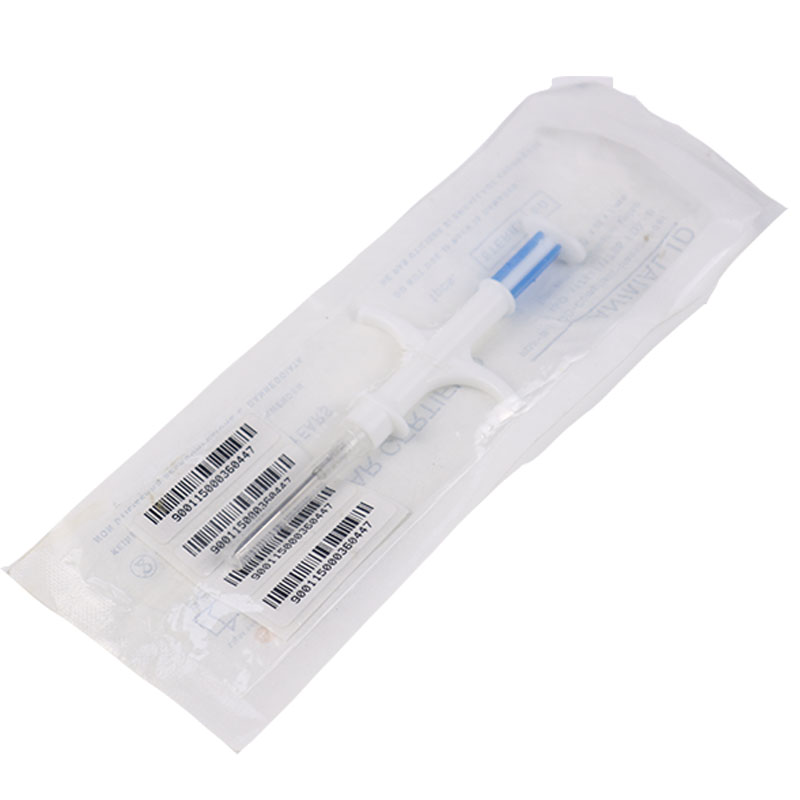
| Packing material | 1 syringe with 1 pre-loaded microchip, then packed in 1 Medical-grade sterilization pouch Microchip with needle or microchip without syringe or needle are for option too. |
| Application | animal pet Identification |
| Technology | EM4305 Glass RFID Tag | PIT Tag | External Tag | Fin Clipping |
| Permanent Identification | Excellent | Excellent | Moderate | Limited |
| Read/Write Capability | Yes | Usually No | No | No |
| Risk of Loss | Very Low | Very Low | High | None |
| Digital Data Management | Excellent | Good | Limited | Manual |
| Suitable for Research | Excellent | Excellent | Moderate | Limited |
| Long-Term Reliability | Excellent | Excellent | Moderate | Low |


Product role and RFID operation
The passive glass tag contains an LF RFID IC and antenna inside a sealed glass capsule. It has no battery. When it enters the magnetic field of a compatible reader, the tag powers up and returns its stored identifier or configured data.
The 134.2 kHz operating frequency is commonly associated with animal-identification workflows. However, frequency alone does not guarantee compatibility. Buyers should confirm the reader protocol, data format and any required compliance profile. An EM4305-based configurable transponder should not automatically be represented as equivalent to every standardized animal-ID tag without confirming the programmed data structure and system requirements.
Uses in aquaculture and fisheries
RFID fish tags can support broodstock and breeding records, growth studies, feeding trials, movement or survival research, high-value fish identification and controlled hatchery or aquarium management. Each scan can connect the individual animal to records such as origin, measurements, treatment events or study observations.
Compared with an external tag, an implanted glass transponder is less exposed to abrasion or loss. It does not by itself provide long-range or continuous location tracking: staff must bring a compatible reader within the tag’s practical read zone. It is therefore best understood as individual electronic identification, which can support tracking records when scans are captured at defined handling points.
Configuration and project planning
DO RFID can discuss glass-tube dimensions, chip programming, numbering, packaging and reader requirements for OEM and research supply projects. The smallest available tag is not automatically appropriate for every fish. Animal welfare, implantation site, retention and scanning procedures should be established by qualified project personnel for the species and study.
Before ordering, confirm:
- fish species and approximate size at tagging;
- required tag dimensions and quantity;
- EM4305 memory or identifier programming;
- reader model, coil geometry and expected scan procedure;
- numbering, database and label-matching requirements;
- sterile or individual packaging requirements, if applicable;
- applicator or injector requirements;
- applicable animal-identification, research and local regulatory requirements.
Read range is normally short and varies with transponder size, reader antenna, orientation, water, container geometry and electromagnetic noise. Testing the proposed tag and reader with the real handling setup is important before a volume deployment.
EM4305 selection boundaries
EM4305 is a configurable LF RFID chip, which can be useful when a project needs programmed identifiers or a defined data format. The configured mode must match the reader and software. If the program requires a particular ISO 11784/11785 animal-identification implementation, confirm the complete encoded format and reader compatibility rather than relying only on the 134.2 kHz label.
For projects that need automatic movement detection across gates or long-distance location, another tag architecture may be necessary. A passive glass microchip is optimized for close-range identity verification, not GPS-like tracking.
Request a fish RFID tag sample or quotation
Share the fish application, tag size, reader, encoding format, quantity, packaging and deployment procedure with DO RFID. Our factory can prepare a suitable EM4305 glass-tag configuration for evaluation and help coordinate transponders, readers and project data requirements. Sample testing provides practical evidence before production and field use.