
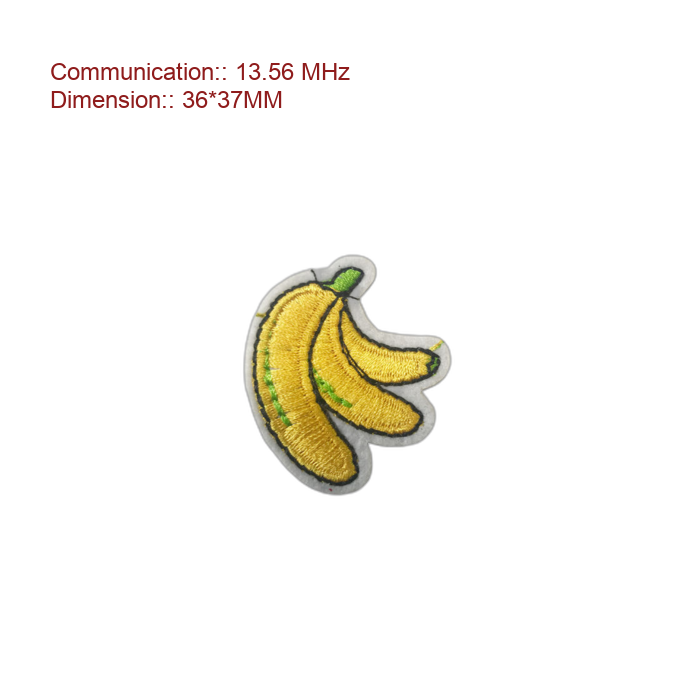
The global textile and garment industry is rapidly embracing RFID technology to improve inventory accuracy, automate laundry operations, enhance brand protection, and optimize supply chain management. Traditional barcode labels often fade, tear, or become unreadable after repeated washing, making them unsuitable for uniforms, hotel linens, hospital textiles, workwear, and reusable garments.
To address these challenges, manufacturers have developed Washable NFC Fabric Woven Laundry RFID Clothing Tags. These tags combine a durable woven fabric structure with an embedded NFC/RFID chip, allowing garments to be identified automatically throughout their entire lifecycle—even after hundreds of industrial washing, drying, ironing, and sterilization cycles.
Whether used by commercial laundries, hospitals, hotels, apparel brands, or textile rental companies, washable NFC fabric RFID tags provide reliable, contactless identification while significantly reducing labor costs and improving operational efficiency.
This guide explains what washable NFC fabric woven laundry RFID clothing tags are, how they work, the problems they solve, their application scenarios, and how they compare with other garment identification technologies.
What Is a Washable NFC fabric-woven laundry RFID Clothing Tag?
A Washable NFC Fabric Woven Laundry RFID Clothing Tag is a textile-integrated RFID label designed specifically for garments and reusable fabrics.
Unlike paper RFID stickers or plastic cards, these tags are manufactured using flexible woven fabric materials that can be permanently sewn into clothing without affecting comfort or appearance.
A typical tag consists of:
- Soft woven polyester fabric
- Flexible RFID/NFC antenna
- Embedded RFID chip
- Waterproof encapsulation
- High-temperature resistant protective layer
Because the RFID chip is fully sealed inside the fabric, the tag continues to function after repeated exposure to water, detergents, high temperatures, and mechanical washing.
Depending on the application, manufacturers can integrate different RFID chips, including:
- NFC (13.56 MHz)
- ISO 15693
- ISO 14443A
- UHF EPC Gen2
- Custom RFID ICs
The choice depends on reading distance, system compatibility, and project requirements.
How Does a Washable RFID Clothing Tag Work?
Washable RFID clothing tags operate using passive RFID technology, meaning they require no battery.
Step 1: RFID Reader Generates a Radio Signal
An RFID reader emits radio waves at the appropriate operating frequency.
The tag may be read by:
- Laundry tunnel readers
- Handheld RFID scanners
- NFC-enabled smartphones
- Fixed inventory readers
- Conveyor-mounted antennas
Step 2: Tag Harvests Energy
The woven antenna inside the fabric captures radio energy through electromagnetic induction.
This powers the RFID chip instantly.
Step 3: Chip Transmits Identification Data
Once activated, the RFID chip sends information such as:
- Unique serial number
- Garment ID
- Laundry history
- Production batch
- Rental information
- Employee assignment
- Maintenance records
The process typically takes only a fraction of a second.
Step 4: Software Updates the Database
The RFID management system automatically records:
- Washing count
- User assignment
- Storage location
- Inventory status
- Delivery records
- Maintenance schedules
This creates complete lifecycle visibility for every textile item.
Key Features
Washable NFC fabric RFID tags offer numerous advantages over conventional clothing labels.
Washable and Durable
Industrial laundry environments are extremely demanding.
High-quality RFID laundry tags typically withstand:
- Hundreds of washing cycles
- Industrial dryers
- Steam sterilization
- High-pressure extraction
- Chemical detergents
- Ironing and pressing
This ensures long-term reliability without frequent replacement.
Flexible Fabric Construction
Unlike rigid plastic tags, woven fabric tags remain soft and comfortable.
They can be:
- Sewn into seams
- Inserted into hems
- Embedded inside labels
- Hidden inside garments
The wearer rarely notices the tag during daily use.
Battery-Free Operation
Passive RFID technology eliminates batteries entirely.
Benefits include:
- Zero maintenance
- Long service life
- Lightweight design
- Lower ownership costs
- Reliable long-term performance
Fast Contactless Reading
Unlike barcodes that require direct line-of-sight scanning, RFID readers can identify garments automatically.
Multiple garments can often be scanned simultaneously, greatly improving efficiency during inventory checks and laundry sorting.
Excellent Data Accuracy
Every RFID chip contains a globally unique identifier.
This minimizes human error and eliminates duplicate garment records.
Problems These RFID Tags Solve
1. Lost Garments
Hotels, hospitals, and industrial laundries often lose thousands of textile items annually.
RFID enables continuous tracking throughout the washing process, significantly reducing misplaced inventory.
2. Manual Inventory Is Slow
Counting uniforms or linens manually requires considerable labor.
RFID readers automatically identify hundreds of garments within seconds, dramatically reducing inventory time.
3. Barcode Labels Wear Out
Traditional barcode labels fade or peel after repeated washing.
Fabric RFID tags remain functional even after prolonged industrial use, providing much greater durability.
4. Laundry Process Errors
Without accurate identification, garments may be sent to the wrong customer or department.
RFID systems automatically verify ownership and destination before delivery, reducing sorting mistakes.
5. Poor Lifecycle Visibility
Many organizations cannot determine how many times a garment has been washed or when it should be replaced.
RFID software records the complete usage history of every item, enabling preventive replacement and better asset management.
Application Scenarios
Commercial Laundry Services
Large-scale laundry companies use RFID tags to automate:
- Garment receiving
- Sorting
- Washing
- Drying
- Folding
- Packaging
- Delivery verification
Automation improves throughput while reducing labor costs.
Hospitals
Hospitals manage thousands of reusable textiles every day.
RFID helps track:
- Surgical gowns
- Patient clothing
- Bed linens
- Blankets
- Towels
- Staff uniforms
This improves hygiene management and ensures adequate inventory.
Hotels and Resorts
Hotels rely on RFID to manage:
- Bed sheets
- Pillowcases
- Bath towels
- Spa robes
- Restaurant linens
- Housekeeping uniforms
Real-time tracking reduces replacement costs and improves service quality.
Uniform Rental Companies
Industrial uniform rental providers use RFID to monitor:
- Employee uniforms
- Safety clothing
- Protective garments
- Rental contracts
- Return status
- Cleaning schedules
Each garment can be assigned to a specific employee throughout its lifecycle.
Apparel Manufacturing
Clothing manufacturers increasingly embed washable RFID tags for:
- Production tracking
- Warehouse management
- Retail inventory
- Brand authentication
- Product traceability
The same tag can continue functioning after the garment reaches the consumer.
Smart Retail
Fashion retailers can use washable NFC tags to enable:
- Product authentication
- Digital product information
- Customer interaction
- Warranty registration
- After-sales support
Consumers simply tap the garment with an NFC-enabled smartphone to access digital content.
Competitive Analysis
Selecting the right garment identification technology depends on durability, automation requirements, and long-term operating costs.
Washable RFID Tags vs Barcode Labels
| Feature | Washable RFID Tag | Barcode Label |
|---|---|---|
| Contactless Reading | Yes | No |
| Line-of-Sight Required | No | Yes |
| Multiple Item Reading | Yes | No |
| Wash Resistance | Excellent | Poor |
| Automation | High | Limited |
| Lifespan | Hundreds of wash cycles | Often damaged after repeated washing |
RFID significantly outperforms barcodes in demanding laundry environments.
NFC Fabric Tags vs UHF Laundry Tags
NFC Fabric Tags
Advantages:
- Smartphone compatibility
- Secure short-range communication
- Ideal for authentication and customer interaction
Limitations:
- Shorter reading distance
UHF Laundry Tags
Advantages:
- Long reading range
- Bulk garment scanning
- High-speed warehouse inventory
Limitations:
- Requires dedicated UHF readers
- Not compatible with standard NFC smartphones
Organizations focused on commercial laundry automation often choose UHF, while apparel brands and consumer-facing products may prefer NFC for smartphone interaction.
Fabric Woven Tags vs Plastic RFID Tags
Plastic RFID tags are suitable for rigid assets but can reduce wearer comfort when attached to clothing.
Fabric woven RFID tags offer:
- Better flexibility
- Improved comfort
- Easier sewing
- Superior appearance
- Better durability during repeated washing
For garments and textiles, woven fabric tags are generally the preferred solution.
How to Choose a Reliable Washable RFID Clothing Tag Supplier
When selecting a supplier, buyers should evaluate several factors:
- RFID chip options (NFC, UHF, ISO standards)
- Washing cycle durability
- Heat and chemical resistance
- Fabric quality and flexibility
- Reading performance
- Custom logo and label printing
- Encoding and serialization services
- OEM and private label capabilities
- Quality certifications
- Large-scale production capacity
An experienced supplier can also assist with chip selection, system integration, and customization based on specific industry requirements.
OEM / ODM Manufacturing Support
As an do rfid reader manufacturer with dedicated RFID tag production lines, we offer comprehensive OEM and ODM services for this washable fabric label. Customers purchasing for large-scale deployment or project integration can specify:
- Custom antenna tuning — impedance matching adjusted for specific fabric thickness, dielectric constant, or reader platform compatibility
- Pre-programmed NDEF payloads — URL, text, vCard, or custom binary data written at factory with locked read-only or read/write configuration
- UID range reservation — sequential or patterned UID blocks for customers who require unique serial ranges for database integration
- Custom label dimensions and shape — die-cut to specific geometry for seam placement, buttonhole insertion, or branding requirements
- Branded printing and encoding — logo, barcode, QR code, or human-readable text printed on fabric surface with wash-resistant ink
- Packaging format options — rolls, sheets, individual pouches, or bulk boxes to match your deployment workflow
- Material customization — fabric color, weave pattern, backing adhesive, or reinforcement layer for specific sewing or heat-press methods
Factory Production Advantages
Our manufacturing facility supports stable long-term supply for distributors, wholesalers, and project contractors who require consistent tag performance across multiple deployment phases. Key production capabilities include:
- Automated chip bonding and antenna lamination — precision placement reduces impedance variation between tags, ensuring consistent read range across each batch
- In-line quality inspection — every tag is tested for resonance frequency, read range, and memory function before packing, with rejection rate below 0.5%
- Batch consistency protocols — production lots are tracked by raw material batch, tuning parameters, and test results, enabling traceability for quality audits
- Flexible production capacity — monthly output exceeds 500,000 units with the ability to scale for large project orders within 10 working days
- Fast lead time — samples ship within 1–7 days, mass production orders deliver within 7–20 days depending on quantity and customization complexity
- Export packaging and documentation — products packed for international freight with commercial invoice, packing list, and material safety data sheet when required
- Long-term supply agreements — volume-based pricing, scheduled delivery, and reserved production capacity available for ongoing distributor and project partnerships
Bulk Supply & Project Deployment Support
Wholesale buyers and system integrators benefit from our structured bulk supply framework designed for commercial and industrial RFID projects:
- Volume-tiered pricing — per-unit cost decreases at 1,000, 5,000, 10,000, 50,000, and 100,000+ quantity breaks, making large-scale deployment economically feasible
- Compatibility testing support — sample tags provided for integration testing with existing reader infrastructure, middleware, or ERP systems before full order commitment
- Project consultation — our engineering team reviews application environment, washing protocol, reader placement, and data requirements to recommend optimal tag configuration
- Consistent batch performance — all tags in an order are produced from the same material lot and tuning setup, eliminating read range variation across deployment zones
- Replenishment reliability — repeat orders match previous specifications exactly, ensuring replacement tags integrate seamlessly into existing tagged inventory
- Distributor cooperation — dedicated pricing, inventory buffer, and marketing support for partners stocking this label for regional project demand
FAQ
1. What is the minimum order quantity for the 36×37 mm washable NFC fabric label?
For stock samples, we provide free samples with the buyer covering shipping. For customized samples, a reasonable production fee is charged and refunded after order confirmation. Minimum production quantity starts at 500 pieces for standard configuration; lower quantities can be discussed for pilot projects.
2. How do I get a price quotation for bulk quantities?
Send your inquiry with target quantity, desired customization (printing, encoding, packaging), and delivery timeline. We respond with a detailed quotation within 24 hours including per-unit pricing, tooling or setup fees if applicable, and estimated lead time.
3. Which chips can I choose for this fabric label?
The standard configuration uses NXP NTAG 213 (180 bytes, 144 bytes user area). If your application requires larger memory, we can integrate NTAG 215 (540 bytes, 504 bytes user area) or NTAG 216 (924 bytes, 888 bytes user area) in the same fabric form factor. Contact us with your data payload size for a recommendation.
4. How many wash cycles does the label survive?
The label is tested to withstand 50+ industrial wash cycles at 85°C followed by high-temperature drying and ironing. Actual lifespan depends on wash chemistry, mechanical agitation, and drying temperature. We provide wash test data for your specific process upon request.
5. What payment methods do you accept?
We accept T/T bank transfer, Ali Trade Assurance for mass production orders, and PayPal for sample orders and smaller quantities.
6. Can the label be sewn or heat-pressed?
Yes. The fabric substrate supports both sewing into seams or hems and heat-press application using standard textile transfer equipment. We recommend a test trial with your specific fabric and process parameters to confirm adhesion strength and read performance.
7. Does the tag work with all NFC smartphones?
Yes. The NTAG 213 chip is compliant with NFC Forum Type 2 Tag standard and is readable by all NFC-enabled smartphones (iOS 11+ and Android 4.4+). Read range on smartphones typically measures 1–3 cm depending on phone antenna placement and tag location in the textile.
8. How is the data secured against unauthorized writing?
The tag supports configurable password protection with an optional limit of unsuccessful attempts. The first 16 pages can be individually locked as read-only, and pages above 16 can be locked in double-page groups. This allows you to protect configuration data while keeping read access open for verification.
For technical specifications, pricing, and project consultation, contact info@dorfidreader.com or submit your requirements through our online inquiry form.
Conclusion
Washable NFC Fabric Woven Laundry RFID Clothing Tags have become an essential technology for modern textile management. Their ability to survive repeated industrial washing while providing reliable contactless identification makes them far superior to traditional barcode labels in demanding environments.
By enabling automated inventory, reducing garment losses, improving laundry efficiency, and delivering complete lifecycle traceability, these RFID tags help hospitals, hotels, uniform rental companies, commercial laundries, apparel manufacturers, and retailers lower operating costs while improving service quality.
Compared with conventional labeling technologies, woven RFID tags offer greater durability, higher automation, and better long-term value. As smart textiles, digital supply chains, and Industry 4.0 continue to expand, washable NFC fabric RFID clothing tags will play an increasingly important role in building more efficient, connected, and intelligent textile management systems.