October 21, 2026
SGS approved
Lead time is 5~7 days
Over 15 years manufacture experience.
| Item | Specification |
| Operating Frequency | HF 13.56MHz, UHF GLOBAL 860MHz-960MHz |
| Standard | ISO14443,ISO15693,ISO 18000-6C |
| Material | PVC,ABS, PET,PEG |
| Dimension | 310mm x 468mm,400*505mm, 490*650mm etc |
| Layout | 2*5,4*5,5*5,4*6,4*7,4*8,3*6,3*7,3*8,6*8,4*10or any Customization of CR80 card or any unit antenna size |
| Thickness | HF normal:0.3mm, 0.35mm,0.4mm0.45mm,0.5mm,( min.0.3mm ) |
| LF normal : 0.5mm0.55mm,6mm | |
| UHF 0.6mm, 0.5mm | |
| Antenna | HF: Copper coil, Aluminium foil |
| LF: Copper Coli | |
| UHF: Aluminium foil | |
| Printing | Silk screen |
Available Chips:
LF125Khz: EM4200,em4305,em4405,T5577 ,HID
HF13.56Mhz ISO14443A Protocol:
NXP Mifare Ultralight EV1, Mifare Ultralight C, NXP Mifare 4k S70, NXP Mifare 1k S50, Compatible Mifare 1k,
Ntag213 ,Ntag215,Ntag216 ,NXP Desfire EV1 D21 ,D41,D81 (D21 is 2 K Byte ,D41 is 4 K Byte ,D81 is 8K Byte)
Popular NFC Chips :Mifare Ultralight ev1 (64 Byte) ,Ntag213 (144Byte),Ntag215 (504byte ),Ntag216 (888 Byte ),Topaz512
HF13.56Mhz ISO15693 Protocol: NXP ICODE SLIX 1K Byte, ICODE SLIX-S 2Kbyte, Tag-it 2K Byte
UHF860~960MHZ ISO18000-6C:Alien H3, Impinj Monza 4D,Monza 4E, Monza 4QT,NXP UCODE G2XM et
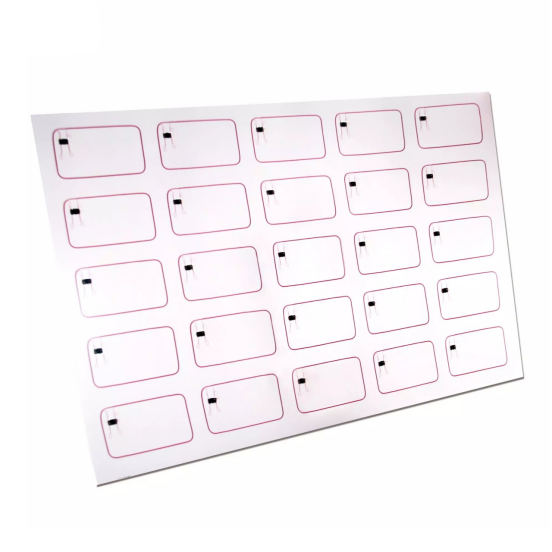
The rapid growth of contactless identification, access control, transportation ticketing, campus management, membership systems, and cashless payment solutions has driven increasing demand for reliable RFID smart card technologies. Among the most widely adopted RFID platforms worldwide are the MIFARE 1K S50 Chip RFID Inlay and MIFARE 4K S70 Smart Card Prelam Inlay Sheet.
These RFID solutions have become industry standards for manufacturing contactless smart cards due to their affordability, compatibility, fast communication speeds, and flexible memory structures. From employee ID cards and hotel key cards to metro tickets and university campus cards, MIFARE technology continues to power millions of daily transactions across the globe.
This comprehensive guide explores what PVC Contactless MIFARE 1K S50 RFID Inlays and MIFARE 4K S70 Prelam Inlay Sheets are, how they work, the challenges they solve, real-world application scenarios, manufacturing processes, and comparisons with competing RFID technologies.
What Is a MIFARE RFID Inlay?
An RFID inlay is the electronic core of a contactless smart card.
It consists of:
- RFID chip
- Antenna coil
- PET substrate
- Bonding materials
The inlay is embedded inside a PVC card during manufacturing.
The RFID chip stores data while the antenna enables wireless communication with RFID readers.
Without the RFID inlay, a contactless smart card cannot function.
MIFARE RFID inlays are among the most widely used RFID card components in the world.
What Is a MIFARE 1K S50 RFID Chip?
The MIFARE Classic 1K S50 chip was developed by NXP Semiconductors and has become one of the most popular contactless smart card ICs.
Key specifications include:
- Operating Frequency: 13.56 MHz
- Memory Capacity: 1 KB EEPROM
- ISO/IEC 14443A compliant
- Read/Write capability
- Fast anti-collision processing
- Contactless communication
The chip is suitable for applications requiring low-cost contactless identification and transaction processing.
MIFARE 1K S50 cards are commonly used in:
- Employee ID cards
- Hotel key cards
- Membership cards
- Public transportation
- Student cards
- Time attendance systems
What Is a MIFARE 4K S70 RFID Chip?
The MIFARE Classic 4K S70 is an upgraded version offering larger memory capacity.
Specifications include:
- Operating Frequency: 13.56 MHz
- Memory Capacity: 4 KB EEPROM
- ISO/IEC 14443A compliant
- Contactless communication
- Multiple application support
Compared with the 1K version, the S70 provides four times more storage capacity.
This additional memory enables more complex applications and larger data storage requirements.
Typical applications include:
- Multi-service campus cards
- Transportation systems
- Smart city projects
- Corporate access management
- Healthcare identification
What Is a Prelam Inlay Sheet?
A prelam inlay sheet is a semi-finished card production material containing multiple RFID inlays embedded inside laminated PVC layers.
Card manufacturers use prelam sheets to streamline production.
The structure typically includes:
- PVC core layers
- RFID inlays
- Overlay films
- Protective laminates
After printing and personalization, the sheet is punched into individual smart cards.
Benefits include:
- Higher production efficiency
- Better card consistency
- Lower manufacturing costs
- Improved yield rates
Prelam sheets are widely used in large-scale RFID card manufacturing.
Structure of a MIFARE RFID Prelam Sheet
A standard prelam sheet contains multiple layers.
PVC Layer
Provides structural support.
RFID Inlay
Contains the chip and antenna assembly.
Overlay Layer
Protects the electronics and printed graphics.
Adhesive Layer
Ensures strong bonding during lamination.
Printable Surface
Allows customization with logos, photos, and branding.
The finished structure is durable and suitable for long-term use.
How Does MIFARE RFID Technology Work?
MIFARE RFID cards use contactless radio frequency communication.
Step 1: Reader Generates RF Field
The RFID reader emits a 13.56 MHz electromagnetic field.
Step 2: Card Activation
When the card enters the field, the antenna captures energy.
The chip powers up without requiring a battery.
Step 3: Data Communication
The RFID chip exchanges information with the reader.
Step 4: Authentication
The system verifies card credentials.
Step 5: Action Execution
The system performs the required function:
- Opening a door
- Recording attendance
- Processing a ticket
- Authorizing access
The entire transaction typically takes less than a second.
Memory Architecture of MIFARE 1K S50
The 1K memory is divided into sectors and blocks.
Total Memory
- 1024 bytes
Sectors
- 16 sectors
Blocks per Sector
- 4 blocks
Each sector can store separate application data.
This architecture enables flexible data management.
Memory Architecture of MIFARE 4K S70
The S70 provides expanded storage.
Total Memory
- 4096 bytes
Sectors
- 40 sectors
Enhanced Capacity
Supports more applications and larger databases.
Organizations requiring multiple functions often choose S70 due to its larger memory.
Problems Solved by MIFARE RFID Inlays
Problem 1: Slow Identification Processes
Traditional manual identification is time-consuming.
MIFARE technology enables instant authentication.
Problem 2: Excessive Paper-Based Systems
Paper tickets and records create inefficiencies.
RFID cards digitize identification and transaction processes.
Problem 3: Multiple Credentials
Users often carry separate cards for different services.
MIFARE cards can consolidate multiple applications.
Problem 4: High Operational Costs
Automated RFID systems reduce labor requirements.
Problem 5: Wear and Tear of Contact Cards
Traditional contact cards suffer from physical wear.
Contactless RFID cards offer longer service life.
Real-World Application Scenarios
Access Control Systems
MIFARE cards are widely used for:
- Office buildings
- Residential communities
- Factories
- Data centers
Users simply tap the card to gain entry.
Hotel Key Cards
Hotels use MIFARE cards for:
- Room access
- Elevator control
- VIP services
The cards improve guest convenience and security.
Public Transportation
Metro and bus systems utilize MIFARE cards for:
- Fare collection
- Passenger identification
- Transit management
Fast transactions reduce congestion.
Campus Smart Cards
Universities deploy MIFARE cards for:
- Student identification
- Library access
- Dormitory entry
- Meal payments
One card serves multiple functions.
Membership Programs
Gyms, clubs, and retail businesses use RFID cards to manage customer memberships.
Healthcare Applications
Hospitals use RFID cards for:
- Staff access
- Patient identification
- Medical records integration
Advantages of PVC MIFARE RFID Inlays
Contactless Convenience
No physical contact is required.
Fast Transaction Speed
Authentication occurs within milliseconds.
Rewritable Memory
Data can be updated repeatedly.
Broad Compatibility
Works with most ISO14443A readers.
Cost-Effective
Offers excellent value for large-scale deployments.
Durable Construction
Suitable for years of daily use.
MIFARE 1K S50 vs MIFARE 4K S70
| Feature | MIFARE 1K S50 | MIFARE 4K S70 |
|---|---|---|
| Memory | 1 KB | 4 KB |
| Applications | Basic | Advanced |
| Data Capacity | Lower | Higher |
| Cost | Lower | Higher |
| Multi-Service Support | Limited | Excellent |
Organizations with simple requirements often choose S50, while complex systems benefit from S70.
MIFARE S50 vs T5577 RFID Cards
T5577 Characteristics
- 125 kHz frequency
- Basic access control
- Lower memory capacity
MIFARE S50 Advantages
- Faster communication
- Higher memory
- Better multi-application support
- ISO14443A compliance
For modern access systems, MIFARE generally offers superior functionality.
MIFARE S50/S70 vs EM4100 Cards
EM4100 cards are commonly used in low-frequency systems.
EM4100 Limitations
- Read-only functionality
- Fixed ID
- Limited applications
MIFARE Advantages
- Read/write capability
- Larger memory
- Flexible data storage
This makes MIFARE more suitable for dynamic applications.
MIFARE Classic vs DESFire EV1
MIFARE Classic
Advantages:
- Lower cost
- Easy deployment
Disadvantages:
- Basic security
DESFire EV1
Advantages:
- AES encryption
- Advanced authentication
- Enterprise security
For high-security projects, DESFire EV1 is often preferred.
For cost-sensitive projects, MIFARE Classic remains highly attractive.
MIFARE Classic vs NFC Technology
Both operate at 13.56 MHz.
NFC Benefits
- Smartphone interaction
- Consumer engagement
MIFARE Benefits
- Established infrastructure
- Access control optimization
- Cost efficiency
Many systems combine both technologies.
Manufacturing Process of RFID Prelam Sheets
Chip Bonding
The chip is attached to the antenna.
Electrical Testing
Each inlay is tested for functionality.
Layer Assembly
PVC layers are combined with RFID inlays.
Lamination
Heat and pressure create a durable structure.
Printing
Graphics and branding are added.
Card Punching
Individual cards are cut from the sheet.
Personalization
Encoding and variable data printing are completed.
This process ensures consistent quality and performance.
New Generation RFID Inlays vs Traditional RFID Inlays
Modern RFID inlays offer significant improvements.
Traditional Inlays
- Basic memory
- Limited applications
- Simpler manufacturing
New Generation Inlays
- Enhanced durability
- Better chip performance
- Improved antenna efficiency
- Greater customization options
Manufacturers continue improving RFID inlay technologies to meet evolving market demands.
Future Trends in MIFARE Card Manufacturing
Smart Cities
Integrated card systems continue expanding.
Mobile Credential Integration
Physical cards work alongside smartphone applications.
Multi-Application Platforms
One card can support:
- Access control
- Payments
- Transportation
- Membership programs
Sustainable Materials
Eco-friendly PVC alternatives are gaining popularity.
Cloud-Based Management
RFID systems increasingly connect to cloud platforms for centralized administration.
These trends will drive future growth in the RFID industry.
Choosing the Right RFID Inlay Supplier
When selecting a manufacturer, consider:
Chip Authenticity
Ensure genuine NXP chips are used.
Production Experience
Experienced suppliers deliver better consistency.
Quality Control
Reliable testing reduces failure rates.
Customization Capabilities
Look for support for:
- Custom layouts
- Printing
- Encoding
- OEM production
Global Compliance
Verify compatibility with international RFID standards.
Conclusion
PVC Contactless MIFARE 1K S50 Chip RFID Inlays and MIFARE 4K S70 Smart Card Prelam Inlay Sheets remain among the most widely used solutions in the global RFID industry. Their combination of contactless convenience, flexible memory architecture, broad compatibility, and cost-effective deployment makes them ideal for access control, transportation ticketing, campus cards, membership programs, hospitality applications, and healthcare systems.
Compared with traditional low-frequency RFID technologies such as T5577 and EM4100, MIFARE solutions offer greater memory capacity, improved functionality, and enhanced application flexibility. While higher-security technologies such as DESFire EV1 provide advanced encryption, MIFARE Classic S50 and S70 continue to deliver exceptional value for organizations seeking reliable and affordable contactless smart card solutions.
As digital transformation accelerates across industries, MIFARE RFID inlays and prelam sheets will continue serving as a critical foundation for secure, scalable, and efficient smart card manufacturing worldwide.