October 21, 2026
The fashion and apparel industry is becoming increasingly digital, with retailers, manufacturers, warehouses, and e-commerce companies seeking faster and more accurate ways to manage millions of garments. Traditional barcode labels have served the industry for decades, but they require manual scanning, line-of-sight reading, and intensive labor, making them less suitable for today’s high-volume operations. As a result, RFID Garment Tags and UHF RFID Stickers have become the preferred solution for intelligent apparel identification, inventory management, and supply chain automation.
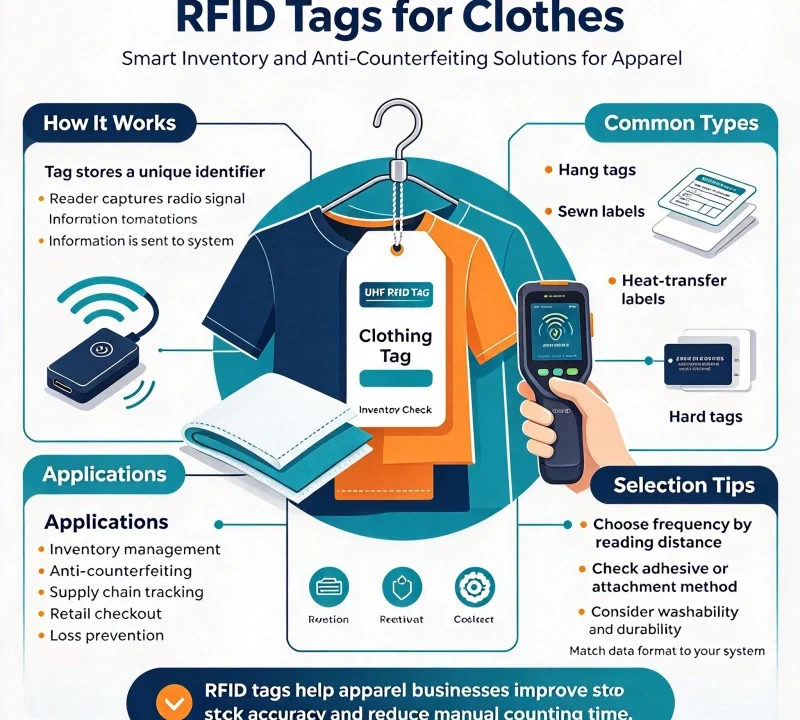
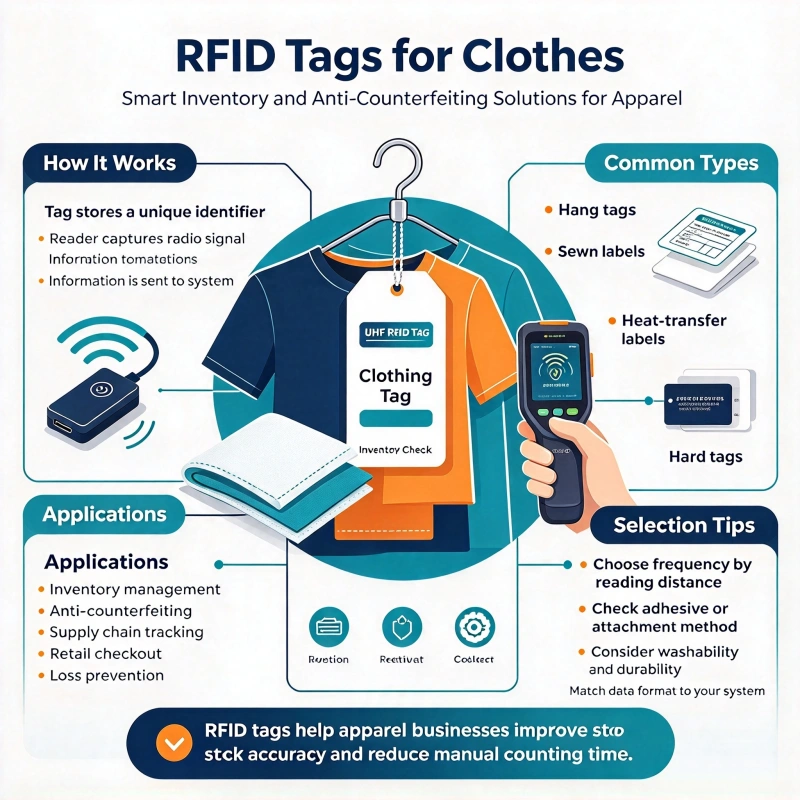
A UHF RFID garment tag is a smart label that incorporates a passive Ultra High Frequency (UHF) RFID chip and antenna into a paper tag, adhesive sticker, woven label, or textile care label. Each garment receives a unique digital identity that can be read wirelessly from several meters away, allowing retailers and logistics providers to identify hundreds of products simultaneously without direct visual contact.
This comprehensive guide explains what RFID garment tags are, how they work, the operational challenges they solve, their specifications, key applications, competitive advantages, and how they compare with barcodes, QR codes, NFC tags, and other RFID technologies.
| RFID Parameter | |
| Item Name | RFID garment tag uhf rfid sticker |
| Type | Passive UHF RFID Hang Tag |
| Protocol | ISO/IEC 18000-6C, EPC Class1 Gen2 |
| Frequency | Worldwide 840-960Mhz, US 902-928mhz, EU 865-868Mhz |
| Chip | Alien Higgs-3,M4/M5, G2,etc |
| Memory | EPC 96bits |
| TID 64bits | |
| User 512bits | |
| Read&Write | Supported |
| Read Range | 1-10meters adjustable(reader and environment dependent) |
| Data retention | 10years |
| Programming Cycles | 100,000 cycles |
| Anti-collision | Support multiple tags reading |
| Physical Parameter | |
| Size | 90×30×0.76mm / 3.54×1.18×0.03inch |
| Material | Plastic PVC |
| Antenna Material | Aluminum Etching |
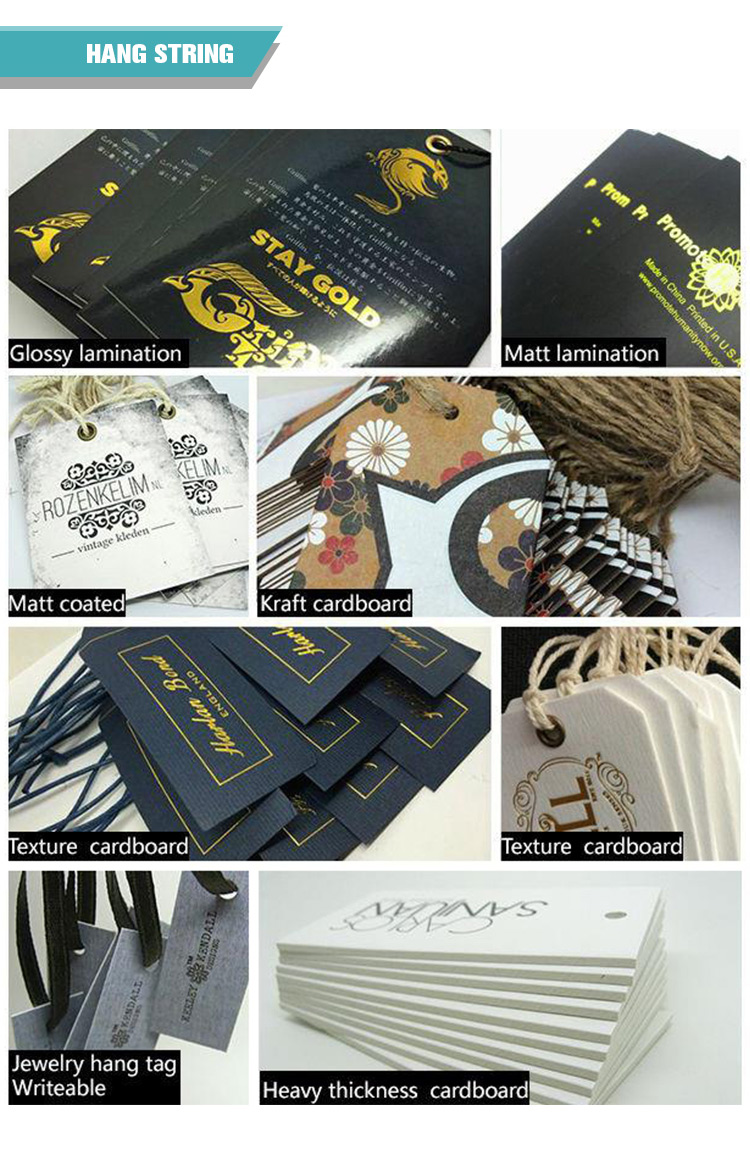
| Installation | Hang with string |
| Operating temperature | ‘-10℃ ~ +65℃ |
| Operating humidity | 20% ~ 90%RH |
| Package | Bags |
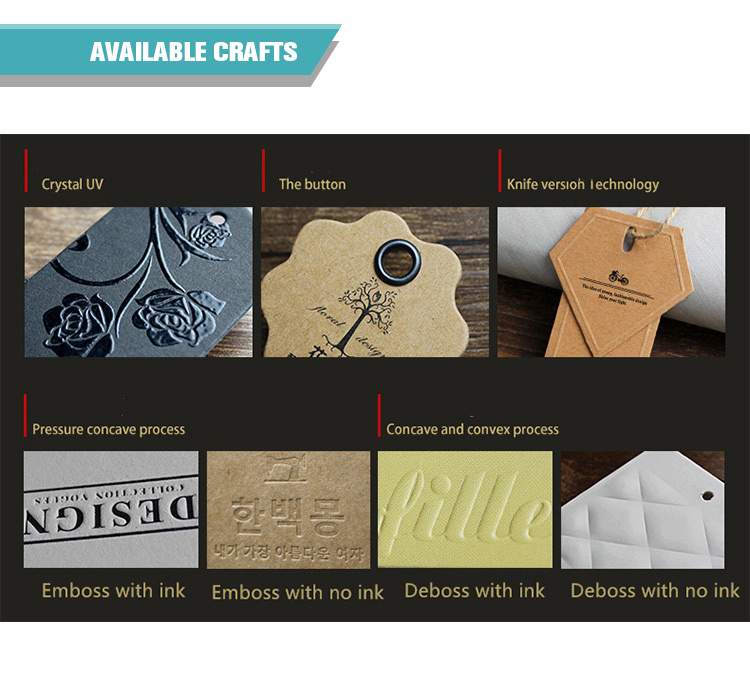
| Customized Service | Printing Logo and designs optional;Size bigger or smaller optional;Material Plastic PVC or Paper;Encoding, Chip&Inlay; |
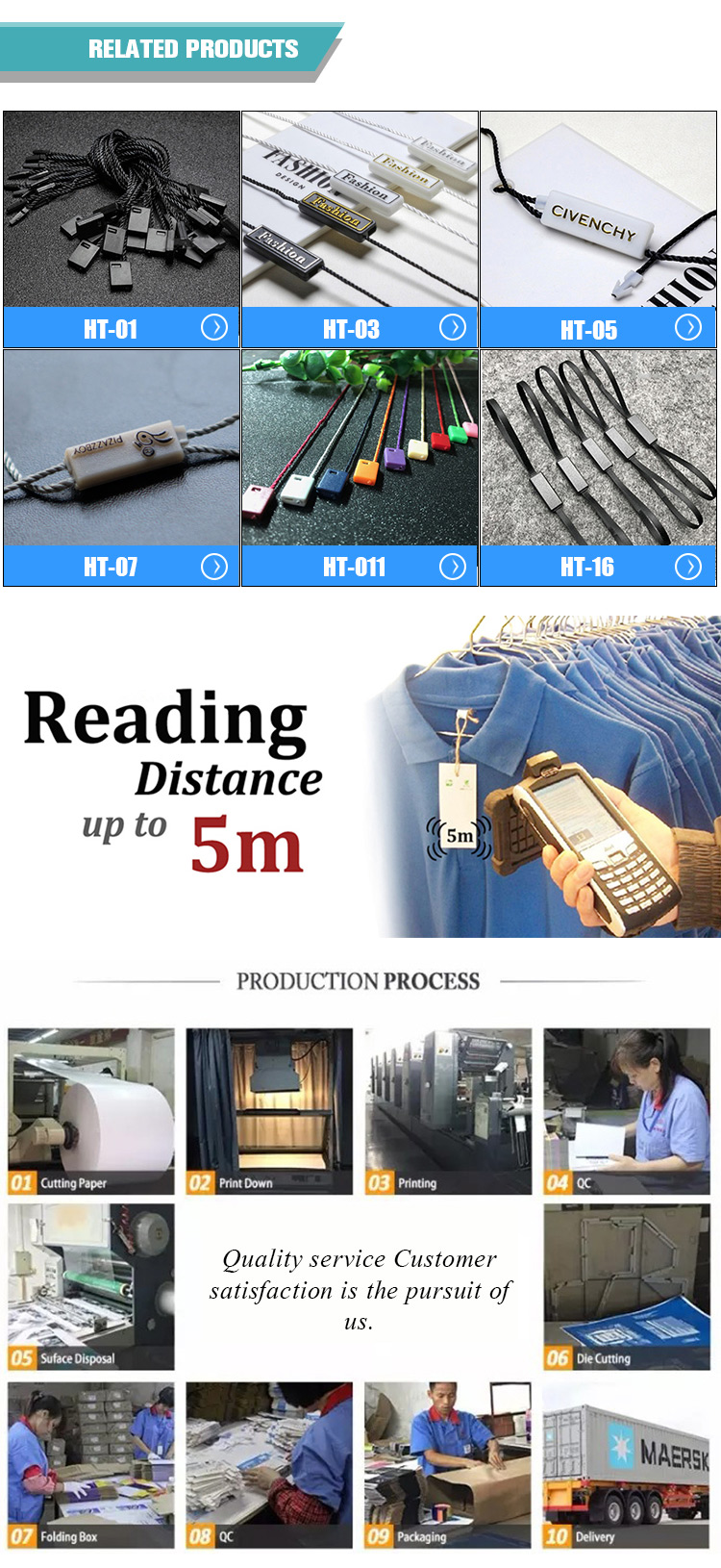
What Is an RFID Garment Tag?
An RFID Garment Tag is an electronic identification label designed specifically for clothing, footwear, accessories, and textile products. It combines an RFID integrated circuit (IC) with a specially designed antenna inside a lightweight label or hang tag.
Common formats include:
- Paper hang tags
- Adhesive RFID stickers
- Woven RFID labels
- Fabric sew-in labels
- Heat-transfer RFID labels
- Care labels with embedded RFID inlays
Each RFID tag stores a unique Electronic Product Code (EPC) that can be linked to product information such as:
- SKU
- Style number
- Color
- Size
- Manufacturing batch
- Warehouse location
- Production date
- Brand
- Price
- Inventory status
Unlike traditional printed labels, RFID tags communicate wirelessly with compatible readers, enabling automatic identification throughout the product lifecycle.
How Does a UHF RFID Sticker Work?
Most garment RFID labels use passive Ultra High Frequency RFID technology.
Step 1: RFID Reader Sends Radio Waves
A handheld or fixed RFID reader emits radio frequency signals within the UHF band.
Typical frequencies include:
- 860–960 MHz
- 865–868 MHz (Europe)
- 902–928 MHz (North America)
Step 2: Passive RFID Chip Harvests Energy
The RFID chip contains no battery.
Instead, it receives energy from the electromagnetic field generated by the RFID reader.
Step 3: Chip Activation
The integrated circuit becomes active and retrieves its stored Electronic Product Code (EPC).
Step 4: Data Transmission
Using backscatter communication, the RFID chip transmits its digital identification number back to the reader.
Step 5: Inventory System Updates
The RFID software automatically updates:
- Inventory quantity
- Product movement
- Warehouse location
- Shipment records
- Retail stock
- Sales information
- Anti-theft status
The complete identification process takes only a fraction of a second.
Main Components
RFID Chip
The RFID IC stores the garment’s electronic identity.
Common chip models include:
- NXP UCODE Series
- Impinj Monza Series
- Alien Higgs Series
- EM Microelectronic chips
- Fudan RFID chips
Most support EPC Class 1 Gen2 and ISO 18000-6C standards.
UHF Antenna
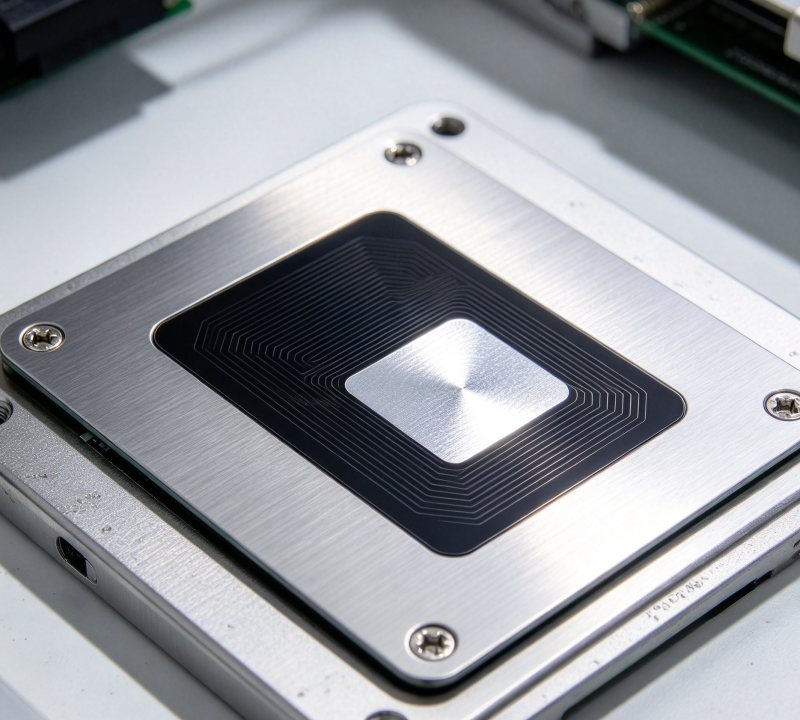
The antenna captures radio energy from the RFID reader and reflects encoded data back efficiently.
Its design determines reading distance, orientation sensitivity, and overall performance.
Label Material
Garment RFID labels may be manufactured using:
- Coated paper
- PET film
- Synthetic paper
- Textile fabric
- Woven materials
- Heat-resistant polymers
The material is selected according to the garment type and intended application.
Typical Specifications
| Parameter | Typical Specification |
|---|---|
| RFID Frequency | 860–960 MHz |
| RFID Standard | EPC Class 1 Gen2 / ISO 18000-6C |
| RFID Type | Passive UHF RFID |
| Reading Distance | 3–10 meters |
| EPC Memory | 96–496 Bits |
| User Memory | Optional |
| Label Material | Paper, PET, Textile |
| Operating Temperature | -20°C to +70°C |
| Storage Temperature | -40°C to +85°C |
| Data Retention | Up to 20 Years |
| Write Cycles | 100,000 Times |
Specifications vary depending on chip model and antenna design.
Key Features
Modern RFID garment tags provide:
- Long-distance wireless identification
- Simultaneous multi-item scanning
- Battery-free operation
- Lightweight construction
- Fast inventory counting
- Global RFID compatibility
- Unique digital identification
- Easy software integration
- High-speed data capture
- Flexible label formats
Pain Points Solved by RFID Garment Tags
Slow Inventory Counting
Traditional barcode systems require each garment to be scanned individually.
RFID allows hundreds of garments to be counted within seconds, significantly reducing inventory time.
Inventory Inaccuracy
Manual stock counts often lead to discrepancies.
RFID provides real-time inventory visibility and improves stock accuracy to over 99%.
High Labor Costs
Manual receiving, shipping, and stock verification consume valuable labor resources.
RFID automates these tasks, reducing labor requirements and operational expenses.
Product Misplacement
Garments frequently become misplaced in warehouses or retail stores.
RFID enables staff to locate products quickly, minimizing search time.
Out-of-Stock Situations
Real-time inventory updates help retailers replenish shelves before stock shortages occur.
Theft and Shrinkage
RFID can integrate with Electronic Article Surveillance (EAS) systems, improving loss prevention and reducing shoplifting.
Major Applications
Apparel Manufacturing
Track garments throughout production, quality inspection, packaging, and shipping.
Fashion Retail
Support:
- Rapid inventory counting
- Smart fitting rooms
- Self-checkout
- Product location
- Loss prevention
Warehouse Management
Improve:
- Receiving
- Picking
- Packing
- Shipping
- Cycle counting
- Inventory visibility
E-commerce Fulfillment
RFID improves order accuracy and accelerates order processing in high-volume fulfillment centers.
Luxury Goods
Luxury brands use RFID for product authentication, anti-counterfeiting, and supply chain transparency.
Uniform Rental
Track uniforms through issuance, return, laundering, repair, and replacement.
Textile Manufacturing
Monitor fabrics and finished products from production to distribution.
Advantages of RFID Garment Tags
Rapid Inventory Counts
Entire racks or cartons of clothing can be scanned without opening packages.
Improved Customer Experience
Store associates can instantly locate requested sizes, colors, or styles, enhancing customer service.
Better Supply Chain Visibility
RFID enables real-time tracking from factory to distribution center to retail store.
Reduced Operating Costs
Automation lowers labor costs while improving productivity and inventory accuracy.
Enhanced Data Accuracy
Automatic data capture eliminates many manual entry errors and provides reliable inventory information.
Scalable Deployment
RFID systems can support small boutiques as well as multinational retailers managing millions of garments.
RFID Garment Tags vs Barcode Labels
| Feature | RFID Garment Tag | Barcode Label |
|---|---|---|
| Line-of-Sight Required | No | Yes |
| Bulk Reading | Yes | No |
| Reading Speed | Very Fast | Manual |
| Inventory Automation | Excellent | Limited |
| Read Distance | Up to 10 m | A Few Centimeters |
| Anti-Theft Integration | Yes | Limited |
RFID offers greater efficiency and automation, particularly in environments with high inventory volumes.
RFID Garment Tags vs QR Code Labels
| Feature | RFID | QR Code |
|---|---|---|
| Automatic Reading | Yes | No |
| Simultaneous Multi-Tag Reading | Yes | No |
| Reading Speed | Very Fast | Manual |
| Inventory Automation | Excellent | Limited |
| Warehouse Efficiency | High | Moderate |
QR codes are economical but require manual scanning, making them less suitable for automated inventory operations.
RFID Garment Tags vs NFC Tags
| Feature | UHF RFID | NFC |
|---|---|---|
| Frequency | 860–960 MHz | 13.56 MHz |
| Reading Distance | 3–10 m | 2–10 cm |
| Batch Reading | Yes | No |
| Smartphone Compatibility | Limited | Excellent |
| Supply Chain Management | Excellent | Moderate |
UHF RFID is designed for logistics and inventory management, while NFC excels in consumer engagement, product authentication, and mobile interactions.
UHF RFID vs HF RFID
| Feature | UHF RFID | HF RFID |
|---|---|---|
| Reading Distance | Long | Short |
| Reading Speed | Higher | Moderate |
| Multi-Tag Reading | Excellent | Good |
| Warehouse Applications | Excellent | Moderate |
| Apparel Inventory | Excellent | Good |
UHF RFID is generally the preferred choice for apparel logistics because it provides longer reading distances and faster bulk identification.
Best Practices for RFID Deployment
To maximize system performance:
- Select RFID chips that comply with EPC Gen2 and ISO 18000-6C standards.
- Position tags consistently on garments to optimize readability.
- Conduct RF site surveys before installation.
- Integrate RFID with ERP, WMS, POS, and inventory management systems.
- Train staff on RFID handling and operational procedures.
- Regularly verify reader performance and tag readability.
A properly designed RFID system delivers higher read rates and faster return on investment.
Future Trends in RFID Apparel Technology
The apparel industry continues to innovate through RFID integration. Key trends include:
- Ultra-thin RFID inlays for seamless garment integration.
- Printable RFID labels that reduce manufacturing costs.
- AI-driven inventory forecasting based on RFID data.
- Cloud-based inventory and supply chain platforms.
- Smart fitting rooms with automatic product recognition.
- Digital Product Passports (DPP) supporting sustainability and regulatory compliance.
- Blockchain integration for end-to-end product traceability.
- Omnichannel retail systems with real-time inventory synchronization.
These technologies are reshaping how apparel companies manage products from manufacturing to consumer purchase.
Conclusion
RFID Garment Tags and UHF RFID Stickers are revolutionizing apparel identification by enabling fast, accurate, and contactless tracking throughout the entire supply chain. Their passive, battery-free design, long reading distance, and ability to identify hundreds of garments simultaneously make them an ideal solution for manufacturers, warehouses, retailers, e-commerce fulfillment centers, and uniform rental providers.
Compared with traditional barcode labels, QR codes, NFC tags, and other identification methods, UHF RFID labels deliver superior inventory accuracy, faster stock counting, lower labor costs, enhanced loss prevention, and real-time supply chain visibility. As retail becomes increasingly digital and data-driven, RFID garment tags provide the foundation for intelligent inventory management and operational excellence.
With ongoing advances in RFID chips, cloud computing, AI, IoT, and Digital Product Passport initiatives, UHF RFID garment tags will continue to play a central role in the future of smart apparel manufacturing, retail automation, and global fashion supply chain management.