October 21, 2026
RFID Library Bookshelf Anti-Metal Tag is a specialized RFID solution designed for libraries, archives, smart bookshelves, and other storage systems where RFID tags need to operate reliably close to metal surfaces. Its compact form factor makes it suitable for discreet installation on or around metal shelving, cabinets, racks, and other conductive structures.
Unlike a standard RFID label, an anti-metal RFID tag is designed to reduce the performance problems caused by conductive materials. Metal can change the behavior of an RFID antenna and cause unstable communication or significantly reduce reading performance. An appropriately designed on-metal tag uses a dedicated antenna structure and isolation or shielding materials to maintain more stable RFID communication.
For library automation projects, tag selection should always be based on the RFID frequency, reader system, mounting position, required reading distance, and the material of the installation surface. This product can be customized according to different library and RFID system requirements.
What Is an RFID Library Bookshelf Anti-Metal Tag?
An RFID library bookshelf anti-metal tag is an RFID transponder developed for applications where the tag is installed close to a metallic bookshelf or other conductive surface.
A conventional RFID tag is normally optimized for installation on materials such as paper, cardboard, plastic, or wood. When it is placed directly against metal, the electromagnetic characteristics around the antenna can change. This may result in reduced read performance or unreliable communication.
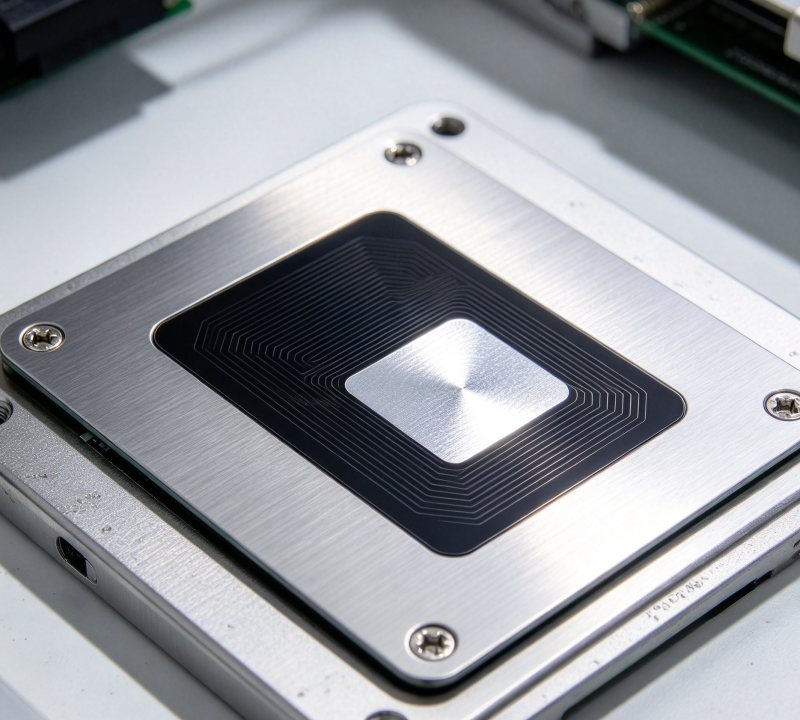
An anti-metal design addresses this issue by optimizing the antenna and tag structure for conductive environments. Depending on the RFID technology and application, the tag may incorporate an isolation layer, shielding material, special antenna geometry, or a dedicated housing.
In a library environment, this design can help RFID systems identify books, shelf locations, cabinets, or other tagged objects more consistently.
Product Specifications
RFID Library Bookshelf Anti-metal Tag
| Item Name | RFID Library Tag |
| Material | ABS+glue+3M sticker |
| Size | 85*22*6mm or customized |
| Compliant Standard | ISO/IEC 15693 or ISO18000-6C |
| Manufacturer/Chip | NXP ICODE SLI-X or Alien H3 chips etc |
| Protocol | ISO15693 |
| Frequency | 13.56MHz |
| Capacity(EPC/TID) | 128Bytes |
| Read Distance | 0-50cm, decided by device |
| Work Mode | passive |
| Working Temperature | -25℃~+55℃ |
| Storage Temperature | -25℃~+65℃ |
| Applications | books anti-theft, automatic borrow and return, inventory counting and tracking. |


Key Features
- Compact design for library shelving and storage systems
- Anti-metal construction for conductive surfaces
- Passive RFID technology
- Customizable dimensions and RFID chip options
- Suitable for library automation and asset identification
- Available for different RFID frequency requirements
- Adhesive mounting options available
- Suitable for smart shelves, cabinets, racks, and book management
- OEM and custom manufacturing supported
- Can be integrated with RFID readers and library management systems
The exact RFID frequency and chip should be selected according to the existing reader infrastructure. HF and UHF RFID are different technologies and should not be treated as interchangeable.
HF RFID vs UHF RFID for Library Applications
One of the most important considerations when selecting a library RFID tag is frequency.
HF RFID operates at 13.56 MHz and is widely used for library applications where controlled reading, item identification, and close-range interaction are important. ICODE SLIX is an HF RFID chip family supporting ISO/IEC 15693 and is commonly associated with library and item-identification applications.
UHF RFID operates at a much higher frequency and is generally selected when longer read distances and high-speed bulk identification are required. UHF systems are widely used for warehouse, logistics, rack, and asset-tracking applications.
| Feature | HF RFID | UHF RFID |
|---|---|---|
| Typical Frequency | 13.56 MHz | 860–960 MHz |
| Common Standard | ISO/IEC 15693 | EPC Gen2 / ISO 18000-63 |
| Typical Application | Libraries, smart shelves, item identification | Inventory, logistics, asset tracking |
| Reading Distance | Short to medium | Medium to long |
| Bulk Reading | Supported | Excellent for high-volume inventory |
| Near-Metal Performance | Depends on tag design | Requires dedicated anti-metal design |
| Reader Infrastructure | HF reader | UHF reader |
| Best Use Case | Controlled library identification | Fast inventory and longer-range tracking |
For a new project, the tag should always match the reader. An HF reader cannot simply be replaced by a UHF tag, and a UHF reader cannot communicate with an HF ISO 15693 tag.
Why Do Library Shelves Need Anti-Metal RFID Tags?
Metal is a challenging material for RFID antennas. When a standard RFID tag is attached directly to a conductive surface, the metal can alter the antenna’s electrical characteristics and interfere with the RF field.
The result can include:
- Reduced reading distance
- Unstable tag responses
- Poor read-rate consistency
- Antenna detuning
- Difficulty identifying tags in their intended position
An anti-metal RFID tag is specifically designed to reduce these problems.
This is particularly important for libraries using metal shelving. Although a library book itself may not be metallic, the shelf, cabinet, smart-shelf structure, or mounting location may contain conductive materials.
The tag therefore needs to be selected according to the complete installation environment rather than only the object being identified.
How the Anti-Metal RFID Structure Works
The performance of an anti-metal tag depends largely on its antenna and physical construction.
A conventional RFID tag places its antenna in an environment where the surrounding material is relatively transparent to RF energy. An anti-metal tag uses a structure designed to isolate or control the interaction between the antenna and the conductive surface.
Depending on the design, this can include:
- A dedicated RFID antenna
- An isolation layer
- A shielding or dielectric structure
- A protective housing
- An adhesive layer optimized for the installation surface
These elements help maintain a more suitable electromagnetic environment for the RFID chip.
For this reason, an anti-metal tag should not be judged only by its physical appearance. Two tags with similar dimensions can have significantly different performance because of differences in antenna design and chip matching.
RFID Tag for Smart Library Shelves
Smart shelving is one of the most important applications for RFID in modern libraries.
A smart shelf can combine RFID tags, readers, antennas, software, and library management systems to automatically identify items and improve inventory visibility.
Depending on the system architecture, RFID technology can support:
- Book identification
- Shelf inventory
- Missing-item detection
- Automated sorting
- Self-service borrowing and returning
- Item location management
- Circulation tracking
- Collection inventory
- Security and anti-theft functions
HF RFID is particularly suitable for controlled library environments because it can provide predictable reading zones and accurate item identification. RFID readers using ICODE SLIX technology, for example, are used in applications including library book identification, smart cabinets, and smart shelves.
Main Applications
Library Bookshelves
Install RFID tags on bookshelves or designated shelf positions to help identify and manage shelf locations.
Smart Cabinets
The compact tag format can be considered for cabinets and storage compartments where RFID identification is required close to metal.
Library Book Management
RFID can be used to identify books throughout their lifecycle, from registration and shelving to circulation and inventory.
Archives and Document Storage
Libraries, museums, universities, and archives can use RFID to improve item identification and reduce manual inventory work.
University Libraries
Large academic libraries can combine RFID tags with self-service stations, smart shelves, gates, and inventory equipment.
Asset Tracking
The same anti-metal concept can also be adapted to track equipment, containers, cabinets, tools, and other assets in environments containing metal.
| Application | RFID Requirement | Recommended Consideration |
|---|---|---|
| Library shelf | Controlled identification | HF or application-specific anti-metal tag |
| Smart cabinet | Near-metal operation | Anti-metal construction |
| Book inventory | Fast item identification | Match tag to existing library RFID system |
| Warehouse rack | Longer-distance scanning | UHF anti-metal RFID |
| IT equipment | Metal mounting surface | UHF on-metal tag |
| Industrial cabinet | Metal and environmental exposure | Rugged anti-metal construction |
Standard RFID Tag vs Anti-Metal RFID Tag
Choosing between a conventional RFID tag and an anti-metal RFID tag should be based on the mounting surface.
| Comparison | Standard RFID Tag | Anti-Metal RFID Tag |
|---|---|---|
| Paper/Cardboard | Excellent | Excellent |
| Plastic | Excellent | Excellent |
| Wood | Excellent | Excellent |
| Metal | Limited or unsuitable | Designed for metal |
| Antenna Design | General-purpose | Optimized for conductive surfaces |
| Installation | Simple | Requires correct orientation and mounting |
| Cost | Generally lower | Generally higher |
| Industrial Use | Application dependent | Better suited to metal assets |
For a metal bookshelf, rack, cabinet, or other conductive mounting surface, an anti-metal configuration is normally the safer choice.
Choosing the Right RFID Chip
The chip should be selected after the RFID frequency and reader system have been confirmed.
For HF library systems, NXP ICODE SLIX-family chips are one possible option because they support 13.56 MHz HF RFID and ISO/IEC 15693.
For UHF applications, EPC Gen2-compatible chips are commonly used. UHF RFID tags can support fast inventory and longer-distance identification, making them suitable for asset and rack management applications.
| Chip Selection | Suitable Environment |
|---|---|
| HF / ISO 15693 | Library item identification and controlled reading |
| UHF / EPC Gen2 | Long-range inventory and asset tracking |
| High-memory chip | Applications requiring additional user data |
| Standard EPC chip | Basic identification and inventory |
| Customized chip configuration | Special system requirements |
The chip should never be selected solely by memory capacity. Compatibility with the reader, software, encoding process, antenna, and required operating distance is equally important.
Read Range and Performance
RFID read range is affected by many variables, so a single theoretical distance should not be treated as a guaranteed result.
Important factors include:
- RFID frequency
- Reader output power
- Reader antenna
- Tag antenna size
- Chip sensitivity
- Tag orientation
- Distance from metal
- Shelf construction
- Nearby RF interference
- Number and position of tags
- Installation method
For UHF anti-metal tags, manufacturers may achieve long reading distances with suitable readers and antennas, but actual results depend strongly on tag size and application conditions.
For library applications, maximum distance is not always the main objective. A controlled and reliable reading zone can be more valuable than an unnecessarily long read range because it helps reduce unintended tag reads.
Installation Recommendations
Correct installation is essential for consistent RFID performance.
Before mass deployment, test the tag in the exact location where it will be installed. This includes the actual shelf material, reader, antenna, mounting adhesive, tag orientation, and surrounding books or equipment.
Recommended steps include:
- Confirm the RFID frequency.
- Confirm reader and tag compatibility.
- Test the tag directly on the target surface.
- Check reading performance from multiple directions.
- Verify adhesive strength.
- Test the complete shelf or cabinet.
- Perform a pilot installation before mass production.
For large projects, samples should be tested under real operating conditions before the final production specification is approved.
Custom RFID Library Tags
Different libraries and system integrators may require different dimensions, chips, materials, or mounting methods.
Customization options can include:
- Tag dimensions
- RFID chip
- Antenna design
- Housing material
- Adhesive type
- Logo printing
- Serial number printing
- Encoding
- Packaging
- Color
- Mounting hole or mechanical structure
Custom dimensions are particularly useful when the tag must fit into an existing shelf profile or a limited installation space.
For OEM projects, the tag should be customized together with the reader and installation environment rather than treated as an independent component.
RFID Tag Encoding and Data Management
An RFID tag can provide a unique electronic identity that can be associated with information stored in a library management or asset management system.
A typical workflow may look like this:
Tag production → Chip encoding → Book or shelf association → RFID reading → Database update → Inventory management
The RFID tag does not necessarily need to store the complete book record. In many systems, the tag’s unique identifier is linked to information stored in external software.
This approach makes it easier to manage large collections while keeping the RFID tag data structure relatively simple.
Quality Testing Before Deployment
A professional RFID project should include performance testing before mass production.
Recommended tests include:
| Test | Purpose |
|---|---|
| Reader compatibility | Confirm communication with the selected RFID reader |
| Read-rate test | Measure identification consistency |
| Read-distance test | Determine practical operating range |
| Metal-surface test | Verify anti-metal performance |
| Orientation test | Check performance from different directions |
| Adhesive test | Verify long-term mounting |
| Temperature test | Confirm environmental suitability |
| Batch test | Check consistency between production batches |
The most useful performance data comes from testing the final tag on the actual target shelf or equipment.
Why Choose a Customized RFID Solution?
A standard RFID tag may be sufficient for simple applications, but library and industrial installations can have specific mechanical and RF requirements.
A customized RFID solution can help optimize:
- Physical dimensions
- Antenna performance
- Reader compatibility
- Mounting method
- Environmental resistance
- Data encoding
- Branding
- Production consistency
D.O RFID Group provides RFID tags across LF, HF, and UHF frequencies and offers customized RFID products for different applications. Its product range includes on-metal and UHF RFID solutions as well as HF RFID products.
How to Select the Right Model
Before placing an order, provide the following information to your RFID supplier:
| Requirement | Information to Provide |
|---|---|
| Application | Library, shelf, cabinet, asset, warehouse, etc. |
| Surface | Metal, wood, plastic, glass, paper |
| Frequency | HF 13.56 MHz or UHF 860–960 MHz |
| Reader | Existing reader model or required reader type |
| Size | Required maximum dimensions |
| Read range | Approximate required distance |
| Environment | Indoor, outdoor, temperature, moisture |
| Mounting | Adhesive, screw, embedded, other |
| Chip | Required chip or memory |
| Quantity | Estimated annual or project volume |
| Printing | Logo, barcode, QR code, serial number |
| Encoding | Pre-encoded or blank tags |
Providing these details allows the tag manufacturer to recommend a configuration rather than simply supplying a generic RFID product.
Frequently Asked Questions
Can an RFID library tag be installed on metal?
Yes. An anti-metal RFID design is specifically developed for conductive surfaces. However, the final performance should be tested on the actual metal shelf or installation structure.
Is this tag HF or UHF?
The RFID technology depends on the selected configuration. HF versions typically operate at 13.56 MHz and can use ISO/IEC 15693 chips such as the ICODE SLIX family. UHF versions operate in the regional 860–960 MHz range and use EPC Gen2-compatible chips.
Can the size be customized?
Yes. Custom dimensions can be developed for specific shelf, cabinet, rack, or equipment requirements.
What is the reading distance?
There is no universal reading distance. Actual performance depends on the RFID frequency, chip, antenna, reader, tag size, installation surface, orientation, and surrounding environment. Testing the final configuration is recommended.
Can the tag be used for library books?
Yes. RFID technology is widely used for library book identification, inventory, self-service circulation, and smart-shelf applications. The appropriate tag should be selected according to the library’s existing RFID infrastructure.
Can you provide samples?
Samples are recommended before bulk production, particularly when the tag will be mounted directly on metal. Sample testing can verify reader compatibility and practical reading performance.
Can the RFID tags be pre-encoded?
Pre-encoding can be arranged according to the selected chip and project requirements. Encoding specifications should be confirmed before production.
Can the tag include a custom logo?
Yes. Custom printing, labeling, serial numbering, packaging, and other OEM requirements can be discussed for suitable production quantities.
Conclusion
RFID Library Bookshelf Anti-Metal Tags provide a practical way to deploy RFID identification in library shelving and other environments where conductive materials create challenges for conventional RFID tags.
The most important step is selecting the correct RFID technology. HF 13.56 MHz RFID and UHF RFID are different systems, and the tag must match the reader infrastructure. For controlled library identification, HF RFID based on standards such as ISO/IEC 15693 can be an appropriate solution. For longer-range inventory and high-speed asset identification, UHF RFID may be more suitable.
For metal shelves, cabinets, racks, and other conductive structures, an anti-metal design is essential for reliable installation. Rather than selecting a tag only by size or advertised reading distance, buyers should evaluate the complete RFID system, including the chip, antenna, reader, mounting position, surface material, and operating environment.
If you are developing a library automation project, smart shelf, archive management system, or metal asset-tracking application, customized RFID tags can be developed around your actual installation requirements. Providing the application details and target surface in advance helps ensure the final RFID tag delivers the required combination of size, compatibility, reading performance, and reliability.