October 21, 2026
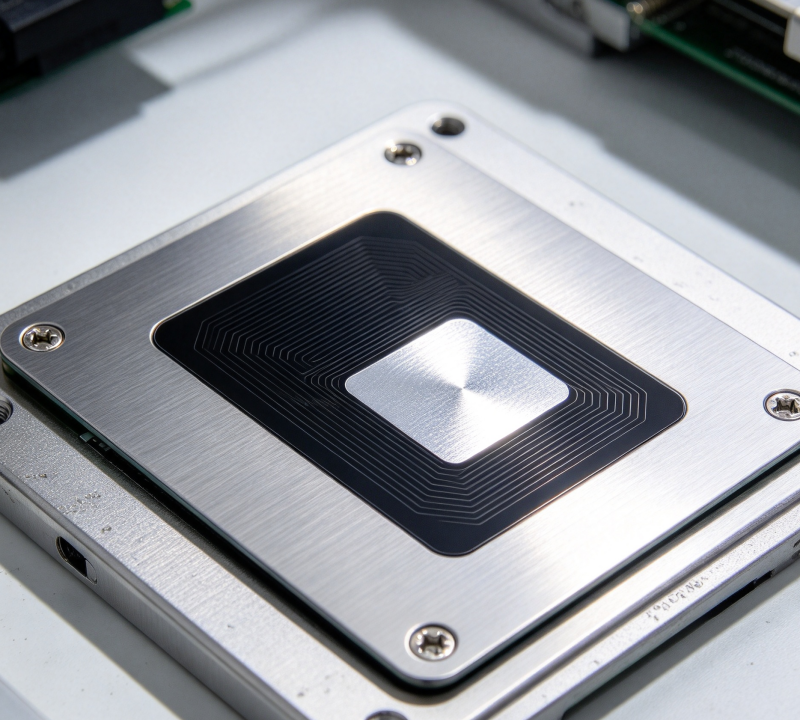
Our custom PVC contactless MIFARE 1K RFID inlay is designed for manufacturers of contactless smart cards, RFID cards, membership cards, access cards, identification cards, and other customized card products. Supplied as a prelam inlay sheet, it integrates the RFID antenna and chip into a thin PVC or PET structure that can be further laminated with printed card layers.
The inlay can be customized according to card dimensions, antenna requirements, sheet size, layout, material, thickness, and printing requirements. For HF applications, the available antenna options include copper coil and aluminum foil. UHF versions use aluminum foil antennas, while LF versions can use copper coil antennas. The product page supports sheet sizes such as 310 × 468 mm, 400 × 505 mm, and 490 × 650 mm, with customized layouts also available.
Whether you need standard CR80 card inlays or a customized antenna size for a specific project, we can provide a prelam solution adapted to your card manufacturing process.
Product Highlights
- Contactless RFID inlay for smart card manufacturing
- MIFARE 1K chip option for HF applications
- 13.56 MHz HF configuration available
- PVC and PET material options
- Copper coil or aluminum foil HF antenna options
- Aluminum foil antenna for UHF configurations
- Multiple prelam sheet sizes available
- Standard and customized card layouts
- CR80 card dimensions supported
- Custom antenna dimensions available
- HF thickness options from approximately 0.30 mm
- Silk screen printing available
- Suitable for OEM and customized card production
The specifications can be adapted to different card structures and production requirements. Before mass production, the chip type, operating frequency, antenna design, sheet layout, material, and finished card thickness should be confirmed according to the intended application.
What Is an RFID Prelam Inlay?
An RFID prelam inlay is an intermediate component used in the production of contactless cards. It normally combines an RFID chip and antenna with a carrier or laminated material layer. The finished inlay can then be incorporated into a PVC, PET, or other card structure during the card manufacturing process.
Compared with producing the complete finished card, using a prelam inlay allows card manufacturers to separate RFID inlay production from card artwork and final lamination. This can be useful when different customers require different printed designs while using the same underlying RFID technology.
For smart card manufacturers, the inlay is therefore an important part of the card construction. Antenna design, chip selection, inlay thickness, material, and placement can all affect compatibility with the final card manufacturing process.

MIFARE 1K RFID Inlay for Contactless Cards
The MIFARE 1K configuration is intended for HF contactless card applications operating at 13.56 MHz. MIFARE-based cards are commonly incorporated into systems where a contactless card needs to communicate with a compatible reader.
The exact chip model, memory configuration, security functions, encoding requirements, and reader compatibility should be confirmed before production because different RFID chip products may have different technical characteristics.
For projects using a MIFARE 1K chip, the most important parameters to confirm include:
| Item | Specification |
| Operating Frequency | HF 13.56MHz, UHF GLOBAL 860MHz-960MHz |
| Standard | ISO14443,ISO15693,ISO 18000-6C |
| Material | PVC, PET |
| Dimension | 310mm x 468mm,400*505mm, 490*650mm etc |
| Layout | 2*5,4*5,5*5,4*6,4*7,4*8,3*6,3*7,3*8,6*8,4*10or any Customization of CR80 card or any unit antenna size |
| Thickness | HF normal:0.3mm, 0.35mm,0.4mm0.45mm,0.5mm,( min.0.3mm ) |
| LF normal : 0.5mm0.55mm,6mm | |
| UHF 0.6mm, 0.5mm | |
| Antenna | HF: Copper coil, Aluminium foil |
| LF: Copper Coli | |
| UHF: Aluminium foil | |
| Printing | Silk screen |
A sample should be tested with the customer’s actual RFID reader and card construction before a large production order.
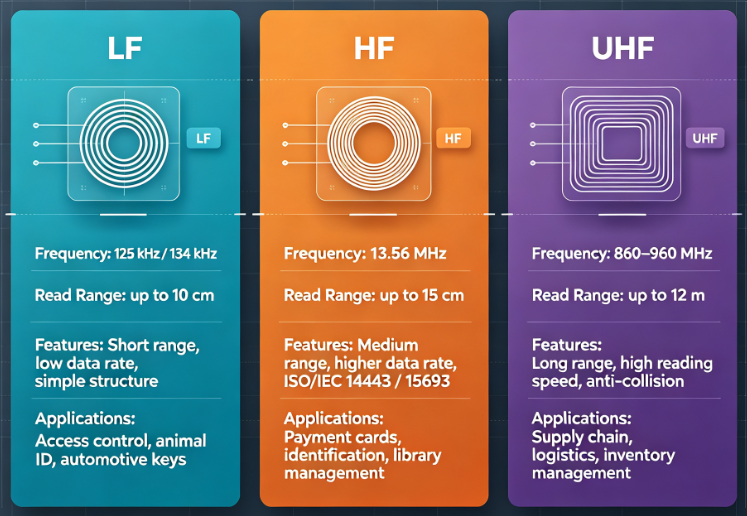
HF, LF and UHF RFID Inlay Comparison
The product range includes different RFID frequency configurations. These configurations should not be treated as interchangeable because frequency, antenna construction, chip technology, and application requirements are different.
| Feature | HF | LF | UHF |
|---|---|---|---|
| Frequency listed | 13.56 MHz | LF | 860–960 MHz |
| Typical antenna | Copper coil / aluminum foil | Copper coil | Aluminum foil |
| Available material | PVC / PET | PVC / PET | PVC / PET |
| Listed thickness | From approx. 0.30 mm | Approx. 0.50 mm+ | 0.50 / 0.60 mm |
| Example standard | ISO14443 / ISO15693 | Application dependent | ISO18000-6C |
| Typical product format | Smart card inlay | RFID inlay | UHF RFID inlay |
| Main consideration | Contactless card compatibility | Low-frequency system compatibility | UHF reader and tag compatibility |
For a MIFARE 1K card project, the HF configuration is the relevant starting point. UHF and LF options can be considered separately when the application requires a different RFID technology.
PVC vs. PET Inlay Material
PVC and PET are both available for RFID inlay construction. The best choice depends on the customer’s card structure, lamination process, required flexibility, thickness, and production method.
| Material | Key consideration | Suitable project type |
|---|---|---|
| PVC | Common card manufacturing material | PVC smart cards and contactless cards |
| PET | Alternative inlay carrier material | Customized card and RFID constructions |
PVC is particularly relevant when the inlay will be incorporated into a conventional PVC card structure. PET may be considered when a different carrier material is required by the card manufacturing process.
The final material selection should be confirmed together with the lamination temperature, pressure, layer structure, and finished card specifications.
RFID Antenna Options
The antenna is one of the key components of an RFID inlay because it provides the coupling structure required for communication between the chip and reader.
For HF products, the available antenna options include copper coil and aluminum foil. Different antenna structures can be selected according to the card design, manufacturing process, and performance requirements.
| RFID Type | Antenna option listed |
|---|---|
| HF | Copper coil |
| HF | Aluminum foil |
| LF | Copper coil |
| UHF | Aluminum foil |
Antenna size and geometry can also be customized. This is important when the RFID inlay needs to fit into a particular card body, printed area, or other product structure.
For custom projects, customers should provide the target card dimensions and, when available, the antenna drawing or technical requirements. Our engineering team can then confirm the suitable inlay configuration.
Available Inlay Sheet Sizes and Layouts
The prelam inlay can be supplied in different sheet dimensions to support different card production arrangements. The listed sheet sizes include:
- 310 × 468 mm
- 400 × 505 mm
- 490 × 650 mm
- Other customized dimensions
Several layout options are also listed, including 2 × 5, 4 × 5, 5 × 5, 4 × 6, 4 × 7, 4 × 8, 3 × 6, 3 × 7, 3 × 8, 6 × 8, and 4 × 10.
| Layout | Example number of positions |
|---|---|
| 2 × 5 | 10 |
| 4 × 5 | 20 |
| 5 × 5 | 25 |
| 4 × 6 | 24 |
| 4 × 8 | 32 |
| 3 × 8 | 24 |
| 6 × 8 | 48 |
| 4 × 10 | 40 |
Custom layouts are available when the standard arrangements do not match a customer’s production equipment or card dimensions.
The optimum sheet layout should consider card size, antenna size, edge spacing, cutting method, material utilization, and the customer’s downstream lamination process.
CR80 and Custom Card Dimensions
CR80 is a common format for plastic identification and smart cards. The product can be customized for CR80 cards as well as other card dimensions.
A custom project may require a specific antenna size even when the finished card uses a standard card format. For this reason, the inlay should be designed according to the complete card structure rather than card dimensions alone.
When requesting a quotation, customers can provide:
- Finished card size
- Required chip
- RFID frequency
- Antenna type
- Required inlay thickness
- Sheet size
- Desired layout
- Printing requirements
- Estimated order quantity
- Existing card or antenna drawing, if available
Providing these details at the beginning can help reduce design revisions and improve sample preparation efficiency.
RFID Inlay Thickness Options
Thickness is an important parameter when the prelam will be integrated into a finished PVC card. The listed HF thickness options include approximately 0.30 mm, 0.35 mm, 0.40 mm, 0.45 mm, and 0.50 mm, with a minimum listed thickness of approximately 0.30 mm.
| RFID configuration | Listed thickness options |
|---|---|
| HF | 0.30 / 0.35 / 0.40 / 0.45 / 0.50 mm |
| LF | Approx. 0.50 mm and above |
| UHF | 0.50 / 0.60 mm |
The actual thickness required for a finished card depends on the complete layer structure. If the card must meet a particular overall thickness, the inlay thickness should be selected together with the PVC overlay, core, printing layer, and other components.
For high-volume production, it is recommended to approve a physical sample before confirming mass production specifications.
Silk Screen Printing for RFID Inlays
Silk screen printing is available as a customization option. Depending on the project, printing can be used for identification marks, technical indicators, logos, or other required graphics.
Printing requirements should be discussed during the quotation stage because artwork, colors, dimensions, printing position, and production tolerances can affect the final specification.
If the inlay will later be laminated with printed PVC layers, the printing process should also be evaluated together with the customer’s card manufacturing process.
RFID Inlay Applications
Custom RFID prelam inlays can be integrated into a wide range of card products. The actual application depends on the selected RFID chip, reader system, antenna design, and card construction.
Potential applications include:
| Application | Possible RFID inlay role |
|---|---|
| Access cards | Contactless identification |
| Membership cards | RFID-enabled card identification |
| Identification cards | Embedded contactless technology |
| Smart cards | RFID communication component |
| Campus cards | Contactless card construction |
| Event cards | RFID-enabled identification |
| Loyalty cards | Contactless customer identification |
| Customized PVC cards | Embedded RFID component |
For any specific application, compatibility with the customer’s reader, software, encoding system, and operating environment should be verified before mass production.
Why Use a Custom Prelam Inlay?
A standardized finished card may not always fit a manufacturer’s existing production process. A customized prelam provides more flexibility because the sheet dimensions, layout, antenna structure, material, and thickness can be adapted to the project.
Customization can help manufacturers:
- Match existing card production equipment
- Optimize sheet utilization
- Select an appropriate antenna structure
- Integrate different RFID chips
- Adjust inlay thickness
- Produce standard CR80 or custom card sizes
- Create different sheet layouts
- Develop OEM card products
For OEM and private-label projects, the inlay specification can be established before the final card artwork is produced.
Customization Options
The product supports multiple customization parameters. Customers do not necessarily need to use the standard configuration shown on the product page.
| Customization item | Options |
|---|---|
| RFID frequency | HF / LF / UHF configuration |
| Chip | Specified according to project |
| Material | PVC / PET |
| Antenna | Copper coil / aluminum foil |
| Card size | CR80 or custom |
| Antenna size | Standard or custom |
| Sheet size | Standard or custom |
| Layout | Standard or custom |
| Thickness | Based on card construction |
| Printing | Silk screen |
| Packaging | Confirm according to order |
The final specification should be approved before production so that the chip, antenna, dimensions, and material are consistent with the intended card structure.
How the RFID Inlay Is Integrated Into a Card
A typical card manufacturing process may involve several stages. The exact process depends on the customer’s equipment and card construction.
Step 1: Specification confirmation
The chip, frequency, antenna, material, dimensions, thickness, and layout are confirmed.
Step 2: Inlay production
The RFID chip and antenna are assembled into the selected inlay structure.
Step 3: Sheet inspection
The inlay sheet is checked according to the agreed production requirements.
Step 4: Card lamination
The prelam is integrated with the customer’s PVC or other card layers.
Step 5: Cutting and finishing
The laminated sheet is processed into individual cards.
Step 6: RFID testing
Finished cards can be tested with the intended reader and system before shipment or deployment.
This workflow allows the RFID inlay to become part of a customized finished card while keeping the RFID component separate from the customer’s graphic design process.
MIFARE 1K Inlay vs. Other RFID Inlays
The correct RFID inlay depends on the required frequency and system. A MIFARE 1K HF inlay should not be selected solely because it is an RFID product; it must match the reader and application.
| Requirement | MIFARE 1K HF Inlay | UHF RFID Inlay | LF RFID Inlay |
|---|---|---|---|
| Frequency family | HF | UHF | LF |
| Listed frequency | 13.56 MHz | 860–960 MHz | LF |
| Antenna | Copper / aluminum | Aluminum | Copper |
| Typical format | Contactless card | UHF tag/card | LF RFID product |
| Main selection factor | HF reader compatibility | UHF system compatibility | LF system compatibility |
| Suitable for MIFARE 1K project | Yes, when specified correctly | No | No |
The table is intended as a technology-selection guide. The exact chip and system compatibility should always be verified against the customer’s reader and application requirements.
Quality and Compatibility Considerations
RFID performance depends on more than the chip alone. The antenna, card material, inlay position, finished card thickness, reader, operating environment, and surrounding materials can all affect the final result.
For this reason, a complete card sample is recommended for projects with specific performance requirements.
Important validation points include:
- Chip and reader compatibility
- RFID frequency
- Antenna design
- Inlay dimensions
- Finished card thickness
- Lamination process
- Reading performance
- Card appearance
- Mechanical quality
- Encoding and data requirements
If the card will be used near metal, other RFID cards, electronic devices, or special materials, additional testing may also be appropriate.
How to Order Custom RFID Prelam Inlays
To request a quotation or sample, provide as much technical information as possible. A basic specification can include the following:
Chip: MIFARE 1K or specified alternative
Frequency: HF 13.56 MHz
Card size: CR80 or customized
Material: PVC or PET
Antenna: Copper coil or aluminum foil
Inlay thickness: Required thickness
Sheet size: Required sheet dimensions
Layout: Number of cards per sheet
Printing: Required or not required
Quantity: Sample or mass production quantity
If you already have an existing RFID card or antenna drawing, providing the reference sample or technical drawing can make customization easier.
Frequently Asked Questions
What is a MIFARE 1K RFID inlay?
A MIFARE 1K RFID inlay is an embedded contactless RFID component designed for use in compatible HF smart card products. It combines the RFID chip with an antenna structure inside an inlay that can be incorporated into a finished card.
What frequency does the MIFARE 1K version use?
The MIFARE 1K configuration is intended for HF 13.56 MHz applications. The product page also lists UHF 860–960 MHz and LF configurations as part of the broader customizable RFID inlay range.
Can the RFID inlay be customized?
Yes. The product supports customization of card dimensions, antenna dimensions, sheet size, sheet layout, material, thickness, and other production parameters.
Is CR80 supported?
Yes. The product page specifically states that CR80 card customization is supported, together with customized unit antenna sizes.
What materials are available?
PVC and PET are listed as available materials. The appropriate material should be selected according to the finished card structure and lamination process.
What antenna options are available?
For HF applications, copper coil and aluminum foil antennas are listed. LF products use copper coil antennas, while UHF products use aluminum foil antennas.
Can you provide different sheet layouts?
Yes. Multiple layouts are listed, including 2 × 5, 4 × 5, 5 × 5, 4 × 6, 4 × 7, 4 × 8, 3 × 6, 3 × 7, 3 × 8, 6 × 8, and 4 × 10. Custom layouts can also be discussed.
What is the minimum HF inlay thickness?
The product page lists approximately 0.30 mm as the minimum HF thickness, with additional options of approximately 0.35, 0.40, 0.45, and 0.50 mm.
Can the inlay be printed?
Silk screen printing is listed as an available option. Printing specifications should be confirmed according to the artwork and production requirements.
Should I order samples before mass production?
For customized RFID cards, sample approval is recommended. Testing the complete finished card with the customer’s actual RFID reader and application can help confirm compatibility before mass production.
Request a Custom RFID Inlay Sample
Looking for a custom MIFARE 1K RFID inlay for PVC smart cards? Send us your required chip, card size, antenna type, inlay thickness, sheet dimensions, layout, and estimated quantity.
Our team can review your specifications and help determine a suitable RFID prelam configuration for your card manufacturing process. Whether you need standard CR80 inlays or a customized RFID antenna and sheet layout, we can support OEM and project-specific requirements.
Send us your requirements to request a quotation or sample.