
Traditional 125kHz RFID cards are widely used in access control, employee identification, parking management, hotel systems, and industrial identification. However, many conventional proximity cards use fixed identification numbers that cannot be modified after manufacturing.
For system integrators and businesses that need more flexible low-frequency identification credentials, the Atmel T5577 125kHz Rewritable Card offers a practical alternative.
Built around the ATA5577 programmable RFID chip, the T5577 card supports contactless reading and writing, configurable data transmission, and reusable memory. Unlike fixed-identifier cards such as TK4100 and EM4200, a T5577 card can be programmed for supported identification formats and applications using compatible LF RFID equipment.
Its flexibility makes it particularly useful for access control projects, employee identification, RFID development, compatible legacy system integration, and customized proximity card manufacturing.
For distributors, wholesalers, access control system integrators, and OEM buyers, understanding the T5577 chip’s memory structure, programming capabilities, reader compatibility, and security limitations is essential before placing a bulk order.
This guide explains everything you need to know about T5577 RFID cards, including their technical specifications, working principles, applications, comparisons with other 125kHz chips, manufacturing options, and practical purchasing considerations.
What Is an Atmel T5577 125kHz Rewritable Card?
An Atmel T5577 125kHz Rewritable Card is a passive Low Frequency (LF) RFID card containing a programmable ATA5577 identification chip and an integrated antenna.
The chip and antenna work together to communicate with compatible 125kHz RFID readers without requiring a battery or physical electrical connection.
Unlike read-only RFID chips, the ATA5577 supports contactless reading and writing. Authorized programming equipment can configure supported memory blocks, identification data, modulation settings, and other operating parameters.
The T5577 chip is also commonly referred to as ATA5577 or ATA5577C in technical documentation. The original Atmel RFID product documentation is now published under Microchip Technology.
A typical T5577 RFID card includes:
- Atmel ATA5577 RFID chip
- Copper coil antenna
- PVC card body
- Programmable EEPROM memory
- Contactless communication interface
- Optional password protection
- Printable card surface
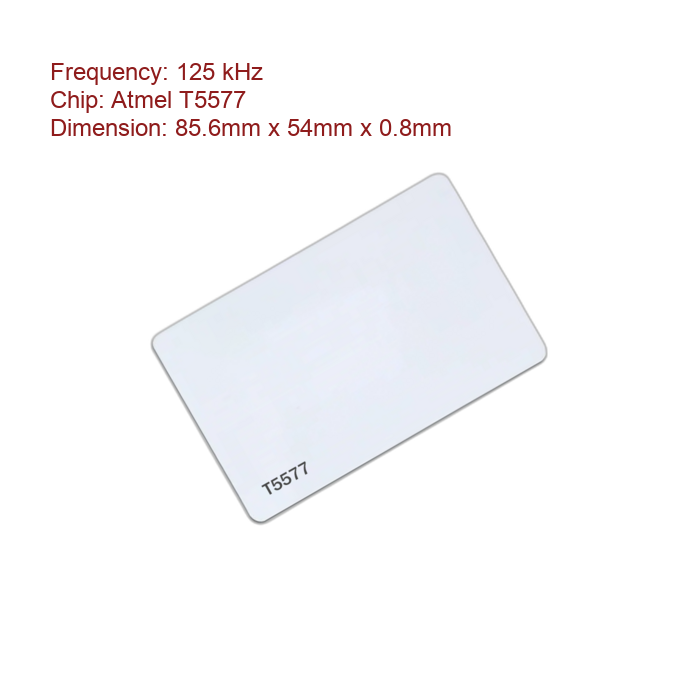
DO RFID Group provides an Atmel T5577 125kHz Rewritable Card designed for system integrators, access control distributors, and commercial identification projects.
Main Product Features
- Operating frequency: 125kHz
- Chip: Atmel T5577 / ATA5577
- Technology: Passive LF RFID
- Total EEPROM: 363 bits
- User memory: 224 bits, including the password block
- Communication: Contactless read/write
- Data encoding: Configurable
- Modulation: Manchester, Bi-phase, FSK, PSK, NRZ, depending on configuration
- Password protection: Supported
- Memory block locking: Supported
- Card material: PVC
- Standard format: ISO CR80
- Card dimensions: Approximately 85.6 × 54 × 0.8mm for the DO RFID product configuration
Actual card construction, chip revision, and programmed format should be confirmed in the approved product specification.
How Does a T5577 RFID Card Work?
The T5577 card uses electromagnetic induction to communicate with a compatible 125kHz RFID reader.
The entire process can be divided into four stages.
Step 1: The RFID Reader Generates an Electromagnetic Field
When an RFID reader is activated, its antenna generates an electromagnetic field.
The frequency is typically configured for a 125kHz LF identification system.
Step 2: The Card Receives Energy
The copper antenna inside the T5577 card captures electromagnetic energy from the reader.
This energy powers the chip, allowing it to activate without an internal battery.
Step 3: The Chip Exchanges Data
The reader sends commands to the chip using a supported communication format.
The T5577 receives and decodes these commands. It can then return its programmed identification information through load modulation.
In simple terms, the card changes the electrical loading of its antenna to modulate the reader’s RF field. The reader detects these changes and converts them into digital information.
Step 4: The Reader Processes the Identification Data
The reader decodes the response and transfers the identification information to the connected access control or management system.
Depending on the configured format and reader capabilities, the information can be used for:
- Employee identification
- Access control
- Attendance records
- Parking management
- Equipment identification
- Membership management
The entire process is contactless and normally takes only a short time.
Technical Specifications of the ATA5577 Chip
The ATA5577 is a configurable low-frequency RFID identification chip designed for applications operating within a frequency range of 100kHz to 150kHz.
Although 125kHz is the most common application frequency, the actual card configuration must match the intended reader system.
Memory Structure
One of the most important technical features of the T5577 is its 363-bit EEPROM.
According to the Microchip ATA5577C datasheet, the memory is organized into 11 blocks, with each block containing 32 data bits and one lock bit.
| Memory Component | Capacity | Function |
|---|---|---|
| User Memory | 7 × 32 bits | Programmable identification and application data |
| Password Storage | 32 bits within user block allocation | Optional write protection |
| Traceability Data | 2 × 32 bits | Factory-programmed chip identification information |
| Configuration Register | 32 bits | Controls chip operating parameters |
| Option Register | 32 bits | Configures analog front-end behavior |
| Total EEPROM | 363 bits | 11 blocks × 33 bits |
Important memory clarification: The seven user-memory blocks provide 224 data bits in total, and the 32-bit password uses one of these blocks when password mode is enabled. Therefore, the remaining application data capacity may be 192 bits when that block is reserved for password storage.
The 363-bit total is not the same as 363 bits of freely available user data.
Configurable Operating Parameters
Depending on the chip revision and configuration, T5577 supports:
- Basic and extended operating modes
- Selectable data rates
- Manchester encoding
- Bi-phase encoding
- Frequency Shift Keying (FSK)
- Phase Shift Keying (PSK)
- Non-Return-to-Zero (NRZ)
- Password mode
- Blockwise write protection
- Answer-on-Request operation
- Configurable maximum readable block
This flexibility makes the chip suitable for different LF RFID designs.
Official technical reference:
What Makes T5577 Different from Ordinary 125kHz RFID Cards?
The biggest difference is programmability.
Traditional read-only RFID cards generally store a fixed identification number that cannot be rewritten through normal RF programming.
T5577 cards provide configurable memory and operating parameters.
| Feature | T5577 | TK4100 | EM4200 |
|---|---|---|---|
| Frequency | 100–150kHz IC range | Typically 125kHz | 100–150kHz |
| Read Function | Yes | Yes | Yes |
| Write Function | Yes | No | No |
| Programmable Memory | Yes | No | No |
| Factory Fixed Identifier | Traceability data | Fixed ID | Fixed ROM code |
| Password Protection | Supported | No standard user-write function | No standard user-write function |
| Main Application | Configurable LF identification | Basic access credentials | Fixed-ID identification |
| Custom Data Configuration | Yes | No | No |
TK4100 and EM4200 are economical choices when an application only requires fixed identification.
T5577 is more suitable when the system requires programmable credentials and configurable data formats.
For businesses that only need standard fixed-ID cards, DO RFID also offers different LF RFID card options.
T5577 vs EM4305: Which Rewritable Chip Is Better?
EM4305 is another programmable low-frequency RFID chip family.
Both T5577 and EM4305 support read/write operations, but their memory structures, communication commands, and application compatibility are different.
| Feature | T5577 | EM4305 |
|---|---|---|
| Technology | LF RFID | LF RFID |
| Typical Frequency | 125kHz | 125kHz |
| Read/Write | Yes | Yes |
| Memory Architecture | 363-bit EEPROM for ATA5577C | Different device-specific EEPROM organization |
| Configuration | Basic and extended modes | Chip-specific configuration |
| Password Protection | Supported | Device-specific protection functions |
| Compatibility | T5577 and selected compatible LF formats | EM4305-compatible readers and software |
| Application | Programmable proximity identification | Configurable identification and industrial applications |
The most important consideration is not simply memory capacity.
It is whether the existing reader and software support the selected chip’s communication format and programming commands.
If a project already uses T5577-compatible hardware and encoding software, changing to EM4305 may require additional integration and validation.
For new installations, compare both options against the complete reader and card system rather than purchasing based on chip features alone.
T5577 Compatibility with 125kHz RFID Readers
Reader compatibility is one of the most important purchasing considerations.
Many customers assume that any 125kHz RFID reader can automatically read and write a T5577 card.
This is not correct.
Although different LF RFID chips may operate at similar frequencies, their data formats, modulation, transmission rates, and communication commands can vary.
A T5577 card must be configured in a format supported by the intended reader.
Factors Affecting Compatibility
1. Operating Frequency
The reader and card must operate within compatible frequency ranges.
2. Modulation and Encoding
The reader must recognize the card’s configured data transmission method.
3. Data Rate
Different RFID systems may use different data rates and clock configurations.
4. Data Frame Structure
The reader must support the required identification format and frame structure.
5. Write Command Support
A reader capable of reading fixed-ID cards may not support writing programmable T5577 memory.
For this reason, buyers should select a dedicated 125kHz RFID Reader Writer when T5577 programming is required.
DO RFID also provides 125kHz RFID Readers for compatible proximity identification applications.
The correct reader should be tested with the actual card configuration before bulk procurement.
What Is the Difference Between a T5577 Card and a T5577 Reader Writer?
The card and reader writer are two different components of an RFID system.
A T5577 card contains the chip and antenna that store and communicate identification information.
A T5577 reader writer provides the RF communication and programming functions required to interact with the card.
| Component | Function |
|---|---|
| T5577 Card | Stores programmable RFID data |
| 125kHz Reader | Reads supported identification information |
| 125kHz Reader Writer | Supports reading and authorized memory programming |
| RFID Access Controller | Evaluates credentials and controls access |
| Management Software | Manages authorized card registration and system records |
For project buyers, purchasing a compatible card and reader writer together can reduce integration problems.
However, the existing access control controller must also support the resulting card format.
Main Applications of T5577 125kHz Rewritable Cards
1. Access Control Systems
Access control remains one of the most common applications for 125kHz RFID credentials.
T5577 cards can be used in compatible installations where programmable LF identification is required.
Typical applications include:
- Office access
- Factory entrances
- Warehouse access
- Residential buildings
- Commercial facilities
- Restricted work areas
- Temporary employee credentials
For these applications, card enrollment and issuance should be managed by authorized system administrators.
T5577 password protection should not be confused with modern cryptographic access control. For high-security facilities, encrypted credentials such as MIFARE DESFire are generally more appropriate.
2. Employee Identification
Factories, warehouses, and commercial organizations often issue RFID cards to employees.
A T5577 card can combine programmable LF identification with printed employee information.
Possible customization includes:
- Company logos
- Employee photographs
- Staff numbers
- Department information
- Serial numbers
- Barcodes
- Expiry dates
The printable card surface is particularly useful for companies that produce employee credentials in batches.
3. Hotel and Hospitality Applications
Some legacy hotel and accommodation systems use 125kHz proximity cards.
T5577 cards may be suitable for systems specifically designed to support programmable LF credentials.
Applications include:
- Guest identification
- Compatible room access systems
- Temporary credentials
- Staff identification
- Parking access
Before purchasing, confirm whether the hotel’s existing lock system supports the exact T5577 configuration.
Not all hotel locks use 125kHz technology. Many newer systems use HF MIFARE or other secure smart card solutions.
4. Parking Management
125kHz RFID systems are used in some vehicle and pedestrian parking facilities.
Programmable LF cards can serve as credentials for:
- Monthly parking
- Employee parking
- Residential parking
- Visitor access
- Controlled parking areas
The card communicates with the compatible reader installed at the entrance or exit.
5. Membership and Identification Systems
T5577 cards can also be used for membership and identification applications.
Examples include:
- Sports clubs
- Fitness facilities
- Community organizations
- Industrial associations
- Employee service centers
- Small commercial membership programs
The card’s programmable information can be associated with a central membership database.
6. RFID Development and Testing
Because the T5577 chip supports configurable communication and programmable memory, it can be useful for authorized RFID development and testing.
Applications include:
- LF RFID system development
- Reader compatibility evaluation
- RFID laboratory demonstrations
- Identification system testing
- Custom transponder design
For development projects, select an appropriate programming tool and test only within systems and credentials for which you have authorization.
T5577 PVC Card Materials and Customization
A professional RFID card supplier should provide more than a blank white card.
Different projects require different card materials, printing methods, and surface finishes.
Card Materials
Common options include:
PVC Cards
PVC is the most widely used material for standard proximity cards.
Advantages include:
- Good printability
- Smooth surface
- Flexible customization
- Suitable for standard card printers
- Economical mass production
PET Cards
PET-based materials are useful for projects that require different durability and environmental characteristics.
ABS Cards
ABS can be used for selected identification products and alternative card constructions.
Material suitability should be checked against the final card thickness, printing process, and environmental requirements.
Standard Card Dimensions
The DO RFID T5577 card is offered in a CR80-style format.
| Parameter | Specification |
|---|---|
| Card Type | T5577 LF RFID Card |
| Standard Dimensions | 85.6 × 54mm |
| Thickness | Approximately 0.8mm |
| Material | PVC |
| Frequency | 125kHz |
| Surface | Glossy, matte, or frosted options |
| Printing | Full-color and customized printing |
Final dimensions should be confirmed in the approved production drawing.
Printing and Customization Options
DO RFID supports multiple card customization options, including:
- Full-color CMYK printing
- Silk screen printing
- Company logo printing
- Employee photo printing
- Serial number printing
- Barcode printing
- QR code printing
- Matte finishing
- Glossy finishing
- Frosted finishing
- Signature panels
- Custom card shapes
For bulk projects, pre-printing and data personalization can help simplify card issuance.
Explore the T5577 blank RFID contactless card range for available customization options.
T5577 Card vs RFID Key Fob: Which Format Should You Choose?
Not every identification project needs a full-size PVC card.
Some applications are better suited to compact ABS proximity key fobs.
| Feature | T5577 PVC Card | T5577-Compatible Key Fob |
|---|---|---|
| Physical Format | Credit-card size | Compact keychain |
| Carrying Method | Wallet or cardholder | Keyring |
| Printing Area | Large | Limited |
| Logo Customization | Excellent | Model dependent |
| Everyday Carrying | Good | Convenient |
| Typical Application | Employee and membership cards | Access control and visitor credentials |
For users who prefer a compact credential, DO RFID provides 125kHz ABS Proximity Key Fobs with different LF chip options.
When placing an order, specify whether the key fob must contain ATA5577 or another 125kHz chip rather than assuming all LF key fobs are programmable.
T5577 Dual-Frequency RFID Cards
Some projects require compatibility with both older 125kHz systems and newer 13.56MHz smart card infrastructure.
In these situations, a dual-frequency RFID card can be a useful alternative.
A T5577 dual-frequency card typically combines:
- T5577 at 125kHz
- A separate HF chip at 13.56MHz
The two chips operate independently within the same physical card.
Possible applications include:
- Offices upgrading access systems
- Universities
- Industrial parks
- Residential communities
- Enterprise identification
- Legacy system migration
For more advanced security requirements, a T5577 + MIFARE DESFire combination can provide LF compatibility alongside a separate secure HF credential.
DO RFID provides Dual Frequency RFID Cards and Combi Hybrid Cards for selected mixed-technology applications.
The exact chip combination and antenna arrangement should be specified before manufacturing.
T5577 Password Protection and Security Limitations
One of the advantages of T5577 is its optional password mode and blockwise write protection.
These features help control unauthorized modification of programmable memory.
However, buyers should understand the limitations.
Password Protection
The chip supports a 32-bit password mechanism for protecting programming operations.
When password mode is enabled, the authorized reader must provide the correct password for supported write or direct-access operations.
Blockwise Write Protection
Each memory block includes a lock bit.
Once a block is locked, it cannot be reprogrammed through the normal RF interface.
This is useful when an authorized identification format needs to be protected against accidental changes.
Important Security Warning
T5577 is a programmable LF identification chip, not a modern cryptographic smart card.
Its password mechanism and memory lock functions do not provide AES-based mutual authentication or the same protection offered by modern secure credentials.
For applications involving high-value assets, financial transactions, sensitive facilities, or strict security requirements, a more advanced encrypted RFID solution should be evaluated.
T5577 is best suited to compatible low-frequency identification systems with appropriate risk controls.
T5577 Manufacturing Process and Quality Control
Manufacturing a reliable T5577 RFID card requires precise chip bonding, antenna assembly, card lamination, and functional testing.
A typical production workflow includes:
Step 1: Chip Selection
Select the appropriate ATA5577 chip version according to project specifications.
Step 2: Antenna Production
Prepare the low-frequency copper coil antenna with suitable electrical characteristics.
Step 3: Chip Bonding
Connect the RFID chip to the antenna using the appropriate bonding process.
Step 4: Inlay Testing
Check antenna continuity and verify that the chip communicates correctly with the test equipment.
Step 5: Card Lamination
Integrate the RFID inlay between the PVC layers under controlled temperature and pressure.
Step 6: Cutting and Finishing
Cut cards to the required dimensions and complete the surface finishing process.
Step 7: Printing
Print company branding, photographs, barcodes, serial numbers, and other customized information.
Step 8: Programming and Functional Testing
For authorized programmed-card orders, verify the requested configuration and confirm that the card performs correctly with the specified compatible reader.
Step 9: Packaging and Inspection
Inspect finished dimensions, print quality, card appearance, and RFID performance before shipment.
For wholesale projects, ask the supplier about its sample approval process, production testing procedures, and batch traceability.
How to Choose a Reliable T5577 RFID Card Manufacturer
Selecting the correct manufacturer is important for distributors, access control integrators, and project contractors.
The following factors should be considered before placing an order.
1. Genuine Chip Sourcing
Ask the supplier to specify the exact chip manufacturer, part number, and revision.
Different chip revisions and substitute products may have different operating characteristics.
2. Reader Compatibility Testing
Ask whether the supplier can test the card with your existing 125kHz reader.
Provide the reader model and required communication format wherever possible.
A generic statement that a card is compatible with all 125kHz readers is not sufficient.
3. Card Material and Printing Quality
Check:
- PVC thickness
- Surface finish
- Lamination quality
- Print clarity
- Edge finishing
- Card flatness
- Resistance to normal handling
For access control projects, stable dimensions are important for consistent card handling and daily use.
4. Programming and Encoding Services
Confirm whether the supplier can provide:
- Blank cards
- Authorized pre-programming
- Specified memory configuration
- Batch numbering
- Print-and-encode services
- Functional verification
The programming specification should be documented before production.
5. Quality Management
Look for manufacturers with established quality control systems and relevant supporting documents.
Depending on the project, relevant documentation may include:
- ISO 9001
- RoHS
- Material declarations
- Production inspection records
- Chip documentation
6. OEM and ODM Capabilities
A reliable supplier should support customization of card appearance, size, material, printing, and packaging.
This is particularly important for distributors managing multiple access control customers.
Practical Purchasing Experience: 8 Things Buyers Should Confirm
In T5577 sourcing projects, the following issues can have a significant impact on product compatibility and long-term reliability.
1. Confirm the exact chip revision.
Do not rely solely on the product name T5577. Request the ATA5577 part number and relevant datasheet.
2. Verify the memory capacity correctly.
The ATA5577C provides 363-bit total EEPROM and 224 bits allocated to user memory, including the password block. Do not confuse total EEPROM with usable application data.
3. Test the card with the actual reader.
The same frequency does not guarantee protocol compatibility. Approve a sample with the intended reader before mass production.
4. Clarify whether the card is blank or pre-programmed.
A blank card gives the system integrator control over authorized programming. A pre-programmed card can reduce work during installation. Choose according to the issuing process.
5. Confirm whether the memory needs to remain rewritable.
Permanent block locking can prevent future updates. Decide on the required memory protection policy before approving production.
6. Separate identification from security.
T5577 is suitable for configurable LF identification, but it should not be treated as a high-security cryptographic access credential.
7. Check card printer compatibility.
For businesses printing employee photographs and logos, confirm card dimensions, thickness, and surface compatibility with the existing printer.
8. Evaluate the complete cost.
Compare chip authenticity, card quality, printing, encoding, packaging, shipping, and reader compatibility rather than choosing a supplier based only on the lowest unit price.
What Information Should You Provide When Requesting a T5577 Card Quotation?
To help a manufacturer prepare an accurate quotation, provide the following details:
| Requirement | Information to Provide |
|---|---|
| Chip Type | ATA5577 / T5577 |
| Frequency | 125kHz |
| Card Size | 85.6 × 54mm or customized |
| Thickness | 0.8mm or required thickness |
| Material | PVC, PET, ABS |
| Surface | Glossy, matte, frosted |
| Programming | Blank or authorized pre-programmed |
| Reader | Existing reader model |
| Compatibility | Required data format |
| Printing | Logo, photo, barcode, QR code |
| Memory | Application data and password requirements |
| Quantity | Sample and bulk order |
| Packaging | Individual or bulk packaging |
| Delivery | Destination country and required schedule |
Providing these details helps reduce misunderstandings and allows the manufacturer to recommend the appropriate card configuration.
Frequently Asked Questions About Atmel T5577 125kHz Rewritable Cards
1. What is the T5577 RFID card?
A T5577 RFID card is a programmable low-frequency contactless card containing an ATA5577 chip. It operates commonly at 125kHz and supports reading and writing of configurable memory.
2. Is T5577 a rewritable RFID chip?
Yes. The ATA5577 contains EEPROM memory that supports contactless programming and rewriting, subject to its configuration and memory lock settings.
3. What is the frequency of a T5577 card?
T5577 chips support an operating RF frequency range of approximately 100kHz to 150kHz. Commercial proximity card configurations commonly use 125kHz.
4. How much memory does a T5577 card have?
The ATA5577C has 363 bits of total EEPROM arranged in 11 blocks of 33 bits each. Seven blocks provide 224 bits of user memory, including a block that can be allocated to password storage.
5. Is T5577 compatible with EM4100 and EM4200 readers?
Compatibility is configuration-dependent. Some T5577 applications can be configured to work with readers expecting compatible EM-style identification formats. However, not every EM4100 or EM4200 reader supports every T5577 configuration.
Confirm the exact reader, data format, modulation, and communication settings before ordering.
6. Can T5577 cards be reused?
Yes, provided the relevant memory blocks have not been permanently locked and the card remains functional. Password and lock configurations may restrict subsequent programming.
7. Is T5577 suitable for access control?
It can be used in compatible low-frequency access control systems. For high-security facilities, consider modern encrypted smart cards with stronger authentication.
8. What is the difference between T5577 and TK4100?
T5577 supports programmable memory and read/write operations, while TK4100 is generally a fixed-ID read-only chip.
T5577 is more flexible, while TK4100 is suitable for basic identification applications.
9. Can T5577 cards be printed?
Yes. PVC T5577 cards can support full-color printing, company logos, employee photos, serial numbers, and barcodes, depending on the manufacturing configuration.
10. What is the reading distance of a T5577 card?
The actual distance depends on the card antenna, reader antenna, reader power, and environment. For conventional 125kHz cards, the operating range is generally a few centimeters.
11. Does T5577 need a battery?
No. T5577 is a passive RFID chip. It receives energy from the electromagnetic field generated by the reader.
12. Can I buy blank T5577 cards in bulk?
Yes. Blank T5577 cards are suitable for distributors, system integrators, and businesses that manage authorized programming internally. Custom printing and pre-programming can also be requested according to project requirements.
Conclusion
The Atmel T5577 125kHz Rewritable Card is a flexible low-frequency RFID credential designed for compatible identification and access control applications.
With its programmable EEPROM, configurable communication parameters, password protection, and customized PVC card format, it offers more flexibility than conventional fixed-ID proximity cards.
However, successful implementation depends on selecting the correct chip configuration and verifying compatibility with the existing reader system. Memory capacity, modulation, data rate, card antenna, and security requirements should all be considered before placing a bulk order.
For access control distributors, system integrators, hotel suppliers, and commercial identification projects, DO RFID Group provides T5577 blank cards, customized RFID credentials, compatible LF readers, and related RFID products.
By choosing a reliable manufacturer and testing samples with the actual reader before mass production, businesses can reduce integration risks, improve card consistency, and build a more reliable 125kHz RFID identification solution.