November 7, 2026
A PIT tagging kit brings together the parts needed for an identification workflow, but “kit” does not describe one standard set of products. It may contain a reader and a few preloaded tags, or tags and an applicator without a reader. Compare the contents, the way the components fit together and the replenishment requirements.
The right combination depends on what the team already owns and how the project will be carried out. A useful kit should make the transition from a physical tag to a recorded identity clear; a collection of individually suitable parts is not enough if those parts are incompatible.
Compare procurement routes at a glance
| Purchase need | Configuration to compare | What still needs checking |
|---|---|---|
| Already have a compatible reader | Loose tags or EO-sterilized preloaded injector sets | Reader format support and, for loose tags, compatibility with the existing application tool |
| First manual identification workflow | Tags + a compatible handheld reader, with the appropriate application format | Data recording or output, charging/power and the items already held by the team |
| Need preloaded injectors | The matching G-series single-use set from the model table below | Tag dimensions and format, EO-sterilized individual packaging, label requirements and pack quantity |
| Fixed passage monitoring | Tags + a fixed reader + antenna, with power and logging | Detection area, intended tag path, power supply and the recording system |
The fixed-station row describes the complete project configuration. It is not a claim that every component is included in our injector packs or supplied as one boxed monitoring kit; the quotation should itemize the equipment actually offered.
DO RFID tag and injector options
The six preloaded G-series models below are EO (ethylene oxide) gas-sterilized, single-use injector sets. Each individual set contains one injector preloaded with one glass tag, a barcode sticker and its own paper/plastic pouch. The catalog supply pack contains 20 individual sets. A reader is a separate item.
| Model | Preloaded tag: diameter × length | Tag format | Injector body dimensions |
|---|---|---|---|
| G-101 | Ø1.4 × 8 mm | FDX-B | 120 × 46 mm |
| G-102 | Ø2.12 × 12 mm | FDX-B | 120 × 46 mm |
| G-103 | Ø1.4 × 8 mm | FDX-B | 140 × 47 mm |
| G-105 | Ø3 × 15 mm | FDX-B or HDX; specify the ordered version | 140 × 47 mm |
| G-106 | Ø2.12 × 12 mm | FDX-B | 133 × 43 mm |
| G-107 | Ø2.12 × 12 mm | FDX-B | 138 × 43 mm |
Read the two size columns separately. Tag dimensions describe the glass capsule. Injector body dimensions describe the injector’s external body; they are not needle gauge, needle length or packaging dimensions. All listed values are in millimetres.
Loose G-002 8 mm and G-003 12 mm tags are supplied in bags of 100 without an injector. A separately supplied applicator must be matched to the capsule and project procedure.
For handheld identification, our 2026 animal-reader catalog lists EMID, FDX-B and HDX support at 125/134.2 kHz for W90A and W91A. Match the selected reader and tag configuration to the intended workflow. A fixed station also needs its own antenna, power and logging arrangement.
EO-sterilized single-use sets and individual packaging
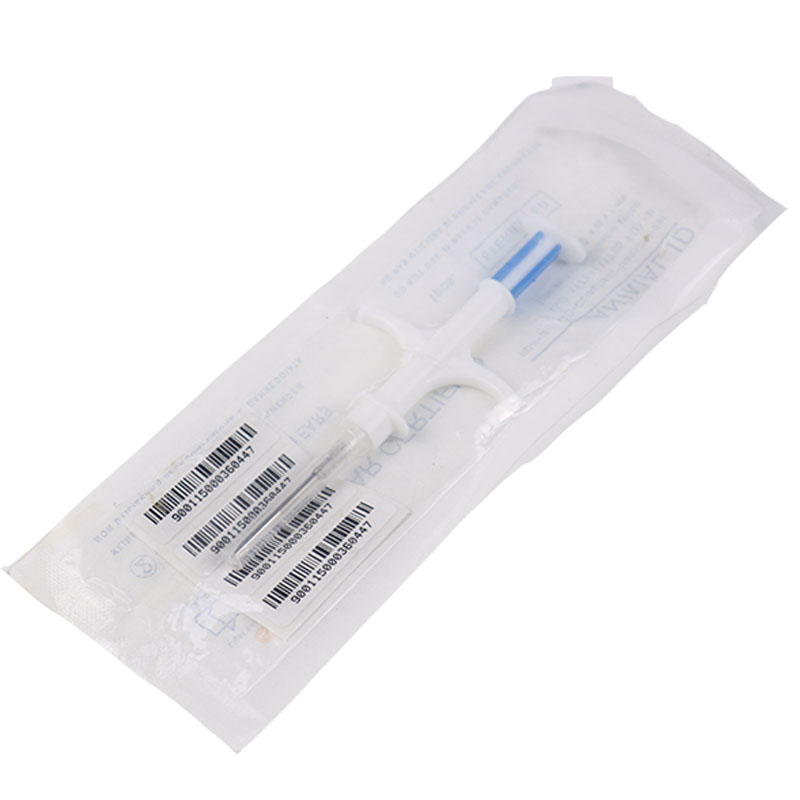
What one supplied set means
- One glass transponder already loaded in its injector.
- A disposable, single-use injector assembly.
- A barcode sticker associated with the supplied tag identity.
- Individual paper/plastic packaging and EO gas sterilization for the listed preloaded sets.
One pouch is one injector set; one supply pack contains 20 sets. This is different from a bag of loose transponders and from a reader bundle. When ordering, specify the injector model, tag format and EO-sterilized individual presentation together.
Keep the supplied product and expiry information with the stock record, and check pouch integrity before use under the product instructions and the project’s qualified procedure. The sets described here are disposable; a reusable handle with separately replaced loaded needles is a different supply format.
What belongs in a PIT tagging setup?
| Component | Its role | What to establish |
|---|---|---|
| PIT transponders | Provide the individual IDs | Full dimensions, supported format, quantity and numbering requirements |
| Needle, syringe or injector | Provides the specified application arrangement | Exact compatibility with the tag and the project’s approved procedure |
| Packaging | Keeps the product in its supplied condition | Loose or preloaded presentation, packaging status and required documentation |
| Reader | Checks and captures the electronic ID | Supported tag formats, practical reading task and recording functions |
| Labels and records | Connect the physical item and the project entry | How printed IDs, scanned IDs and records are matched |
| Accessories | Support use and transport | Charging, cables, protection and actual replacement items |
This is a component map, not a claim that every commercial kit includes every item. For a documented example, the BamaBass kit lists a portable reader, ten preloaded tags, barcode labels and a case. It illustrates one complete offer. Another supplier’s kit may be organized differently.
Loose tags, preloaded needles and complete syringes
Loose tags are supplied without the tag already positioned in a single-use application assembly. They can suit an established preparation workflow, but the project must account for the equipment and work associated with that format.
Preloaded needles contain the transponder in the specified needle assembly. They may require a particular reusable handle or injector. Buying the loaded needle does not automatically provide the mechanism that operates it.
Preloaded syringes combine more of the assembly in an individual unit. The DO RFID models listed above are EO-sterilized single-use sets with individual paper/plastic packaging. For other products, read the supplied specification: “preloaded” describes the assembly and does not itself state the sterilization method.
The practical difference is where preparation takes place and which parts are reused or replaced. It also affects storage, stock control and the form in which the team receives each tag. The selection should follow the qualified project procedure rather than a generic recommendation about which format is easiest.
Electronic compatibility and mechanical compatibility are separate
A reader and a transponder must agree electronically: the reader needs to support the tag’s frequency, communication format and relevant ID handling. FDX-B and HDX should be treated as specific supported formats, not inferred from a shared frequency label.
The tag and application assembly must also agree physically. Length, diameter, loading arrangement and the injector mechanism matter. Two glass transponders described as “12 mm” have not been shown to fit the same assembly merely by sharing a length category.
Biomark’s implanter listings demonstrate model-specific pairings between tags, needles and injectors. Use such a pairing as a manufacturer’s specified combination, not as a universal needle chart for products from all suppliers.
If size selection is still open, resolve that question alongside the application arrangement. Our fish PIT tag size guide explains why neither animal suitability nor detection performance should be reduced to length alone.
Choose a kit around what the team already has
An existing compatible reader
Start with the exact tag formats that reader supports. The purchase may only need transponders, the matching preparation/application items and labels. Adding another scanner to a bundle is useful only if it addresses a real operational need, such as an additional field team or a different data function.
A first identification workflow
Follow one identity through the whole process before ordering the full quantity. The team should be able to match the supplied item with its code, capture the code with the reader, and associate it with the correct project record. Check how charging, offline work and later data transfer will be handled.
A team that specifically needs preloaded injectors
Choose the complete G-series model rather than ordering only by tag length. G-101 and G-103 both contain Ø1.4 × 8 mm tags but have different injector body dimensions; G-102, G-106 and G-107 share the Ø2.12 × 12 mm tag size while their injector bodies differ. Include the required EO-sterilized individual packaging and pack quantity in the order line.
A project using fixed detection
A tagging kit can prepare identities for an existing monitoring network, but it does not automatically include that network. Fixed antennas, reader infrastructure, power and logging need their own configuration. The tags in the kit must also match the network the project intends to use.
A practical 100-tag configuration
For a hypothetical team evaluating Ø1.4 × 8 mm FDX-B tags at one handling station, a component list could contain five packs of G-101 or G-103 sets, a compatible handheld reader, its specified charging accessories, and the project’s recording materials. Five packs provide 100 tags and 100 injectors. The barcode stickers belong to those 100 identities, not an additional set of animals.
If the project already has a suitable applicator and preparation workflow, the alternative tag line is one bag of 100 G-002 tags. The reusable equipment and separately required preparation items then need their own list. These are configurations to evaluate and quote, not a named DO RFID boxed bundle.
Match the supplied itemKeep its printed label with the tag configuration
Read the electronic IDCompare the full value with the supplied record
Associate the animalKeep the scan and the project entry together
Save the observationPreserve ID, measurement, date and operator
A spare allowance changes the pack calculation. If the planned requirement is 100 tags plus ten spares, complete packs of 20 require six packs, supplying 120 sets. Stock those extra identities as unused inventory and keep their records separate from deployed tags.
Think about the second order as well as the first
A starter kit is only the beginning of the supply arrangement. Establish which parts are consumed, which can be reused under the approved procedure, and which replacements depend on a particular manufacturer’s system.
For example, a kit with a small number of tags can be useful for evaluation. A later order should preserve the agreed tag configuration and its package-to-ID relationship. If a cartridge or loaded-needle format is required, include that format in the replenishment specification instead of ordering only a similar capsule.
Also distinguish the number of tags from the number of labels. Several labels may correspond to one ID for use on different records. Their quantity is not the number of independent electronic identities supplied.
Compare the same kit contents when comparing prices
Separate the transponders, reader, application equipment, labels and accessories into individual cost lines. A cheaper package may contain fewer tags or omit equipment the team still needs. A more expensive package may include reusable items that should not be charged again to every replenishment batch.
Our PIT tag cost guide compares tag-only and starter-kit prices and shows how preparation work can change the comparison. The aim is a budget for the intended workflow, not the lowest headline price.
Define the configuration for a supply discussion
When discussing PIT tag supply with DO RFID, describe the tag dimensions, required format, quantity and preferred presentation. Include the intended reader and any application system already in use. Include the EO-sterilized single-use requirement, individual pouch format, pack quantity and any label-to-ID matching requirements in the enquiry.
We can then discuss the actual configuration rather than treating “a fish tagging kit” as one universal product. Concrete reader information is available through our animal RFID reader page; equipment selection is explored in the reader guide.
Frequently asked questions
Does every PIT kit include a scanner?
No. Confirm the itemized contents. “Tagging kit” can refer to several different combinations.
Are these DO RFID preloaded injector sets EO-sterilized?
Yes. The G-101, G-102, G-103, G-105, G-106 and G-107 sets listed here use EO gas sterilization, disposable injectors and individual paper/plastic packaging. For other preloaded formats, check their own sterilization and packaging specification.
Can I use any PIT syringe with any glass tag?
No. Use a specified tag-and-application-system combination consistent with the project procedure.
Can I add different tags to an existing kit?
Only after checking both reader support and physical compatibility with the application arrangement. Preserve the full configuration when replenishing stock.

Do RFID is a leading China-based manufacturer with over 15 years of experience. We specialize in customized RFID readers, tags, and cards, delivering high-quality, tailored solutions that meet your unique business needs and drive seamless, efficient identification.