October 21, 2026
Our blank white NFC PVC NTAG215 card combines a standard ISO card format with reliable contactless NFC technology for identification, digital interaction, access control, smart cards, and other tap-to-connect applications. Built with an NXP NTAG215 NFC chip, the card complies with NFC Forum Type 2 Tag and ISO/IEC 14443 Type A standards, making it suitable for use with compatible NFC readers, smartphones, and other NFC-enabled devices.
The blank white surface provides a clean base for custom printing, branding, numbering, QR codes, logos, or other visual information. The card can also be encoded with NDEF data before shipment or programmed by the customer after delivery.
With a 13.56 MHz operating frequency, 504 bytes of freely available user memory, programmable read/write functions, and configurable locking and password protection, the NTAG215 card is a practical choice for businesses that need a reusable and customizable NFC card in a familiar credit-card-sized format.
Key Features of NTAG215 NFC Cards
The NTAG215 NFC card is designed for projects that require both physical identification and digital interaction. Its standard card construction makes it easy to integrate into existing card-based workflows, while the embedded NFC chip allows users to access digital information with a simple tap.
Key advantages include:
- Original NXP NTAG215 NFC chip
- NFC Forum Type 2 Tag compliant
- ISO/IEC 14443 Type A compliant
- 13.56 MHz operating frequency
- 504 bytes of freely available user memory
- Read/write capability for programmable applications
- Configurable read-only locking function
- Password protection for selected memory areas
- Up to approximately 100 mm operating distance under suitable conditions
- Standard credit-card-size format
- Blank white surface for custom printing
- PVC, ABS, and high-temperature PET material options
- Offset and silk-screen printing available
- Custom card size and thickness available
- Suitable for smartphones and compatible NFC readers
The actual read distance depends on the NFC reader, antenna design, card construction, device power, and surrounding environment. The maximum distance should therefore be treated as an application-dependent specification rather than a guaranteed reading distance.
NTAG215 NFC Card Specifications
Blank NTAG215 Card is designed to fully comply with NFC Forum Type 2 Tag and ISO/IEC14443‑A Type specifications. Based on the NTAG215 chip from NXP, NTAG215 delivers advanced security, anti‑cloning features as well as permanent‑lock functionality, so user data can be permanently configured as read‑only.
| Material | PVC/ABS/PET(high temperature resistance ) etc |
| Frequency | 13.56Mhz |
| Size | 85.5*54mm or customized size |
| Thickness | 0.76mm,0.8mm,0.9mm etc |
| Chip Memory | 504 Byte |
| Encode | Available |
| Printing | Offset ,silkscreen Printing |
| Read range | 1-10cm (depend on the reader and reading environment) |
| Operation temperature | PVC:-10°C -~+50°C;PET: -10°C~+100°C |
| Application | Access Control, Payment, hotel key card, resident key card, attendance system ect |

NTAG215 NFC Card is one of original NTAG® card. Seamlessly working with NFC readers as well ascompatible with all NFC enabled devices and conform to ISO 14443. The 215 chip has a read-write lockfunction that makes the cards can be edited repeatedly or read-only.
Due to the excellent safety performance and better RF performance of Ntag215 chip, Ntag215 print card is widely used in financial management, communications telecommunications, social security, transportation tourism, health care, government administration, retail, storage and transportation, member management, access control attendance, identification, highways, hotels, entertainment, school management, etc.
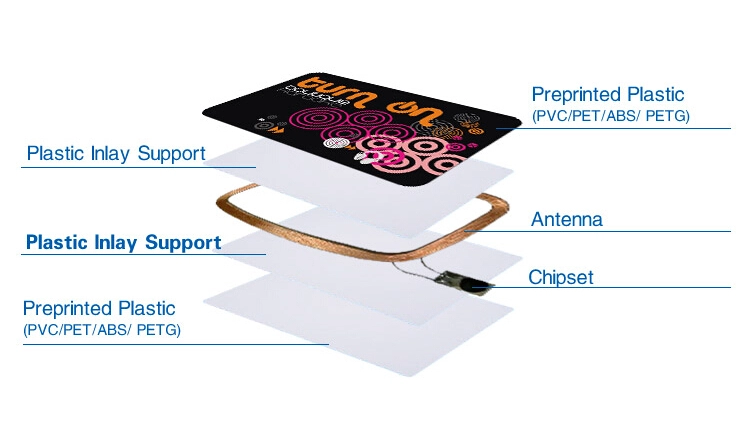


What Is an NTAG215 NFC Card?
NTAG215 is an NFC tag IC developed by NXP Semiconductors for mass-market NFC applications. It belongs to the NTAG213/215/216 family and is designed to comply with NFC Forum Type 2 Tag and ISO/IEC 14443 Type A requirements.
The NTAG215 version provides 504 bytes of freely available user memory, positioned between the smaller NTAG213 and larger NTAG216. This makes it useful for applications where NTAG213 capacity is insufficient but the larger memory of NTAG216 is unnecessary.
The chip supports contactless data transfer at 13.56 MHz and can communicate with compatible NFC readers and NFC-enabled devices. Typical applications include smart marketing materials, digital business cards, product information, NFC identification, mobile companion tags, and other tap-based experiences.
NTAG213 vs NTAG215 vs NTAG216
Choosing the right NTAG chip depends mainly on memory requirements, application complexity, and project cost. The three chips share the same basic NFC technology but provide different amounts of user memory.
| Feature | NTAG213 | NTAG215 | NTAG216 |
|---|---|---|---|
| User Memory | 144 bytes | 504 bytes | 888 bytes |
| NFC Type | Type 2 Tag | Type 2 Tag | Type 2 Tag |
| Frequency | 13.56 MHz | 13.56 MHz | 13.56 MHz |
| ISO Standard | ISO/IEC 14443 Type A | ISO/IEC 14443 Type A | ISO/IEC 14443 Type A |
| Best For | Short URLs and simple data | Medium-size NFC data | Larger NFC data |
| Read/Write | Yes | Yes | Yes |
| Password Protection | Yes | Yes | Yes |
| Locking Function | Yes | Yes | Yes |
NTAG215 is often a practical middle option. It offers substantially more user memory than NTAG213 while remaining smaller in memory capacity than NTAG216. NXP specifies 144, 504, and 888 bytes of freely available user memory for NTAG213, NTAG215, and NTAG216 respectively.
Why Choose NTAG215 for Your NFC Card Project?
NTAG215 is suitable when the project needs more data capacity than a basic NFC URL tag but does not require the larger memory capacity of NTAG216.
For example, a business card may only need a short URL, while a product information card may contain a longer NDEF record or multiple data elements. A membership or event card may also use the chip to store an identifier that connects the physical card to information stored in a cloud-based system.
Using a unique identifier and keeping sensitive information on a server can also make the overall system easier to manage. The card does not have to contain an entire customer profile or database record. Instead, it can store a short identifier or URL that points to the current information online.
This approach is particularly useful when the content needs to be updated without replacing the physical NFC card.
Blank White PVC Card for Custom Printing
The blank white card surface is designed for businesses that want to add their own visual identity or card information.
Custom printing can include:
- Company logos
- Brand colors
- Product images
- Customer names
- Membership numbers
- QR codes
- Website addresses
- Event information
- Instructions for tapping the card
Offset printing is suitable for detailed, full-color artwork and larger production quantities, while silk-screen printing can be considered for selected designs and specific visual effects.
For projects requiring variable information, NFC encoding and printed personalization can be combined. For example, each card can have a unique NFC identifier and a matching printed number.
NFC Encoding and Data Programming
NTAG215 cards can be supplied blank or encoded according to project requirements.
A common NFC application is NDEF encoding. NDEF is the standard data format used by many NFC applications and can contain information such as a URL, text, contact information, or other supported records.
For a simple digital business card, the NFC chip may contain a URL that opens a mobile-friendly profile. For a product label, the NFC tag may open a product authentication or product information page. For an event card, the NFC data may direct visitors to registration, schedules, maps, or digital content.
The appropriate data structure depends on the application and the NFC software or reader being used.
Before mass production, it is recommended to test the exact encoding format with the target smartphones or NFC readers. This helps verify compatibility, read performance, and the user experience before a large batch is produced.
Read/Write and Read-Only Functions
NTAG215 supports programmable read/write operation, allowing information to be changed during the development or deployment stage.
This is useful when cards are produced in advance but their digital content is assigned later. For example, a batch of blank cards can be encoded after customer information becomes available.
When the information should no longer be changed, the card’s locking function can be configured to make selected memory areas read-only.
This provides a useful distinction between two production stages:
| Project Stage | Recommended Card Status |
|---|---|
| Development | Read/write |
| Testing | Read/write |
| Initial encoding | Read/write |
| Data verification | Read/write |
| Final deployment | Read-only when required |
| Permanent fixed information | Read-only |
Because locking can be permanent for the affected memory area, the lock configuration should be tested carefully before final production.
Password Protection and NFC Security
NTAG215 provides configurable password protection for selected memory areas. NXP also specifies an ECC-based originality check for the NTAG21x family.
These features can help protect data and support tag identification, but they should not be interpreted as equivalent to a high-security cryptographic smart card.
For applications involving high-value transactions, sensitive credentials, or strong anti-counterfeiting requirements, the complete system should be designed around the security capabilities of the chosen NFC chip, reader, backend software, and authentication protocol.
For ordinary NFC marketing, identification, digital content, and basic controlled-data applications, NTAG215 can provide a practical balance between functionality, compatibility, and cost.
NFC Card Applications
NTAG215 PVC cards can be adapted to a wide range of contactless applications.
Digital Business Cards
Store a URL or digital contact record on the card and allow users to access it by tapping an NFC-enabled smartphone.
Smart Product Cards
Connect physical products to digital product information, manuals, registration pages, warranty information, or after-sales services.
Membership and Loyalty Cards
Use an NFC card as a physical membership identifier that connects to an online customer account or loyalty platform.
Event and Visitor Cards
Encode event information, registration links, schedules, venue information, or a unique attendee identifier.
Access Identification
The card can be integrated into compatible NFC identification or access-control systems. System compatibility should always be confirmed with the specific reader and software before deployment.
Marketing and Advertising
An NFC card can turn printed advertising into an interactive experience. Customers can tap the card to open a website, promotional landing page, social profile, product video, or other digital content.
Education and Training
Schools, training organizations, and museums can use NFC cards to connect physical materials with digital lessons, multimedia, or additional information.
NFC Card Applications at a Glance
| Application | Typical NFC Data | Main Benefit |
|---|---|---|
| Digital Business Card | URL / Contact | Easy mobile sharing |
| Product Information | URL / Product ID | Connects physical and digital content |
| Membership Card | Member ID / URL | Links card to customer account |
| Event Card | Registration URL / Event ID | Fast event interaction |
| Marketing Card | Landing Page URL | Tap-to-access campaigns |
| Smart Packaging | Product URL / ID | Adds digital product information |
| Education | URL / Text | Connects physical and digital learning |
| Identification | Unique ID | Supports compatible identification systems |
PVC, ABS, or PET: Which Material Should You Choose?
Different card materials can be selected according to the operating environment.
PVC is a common choice for standard indoor cards because it offers a familiar card format and supports common printing processes.
ABS can be considered for applications that require a different plastic construction or mechanical characteristics.
PET is particularly useful when higher temperature resistance is required. The original product specification lists PET as a high-temperature material option and indicates a higher operating-temperature range than standard PVC.
| Material | Typical Use | Temperature Consideration |
|---|---|---|
| PVC | Standard NFC cards | Approximately -10°C to +50°C |
| ABS | Durable plastic card applications | Confirm according to selected material grade |
| PET | Higher-temperature applications | Approximately -10°C to +100°C |
The final material should be selected according to the actual environmental conditions, printing requirements, card construction, and antenna design.
Standard Card Size and Custom Options
The standard card size is approximately 85.5 × 54 mm, which is close to the familiar bank-card format. This makes the card convenient for wallets, card holders, badge systems, membership programs, and other applications designed around standard card dimensions.
Custom dimensions and thicknesses can also be discussed for projects requiring a different physical format.
Available thickness options include approximately 0.76 mm, 0.8 mm, and 0.9 mm, depending on the selected construction and production requirements.
Custom manufacturing can combine physical card specifications with NFC encoding and printed artwork, allowing businesses to create a card designed specifically for their application.
NFC Read Range: What Should You Expect?
The product specification lists a read range of approximately 1–10 cm, while NXP specifies an operating distance of up to 100 mm under suitable conditions.
Actual performance can vary significantly.
Important factors include:
- NFC reader antenna size
- Smartphone model
- Reader output power
- Card antenna design
- Position and orientation of the card
- Nearby metal objects
- Card construction
- Environmental interference
For this reason, read distance should not be treated as a guaranteed fixed value for every NFC-enabled device.
For most tap-to-interact applications, a short intentional reading distance is often desirable because it gives the user clear feedback that the NFC interaction has occurred.
How NTAG215 NFC Cards Work
The operating process is simple:
- An NFC-enabled smartphone or compatible reader generates a 13.56 MHz RF field.
- The NFC card’s antenna receives energy from the field.
- The NTAG215 chip communicates with the reader through the NFC interface.
- The reader retrieves the programmed information.
- The smartphone or application performs the corresponding action, such as opening a URL or identifying the card.
The card itself does not require a conventional battery. Power is supplied wirelessly by the NFC reader during communication.
This makes NFC cards convenient for applications where a thin, maintenance-free contactless interface is preferred.
NTAG215 vs. QR Code
NFC and QR codes can also be used together rather than treated as competing technologies.
| Feature | NTAG215 NFC Card | QR Code |
|---|---|---|
| User Action | Tap | Scan |
| Camera Required | No | Usually yes |
| Physical Printing | Not required for NFC data | Required |
| Digital Content | Programmable | Encoded in printed code |
| Can Be Rewritten | Yes, before locking | Depends on implementation |
| Visual Branding | Excellent with printed card | Excellent |
| Works Without NFC | No | Yes |
| Best Use | Tap-to-connect experience | Visual scan access |
A strong product design can include both an NFC tag and a QR code. NFC provides a convenient tap experience, while the QR code provides an alternative for devices without NFC support.
How to Order Custom NTAG215 NFC Cards
Before production, prepare the basic project requirements so the card can be manufactured and encoded correctly.
Recommended information includes:
- Required quantity
- Card dimensions
- Card thickness
- Material
- Printing artwork
- NFC chip requirement
- Encoding requirements
- NDEF data or encoding format
- Whether cards should remain rewritable
- Whether specific memory areas should be locked
- Packaging requirements
- Target NFC readers or smartphones
For larger projects, it is recommended to approve a sample before mass production. Testing the sample with the actual devices and software can identify compatibility or encoding issues early.
Frequently Asked Questions
Is NTAG215 compatible with NFC-enabled smartphones?
NTAG215 is designed as an NFC Forum Type 2 Tag and ISO/IEC 14443 Type A compliant IC. Compatible NFC-enabled smartphones can generally interact with properly configured NTAG215 tags. Device and application compatibility should still be verified for specialized use cases.
How much data can an NTAG215 card store?
NTAG215 provides 504 bytes of freely available user memory according to NXP’s specifications. The usable space for an NDEF message may be somewhat different depending on the data format and memory structure.
Can NTAG215 cards be rewritten?
Yes. NTAG215 supports read/write operation, allowing the user data to be updated. Selected areas can also be configured as read-only when the data should no longer be changed.
Can the card be custom printed?
Yes. The blank white surface is suitable for custom artwork, including logos, text, numbering, QR codes, and other printed elements. Offset and silk-screen printing are available according to the project requirements.
Can NTAG215 be used for access control?
It can be used in compatible NFC-based identification and access-control systems. However, the card should only be selected after confirming compatibility with the specific reader, access-control software, security requirements, and card protocol used by the system.
Is NTAG215 suitable for anti-counterfeiting?
NTAG215 provides useful NFC identification and security-related features, including password protection and an ECC-based originality check. However, high-security anti-counterfeiting applications should be evaluated as a complete system rather than relying on the NFC tag alone.
What is the difference between NTAG215 and NTAG216?
The main difference is user-memory capacity. NTAG215 provides 504 bytes of user memory, while NTAG216 provides 888 bytes. If your application needs more data space, NTAG216 may be more appropriate.
Can the card be supplied already encoded?
Yes. Encoding can be discussed as part of the production requirements. Customers should provide the required data structure, URLs, identifiers, or encoding specifications before production.
Does the NFC card require a battery?
No. NTAG215 is a passive NFC tag IC. It receives the energy required for communication from the RF field generated by a compatible NFC reader or smartphone.
Why Choose a Blank NTAG215 NFC Card?
The NTAG215 card is a practical option for businesses that need a standard-size NFC card with more memory than a basic NTAG213 tag and less memory than an NTAG216.
Its combination of 13.56 MHz NFC communication, 504-byte user memory, read/write functionality, locking options, password protection, and customizable card construction makes it suitable for a broad range of smart-card and tap-to-connect projects.
The blank white format also gives businesses flexibility. Cards can be printed with a complete visual design, encoded with digital information, or supplied blank for later personalization and programming.
For applications that need a balance of memory capacity, NFC compatibility, card-size convenience, and customization, NTAG215 provides a versatile foundation for a wide range of contactless products.
Request a Custom NTAG215 NFC Card
If you are developing NFC business cards, membership cards, smart product cards, event cards, identification cards, or another NFC-enabled product, provide your required card size, material, artwork, quantity, and encoding specifications.
Our team can help confirm the appropriate NTAG215 configuration, printing method, material, card thickness, encoding requirements, and production options for your project.
Contact us to discuss your NTAG215 NFC card requirements and request a quotation or sample.