March 27, 2026
Multi Frequency RFID Reader Writer: The Complete Guide to Flexible, Future-Ready RFID Solutions
Radio Frequency Identification is one of those technologies that quietly runs the modern world. Warehouses move millions of items without paper. Hospitals track surgical tools. Vehicles pass toll gates without stopping. Jewelry stores count thousands of items in minutes. Behind all of that? Tags and readers talking through invisible radio waves.
Now imagine one device that can speak multiple RFID “languages” across different frequencies. That’s the power of a Multi Frequency RFID Reader Writer.
This article offers a comprehensive, practical, and technically grounded overview of multi frequency RFID reader writers—what they are, how they work, why they matter, and where they create real business value.
What Is a Multi Frequency RFID Reader Writer?
A multi frequency RFID reader writer is a device capable of reading and writing RFID tags operating at different frequency bands, typically:
- LF (Low Frequency) – around 125 kHz or 134.2 kHz
- HF (High Frequency) – 13.56 MHz
- UHF (Ultra High Frequency) – 860–960 MHz
Traditional RFID systems usually operate on a single frequency band. A multi frequency reader integrates multiple RF modules or tunable radio architectures into one device, allowing it to interact with tags across several standards and protocols.
Think of it as a multilingual translator for RFID ecosystems.
Why Multiple Frequencies Matter
Different RFID frequencies behave differently in the real world. Physics doesn’t negotiate.
Low Frequency (LF)
- Short read range (a few centimeters)
- Strong penetration through water and metal
- Common in access control and animal identification
High Frequency (HF)
- Medium read range (up to 10–30 cm)
- Widely used for NFC, smart cards, ticketing
- Works relatively well near liquids
Ultra High Frequency (UHF)
- Long read range (up to several meters)
- Fast data transfer
- Ideal for inventory, logistics, and asset tracking
A business operating across multiple applications—say, access control (HF), warehouse tracking (UHF), and industrial tagging (LF)—would otherwise need separate readers. A multi frequency RFID reader writer consolidates these capabilities.
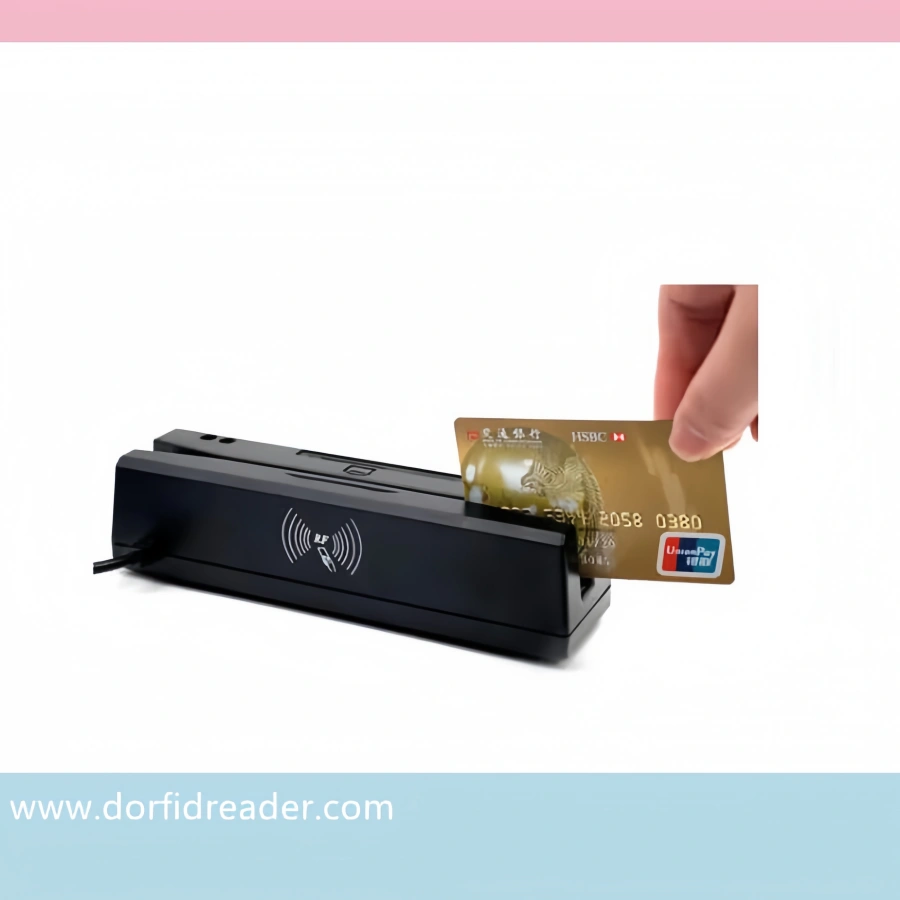
Core Components of a Multi Frequency RFID Reader Writer
To understand how it works, let’s break down its internal architecture.
1. RF Front-End Modules
Each frequency band requires dedicated RF circuitry:
- LF transceiver module
- HF/NFC transceiver
- UHF RF module
Some advanced readers use software-defined radio (SDR) architectures that allow flexible frequency tuning.
2. Antenna System
Different frequencies require different antenna designs:
- LF uses coil antennas
- HF uses loop antennas
- UHF uses dipole or circular polarized antennas
A multi frequency reader may include:
- Separate antennas for each band
- Integrated multi-band antenna arrays
- External antenna ports
3. Microcontroller or Embedded Processor
This acts as the system brain:
- Protocol handling
- Tag data parsing
- Encoding/decoding
- Communication with host systems
4. Communication Interfaces
Common connectivity options include:
- USB
- RS232
- Ethernet
- Wi-Fi
- Bluetooth
- TCP/IP
Industrial-grade devices may also support Modbus or other automation protocols.
Supported RFID Standards and Protocols
A powerful multi frequency RFID reader writer typically supports multiple global standards:
LF Standards
- EM4100
- EM4200
- TK4100
- ISO11784/11785
HF Standards
- ISO/IEC 14443 A/B
- ISO/IEC 15693
- NFC
- MIFARE series
UHF Standards
- EPC Global Class 1 Gen 2
- ISO/IEC 18000-6C
Compatibility across these standards enables cross-industry integration.
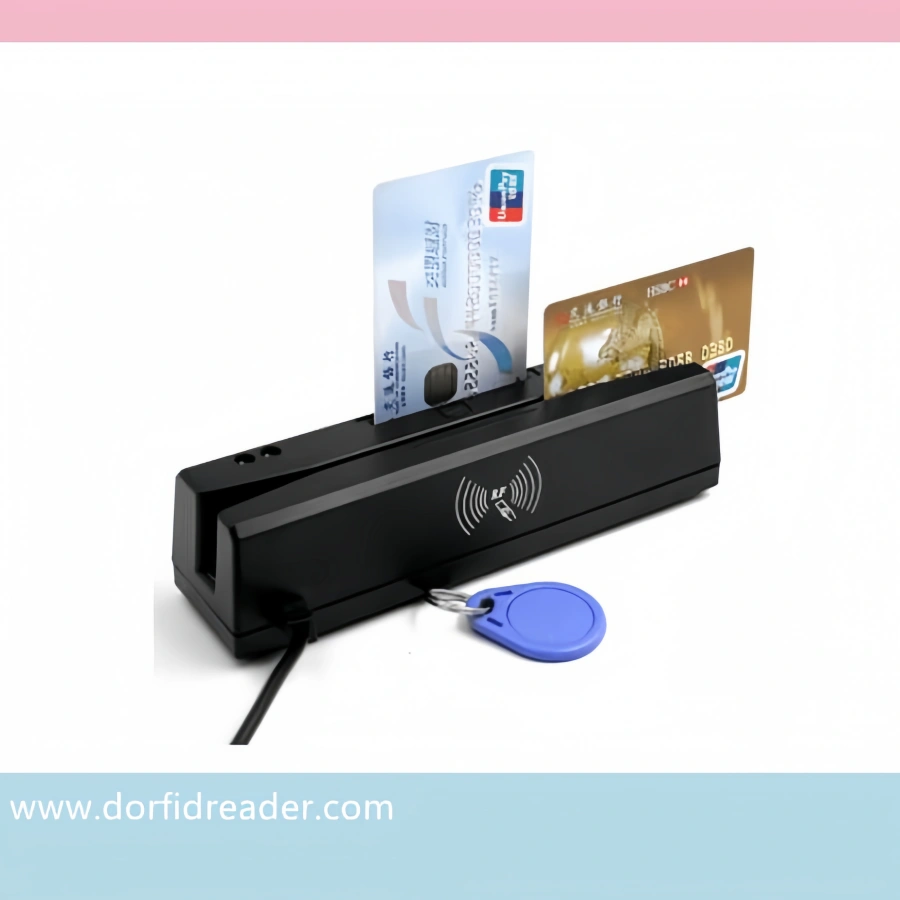
Read and Write Capabilities
Not all RFID readers are writers. A reader writer can:
- Read unique tag IDs
- Write data into tag memory
- Lock memory segments
- Configure EPC codes
- Update user memory blocks
For UHF tags, memory banks typically include:
- EPC memory
- TID memory
- User memory
- Reserved memory (access passwords)
Being able to write data is essential in:
- Asset lifecycle management
- Encoding logistics labels
- Access credential issuance
- Manufacturing serialization
Key Technical Specifications
While specifications vary by model, common parameters include:
- Frequency: LF 125 kHz / HF 13.56 MHz / UHF 860–960 MHz
- Read range: LF (0–5 cm), HF (0–30 cm), UHF (up to 10 meters depending on antenna)
- Output power (UHF): up to 30 dBm adjustable
- Operating mode: R/W
- Interface: USB / Ethernet / Wi-Fi
- Power supply: DC 9–12V or PoE
- Operating temperature: -20°C to +70°C
Industrial models may include IP65 or IP67 protection ratings.
Advantages of Multi Frequency RFID Reader Writers
1. One Device, Multiple Applications
Instead of purchasing and maintaining separate LF, HF, and UHF readers, one integrated system handles all.
This reduces:
- Hardware costs
- Maintenance complexity
- Installation time
- Training requirements
2. Future-Proof Investment
Technology evolves. Companies often start with one RFID application and later expand.
A multi frequency reader prevents hardware obsolescence.
3. Cross-System Integration
Organizations merging legacy systems with modern logistics platforms benefit from multi-band compatibility.
For example:
- Legacy LF employee badges
- HF smart card payments
- UHF warehouse inventory
One reader can interface with all.
Application Scenarios
Warehouse Management
UHF enables rapid inventory scanning of hundreds of items simultaneously.
HF may be used for employee authentication.
LF may support equipment access control.
A multi frequency reader integrates all layers.
Retail and Smart Stores
- UHF for inventory and anti-theft
- HF/NFC for customer interaction
- Access card authentication
Retail environments benefit from flexibility.
Manufacturing and Asset Tracking
Production lines may use:
- HF tags for work-in-progress tracking
- UHF tags for pallet and logistics management
- LF tags for tool identification
Integrated readers simplify infrastructure.
Healthcare
Hospitals use RFID to track:
- Surgical instruments
- Medical devices
- Patient wristbands
- Access credentials
Different frequencies serve different safety requirements.
Transportation and Smart Cities
- Vehicle identification (UHF)
- Access control (HF)
- Equipment tagging (LF)
Urban infrastructure becomes more interconnected.
Industrial and Outdoor Use
Advanced multi frequency RFID reader writers are designed for:
- Dust resistance
- Moisture resistance
- High vibration environments
- Wide temperature ranges
Industrial-grade models ensure performance in harsh environments.
Security and Data Protection
RFID systems must protect sensitive data.
Security features may include:
- Password-protected writing
- Encrypted communication
- Access control authentication
- Anti-collision algorithms
Anti-collision allows multiple tags to be read simultaneously without signal confusion.
Software Integration
Hardware alone is not enough.
A strong multi frequency RFID reader writer supports:
- SDKs (Software Development Kits)
- API integration
- Windows, Linux, Android compatibility
- Middleware connectivity
ERP and WMS systems often integrate directly with RFID data streams.
Performance Factors Affecting Read Range
Read distance depends on:
- Tag type
- Antenna design
- Environmental interference
- Output power
- Orientation and polarization
UHF signals reflect off metal surfaces. HF signals struggle with thick metal barriers. LF signals are slower but stable near liquids.
Choosing correct antenna placement matters more than theoretical specifications.
Fixed vs Portable Multi Frequency Readers
Fixed Readers
- Mounted at gates
- Used in warehouses
- Integrated into conveyor systems
Handheld Readers
- Portable inventory scanning
- Field service operations
- On-site encoding
Portable multi frequency readers combine mobility with flexibility.
Embedded Multi Frequency Modules
Some manufacturers offer compact modules for integration into:
- Kiosks
- Vending machines
- Access terminals
- Industrial controllers
OEM solutions allow customized hardware deployment.
Regulatory Compliance
Global RFID operation requires compliance with:
- FCC (USA)
- CE (Europe)
- RoHS
- ISO standards
Multi frequency readers often support region-specific UHF frequency tuning (e.g., 865–868 MHz in Europe, 902–928 MHz in North America).
Choosing the Right Multi Frequency RFID Reader Writer
Key selection criteria:
- Required frequency bands
- Read range requirements
- Indoor or outdoor use
- Integration interface
- Power supply constraints
- Environmental conditions
- Tag compatibility
Specification alignment ensures system efficiency.
Benefits for System Integrators
System integrators benefit from:
- Reduced hardware diversity
- Simplified maintenance
- Standardized training
- Scalable deployment
A unified reader architecture simplifies project management.
Cost Efficiency Over Time
While multi frequency readers may have higher initial cost compared to single-frequency devices, they reduce:
- Long-term hardware replacement
- Integration complexity
- Upgrade expenses
- Infrastructure redundancy
Total cost of ownership matters more than purchase price.
Challenges and Considerations
No technology is magical.
Multi frequency systems must manage:
- RF interference
- Antenna switching complexity
- Power consumption
- Protocol switching delays
High-quality firmware optimization is critical.
Future Trends in Multi Frequency RFID
The RFID industry continues to evolve.
Emerging developments include:
- IoT integration
- Edge computing
- AI-based tag analytics
- Energy-efficient chipsets
- Cloud-connected readers
Multi frequency readers are well positioned for IoT ecosystems where flexibility is key.
Sustainability and Energy Efficiency
Modern readers emphasize:
- Low power standby modes
- Efficient RF amplification
- Durable materials
- Long product lifespan
Reducing hardware redundancy also reduces electronic waste.
Real-World Example Scenario
Consider a logistics company:
- UHF tags on pallets
- HF badges for staff
- LF tags on forklifts
Without multi frequency capability, three systems are required.
With a unified reader, infrastructure becomes cleaner, more efficient, and easier to manage.
That is operational intelligence in action.
Conclusion
A Multi Frequency RFID Reader Writer is more than a convenience device. It is a strategic infrastructure component for organizations operating across diverse RFID ecosystems.
By supporting LF, HF, and UHF frequencies within one platform, it provides:
- Flexibility
- Scalability
- Cost efficiency
- Future readiness
- Cross-industry compatibility
As industries continue integrating automation, IoT, and intelligent tracking systems, the demand for adaptable RFID hardware grows.
Multi frequency readers represent a practical answer to technological fragmentation.
Invisible radio waves move data through space. Smart infrastructure ensures that data moves reliably, securely, and efficiently.
And sometimes, the smartest tool is the one that speaks every frequency fluently.