September 28, 2026
An RFID sticker is an adhesive label embedded with an RFID inlay that allows products, assets, inventory, and other objects to be identified and tracked using radio frequency technology. The primary purpose of an RFID sticker is to make identification and data collection faster, more automated, and less dependent on manual scanning.
Unlike traditional barcode labels, RFID stickers can often be read without direct line of sight, and multiple tags can potentially be read at the same time. This makes them useful in retail, warehousing, manufacturing, logistics, healthcare, asset management, and supply chain applications.
But what exactly does an RFID sticker do, and why would a business choose one instead of a conventional barcode label? This guide explains how RFID stickers work, their main purposes and applications, their benefits, and the factors to consider when choosing the right RFID sticker.
What Is an RFID Sticker?
An RFID sticker is a type of RFID tag designed in an adhesive label format. It typically consists of an RFID chip and antenna mounted on or incorporated into an RFID inlay, together with a label material and adhesive backing.
The sticker can be attached directly to products, cartons, pallets, equipment, documents, tools, or other assets. When the sticker comes within the operating range of a compatible RFID reader, the reader can communicate with the RFID chip and collect its identification data.
The term “RFID sticker” generally describes the physical format rather than one specific RFID technology. Depending on the application, RFID stickers can use different frequencies, chip types, antenna designs, materials, and adhesives.
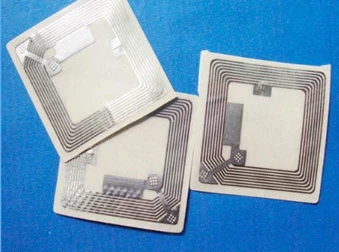
RFID sticker
What Does RFID Stand For?
RFID stands for Radio Frequency Identification. It is a technology that uses radio waves to identify objects and exchange information between an RFID tag and a reader.
A typical RFID system consists of three main components:
- RFID tag or sticker: Stores identification data and communicates with the reader.
- RFID reader: Sends and receives radio signals to communicate with the tag.
- Software system: Processes the collected information and connects it with inventory, asset, logistics, or other business data.
What Is Inside an RFID Sticker?
Most RFID stickers contain several basic components:
- RFID chip: Stores a unique identification number and, depending on the chip, other data.
- RFID antenna: Enables communication between the chip and RFID reader.
- Substrate or inlay material: Holds the chip and antenna in place.
- Adhesive: Allows the sticker to be attached to a target surface.
- Label face material: Provides protection and may contain printed text, barcodes, logos, or other information.
The exact construction depends on the intended application. For example, an RFID sticker designed for ordinary cardboard packaging may have very different requirements from one intended for metal equipment or outdoor assets.
What Is the Purpose of an RFID Sticker?
The main purpose of an RFID sticker is to give an object a machine-readable identity that can be captured automatically using radio frequency technology.
In practical applications, RFID stickers can serve several purposes.
1. Item Identification
An RFID sticker can provide a unique digital identity for an individual product, package, asset, or piece of equipment.
Instead of relying only on printed information, a business can associate the RFID tag’s unique ID with information in its database.
For example:
RFID ID → Product ID → SKU → Inventory Record
When the RFID sticker is read, the system can retrieve the corresponding information.
2. Inventory Tracking
One of the most common purposes of RFID stickers is inventory management.
Businesses can attach RFID stickers to individual products, boxes, cases, or pallets and use RFID readers to collect inventory information. This can reduce the amount of manual scanning required during receiving, counting, picking, and shipping.
RFID can be particularly useful when a business needs to process large numbers of items efficiently.
3. Asset Tracking
RFID stickers can also be used to identify and manage valuable or frequently moved assets.
Examples include:
- Tools
- IT equipment
- Manufacturing equipment
- Containers
- Returnable transport items
- Medical equipment
- Office equipment
Each asset can have its own RFID identity, making it easier to associate physical items with records in an asset management system.
4. Automated Data Collection
Traditional inventory processes often require employees to scan individual barcodes or enter information manually.
RFID can automate part of this process.
An RFID reader can detect compatible RFID tags within its reading area, allowing identification data to be collected with less manual intervention.
This is one of the major reasons companies use RFID stickers in high-volume operations.
5. Supply Chain Visibility
RFID stickers can help businesses collect information as products move through different stages of the supply chain.
For example, an RFID-tagged shipment may be read when it:
- Arrives at a warehouse
- Enters an inventory area
- Moves to a picking area
- Leaves the warehouse
- Arrives at another facility
The RFID sticker itself does not necessarily provide GPS coordinates. Instead, each RFID reading can create an event in a connected system, helping businesses understand where and when an item was identified.
6. Process Automation
RFID stickers can be integrated with automated workflows.
For example, a warehouse system could use RFID data to trigger inventory updates when tagged goods pass through a designated reading area.
This can reduce repetitive manual tasks and improve the connection between physical products and digital business systems.
7. Product Authentication and Identification
Depending on the RFID technology and system design, RFID can also support product authentication, serialization, and anti-counterfeiting initiatives.
A unique RFID identity can be associated with a specific product or production record, making it possible to verify whether the tag corresponds to information stored in a database.
However, RFID should not automatically be considered a complete anti-counterfeiting solution. The level of security depends on the RFID chip, software, authentication method, and overall system architecture.
How Does an RFID Sticker Work?
The basic operation of an RFID sticker is relatively simple.
Step 1: The RFID Reader Sends a Radio Signal
An RFID reader generates a radio frequency signal through its antenna.
Step 2: The RFID Sticker Receives the Signal
When the RFID sticker enters the reader’s operating field, its antenna interacts with the radio signal.
For many passive RFID stickers, the energy from the reader’s signal is used to activate the RFID chip.
Step 3: The RFID Chip Responds
The RFID chip sends its stored identification information back to the reader through the RFID communication process.
Step 4: The System Processes the Data
The RFID reader sends the collected information to a connected software system.
The system can then associate the RFID ID with information such as:
- Product number
- Serial number
- Asset information
- Inventory status
- Batch information
- Shipment information
The result is a connection between a physical object and its digital record.
What Are RFID Stickers Used For?
RFID stickers are used across many industries because the same basic identification technology can be adapted to different workflows.
RFID Stickers in Retail
Retailers can use RFID stickers on individual products to improve inventory visibility.
Potential applications include:
- Product identification
- Inventory counting
- Stock replenishment
- Receiving
- Shipping
- Store inventory management
- Loss prevention
For large retail inventories, the ability to identify multiple tagged products can be particularly useful.
RFID Stickers in Warehousing
Warehouses can use RFID stickers on products, cartons, cases, pallets, or other handling units.
Common applications include:
- Goods receiving
- Inventory management
- Picking
- Packing
- Shipping
- Location or zone identification
- Warehouse automation
RFID can help connect physical goods with warehouse management software and other operational systems.
RFID Stickers in Manufacturing
Manufacturers can use RFID stickers to identify components, work-in-progress items, finished products, and production assets.
For example, an RFID ID can be associated with a particular production order or serial number. As the item moves through the production process, RFID readers can capture identification events.
This can improve traceability and production visibility.
RFID Stickers in Logistics
Logistics companies can use RFID labels to identify shipments, containers, pallets, and other transport units.
Potential applications include:
- Shipment identification
- Automated receiving
- Distribution center management
- Container tracking
- Supply chain visibility
RFID Stickers in Healthcare
Healthcare organizations may use RFID technology to identify and track equipment, supplies, and other assets.
Potential applications include:
- Medical equipment tracking
- Inventory management
- Supply identification
- Asset management
- Equipment utilization
The specific RFID technology should be selected according to the healthcare environment and the characteristics of the items being tagged.
RFID Stickers for Asset Management
Organizations with large numbers of physical assets can attach RFID stickers to individual items and associate each tag with an asset record.
This can make it easier to conduct inventories, identify equipment, and maintain more accurate asset records.
What Are the Benefits of RFID Stickers?
The value of RFID stickers comes from the combination of automatic identification, wireless communication, and adhesive label convenience.
Faster Identification
RFID systems can identify tagged items without requiring an employee to manually scan each label one by one.
This can save time in high-volume operations.
No Direct Line of Sight
Barcode scanners generally need an unobstructed view of the barcode.
RFID technology can often read a tag without direct line of sight, depending on the RFID frequency, reader, antenna configuration, tag orientation, and surrounding environment.
This makes RFID useful when labels are difficult to see or access.
Multiple-Item Reading
Depending on the system and application, RFID readers can identify multiple tags within their reading field.
This is one of the major differences between RFID and conventional barcode scanning.
Reduced Manual Work
Because RFID identification can be automated, employees may spend less time performing repetitive scanning tasks.
This can be especially valuable in warehouses, distribution centers, manufacturing facilities, and large retail operations.
Improved Inventory Visibility
When RFID readers are integrated with inventory software, RFID data can help businesses maintain more timely information about tagged items.
Better visibility can support more efficient inventory management and operational decision-making.
Flexible Label Format
RFID stickers can be produced in different sizes and materials and can include printed information such as:
- Product names
- Barcodes
- Serial numbers
- Logos
- Instructions
- Variable data
This allows businesses to combine RFID functionality with conventional printed labeling.
RFID Sticker vs. Barcode Label: What’s the Difference?
RFID stickers and barcode labels can both be used to identify products and assets, but they use different technologies.
| Feature | RFID Sticker | Barcode Label |
|---|---|---|
| Reading technology | Radio frequency | Optical scanning |
| Direct line of sight | Often not required | Usually required |
| Multiple-item reading | Possible | Typically one item at a time |
| Manual scanning | Can be reduced | Usually required |
| Data capacity | Depends on RFID chip | Generally limited |
| Automation potential | High | Moderate |
| Typical cost | Higher | Lower |
| Best suited for | Automated identification and tracking | Simple identification and scanning |
This does not mean RFID is always better than barcodes.
For simple applications where an employee only needs to scan one visible item at a time, a barcode may be the more economical solution.
RFID becomes more attractive when a business needs faster identification, automated data collection, bulk reading, or greater visibility across a process.
What Can an RFID Sticker Track?
An important distinction is that an RFID sticker does not necessarily “track location” by itself.
Instead, it provides an identifiable digital identity that can be detected by RFID readers.
For example, suppose a product has an RFID sticker with a unique ID.
When that product is detected by a reader at a warehouse entrance, the system may record:
Product ID + Reader Location + Date + Time
If the same product is later detected at another location, the system can create another event.
In this way, RFID can provide event-based tracking and visibility.
For continuous geographic positioning, other technologies such as GPS, cellular connectivity, Wi-Fi, Bluetooth, or real-time location systems may be more appropriate.
What Information Can an RFID Sticker Store?
The amount of information an RFID sticker can store depends on the RFID chip and system design.
Depending on the application, the tag may contain or represent information such as:
- Unique identification number
- Product ID
- Serial number
- Asset ID
- Batch number
- Production information
- Other application-specific data
In many business applications, the RFID chip does not need to store a large amount of product information.
Instead, the RFID ID can act as a key that connects the physical item to a much larger database.
For example:
RFID ID → Database Record → Product Details
This approach can provide greater flexibility because the detailed information remains in the business system rather than being stored entirely on the RFID chip.
What Types of RFID Stickers Are Available?
RFID stickers are available in different technologies and configurations.
Passive RFID Stickers
Passive RFID stickers do not normally contain their own battery.
They receive energy from the RFID reader’s signal and use that energy to communicate.
Passive RFID labels are widely used for applications such as inventory management, retail, logistics, and asset identification.
UHF RFID Stickers
UHF RFID is commonly used for applications requiring relatively longer reading distances and fast identification of multiple tags.
UHF RFID stickers are frequently considered for:
- Inventory management
- Retail
- Warehousing
- Logistics
- Supply chain applications
HF RFID Stickers
HF RFID operates at a different frequency and can be suitable for applications where shorter-range communication is appropriate.
HF RFID is used in areas such as identification, access applications, libraries, and other specialized systems.
NFC Stickers
NFC is a short-range technology based on HF RFID technology.
NFC stickers can be used for applications such as:
- Product information
- Smart marketing
- Authentication
- Access
- Mobile interactions
NFC stickers are particularly useful when interaction with NFC-enabled smartphones is part of the application.
How to Choose the Right RFID Sticker
Choosing an RFID sticker is not simply a matter of selecting the cheapest label.
The right design depends on the application environment and the RFID system being used.
Frequency
The first consideration is the required RFID frequency.
Common options include:
- LF
- HF
- UHF
The appropriate frequency depends on the required reading range, application, reader system, and regulatory requirements.
Reading Distance
Consider how far the RFID reader needs to detect the sticker.
A warehouse portal, handheld reader, and smartphone-based NFC application may have very different requirements.
Reading distance depends on multiple factors, including:
- RFID frequency
- Chip
- Antenna design
- Reader power
- Reader antenna
- Tag orientation
- Installation environment
Therefore, a claimed reading distance should always be evaluated under realistic operating conditions.
Surface Material
The surface where the RFID sticker will be applied is extremely important.
Materials such as metal and liquids can affect RFID performance.
If the sticker will be attached to metal equipment, a standard paper RFID label may not provide the desired performance. A specially designed on-metal RFID tag may be more appropriate.
Label Material
The label material should match the operating environment.
Common considerations include:
- Indoor or outdoor use
- Moisture exposure
- Temperature
- Abrasion
- Chemicals
- UV exposure
Paper may be appropriate for ordinary indoor applications, while synthetic materials may be more suitable for demanding environments.
Adhesive
The adhesive must be compatible with the target surface and operating conditions.
Consider whether the sticker needs:
- Permanent adhesion
- Removable adhesion
- High-temperature resistance
- Moisture resistance
- Strong adhesion to plastic or metal
Size and Antenna Design
RFID sticker size can affect antenna design and performance.
A smaller sticker may be convenient for product labeling, but achieving the desired reading performance may require careful antenna and chip selection.
RFID Reader Compatibility
The RFID sticker must be compatible with the RFID readers used in the system.
Before purchasing large quantities, it is generally advisable to test the label with the actual reader, antenna, target surface, and operating environment.
Can RFID Stickers Be Customized?
Yes. RFID stickers can often be customized for specific applications.
Customization may include:
- Sticker dimensions
- Label material
- Adhesive
- RFID chip
- Antenna design
- Printing
- Logo
- Serial numbering
- Barcode or QR code
- Variable data
- RFID encoding
For example, a manufacturer may require a small UHF RFID sticker with a specific chip, strong adhesive, custom printing, and encoding for use on plastic products.
Another customer may need a larger on-metal RFID label for industrial equipment.
The best RFID sticker design therefore depends on the complete application rather than simply the desired label size.
How Much Do RFID Stickers Cost?
There is no single standard price for an RFID sticker because the cost depends on its specifications and order requirements.
Important cost factors include:
- RFID chip
- Frequency
- Antenna design
- Label size
- Material
- Adhesive
- Printing
- Encoding
- Special environmental requirements
- Order quantity
- Packaging
For high-volume applications, the unit cost may be significantly lower than for small customized orders.
When comparing suppliers, businesses should consider not only the sticker price but also RFID performance, consistency, customization capability, encoding services, quality control, and compatibility with the intended RFID system.
Frequently Asked Questions About RFID Stickers
What is the main purpose of an RFID sticker?
The main purpose of an RFID sticker is to provide an object with a machine-readable identity that can be detected automatically using radio frequency technology. RFID stickers are commonly used for product identification, inventory management, asset tracking, logistics, and process automation.
Are RFID stickers the same as RFID tags?
Not exactly. An RFID sticker is one physical form of an RFID tag. The term RFID tag is broader and can include adhesive labels, hard tags, cards, key fobs, and other form factors.
Can RFID stickers track location?
RFID stickers can support location and movement tracking when they are detected by RFID readers installed at known locations. However, a standard passive RFID sticker does not independently determine its geographic position like a GPS device.
Do RFID stickers need batteries?
Many commonly used RFID stickers are passive and do not require batteries. They receive energy from the RFID reader’s radio signal. Battery-powered RFID tags also exist, but these are generally different from standard passive RFID stickers.
Can RFID stickers be read without line of sight?
Yes, RFID technology generally does not require direct optical line of sight in the same way that barcode scanning does. However, actual readability depends on the RFID frequency, tag design, reader, orientation, distance, and surrounding materials.
How far can an RFID sticker be read?
There is no universal reading distance. It depends on the RFID frequency, chip, antenna, reader, reader antenna, tag orientation, installation conditions, and surrounding materials.
Can RFID stickers work on metal?
Some RFID stickers are specifically designed for metal surfaces, but ordinary RFID labels may not perform well when directly attached to metal. For metal applications, an on-metal RFID design is usually more appropriate.
Are RFID stickers reusable?
Reusability depends on the adhesive, sticker construction, application surface, and operating environment. Some RFID labels are intended for one-time use, while durable RFID tags may be designed for repeated use.
Conclusion
The primary purpose of an RFID sticker is to give a physical object a digital identity that can be detected and processed automatically using radio frequency technology. From inventory management and asset tracking to logistics and supply chain applications, RFID stickers can help businesses improve identification, visibility, and operational efficiency.
The right RFID sticker depends on factors such as frequency, chip, antenna design, reading distance, surface material, adhesive, and application environment. Choosing the right RFID solution is therefore essential for achieving reliable performance.
About DO RFID Reader
DO RFID Reader is a professional RFID product manufacturer and one of the factories of D.O RFID Group, with more than 15 years of experience in the RFID and smart card industry. We provide RFID readers, RFID cards, RFID tags, and NFC tags for applications including access control, vehicle identification, logistics, inventory management, and asset tracking.
With a focus on Source Quality Products and Enjoy Efficient Service, DO RFID Reader provides customized RFID and NFC solutions designed around different application requirements. Our products are manufactured with strict quality control, and we provide a 36-month warranty and 24-hour technical support to help customers implement their RFID projects with confidence.
Looking for customized RFID stickers, RFID tags, or NFC solutions for your application? Contact DO RFID Reader to discuss your requirements and find the right RFID solution for your project.

Do RFID is a leading China-based manufacturer with over 15 years of experience. We specialize in customized RFID readers, tags, and cards, delivering high-quality, tailored solutions that meet your unique business needs and drive seamless, efficient identification.