February 10, 2026
A Complete Professional and Plain-Language Guide
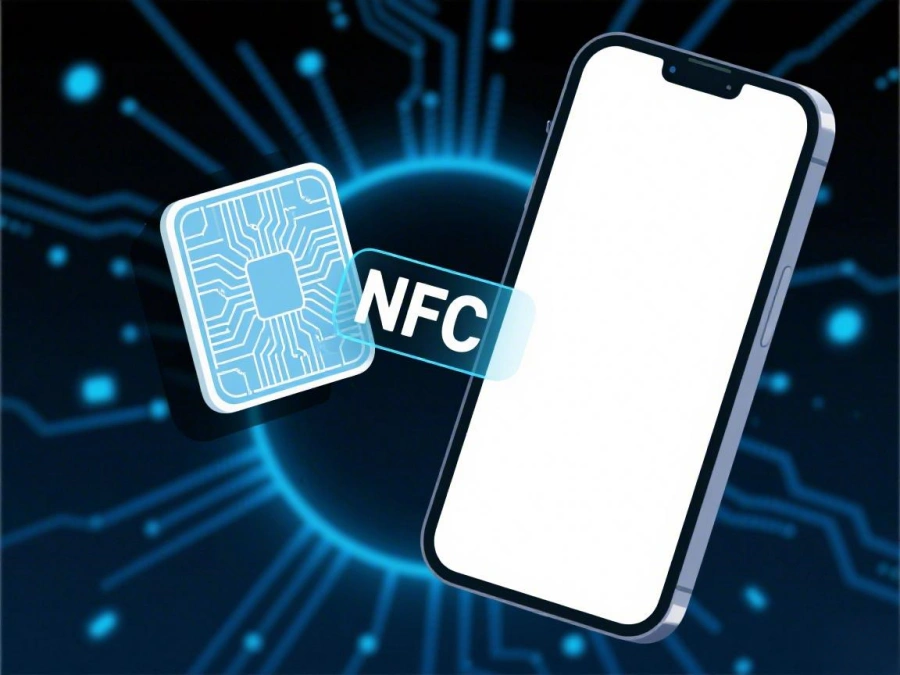
Near Field Communication (NFC) tags are quietly embedded into modern life. They sit inside smartphones, payment cards, smart posters, access badges, product labels, and even business cards. You rarely notice them, but they perform instant digital magic when two devices come close—no batteries, no pairing, no effort.
This article explains how NFC tags work, from the physics and standards behind them to real-world applications. It is written in two layers:
-
Professional explanations for engineers, integrators, and decision-makers
-
Plain-language explanations for non-technical readers
By the end, you will understand not only what NFC tags do, but why they work, how they differ from RFID, and how to use them effectively.
1. What Is an NFC Tag?
Professional explanation
An NFC tag is a passive electronic device that stores small amounts of data and communicates wirelessly with an NFC-enabled reader (such as a smartphone or terminal) using radio frequency electromagnetic fields. NFC operates at 13.56 MHz and follows international standards such as ISO/IEC 14443 and ISO/IEC 15693 (in some variants).
NFC tags contain:
-
A microchip for data storage and processing
-
An antenna for inductive coupling
-
No internal power source
Plain-language explanation
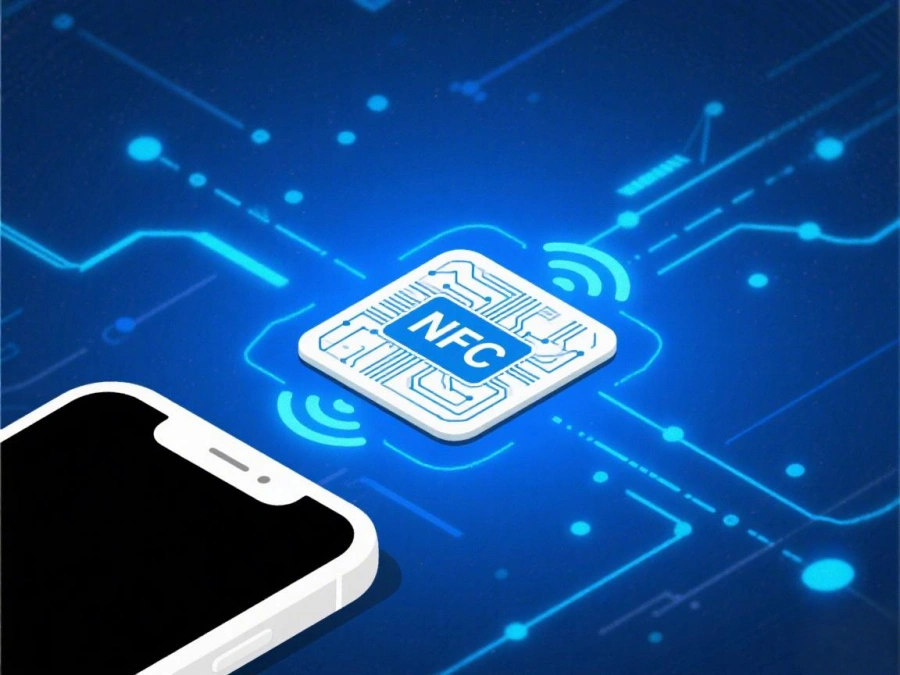
An NFC tag is a tiny chip with a loop of metal inside it. When you bring your phone close, the phone “wakes up” the chip and reads what’s stored on it. The tag doesn’t have a battery—it borrows power from your phone for a split second.
Think of it like tapping a light switch that only turns on when your hand gets close.
2. How NFC Technology Works at a Fundamental Level
Professional explanation
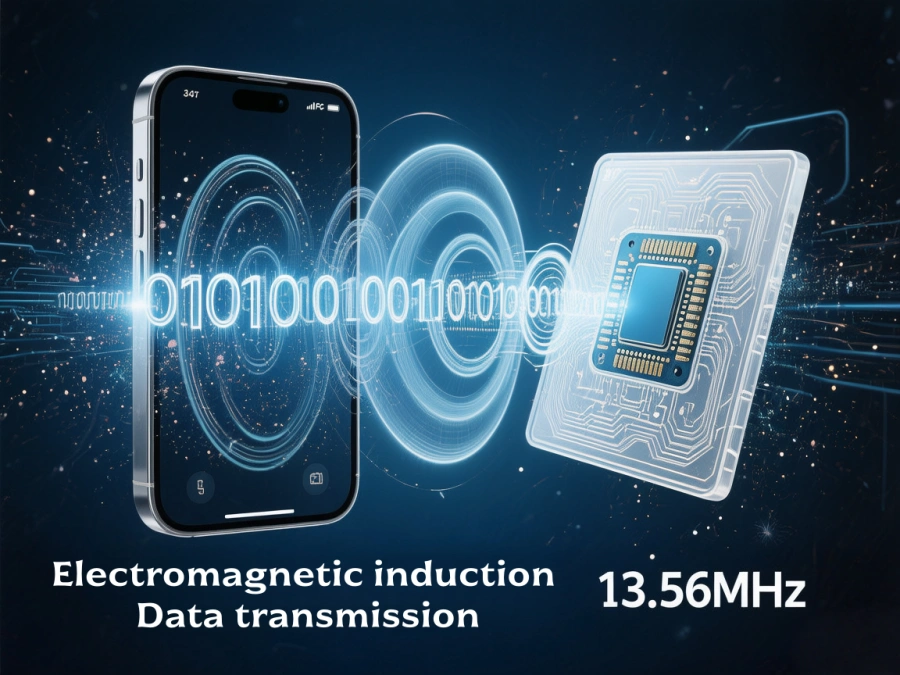
NFC is based on inductive coupling, a near-field electromagnetic interaction between two loop antennas operating at 13.56 MHz. When an NFC reader generates an alternating magnetic field, a passive NFC tag placed within range (typically <4 cm) induces a current in its antenna coil. This induced energy powers the tag’s integrated circuit, enabling data transmission back to the reader via load modulation.
Key characteristics:
-
Communication range: 0–4 cm
-
Data rate: up to 424 kbps
-
Half-duplex communication
-
Strong resistance to interference due to short range
Plain-language explanation
Your phone sends out a tiny invisible magnetic wave. When the NFC tag gets close enough, that wave creates electricity inside the tag—just enough to turn it on and let it talk back.
That’s why NFC only works when devices are very close. It’s not a bug. It’s a safety feature.
3. Active vs Passive NFC Devices
Professional explanation
NFC systems include:
-
Active devices: smartphones, tablets, POS terminals
-
Passive devices: NFC tags, cards, stickers
Active devices generate RF fields and manage communication. Passive devices respond only when energized by an active reader.
Plain-language explanation
Phones do the talking. Tags do the listening.
Your phone is the loudspeaker. The tag is the note taped to the wall that only shows up when the light hits it.
4. What Data Can NFC Tags Store?
Professional explanation
NFC tags typically store data in NDEF (NFC Data Exchange Format) records. Common data types include:
-
URLs
-
Text strings
-
Contact information (vCard)
-
App launch instructions
-
Commands for automation
-
Secure identifiers (UIDs)
-
Encrypted credentials (secure tags)
Memory size ranges from:
-
48 bytes (basic tags)
-
144 bytes
-
504 bytes
-
Up to several kilobytes (advanced secure tags)
Plain-language explanation
An NFC tag doesn’t store movies or photos. It stores instructions.
For example:
-
“Open this website”
-
“Add this contact”
-
“Unlock this door”
-
“Check in here”
Small message, big effect.
5. NFC Communication Modes
Professional explanation
NFC operates in three standardized modes:
-
Reader/Writer Mode
An active device reads or writes data to a passive tag. -
Peer-to-Peer Mode
Two active devices exchange data (e.g., Android Beam). -
Card Emulation Mode
A smartphone behaves like a contactless smart card (used in payments and access control).
Plain-language explanation
NFC works in three ways:
-
Reading a tag
-
Talking phone-to-phone
-
Pretending your phone is a card
Tap. Share. Pay.
6. NFC Tags vs RFID Tags
Professional explanation
NFC is a subset of RFID technology, optimized for short-range, secure interactions.
| Feature | NFC | UHF RFID |
|---|---|---|
| Frequency | 13.56 MHz | 860–960 MHz |
| Range | <4 cm | Up to 10+ meters |
| Security | High | Moderate |
| Data interaction | Two-way | Mostly one-way |
| Typical use | Payments, access, phones | Logistics, inventory |
Plain-language explanation
RFID is for warehouses.
NFC is for people.
RFID scans pallets from far away. NFC works only up close, so you know exactly what you’re touching.
7. Security in NFC Tags
Professional explanation
NFC security mechanisms include:
-
UID authentication
-
Password protection
-
Read/write locking
-
AES or DES encryption (secure tags)
-
Secure elements (e.g., DESFire, NTAG 424 DNA)
Because of the short communication range, NFC is inherently more secure than long-range wireless technologies.
Plain-language explanation
You have to be right there to use NFC. No long-distance snooping.
Some NFC tags are like notebooks. Others are like safes.
8. Common Types of NFC Tags
Professional explanation
Popular NFC chip families include:
-
NTAG213 / 215 / 216 – consumer & marketing
-
NTAG424 DNA – secure authentication
-
MIFARE Ultralight – low-cost access
-
MIFARE DESFire EV1/EV2 – high-security systems
-
ICODE SLIX – extended memory HF tags
Plain-language explanation
Some NFC tags are cheap and simple.
Some are smart and locked down.
Choose the tag based on what you’re protecting.
9. Real-World Applications of NFC Tags
Professional explanation
NFC is used across industries:
-
Mobile payments and ticketing
-
Access control systems
-
Smart posters and marketing
-
Product authentication
-
Inventory traceability
-
Healthcare identification
-
Smart homes and automation
-
Event management
-
Industrial configuration
Plain-language explanation
NFC tags are everywhere:
-
Tap to pay
-
Tap to enter
-
Tap to learn
-
Tap to prove something is real
If it needs to be fast and simple, NFC fits.
10. How NFC Tags Are Used in Smartphones
Professional explanation
Smartphones integrate NFC controllers and antennas that support all three NFC modes. Operating systems manage tag interactions using APIs:
-
Android: Android NFC Framework
-
iOS: Core NFC
Phones interpret NDEF records and execute associated actions automatically or with user confirmation.
Plain-language explanation
Your phone reads the tag and decides what to do.
The tag says, “Open this link.”
The phone says, “Got it.”
11. Writing and Programming NFC Tags
Professional explanation
NFC tags can be programmed using:
-
Smartphones
-
USB NFC readers
-
Industrial encoders
Once written, tags can be:
-
Rewritable
-
Password-protected
-
Permanently locked
Plain-language explanation
You can write an NFC tag like saving a note—then lock it so no one changes it.
One tap can set it forever.
12. Limitations of NFC Tags
Professional explanation
Key limitations include:
-
Very short range
-
Limited memory
-
Not suitable for bulk scanning
-
Metal and liquids can interfere
-
Requires NFC-enabled devices
Plain-language explanation
NFC is powerful, but not magical.
It works best up close, one-to-one, with clear intent.
13. NFC Tags in the Internet of Things (IoT)
Professional explanation
In IoT ecosystems, NFC acts as:
-
A secure onboarding method
-
A configuration trigger
-
A human-machine interface
-
A device identity layer
Plain-language explanation
NFC helps people talk to smart devices without screens, apps, or passwords.
Tap. Configure. Done.
14. Why NFC Is Growing So Fast
Professional explanation
Growth drivers include:
-
Smartphone penetration
-
Contactless payments
-
Security demands
-
Simplicity over Bluetooth/Wi-Fi
-
Low cost and zero power usage
Plain-language explanation
NFC wins because it’s easy.
No pairing. No searching. No confusion.
Just tap.
15. The Future of NFC Tags
Professional explanation
Future developments include:
-
Cryptographic authentication
-
Digital product passports
-
Supply-chain compliance
-
Smart packaging
-
Anti-counterfeiting systems
-
Integration with blockchain and AI
Plain-language explanation
NFC tags are becoming digital fingerprints for physical objects.
The internet is learning how to touch.
Conclusion
NFC tags work by combining elegant physics, international standards, and thoughtful design. They are small, passive, secure, and incredibly efficient at connecting physical objects to digital actions.
From a technical perspective, NFC is a near-field, inductively coupled communication system operating at 13.56 MHz.
From a human perspective, NFC is simply a tap that makes things happen.
That quiet tap is reshaping how we pay, authenticate, track, and interact with the physical world.
And it’s only getting started.