
High-Performance Android Handheld RFID Reader for Industrial Inventory and Asset Tracking
For warehouses, manufacturing facilities, logistics companies, and asset management operators, collecting accurate product information across large areas can be time-consuming. Manual barcode scanning requires workers to locate and scan individual labels, while fixed RFID installations may not be economical or flexible enough for every inventory task.
A high-performance Android handheld RFID reader offers another approach. By combining UHF RFID reading and writing, an Android-based mobile terminal, an integrated antenna, and a rechargeable battery, it allows operators to collect identification data while moving between shelves, storage areas, production lines, and equipment locations.
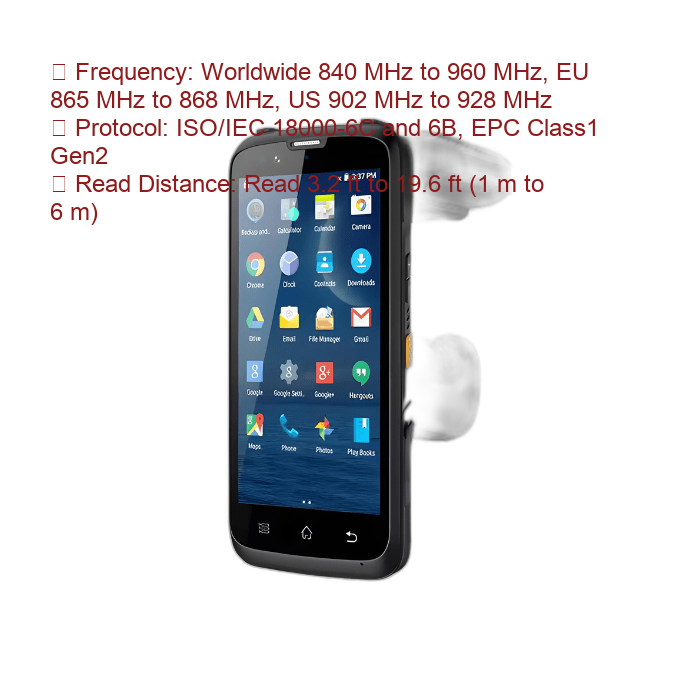
The DO RFID high-performance Android handheld RFID reader is designed for these mobile identification applications. Its published configuration includes an 8dBi circularly polarized UHF antenna, a stated 1–6m reading and writing range, a removable 10,000mAh battery, and a 5-inch touchscreen. Optional functions include 1D/2D barcode scanning, fingerprint identification, and low-frequency RFID recognition.
This product guide explains its technical features, practical applications, operating considerations, and purchasing requirements to help distributors, system integrators, and OEM buyers determine whether the device fits their projects.
1. What Is a High-Performance Android Handheld RFID Reader?
A high-performance Android handheld RFID reader is a portable data collection terminal that combines RFID communication hardware with a mobile computing platform.
Instead of carrying a separate RFID reader and computer, an operator can use one integrated device to identify tagged products, display information, record results, and communicate with a business application.
A typical system consists of:
| Component | Function |
|---|---|
| UHF RFID module | Communicates with compatible UHF RFID tags |
| Integrated antenna | Transmits and receives RFID signals |
| Android platform | Runs inventory, asset tracking, or identification applications |
| Touchscreen | Displays tag data and provides user interaction |
| Rechargeable battery | Powers the terminal during mobile operations |
| Wireless connectivity | Supports communication with compatible networks and software |
| Optional barcode scanner | Captures printed 1D and 2D codes |
| Optional fingerprint module | Provides an additional identity verification function |
The main advantage is mobility. Workers can carry the terminal to different storage locations rather than depending entirely on fixed reading points.
For buyers evaluating different mobile RFID products, the DO RFID handheld reader range provides an overview of the available reader categories.
2. Key Features of the DO RFID High-Performance Android Handheld Reader
This model combines several functions that are useful for industrial identification and inventory operations.
8dBi Circularly Polarized UHF Antenna
The device features a built-in 8dBi circularly polarized antenna.
Antenna polarization is an important part of handheld RFID performance. In real inventory operations, tags are not always presented in the same orientation. Some may be attached vertically to boxes, while others are placed horizontally on equipment or packaging.
Circular polarization can help reduce sensitivity to tag orientation compared with a linearly polarized setup in certain applications. However, it does not eliminate the effects of poor tag placement, metal surfaces, liquid products, or RF interference.
The integrated antenna also makes the terminal convenient for mobile scanning because operators do not need to connect a separate external UHF antenna for normal handheld operation.
Published UHF Reading and Writing Range of 1–6 Meters
The product page specifies a UHF reading and writing range of approximately 1–6 meters, depending on tag selection and the operating environment.
This range is suitable for many mobile identification tasks, such as:
- Reading tagged goods on warehouse shelves.
- Checking cartons and equipment from a practical working distance.
- Identifying pallets during warehouse inspections.
- Locating selected tagged assets.
- Performing inventory checks without touching each item.
Actual performance depends on the RFID tag, antenna design, tag orientation, reader power configuration, and surrounding materials.
For purchasing decisions, the 1–6m specification should be treated as the published product range rather than a guaranteed distance for every tag. Read and write performance should also be tested separately with the intended RFID chip and memory operation.
Removable 10,000mAh Battery
A large battery is especially important for workers who use an RFID terminal throughout a shift.
The published configuration includes:
| Battery Parameter | Specification |
|---|---|
| Battery type | Removable polymer lithium-ion |
| Rated voltage | 3.7V |
| Capacity | 10,000mAh |
| Published operating time | Approximately 8 hours |
| Published standby time | More than 300 hours |
The removable design can help businesses manage battery replacement and prepare spare batteries for longer operations.
Actual runtime depends on the frequency of RFID scanning, screen brightness, wireless communication, barcode use, camera activity, and application workload.
For a warehouse deployment with continuous inventory scanning, buyers should test battery performance using the same workflow expected during daily operation.
5-Inch HD Touchscreen
The device has a 5-inch display with a resolution of 1280 × 720 pixels and a multi-touch panel.
This provides a practical interface for viewing RFID information, selecting inventory tasks, entering data, and reviewing scanning results.
The product page also lists a Corning Grade 3 toughened glass touch panel. Buyers operating in industrial environments should confirm the final screen configuration and test usability with the gloves and working conditions expected at their facilities.
Multiple Data Capture Options
One of the product’s useful features is its ability to combine RFID with other identification functions.
Depending on the selected configuration, the device can include:
- Optional 1D/2D barcode scanning.
- A 13MP autofocus rear camera with flash.
- A 5MP front camera.
- An optional capacitive fingerprint module.
- Additional LF RFID functionality.
These options allow businesses to design a mobile data collection workflow around more than one identification method.
For example, a warehouse operator may read an RFID tag, scan a printed barcode when required, and capture a photograph of damaged packaging. A maintenance team may identify equipment and record its condition during an inspection.
Not every option should be assumed to be standard. Confirm the installed barcode engine, fingerprint module, LF reader, and associated software configuration before placing an order.
3. Technical Specifications of the High-Performance Android Handheld RFID Reader
The following table summarizes the published specifications of this product configuration.
| Parameter | Published Specification |
|---|---|
| Product type | Android UHF RFID handheld reader |
| UHF frequency | 840–960MHz product-page range |
| Regional frequency examples | EU 865–868MHz; US 902–928MHz |
| RFID protocols | ISO/IEC 18000-6C and 6B; EPC Class 1 Gen 2 listed |
| Antenna | Built-in 8dBi circularly polarized antenna |
| Reading and writing range | Approximately 1–6m, tag and environment dependent |
| Working mode | RFID read and write |
| Display | 5-inch |
| Resolution | 1280 × 720 |
| Touch panel | Multi-touch, Corning Grade 3 glass |
| Battery | Removable 3.7V, 10,000mAh polymer lithium-ion |
| Operating time | Approximately 8 hours |
| Standby time | More than 300 hours |
| Rear camera | 13MP autofocus with flash |
| Front camera | 5MP |
| Barcode scanning | Optional 1D/2D; 5 mil resolution listed |
| Barcode scanning speed | 50 scans per second listed |
| Fingerprint | Optional capacitive USB fingerprint module |
| Additional LF function | Optional 125kHz / 134.2kHz |
| LF recognition distance | Approximately 30–50mm |
| Operating temperature | -20°C to 50°C |
| Housing material | ABS listed |
| Weight | Approximately 580g |
Important configuration note: The 840–960MHz description should not be interpreted as permission to use every frequency throughout that range in every country. The actual UHF frequency configuration must match the destination market’s regulations. The Android version, processor, RAM, storage, IP protection rating, and drop-test specification should also be confirmed for the exact quotation configuration.
4. Why an 8dBi Circularly Polarized Antenna Matters
The integrated UHF antenna is one of the most important parts of this handheld reader.
An RFID reader generates an electromagnetic field that allows compatible passive tags to communicate with it. The antenna determines how RF energy is transmitted and received.
Three factors are particularly relevant when evaluating handheld RFID antennas.
Antenna Gain
Antenna gain describes how effectively an antenna concentrates RF energy in a particular direction compared with a reference antenna.
The 8dBi specification is a stated antenna parameter, not a guaranteed reading distance. Actual range also depends on the reader’s permitted RF output, antenna losses, tag sensitivity, and environmental conditions.
Circular Polarization
In practical inventory work, tags can be attached to goods in different directions.
Circular polarization can help reduce the impact of tag orientation compared with using a single linear polarization direction. This is useful when operators scan mixed cartons, stacked products, or assets placed at different angles.
However, tag antenna design still matters. A poorly selected tag may perform inconsistently even when paired with a circularly polarized reader.
Integrated Antenna Design
A built-in antenna makes the device easier to carry and operate. Workers can scan tagged items without setting up an additional antenna or holding a separate reader module.
For projects that require a different antenna arrangement or a permanent reading zone, a fixed-reader solution may be more appropriate than a handheld unit. DO RFID also provides UHF long-range RFID reader modules for OEM equipment and fixed-system integration.
5. What Can a 1–6m Reading Range Do in Real Applications?
A reading distance of 1–6 meters can support many mobile inventory tasks, but the suitable working distance depends on what is being identified.
| Application | Practical Use of the Handheld Reader |
|---|---|
| Warehouse shelves | Identify tagged cartons and products without touching every label |
| Pallet checking | Collect tag information from grouped goods |
| Equipment tracking | Identify tagged tools and machinery |
| Retail inventory | Count tagged merchandise across shelves and storage areas |
| Manufacturing | Verify tagged components and work-in-process materials |
| Logistics inspection | Check tagged containers and returnable transport items |
Why Real-World Range May Be Shorter Than the Published Range
Several factors can affect RFID communication.
Tag size: A larger antenna inlay may perform differently from a small compact tag.
Tag orientation: A tag facing away from the reader may produce a different result from one facing the antenna directly.
Metal surfaces: Metal can interfere with conventional UHF tag antenna performance.
Liquid products: Water and other liquids can absorb or affect UHF energy, depending on the product and tag position.
Reading environment: Metal shelving, nearby readers, machinery, and surrounding materials can change the reading zone.
Reader settings: RF output power and inventory parameters influence reading performance and must comply with local regulations.
For metal equipment, cabinets, and steel racks, consider using UHF RFID anti-metal tags instead of ordinary labels.
The best evaluation method is to test the handheld reader with the actual RFID tag, product, mounting position, and working distance.
6. UHF RFID Protocol and Tag Compatibility
The product page lists EPC Class 1 Gen 2 and ISO/IEC 18000-6C and 6B compatibility.
These standards and protocol references help define how the reader and RFID tags communicate. Nevertheless, buyers should not assume that every UHF tag supports every memory operation or performs identically.
Before selecting the reader, confirm the following:
- UHF frequency configuration.
- Supported air-interface protocol.
- Tag chip model.
- EPC memory reading and writing requirements.
- TID access requirements.
- User memory access requirements.
- Access or kill password operations, where needed.
- Regional RF compliance.
For instance, reading a tag’s EPC number is not the same as writing new EPC data or accessing protected memory.
A write operation may require the correct tag chip, memory bank, access password, and software command. The buyer should provide the exact tag model and describe the required operation instead of simply requesting a “read/write RFID reader.”
DO RFID supplies different UHF RFID tags for inventory, asset tracking, and industrial applications. Matching the tag and reader before purchasing can help avoid unnecessary compatibility testing later.
7. Optional LF RFID Function: When Is It Useful?
In addition to UHF identification, the published specification lists an optional low-frequency RFID function operating at 125kHz and 134.2kHz, with a stated recognition distance of approximately 30–50mm.
This gives buyers an additional option for projects that need to identify certain LF credentials or compatible tags alongside UHF inventory labels.
The two technologies serve different purposes:
| Technology | Frequency | Typical Application |
|---|---|---|
| LF RFID | 125kHz / 134.2kHz | Close-range identification and selected animal identification applications |
| UHF RFID | Regional bands around 860–960MHz | Inventory, pallet identification, logistics and asset tracking |
LF recognition is a separate close-range function. It should not be confused with the UHF antenna’s 1–6m published range.
The optional LF capability must also be confirmed for the specific device configuration. Buyers should provide their existing LF card or tag model for testing.
8. Android RFID Terminal vs. RFID Sled: Which Is Better?
Not all mobile RFID readers have the same structure.
An integrated Android RFID terminal combines the mobile computer and RFID reader in one device. An RFID sled is an accessory that connects to a compatible smartphone or mobile computer.
| Comparison | Integrated Android RFID Terminal | RFID Sled |
|---|---|---|
| Device structure | Mobile computer and RFID module in one unit | Separate RFID accessory and host device |
| Screen | Built-in touchscreen | Usually depends on the connected host |
| Software | Runs compatible Android applications | Depends on the host platform and supported connection |
| Battery | Integrated or removable device battery | Separate sled battery |
| Hardware setup | One main device | Requires device and sled compatibility |
| Best suited for | Dedicated mobile inventory terminals | Organizations with an existing supported mobile device fleet |
The Zebra RFD40 Premium is an example of a UHF RFID sled. Zebra publishes a maximum reading distance of approximately 12m and a reading rate of 1,300+ tags per second for the product, while its operating model relies on compatible mobile computers or other supported hosts.
By contrast, the DO RFID product is positioned as an integrated Android handheld terminal with a built-in UHF antenna and a removable 10,000mAh battery.
For more mobile RFID options, see the DO RFID Android UHF handheld reader and the Android 9.0 / 11.0 UHF handheld reader range.
9. Applications of the High-Performance Android Handheld RFID Reader
Warehouse Inventory and Cycle Counting
Warehouse operators frequently need to compare physical stock with the inventory records in their management systems.
A handheld UHF reader can collect information from multiple compatible tags while the operator moves along storage aisles.
Typical tasks include:
- Receiving goods.
- Checking pallet contents.
- Performing cycle counts.
- Locating selected tagged items.
- Verifying stock transfers.
- Checking inventory discrepancies.
For example, a warehouse may assign UHF tags to cartons and storage assets. An operator can use the handheld reader to scan a selected aisle, collect EPC information, and compare it with the expected inventory list.
The final accuracy depends on tag placement, reading-zone design, software filtering, and the process used to investigate missing or unexpected tags.
Industrial Asset Tracking
Manufacturing facilities, construction companies, and maintenance departments often manage many tools, machines, and reusable assets.
A handheld reader can help identify these assets during inspections and maintenance operations.
With optional camera functionality, workers can also record equipment condition or capture supporting images during an asset audit.
For metallic equipment, tag selection is especially important. An ordinary UHF label may perform poorly when directly attached to metal, so the project should evaluate an appropriate anti-metal tag.
Logistics and Fleet Management
Logistics companies can use handheld RFID equipment to identify tagged pallets, containers, and returnable transport items.
Mobile scanning is particularly useful when goods move through different warehouse locations or inspection areas where a permanent RFID reading point is unavailable.
For automated conveyor or gate identification, however, a fixed reader may be more suitable.
Retail and Merchandise Management
Retail teams can perform stock checks, product searches, and inventory verification with portable UHF equipment.
For apparel, footwear, and general merchandise, the reading process can help identify multiple tagged items without scanning each printed label individually.
The tag should be tested in the actual product packaging and shelf arrangement because tightly packed merchandise may influence the reading result.
10. Integrating the Android Handheld Reader with WMS and ERP Systems
Hardware performance is only part of a successful RFID project. The device must also work with the software that manages inventory, assets, and business operations.
A typical workflow may include:
- Employee login: The operator signs in to the mobile application.
- Task selection: The system loads an inventory, receiving, or inspection task.
- RFID scanning: The reader collects compatible tag information.
- Data filtering: The application removes unnecessary duplicate reads.
- Database matching: EPC values are compared against expected inventory records.
- Exception reporting: Missing or unexpected tags are flagged.
- Data synchronization: Approved records are uploaded to the WMS or ERP system.
Before placing an order for a large project, ask the supplier to confirm:
- Android operating system version.
- Available RFID SDK and API documentation.
- Supported programming environment.
- Sample application availability.
- RFID inventory and writing commands.
- Memory-bank access functions.
- Local data storage capability.
- Network synchronization options.
- Firmware update and technical support arrangements.
The exact Android version, processor, RAM, storage, and SDK availability are not fully specified on this product page. They should be documented in the final quotation or technical agreement.
For applications requiring more advanced tag encoding or programming, compare the available RFID reader writer products.
11. High-Performance Android Handheld RFID Reader vs. Other UHF Devices
A comparison of handheld RFID products should consider more than the maximum published reading distance.
| Comparison Item | DO RFID High-Performance Model | Chainway C72 | Nordic ID HH85 |
|---|---|---|---|
| Device type | Integrated Android handheld | Integrated Android handheld | Integrated Android handheld |
| Published UHF antenna | 8dBi circular polarization | Circular polarization | Configurable antenna polarization |
| Published range | 1–6m | Up to 26–30m with specified tags and conditions | Up to 15m |
| Read rate | Not specified on target product page | 1,300+ tags/s | Up to 1,000 tags/s |
| Battery | 10,000mAh removable | 8,000mAh | 10,050mAh |
| Published runtime | Approximately 8 hours | Depends on configuration and environment | Up to 18 hours |
| Additional functions | Optional barcode, fingerprint, LF | Optional barcode and NFC, among other options | Barcode and other options |
| Protection specification | ABS housing listed; IP rating requires confirmation | IP65 | IP65 listed in product information |
The comparison is intended to show product positioning, not declare a universal performance ranking. Competitor maximum range figures are published under specific tag and testing conditions, and the tested configurations may differ.
For example, Chainway lists its longer C72 distances using particular tag models in an open outdoor environment with low interference. Nordic ID lists a different handheld antenna and battery configuration. Actual results must be tested in the buyer’s own environment.
For some projects, a dedicated mobile device with longer theoretical range may be more suitable. For others, a removable battery, integrated identification options, and a 1–6m working zone may be a better match.
The most appropriate choice depends on the tag population, warehouse layout, software architecture, and operator workflow.
12. What Should Buyers Confirm Before Ordering?
For wholesale and OEM purchasing, it is important to turn general product requirements into a precise technical specification.
| Confirmation Item | What Buyers Should Provide |
|---|---|
| RFID frequency | Destination market and required regional UHF band |
| Tag protocol | EPC Gen2 / ISO 18000-6C or other required protocol |
| Tag chip | Exact UHF tag chip model |
| Read distance | Required operating distance and tag orientation |
| Write requirements | EPC, TID, User memory, and access operations |
| Antenna | Confirm built-in 8dBi circular polarization configuration |
| Barcode | Whether 1D/2D scanning is required |
| Fingerprint | Whether the optional fingerprint module is needed |
| LF identification | Whether 125kHz / 134.2kHz functionality is required |
| Battery | Confirm removable 10,000mAh battery configuration |
| Android platform | Exact operating system version, RAM, and storage |
| Software | SDK, API, and development support requirements |
| Environment | Operating temperature, IP rating, and drop-test requirements |
| Quantity | Sample quantity and estimated bulk order volume |
| OEM requirements | Branding, packaging, accessories, and other customization |
A physical tag sample is particularly helpful. It allows the supplier to check reading performance, memory operations, and compatibility before approving the device for mass deployment.
13. Sample Testing and Quality Control
Before accepting a large shipment, buyers should evaluate the device under conditions close to actual operation.
A practical test procedure includes:
RFID compatibility test: Read all agreed UHF tag models and check the returned EPC data.
Reading distance test: Record the results at different distances and tag orientations.
Writing test: Confirm the required memory operations using the intended writable tag models.
Multi-tag test: Read a group of tags together and compare the detected quantity with the known quantity.
Battery test: Run the reader under a realistic scanning and communication workload.
Barcode test: Where the optional scanner is included, test the actual barcode types and label quality.
LF test: If the optional low-frequency module is installed, test the required 125kHz or 134.2kHz credentials separately.
Software test: Confirm that data is displayed, stored, filtered, and synchronized correctly.
Environmental test: Verify operating temperature and any agreed protection or drop-test requirements.
For mass production, record the approved model, firmware, frequency configuration, tag samples, and test results. This creates a repeatable standard for future batches and replacement units.
14. Frequently Asked Questions
1. What is the reading distance of this high-performance Android handheld RFID reader?
The product page specifies a reading and writing range of approximately 1–6 meters. Actual distance depends on the RFID tag, antenna orientation, RF configuration, and surrounding environment.
2. Does this handheld reader support EPC Gen2 tags?
Yes. Its published specifications list EPC Class 1 Gen 2 and ISO/IEC 18000-6C support. Buyers should confirm compatibility with the exact tag chip and required memory operations.
3. What is the advantage of an 8dBi circularly polarized antenna?
The integrated antenna provides a circularly polarized UHF reading field that can help reduce sensitivity to tag orientation in suitable applications. It is useful for scanning products and assets presented at different angles, although actual reading performance still depends on tag design and the environment.
4. How long can the 10,000mAh battery operate?
The published operating time is approximately eight hours, with standby time exceeding 300 hours. Actual runtime varies depending on RFID scanning activity, screen use, wireless communication, and optional functions.
5. Is the battery removable?
Yes. The published configuration specifies a removable 3.7V, 10,000mAh polymer lithium-ion battery.
6. Does the reader support barcode scanning?
The product supports optional 1D/2D barcode scanning. Confirm the scanner module and supported barcode symbologies before ordering.
7. Can the device read low-frequency RFID tags?
An additional LF function is listed for 125kHz and 134.2kHz recognition, with a published range of approximately 30–50mm. This is an optional function and should be confirmed for the selected configuration.
8. Can the reader write UHF RFID tags?
Yes. The product page lists RFID read and write operation. The available writing functions depend on the tag chip, memory permissions, software, and configuration. Confirm the exact memory operation required for your project.
9. Does the reader support worldwide UHF frequencies?
The product page lists a broad 840–960MHz range and provides EU and US frequency examples. The actual hardware configuration must be confirmed for the destination market and comply with local radio regulations.
10. Is this reader waterproof?
The product page lists ABS waterproof housing material, but it does not state a verified IP protection rating. Buyers requiring outdoor or wet-environment operation should request the exact IP rating and supporting test documentation before purchasing.
11. Can the reader connect to warehouse management software?
The Android-based platform is designed for mobile data processing. However, specific integration depends on the installed Android version, SDK/API availability, software architecture, and communication configuration. Confirm the development documentation before beginning integration.
12. Can DO RFID support wholesale and OEM orders?
DO RFID accepts inquiries for wholesale and OEM projects. Buyers should provide the expected quantity, destination market, tag model, functional requirements, and any branding or configuration needs for a suitable quotation.
15. Request a Quote for the High-Performance Android Handheld RFID Reader
Selecting an industrial RFID terminal involves more than comparing advertised reading distances. The device must communicate with the correct RFID tags, support the required regional frequency, operate reliably during the intended working shift, and integrate with the company’s software system.
The DO RFID high-performance Android handheld RFID reader combines an 8dBi circularly polarized UHF antenna, a stated 1–6m read/write range, a removable 10,000mAh battery, and optional barcode, fingerprint, and LF identification functions.
It is worth evaluating for warehouse inventory, industrial asset tracking, logistics operations, and other projects that need mobile RFID identification with additional data collection capabilities.
DO RFID also supplies RFID readers and related equipment, including handheld readers, modules, and other RFID identification products.
Visit DO RFID to discuss your wholesale or OEM requirements. Send us your target RFID tags, destination country, expected reading distance, required functions, and estimated order quantity so our team can evaluate a suitable configuration for your project.