
In the world of access control, not every solution needs to be complicated. Sometimes what you want is a device that reads a card, sends the data, survives rain, tolerates temperature swings, and keeps working year after year without drama. That’s where Low Frequency 125KHz Passive RFID Readers shine.
This article provides a comprehensive SEO-focused overview of a waterproof 125KHz passive RFID reader with Wiegand 26/34 output. We will cover technical specifications, working principles, installation guidance, application scenarios, environmental performance, and integration advantages.
Because in access control, reliability beats novelty.
What Is a Low Frequency 125KHz Passive RFID Reader?
A low-frequency 125KHz passive RFID reader is an identification device that reads data from passive RFID cards operating at 125KHz. “Passive” means the card does not contain a battery. The reader generates an electromagnetic field, which powers the card when it enters the reading zone.
The reader then extracts the card’s unique identification number and transmits it to a controller—commonly through a Wiegand protocol interface.
This type of reader is widely used in:
- Access control systems
- Building entry management
- Industrial gate control
- Parking systems
- Time attendance systems
Low frequency systems are valued for stability, low interference, and long service life.
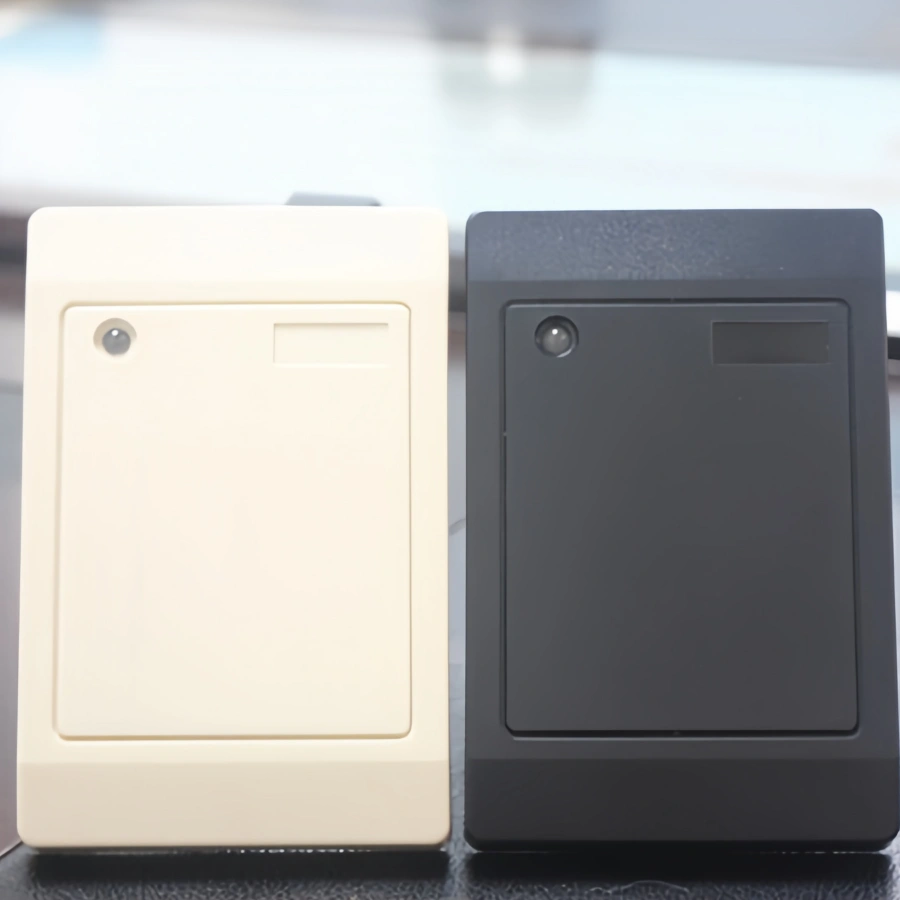
Technical Specifications
Let’s break down the key specifications of this 125KHz passive RFID reader:
Frequency: 125KHz
Operating Voltage: DC 9V–16V
Consumed Current: 0–100mA
Support Cards: Mifare one (S50, S70 etc.)
Read Range: 0mm–100mm (related to card and environment)
Reader Interval: < 0.5 seconds
Output Format: Wiegand 26 / Wiegand 34 (configurable)
Transmission Distance: WG26/34 ≥ 100 meters
Service Temperature: -25℃ to +75℃
Size: 114mm × 76mm × 16mm
Weight: About 190g
Lead Length: 180mm ± 5mm
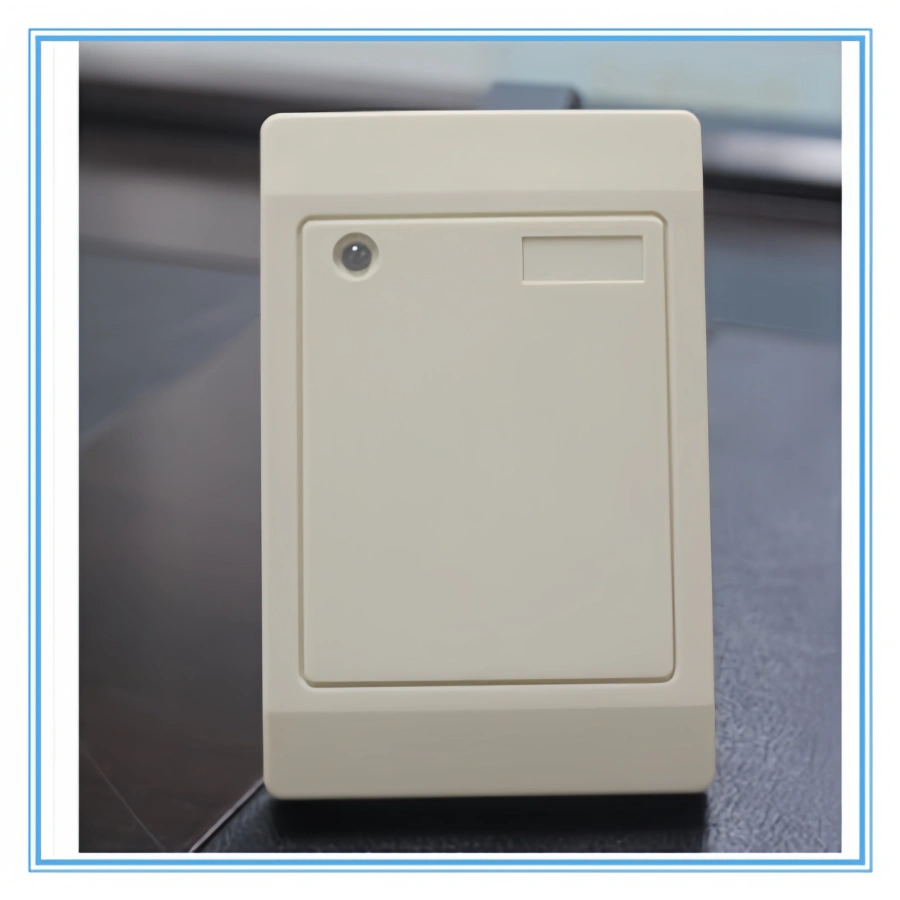
Material: ABS & Resin adhesive (Waterproof)
Status Indication: 1 LED (Red standby, Green success)
Each parameter serves a purpose. Let’s explore what they mean in real-world applications.
125KHz Frequency – Why Low Frequency Still Matters
125KHz is classified as Low Frequency (LF) RFID. Compared to higher frequencies (such as 13.56MHz or UHF), LF systems offer:
- Strong resistance to interference
- Stable performance near metal and water
- Reliable short-range reading
- Lower deployment cost
In environments like factories, parking entrances, or outdoor gates, signal stability matters more than long-range reading.
Short-range can actually improve security by preventing unintended card detection.
Operating Voltage: DC 9V–16V
The wide voltage input range provides installation flexibility.
Benefits include:
- Compatible with common 12V access control power supplies
- Tolerant of minor voltage fluctuations
- Suitable for centralized power systems
Access control installations often involve long cable runs. Voltage flexibility helps reduce failure risks due to power instability.
Low Power Consumption: 0–100mA
With a maximum consumption of 100mA, this reader is energy-efficient.
Low current draw means:
- Reduced load on power supply
- Lower heat generation
- Stable 24/7 operation
Energy efficiency improves system longevity.
Supported Cards – Mifare One (S50, S70 etc.)
The reader supports Mifare One cards including S50 and S70 types.
Important note: Always verify compatibility with your card type before deployment, as different frequency systems may require specific reader configurations.
Card compatibility determines integration success.
Read Range: 0mm–100mm
Maximum reading distance: 100mm (10cm).
Actual read range depends on:
- Card quality
- Environmental interference
- Installation method
- Mounting surface material
Short-range reading enhances access precision. It reduces accidental scanning and improves user control.
In access control, intentional scanning is usually preferred over automatic long-distance detection.
Fast Reader Interval: < 0.5 Seconds
The reader processes card scans in less than half a second.
Practical advantages:
- Smooth user flow
- Reduced queuing time
- Efficient entry management
For high-traffic office buildings or factories, quick response time improves operational efficiency.
Wiegand 26 / Wiegand 34 Output
This reader supports:
- Wiegand 26
- Wiegand 34
The format can be set according to system requirements.
Wiegand protocol is a widely adopted communication standard in access control systems. It ensures compatibility with:
- Access control panels
- Door controllers
- Gate automation systems
- Parking control units
Standardization reduces integration headaches.
Long Transmission Distance: ≥ 100 Meters
Wiegand signal transmission distance of 100 meters or more allows flexible installation.
This is especially useful in:
- Industrial parks
- Large campuses
- Parking lot entrances
- Warehouse complexes
Controllers can be installed securely in protected rooms while readers operate outdoors.
Separation improves system security.
Wide Service Temperature: -25℃ to +75℃
Temperature tolerance matters in outdoor applications.
This range ensures performance in:
- Cold winter climates
- Hot summer environments
- Desert conditions
- High humidity zones
Electronics that survive thermal stress reduce maintenance cost.
Weather resilience equals operational reliability.
Compact Design: 114mm × 76mm × 16mm
Slim profile benefits include:
- Easy wall mounting
- Aesthetic integration
- Space-saving installation
- Compatibility with narrow surfaces
Minimalist design suits both indoor and outdoor applications.
Durable Construction – ABS & Resin Adhesive (Waterproof)
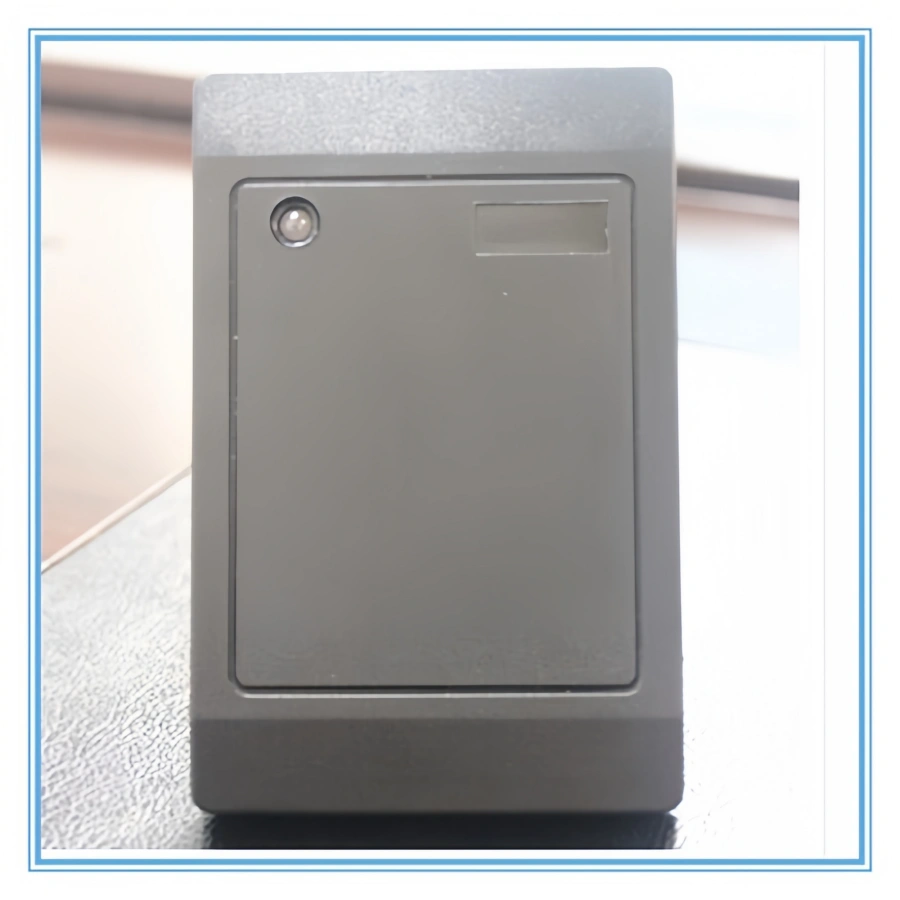
The housing is made from ABS combined with resin adhesive sealing.
Advantages:
- Waterproof design
- Dust resistance
- Corrosion resistance
- Impact durability
Outdoor installations demand waterproofing. Rain, humidity, and dust are constant threats.
Resin sealing protects internal circuits from moisture damage.
LED Status Indication
One LED indicator provides clear feedback:
- Red: Standby mode
- Green: Card read successfully
Visual feedback improves user confidence and reduces confusion.
Simple design. Clear communication.
Installation and Wiring
The reader includes a lead wire length of 180mm (±5mm), which connects to the access control system.
Basic installation steps:
- Mount the reader on a wall or access panel.
- Connect power supply (DC 9V–16V).
- Connect Wiegand output wires to controller.
- Configure Wiegand format if required.
- Test with authorized cards.
Always ensure correct grounding and cable shielding for long-distance transmission.
Application Scenarios
Access Control Systems
Most common use:
- Office entry doors
- Factory gates
- Residential community entrances
- Server rooms
The reader communicates with a door controller that grants or denies access.
Parking Management
RFID readers can control:
- Barrier gates
- Vehicle access
- Monthly parking subscriptions
Stable short-range detection prevents misreads.
Industrial Sites
Factories use RFID for:
- Restricted area control
- Equipment rooms
- Warehouse access
Industrial environments benefit from rugged design.
Campus & Institutional Systems
Schools and institutions apply RFID for:
- Staff access
- Dormitory management
- Library entrance
Consistency and durability are key.
Why Choose Low Frequency 125KHz Readers?
Despite newer technologies, 125KHz remains widely used because:
- It is mature and proven
- Infrastructure already exists
- Cards are affordable
- Maintenance is simple
- Integration is straightforward
High-tech is exciting. Stable-tech pays the bills.
Security Considerations
125KHz systems generally transmit card ID numbers without encryption. For high-security environments, additional layers may be used:
- Controller-based authentication
- Multi-factor authentication
- PIN integration
- Biometric combination
Security is always a system-level design decision.
Advantages Summary
- Waterproof ABS housing
- Wide voltage range
- Low power consumption
- Fast reading speed
- Long Wiegand transmission
- Stable 125KHz frequency
- Outdoor temperature resistance
- Easy integration
Reliable performance in diverse environments.
Maintenance and Longevity
Because passive RFID systems have no moving parts and minimal power demand, maintenance requirements are low.
Periodic checks include:
- Cable inspection
- Power supply stability
- Surface cleaning
Electronic simplicity supports long service life.
Conclusion
Low Frequency 125KHz Passive RFID Readers remain one of the most practical and reliable solutions for access control and identification systems. With waterproof ABS construction, wide operating voltage range, Wiegand 26/34 compatibility, fast response time, and long transmission distance, this reader offers a balanced combination of durability, performance, and integration flexibility.
Technology evolves rapidly, but some standards endure because they work under real-world conditions. In access control, predictability and resilience often outweigh complexity.
A well-installed 125KHz reader may operate quietly for years—reading thousands of cards, opening thousands of doors—without demanding attention.
In infrastructure systems, that kind of quiet reliability is not boring. It is engineering discipline at work.