
In the fashion industry, speed and accuracy decide who wins and who ends up drowning in unsold inventory. Traditional barcode labels helped for decades, but today’s apparel supply chains move too fast, across too many channels, for line-of-sight scanning and manual counting. This is where the RFID clothing tag quietly changes the rules of the game.
An RFID clothing tag is not just a label. It is a data carrier, a digital identity for each garment, and a real-time bridge between physical clothing and information systems. From factory floors to retail shelves, RFID apparel tags enable faster inventory checks, lower shrinkage, and smarter decision-making.
This article provides a comprehensive overview of RFID clothing tags, including specifications, working principles, applications, and the real industry pain points they solve.
What Is an RFID Clothing Tag?
An RFID clothing tag is a passive UHF RFID label designed specifically for garments and apparel products. It combines a woven or printed clothing label with an embedded RFID chip and antenna. Each tag carries a unique EPC (Electronic Product Code) that can be read wirelessly, without direct contact or line of sight.
Unlike barcodes, RFID clothing tags can be read:
-
In bulk (hundreds of items at once)
-
From several meters away
-
Even when tags are hidden inside packaging or stacked clothing
This makes them ideal for retail stores, garment warehouses, logistics centers, and apparel manufacturing lines.
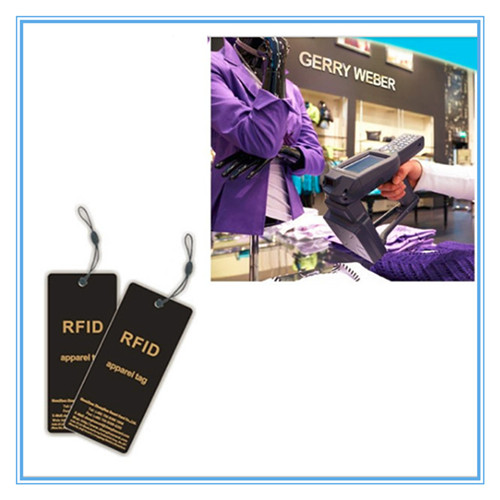
RFID Clothing Tag Technical Specifications
Below is a clear summary of the key technical parameters for this RFID apparel tag:
Product Overview
-
Product Type: Woven clothing label passive RFID apparel tag
-
Application: Clothes / garment inventory and tracking management
Material & Form
-
Material: Woven fabric, custom printed
-
Tag Form Factor: Label
-
Attachment Method:
-
General-purpose adhesive
-
Sewing into garments
-
RFID Performance
-
Protocol: ISO 18000-6C
-
Operating Frequency: 860–960 MHz (UHF)
-
Read Distance: 1 meter to 10 meters (depending on reader and environment)
Chip Options
-
Chip Type:
-
Alien H3
-
Impinj Monza 4
-
Impinj Monza 5
-
Impinj Monza 6
-
Memory Configuration
-
EPC Memory: 96–480 bits
-
User Memory: 512 bits
-
TID Memory: 32 bits
-
EPC Content: Unique, randomized number for secure identification
Physical Properties
-
Label Sizes:
-
87 × 53 mm
-
73 × 23 mm
-
Custom sizes available
-
-
Weight: 4 grams
Environmental Conditions
-
Operating Temperature: -35°C to +60°C
-
Storage Humidity: 20% to 90% RH
These specifications ensure the RFID clothing tag performs reliably in both retail and industrial environments.
How RFID Clothing Tags Work
Each RFID clothing tag contains three core elements:
-
RFID chip – stores EPC and other data
-
Antenna – transmits and receives radio signals
-
Label substrate – woven or printed fabric for garment integration
When an RFID reader emits radio waves, the passive RFID tag harvests energy from the signal. The chip activates and sends its unique EPC data back to the reader. This happens in milliseconds, without physical contact.
One scan can identify dozens or even hundreds of garments at once. Barcodes, by comparison, still require one-by-one scanning like it’s 1999.
Applications of RFID Clothing Tags
1. Retail Store Inventory Management
Retail is where RFID clothing tags shine brightest. With RFID-enabled garments, stores can:
-
Perform full inventory counts in minutes instead of hours
-
Maintain real-time stock visibility
-
Reduce out-of-stock situations
-
Improve omnichannel fulfillment accuracy
Store staff can scan entire racks with handheld readers or fixed portals, eliminating manual counting errors.
2. Garment Warehouse Management
In warehouses, RFID clothing tags enable:
-
Faster inbound and outbound processing
-
Accurate pallet and carton verification
-
Automated location tracking
-
Reduced labor costs
Bulk reading capability allows warehouse operators to scan sealed boxes without opening them, saving time and preserving packaging integrity.
3. Apparel Manufacturing and Production Control
During garment production, RFID apparel tags support:
-
Work-in-process (WIP) tracking
-
Production line balancing
-
Quality control traceability
-
Batch and style management
Each garment carries its digital identity from sewing to finishing, helping factories reduce errors and delays.
4. Logistics and Distribution Centers
In logistics operations, RFID clothing tags improve:
-
Shipment verification
-
Cross-docking efficiency
-
Loss prevention
-
Delivery accuracy
By scanning entire shipments automatically, logistics providers reduce disputes and improve customer trust.
5. Anti-Theft and Loss Prevention
When integrated with EAS or RFID-based security systems, RFID clothing tags help retailers:
-
Detect unauthorized removals
-
Reduce shrinkage
-
Link inventory data with security events
This dual function—inventory and security—adds extra ROI without adding extra labels.
Industry Pain Points Solved by RFID Clothing Tags
Inventory Inaccuracy
Traditional barcode systems typically achieve 60–70% inventory accuracy. RFID clothing tags push accuracy above 95%, which directly impacts sales and customer satisfaction.
Labor-Intensive Stock Counts
Manual stock-taking consumes time and staff resources. RFID reduces counting time by up to 90%, freeing employees for customer-facing tasks.
Omnichannel Fulfillment Errors
Click-and-collect and ship-from-store fail when inventory data is wrong. RFID apparel tags provide real-time visibility across all channels.
High Shrinkage Rates
Apparel retail faces constant loss from theft and misplacement. RFID improves traceability and accountability throughout the supply chain.
Poor Supply Chain Visibility
Without item-level tracking, brands struggle to understand where delays occur. RFID clothing tags provide end-to-end transparency.
Why UHF RFID Clothing Tags Are Preferred
UHF RFID clothing tags operating at 860–960 MHz are ideal for apparel because they offer:
-
Long read range (up to 10 meters)
-
Fast bulk reading
-
Compatibility with global retail RFID standards
-
Lower cost per tag at scale
Combined with ISO 18000-6C compliance, these tags integrate seamlessly with most commercial RFID readers and software platforms.
Customization Options for RFID Clothing Tags
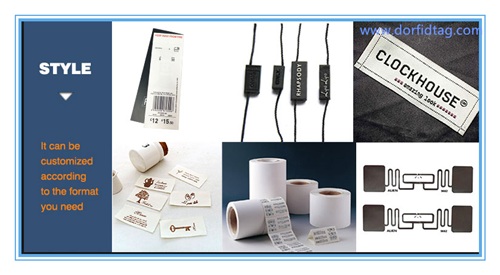
RFID apparel tags are not one-size-fits-all. Customization options include:
-
Label size and shape
-
Woven or printed branding
-
Chip selection based on memory needs
-
Adhesive or sew-in attachment
-
EPC encoding formats
This flexibility allows brands to maintain visual identity while adding smart functionality.
Final Thoughts
The RFID clothing tag is no longer a futuristic upgrade—it is a practical tool already reshaping how apparel businesses operate. By combining durable woven labels with powerful UHF RFID technology, these tags deliver accuracy, efficiency, and visibility across retail, warehouse, logistics, and manufacturing environments.
In a world where fashion cycles move fast and margins stay tight, RFID clothing tags don’t just track garments. They track truth—what you really have, where it really is, and how fast it’s moving. And in modern retail, truth is profit.
Frequently Asked Questions (FAQ) – RFID Clothing Tag
1. What is an RFID clothing tag used for?
An RFID clothing tag is used for item-level identification and tracking of garments throughout the supply chain. It enables fast inventory counting, real-time stock visibility, loss prevention, and accurate order fulfillment in retail stores, warehouses, logistics centers, and garment factories.
2. How is an RFID clothing tag different from a barcode label?
The key difference is that RFID clothing tags do not require line-of-sight scanning. Multiple garments can be read simultaneously from distances up to 10 meters, while barcodes must be scanned one by one. RFID also provides higher inventory accuracy and supports automation.
3. Are RFID clothing tags reusable?
Yes, most RFID clothing tags are reusable. When attached by sewing or removable adhesive, they can be recovered after sale or return and re-encoded for future use. Reusability depends on the attachment method and retail workflow.
4. What RFID frequency is best for apparel tracking?
UHF RFID (860–960 MHz) is the preferred frequency for apparel tracking. It offers long read range, fast bulk reading, and compatibility with global retail RFID systems using the ISO 18000-6C protocol.
5. How far can RFID clothing tags be read?
The read distance typically ranges from 1 meter to 10 meters, depending on the RFID reader power, antenna design, tag placement, and surrounding environment such as metal racks or dense fabric stacking.
6. Can RFID clothing tags be sewn into garments?
Yes. These RFID apparel tags support sewing attachment, making them suitable for permanent or semi-permanent integration into clothing labels without affecting comfort or washing performance.
7. Are RFID clothing tags safe for garments and users?
RFID clothing tags are completely passive and do not emit signals on their own. They contain no batteries and are safe for garments, users, and the environment under normal operating conditions.
8. What information is stored on an RFID clothing tag?
Typically, the tag stores a unique EPC number used to identify each garment. Additional data such as size, color, batch, or SKU can be stored in the user memory and linked to backend systems.
9. Can RFID clothing tags work with existing retail systems?
Yes. RFID clothing tags compliant with ISO 18000-6C are compatible with most commercial RFID readers, antennas, middleware, and retail ERP or WMS systems.
10. Do RFID clothing tags help reduce theft?
Yes. RFID clothing tags improve loss prevention by enabling real-time inventory reconciliation and integration with RFID-based security systems. Missing items are detected faster, reducing shrinkage.