March 27, 2026
Jewelry retail is a paradox.
The products are small.
The value is enormous.
The margins are tight.
The risks are high.
A single ring can be worth thousands of dollars. A misplaced bracelet can damage trust. Manual counting consumes staff time. Security concerns never sleep.
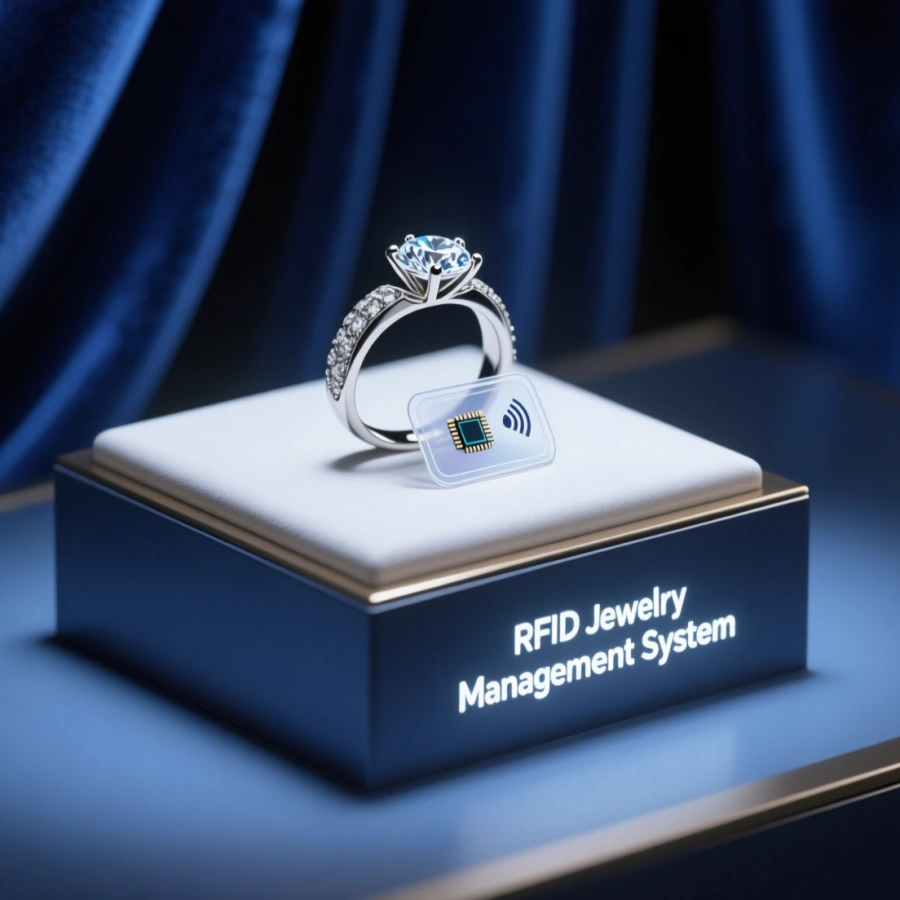
An RFID Jewelry Management System transforms how jewelry is tracked, secured, displayed, and audited. It combines ultra-small RFID tags, high-sensitivity readers, smart cabinets, and integrated management software to provide real-time inventory visibility with near-perfect accuracy.
This article provides a deep, professional, yet practical explanation of:
- What an RFID jewelry management system is
- How it works technically
- Core system components
- Implementation architecture
- Real retail use cases
- Security advantages
- ROI and operational benefits
Let’s explore how radio frequency technology solves one of the most delicate inventory challenges in retail.
1. What Is an RFID Jewelry Management System?
An RFID Jewelry Management System is a specialized inventory control solution designed for high-value jewelry products using RFID (Radio Frequency Identification) technology.
Unlike barcode systems that require manual line-of-sight scanning, RFID allows:
- Automatic identification
- Batch scanning
- Real-time tracking
- Loss prevention monitoring
- Rapid inventory audits
In jewelry retail, precision matters more than speed. RFID delivers both.
2. Why Traditional Jewelry Inventory Methods Fail
Before understanding the solution, it helps to examine the problem.
2.1 Manual Counting Is Slow and Risky
Many jewelry stores still rely on:
- Daily manual inventory counting
- Barcode scanning
- Paper-based tracking
This process:
- Takes hours
- Is prone to human error
- Increases staff fatigue
- Interrupts sales activities
2.2 Security Blind Spots
Jewelry display cases open and close dozens of times daily.
Without automation:
- Items can be misplaced
- Theft may go unnoticed
- Internal shrinkage risks increase
2.3 Lack of Real-Time Visibility
Managers often cannot instantly answer:
- How many diamond rings are in store?
- Which showcase contains a specific SKU?
- What is missing right now?
RFID solves these problems by making inventory visible continuously.
3. Core Components of an RFID Jewelry Management System
An RFID jewelry system consists of five primary components:
- RFID Jewelry Tags
- RFID Readers
- Antennas
- RFID Middleware
- Jewelry Management Software
Each component must work together precisely.
3.1 RFID Jewelry Tags
Jewelry tags are extremely small and lightweight.
Typical characteristics:
- UHF (860–960 MHz) frequency
- Ultra-thin inlay
- Lightweight paper or synthetic label
- EPC Gen2 compliant
- Unique serial number (EPC code)
These tags are designed specifically for:
- Rings
- Earrings
- Necklaces
- Bracelets
- Watches
The antenna design must function near metal and gemstones, which can interfere with radio signals.
High-quality jewelry tags use optimized antenna tuning to ensure reliable reads.
3.2 RFID Readers
Readers capture signals from tagged jewelry items.
Types used in jewelry systems:
1. Desktop Readers
Used at POS counters or inventory stations.
2. Handheld RFID Readers
Used for fast inventory audits and search.
3. Smart Display Cabinet Readers
Embedded inside showcases for real-time monitoring.
3.3 Antennas
Antennas determine:
- Read zone shape
- Detection sensitivity
- Signal stability
In jewelry systems, antennas must be:
- Precisely calibrated
- Low power to avoid cross-reading
- Tuned for small tag detection
Improper antenna layout can cause:
- Missed reads
- False alerts
- Signal overlap
RF engineering is critical.
3.4 RFID Middleware
Middleware filters and processes raw RFID data before sending it to the main system.
Functions include:
- Duplicate data filtering
- Event triggering
- Location mapping
- Alert management
- API integration
Without middleware, RFID data would overwhelm the system.
3.5 Jewelry Management Software
This is the intelligence layer.
Core features:
- Real-time inventory dashboard
- SKU-level tracking
- Location tracking (store, cabinet, counter)
- Sales integration
- Audit reporting
- Loss detection alerts
- Analytics
Software integrates with:
- POS systems
- ERP systems
- CRM platforms
4. Working Principle of RFID Jewelry Management System
Let’s break down how it works in practice.
Step 1: Tagging
Each jewelry item is attached with a unique RFID tag encoded with:
- EPC number
- SKU
- Product details
- Price category
- Material type
Step 2: Data Registration
Tag information is uploaded into the management system.
Step 3: Real-Time Monitoring
When jewelry is:
- Moved
- Displayed
- Sold
- Returned
Readers detect tag movement automatically.
Step 4: System Update
Software updates inventory instantly.
If an item leaves the store without proper checkout, the system triggers an alert.
It’s silent, automatic surveillance—without invading customer experience.
5. Application Scenarios
5.1 Daily Inventory Audit
Traditional audit:
2–3 hours for full store.
RFID audit:
5–15 minutes using handheld reader.
Staff walk around the store scanning all items simultaneously.
Accuracy rate can reach 99% or higher.
5.2 Smart Display Cabinets
RFID-enabled showcases:
- Detect items placed inside
- Monitor removal
- Trigger alarm if unauthorized removal occurs
- Count items automatically when cabinet closes
This ensures no piece is accidentally left outside.
5.3 Sales Integration
When a jewelry item is sold:
- POS triggers RFID update
- Inventory automatically deducts
- Database updates immediately
No manual inventory adjustment needed.
5.4 Item Search Function
If a customer asks for:
“A white gold ring size 6”
Staff can:
- Search system
- Locate specific cabinet
- Use handheld reader to pinpoint item
Search time drops dramatically.
5.5 Multi-Store Chain Management
RFID enables centralized control:
- Real-time inventory visibility across branches
- Transfer tracking
- Loss pattern detection
- Performance analytics
Chain management becomes data-driven.
6. Security Advantages
Jewelry stores face three main security risks:
- External theft
- Internal shrinkage
- Inventory misplacement
RFID addresses all three.
Real-Time Alerts
If jewelry exits without authorization:
- Alarm triggers
- System logs timestamp
- Staff notified instantly
Movement Tracking
Each movement event is recorded:
- Time
- Location
- Operator ID (if integrated)
Accountability improves significantly.
Audit Trail
Historical tracking allows management to analyze:
- Loss trends
- High-risk periods
- Staff patterns
Security becomes proactive rather than reactive.
7. Performance Metrics
Typical RFID jewelry system performance:
- Inventory accuracy: 98–99%
- Audit time reduction: 70–90%
- Shrinkage reduction: 20–50%
- Sales floor efficiency improvement: 15–30%
Results depend on implementation quality.
8. Technical Challenges and Solutions
Metal Interference
Jewelry contains precious metals which reflect RF signals.
Solution:
Use specially designed UHF jewelry tags optimized for metal proximity.
Small Tag Design
Jewelry tags must be:
- Lightweight
- Non-damaging
- Discreet
Advanced micro-inlays solve this problem.
Cross-Reading Between Cabinets
Low-power tuning and directional antennas prevent overlap.
9. System Architecture Overview
Typical architecture:
Jewelry Tag → RFID Reader → Middleware → Jewelry Management Software → ERP/POS
Data flow must be:
- Encrypted
- Structured
- Secure
Enterprise-level systems support cloud deployment.
10. Cost and ROI Considerations
Investment areas:
- RFID tags
- Readers and antennas
- Smart cabinets
- Software licensing
- Integration services
ROI sources:
- Reduced labor
- Lower shrinkage
- Faster audits
- Improved sales service
- Inventory accuracy
Most retailers achieve ROI within 12–24 months.
High-value industries benefit faster.
11. Comparison: RFID vs Barcode in Jewelry Retail
| Feature | RFID | Barcode |
|---|---|---|
| Bulk Reading | Yes | No |
| Real-Time Tracking | Yes | No |
| Manual Scanning | Minimal | Required |
| Loss Prevention | High | Limited |
| Inventory Speed | Very Fast | Slow |
Barcode is reactive.
RFID is proactive.
12. Integration with Smart Retail Technologies
Modern RFID jewelry systems integrate with:
- Smart mirrors
- Digital price displays
- Customer analytics tools
- AI sales tracking
- Cloud dashboards
The store becomes intelligent.
Jewelry becomes data-enabled.
13. Best Practices for Implementation
- Conduct site survey.
- Select high-performance jewelry tags.
- Optimize antenna placement.
- Integrate with POS and ERP.
- Train staff properly.
- Run pilot before full deployment.
RFID success depends more on system design than hardware alone.
14. Industries Benefiting from RFID Jewelry Systems
- Luxury jewelry chains
- Diamond retailers
- Watch boutiques
- High-end department stores
- Auction houses
- Precious metal traders
Where value density is high, RFID impact is significant.
15. Future Trends
Emerging innovations include:
- Blockchain integration for authenticity
- AI-powered sales analytics
- RFID + NFC hybrid tags
- Cloud-based centralized dashboards
- Smart tray-level detection systems
The future is not just tracking jewelry.
It is transforming jewelry into intelligent assets.
Conclusion
An RFID Jewelry Management System is not just a security tool.
It is a complete operational upgrade.
It delivers:
- Real-time visibility
- Fast inventory audits
- Loss prevention
- Sales efficiency
- Data-driven management
- Multi-store control
Jewelry is small.
Its value is massive.
Its management must be precise.
RFID technology brings invisible radio waves into one of the most delicate retail environments and makes inventory transparent without disrupting customer experience.
A ring moves.
The system knows.
A necklace is sold.
Inventory updates instantly.
No clipboard.
No counting errors.
No guessing.
Just structured, reliable, intelligent control.
In luxury retail, trust is everything.
RFID helps protect it.