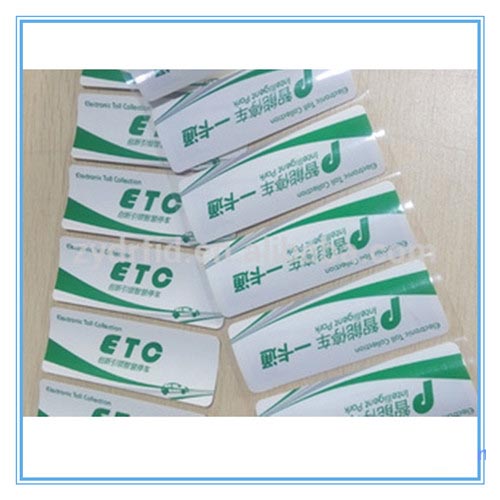
The UHF Windshield Car Sticker is a passive RFID tag designed for automatic vehicle identification, parking access control, electronic toll collection, and other applications where vehicles need to be recognized quickly and reliably. Installed on the inside of a vehicle windshield, the tag enables contactless identification without batteries, manual scanning, or direct line-of-sight operation.
Using UHF RFID technology in the 860–960 MHz frequency range, this windshield RFID tag can support long-range vehicle identification with compatible RFID readers and antennas. Its specialized RFID inlay is designed to perform through automotive windshield glass, making it suitable for hands-free access control and automated vehicle management.
The tag is available in different materials, dimensions, RFID chips, and printing options. A destructible version is also available for applications where preventing unauthorized transfer between vehicles is important.
Features
1. Specialized inlays read well through windshield glass.
2. Read ranges of 30+ feet
3. Customized printing
4. Destructible option prevents unauthorized vehicles from using tags transferred from authorized vehicles.
Specification
| Material | Paper, PVC, PET, PP |
| Dimension | 101*38mm, 105*42mm, 100*50mm, 96.5*23.2mm, 72*25 mm, 86*54mm |
| Size | 30*15, 35*35, 37*19mm, 38*25, 40*25, 50*50, 56*18, 73*23, 80*50, 86*54, 100*15, etc, or customized |
| Optional craft | One side or two side customised printing |
| Feature | Waterproof, printable, long range up to 6m |
| Application | Widely used for vehicle, car access management in parking lot, electronic toll collection in high way, etc,installed inside car windshiled |
| Frequency | 860-960mhz |
| Protocol | ISO18000-6c , EPC GEN2 CLASS 1 |
| Chip | Alien H3, H9,Monza 4QT, Monza 4E, Monza 4D, Monza 5, etc |
| Read Distance | 1m- 6m |
| User memory | 512 bits |
| Reading Speed | < 0.05 seconds Valid Using lifetime > 10 years Valid Using times >10,000 times |
| Temperature | -30 ~ 75 degrees |
The UHF Windshield Tag is a vehicle identification tag. It offers cost effective long-range identification for parking applications. Based on passive UHF technology (± 900 MHz), the UHF Windshield Tag is identified up to 10 meters (33 ft) with uPASS Target or 5 meters (16 ft) with uPASS Reach. The tag does not contain a battery and is maintenance free.

Key Features of the UHF Windshield Car Sticker
Long-Range Vehicle Identification
The UHF windshield tag is designed for applications that require vehicles to be identified before they reach a gate, parking barrier, or toll collection point. Under standard conditions, the listed read distance is approximately 1–6 meters.
With suitable RFID readers and antennas, longer read distances can be achieved. For example, the product information indicates identification of up to 10 meters (33 ft) with a uPASS Target reader and up to 5 meters (16 ft) with a uPASS Reach reader. Actual performance depends on the reader, antenna, windshield, installation position, vehicle speed, and surrounding RF environment.
Passive and Maintenance-Free
The tag does not contain a battery. It receives energy from the electromagnetic field generated by a compatible UHF RFID reader and responds with its stored identification data.
Because there is no battery to replace, the tag can remain installed on a vehicle for long periods with minimal maintenance. The listed service life is more than 10 years under suitable operating conditions.
Designed for Windshield Installation
Unlike general-purpose RFID labels, this product is intended for installation inside a vehicle windshield. Its specialized inlay is designed to maintain RFID performance through windshield glass.
The tag can be attached to the recommended area of the windshield to provide stable communication with an external RFID reader. Correct installation is important because windshield construction, metallic films, coatings, and other vehicle components can affect RF performance.
Custom Printing Available
The UHF windshield car sticker can be customized with one-sided or two-sided printing. Depending on the project, printed information can include company logos, vehicle numbers, identification codes, instructions, warning information, or other visual elements.
Customized printing allows the RFID tag to serve both as an electronic identification device and as a visible vehicle credential.
Destructible Option for Anti-Transfer Applications
A destructible version is available for systems where RFID tags should not be transferred from an authorized vehicle to another vehicle.
When properly designed and applied, a destructible windshield sticker can make unauthorized removal or transfer more difficult. This is particularly useful for parking management, fleet identification, membership access, and other applications where the RFID credential needs to remain associated with a specific vehicle.
Available RFID Chip Options
Different RFID chips can be selected depending on memory requirements, application design, availability, and system compatibility.
Common chip options include Alien H3, Alien H9, Impinj Monza 4QT, Monza 4E, Monza 4D, and Monza 5. These chip families are widely used in UHF RFID applications and can be integrated into windshield labels for vehicle identification.
| Chip Option | Typical Application Consideration |
|---|---|
| Alien H3 | General-purpose UHF RFID identification |
| Alien H9 | Applications requiring a modern UHF RFID chip option |
| Impinj Monza 4QT | Suitable for vehicle and asset identification applications |
| Impinj Monza 4E | General UHF RFID identification and tracking |
| Impinj Monza 4D | Suitable for standard EPC-based RFID systems |
| Impinj Monza 5 | Advanced UHF RFID applications |
The final chip selection should be based on the RFID reader, required memory, EPC configuration, application environment, and project requirements rather than chip model alone.
Why Use a Windshield RFID Sticker Instead of a Traditional RFID Card?
A vehicle windshield RFID sticker provides a different user experience from conventional proximity cards or key fobs. The driver does not normally need to stop, open the window, or manually present a card to a reader.
| Feature | UHF Windshield Sticker | Traditional RFID Card | UHF Handheld/General Tag |
|---|---|---|---|
| Vehicle Identification | Excellent | Limited | Excellent |
| Hands-Free Access | Yes | Usually no | Yes |
| Long-Range Reading | Yes | Usually limited | Yes |
| Battery Required | No | No | No |
| Windshield Installation | Designed for it | Not designed for it | Depends on tag |
| Printing | Customizable | Customizable | Usually customizable |
| Automatic Gate Access | Suitable | Requires closer presentation | Suitable |
| Driver Interaction | Minimal | Manual presentation | Depends on system |
| Typical Use | Parking and vehicle access | Personnel access | Asset/vehicle tracking |
For vehicle access systems, the main advantage of a windshield RFID tag is that the RFID credential stays with the vehicle and can be read automatically as the vehicle approaches the RFID reader.
UHF Windshield Sticker vs. Active RFID Vehicle Tags
Active RFID systems use a battery-powered tag and can provide long communication distances. However, battery replacement and higher tag costs can make active systems less convenient for large-scale vehicle deployments.
Passive UHF RFID tags use energy from the reader and therefore do not require an internal battery.
| Comparison | Passive UHF Windshield Sticker | Active RFID Vehicle Tag |
|---|---|---|
| Power Source | Reader-powered | Internal battery |
| Battery Replacement | Not required | Required |
| Tag Cost | Generally lower | Generally higher |
| Maintenance | Low | Higher |
| Tag Size | Compact | Usually larger |
| Long-Term Deployment | Well suited | Requires battery planning |
| Parking Access | Suitable | Suitable |
| Fleet Identification | Suitable | Suitable |
| Installation | Windshield adhesive | Depends on tag design |
For large parking facilities, residential communities, corporate campuses, commercial fleets, and other high-volume deployments, passive UHF RFID can provide a practical balance between read range, cost, and maintenance.
Applications of UHF Windshield Car Stickers
Parking Access Control
The windshield RFID sticker can be used to identify registered vehicles when they enter or leave a parking facility.
An RFID reader installed near the entrance detects the tag and sends the identification information to the parking management system. The system can then verify authorization and control the barrier automatically.
This reduces the need for drivers to use access cards, scan QR codes, or interact with parking equipment.
Residential and Community Parking
Residential communities can assign an RFID windshield sticker to each registered vehicle. The vehicle’s RFID identifier can be associated with a resident account in the parking management software.
This can simplify entry and exit management while providing an electronic record of vehicle access.
Corporate and Office Parking
Companies can use windshield RFID tags to manage employee vehicles, visitor vehicles, service vehicles, and company fleets.
The RFID identifier can be linked to employee or vehicle records, allowing the access system to determine whether a vehicle is authorized to enter a particular parking area.
Fleet Management
Fleet operators can use windshield RFID tags to associate a unique RFID identity with each vehicle.
When a vehicle passes an RFID checkpoint, the system can automatically record its identification. This can be useful for fleet entry and exit, depot management, logistics yards, service centers, and vehicle checkpoints.
Electronic Toll Collection
UHF windshield RFID technology can also be used in electronic toll collection and highway vehicle identification systems.
The RFID reader identifies the vehicle tag as it passes through the designated reading area. System requirements for tolling applications vary by country and infrastructure, so the RFID frequency, reader configuration, tag placement, and local regulations should be confirmed before deployment.
Vehicle Access Management
The tag can be integrated into automated gates, industrial facilities, logistics centers, parking garages, restricted areas, and other vehicle access systems.
A typical system includes the RFID windshield sticker, UHF RFID reader, antenna, access controller, barrier gate, and management software.
How the UHF Windshield RFID System Works
The basic operating process is straightforward:
- A UHF RFID windshield sticker is assigned to an authorized vehicle.
- The tag is installed inside the vehicle windshield.
- A UHF RFID reader and antenna are installed near the entrance, exit, or checkpoint.
- When the vehicle enters the RFID reading zone, the reader transmits RF energy.
- The passive tag receives energy and responds with its stored RFID identification data.
- The access control system checks the tag information.
- If the vehicle is authorized, the system can trigger the parking barrier or gate.
Because the tag is passive, no battery or routine charging is required.
Recommended Windshield Installation
Correct installation can have a significant effect on RFID performance.
The sticker should normally be installed on the inside surface of the windshield in the recommended location. The selected position should provide a clear RF path between the tag and the external RFID antenna.
Avoid installing the tag directly behind metallic objects, metallic coatings, heating elements, or other materials that may interfere with UHF RFID communication.
Some modern vehicles use special windshield structures or films that can affect RFID signals. Therefore, testing the tag on the target vehicle models before mass deployment is recommended.
Installation Checklist
| Checkpoint | Recommendation |
|---|---|
| Installation Surface | Clean and dry windshield surface |
| Installation Side | Inside of windshield |
| Tag Orientation | Follow the tested system orientation |
| Metallic Film | Check compatibility before deployment |
| Adhesive Area | Keep free from dust and moisture |
| Reader Position | Test based on actual vehicle approach direction |
| Antenna Position | Optimize for the required reading zone |
| Vehicle Testing | Test representative vehicle models |
Materials and Size Options
The product can be manufactured using paper, PVC, PET, PP, and other suitable constructions depending on the project requirements.
Available dimensions include 101 × 38 mm, 105 × 42 mm, 100 × 50 mm, 96.5 × 23.2 mm, 72 × 25 mm, and 86 × 54 mm. Other sizes can also be customized.
Additional listed size options include 30 × 15 mm, 35 × 35 mm, 37 × 19 mm, 38 × 25 mm, 40 × 25 mm, 50 × 50 mm, 56 × 18 mm, 73 × 23 mm, 80 × 50 mm, 86 × 54 mm, and 100 × 15 mm.
| Requirement | Available Option |
|---|---|
| Standard Materials | Paper, PVC, PET, PP |
| Standard Dimensions | Multiple sizes available |
| Custom Dimensions | Available |
| Printing | One-side or two-side |
| Waterproof Construction | Available |
| Destructible Construction | Available |
| RFID Chip Selection | Multiple UHF chip options |
| Artwork Customization | Available |
The final material and construction should be selected according to the installation environment, expected service life, printing requirements, and adhesive requirements.
Custom Printing and Branding
For commercial deployments, customized printing can make the RFID windshield sticker easier to identify and manage.
Possible printed information includes:
- Company logo
- Vehicle number
- RFID identification number
- Parking permit information
- Serial number
- Barcode or QR code
- Usage instructions
- Warning or security information
For large vehicle fleets, printed vehicle numbers can provide a quick visual reference while the embedded RFID chip provides automated electronic identification.
Destructible RFID Windshield Sticker for Security
Standard removable RFID labels may potentially be transferred from one vehicle to another. This can create a security problem when a parking credential is intended to belong to one specific vehicle.
A destructible windshield RFID sticker is designed to address this issue by making unauthorized removal more difficult.
For example, a parking operator can associate the RFID tag’s unique identifier with a vehicle registration number. If someone attempts to move the sticker to another vehicle, the physical condition of the tag can provide an additional security control.
For high-security deployments, the RFID tag should be combined with software-based authorization, vehicle records, cameras, or other security measures rather than relying on the physical sticker alone.
Read Range and RFID Performance
The listed read distance of the UHF windshield car sticker is approximately 1–6 meters. Under specific reader configurations, the product information indicates that identification can reach up to 10 meters.
However, RFID read range is not a fixed characteristic of the tag alone.
Actual performance can be affected by:
- RFID reader output power
- Antenna gain and polarization
- Reader antenna installation height
- Vehicle speed
- Tag orientation
- Windshield construction
- Metallic windshield films
- Vehicle body structure
- Nearby metal surfaces
- Electromagnetic interference
- Local regulations for UHF RFID transmission
For this reason, a complete RFID system should be tested as a combination of tag, reader, antenna, vehicle, and installation environment.
RFID Compatibility
The windshield car sticker supports the ISO18000-6C / EPC Gen2 Class 1 protocol and operates in the 860–960 MHz UHF RFID range.
This protocol family is widely used for passive UHF RFID identification. However, regional frequency regulations can differ, so system integrators should select the appropriate reader configuration for the deployment country or region.
Before placing a large production order, it is recommended to verify compatibility with the actual RFID reader model and antenna that will be used in the project.
Who Should Use This UHF Windshield RFID Tag?
This product can be a suitable choice for:
- Parking management companies
- Property management companies
- Residential communities
- Office buildings
- Shopping centers
- Airports and transportation facilities
- Corporate campuses
- Logistics companies
- Fleet operators
- Industrial facilities
- Highway and toll system integrators
- RFID system integrators
- Access control solution providers
It is particularly suitable when the project requires automatic vehicle identification without requiring drivers to manually present an RFID card.
Frequently Asked Questions
What is a UHF windshield car sticker?
A UHF windshield car sticker is a passive RFID tag designed to identify vehicles from a distance. It is installed inside the windshield and communicates wirelessly with a compatible UHF RFID reader.
Does the windshield RFID tag need a battery?
No. The tag is passive and does not contain a battery. It receives energy from the RFID reader during communication, making it maintenance-free during normal operation.
How far can the UHF windshield sticker be read?
The listed read distance is approximately 1–6 meters. Under specific reader and antenna configurations, the identification distance can reach up to approximately 10 meters. Actual performance depends on the complete RFID system and installation environment.
Can the RFID windshield sticker be customized?
Yes. The product supports customized sizes and one-sided or two-sided printing. RFID chip selection and other construction details can also be customized for specific projects.
Is the windshield RFID sticker waterproof?
The product is listed as waterproof. However, the final environmental resistance should be evaluated according to the selected material, adhesive, printing process, and installation conditions.
Can the sticker prevent unauthorized transfer?
A destructible option is available. It is designed to make physical removal and transfer more difficult. For higher security, it should be combined with software authorization and other vehicle verification methods.
Which RFID frequency does it use?
The tag operates in the 860–960 MHz UHF RFID frequency range and supports ISO18000-6C / EPC Gen2 Class 1.
Can it be used for parking barriers?
Yes. Parking access control is one of the main applications. A typical system uses the windshield RFID tag together with a UHF RFID reader, antenna, controller, management software, and barrier gate.
How long does the tag last?
The listed service life is more than 10 years under suitable operating conditions, with more than 10,000 valid uses indicated in the product specifications.
How to Choose the Right Windshield RFID Sticker
Choosing the correct RFID windshield tag requires more than selecting a chip. Consider the complete operating environment.
First, confirm the RFID frequency required in your region. Next, identify the RFID reader and antenna that will be used. Then test the tag on representative vehicle models, especially when vehicles use special windshield films or coatings.
For parking applications, also consider whether the tag needs to be destructible, whether custom printing is required, and whether the system needs a short, medium, or long reading zone.
A practical selection process is:
| Requirement | Recommended Consideration |
|---|---|
| Standard parking access | Passive UHF windshield RFID tag |
| Long-range vehicle recognition | Select tag + reader + antenna as a complete system |
| High-volume vehicle deployment | Durable, maintenance-free passive tag |
| Anti-transfer requirement | Destructible windshield sticker |
| Branding requirement | Custom printed version |
| Different vehicle models | Conduct vehicle-specific testing |
| Outdoor or demanding environment | Select suitable waterproof material and adhesive |
| Large project | Request samples before mass production |
Why Choose a Customized UHF Windshield RFID Solution?
Every vehicle access project has different requirements. A parking garage may need compact labels and a medium reading range, while a logistics facility may require longer detection distances and customized vehicle identification.
Customization allows the RFID tag to be matched to the project’s reader, vehicle type, installation position, printing requirements, and security needs.
Instead of treating the RFID sticker as an isolated component, it is better to evaluate the complete system during development. This approach can help reduce unexpected read failures after installation and improve the consistency of vehicle identification.
Get a UHF Windshield RFID Sticker for Your Project
Whether you need RFID windshield stickers for a parking management system, vehicle access control, fleet identification, electronic toll collection, or another automated vehicle identification application, the tag can be customized according to your project requirements.
Available options include different RFID chips, materials, sizes, printing methods, and destructible constructions. Samples can be evaluated with your RFID reader and target vehicle models before mass production.
When requesting a quotation, provide the following information to help determine the appropriate configuration:
- Application and deployment environment
- Target RFID reader model
- Required reading distance
- Vehicle or windshield type
- Required tag dimensions
- Preferred RFID chip
- Printing requirements
- Estimated order quantity
- Destructible or standard construction
- Delivery destination
With the right RFID tag, reader, antenna, and installation configuration, a passive UHF windshield RFID system can provide fast, contactless, and low-maintenance vehicle identification for modern access control and parking applications.