
Technical Parameters (Typical)
From a buyer’s perspective, these are the specifications that actually matter:
Operating Frequency: 13.56 MHz
Standard: ISO/IEC 14443A / 14443B
Read Range: 2–10 cm (reader-dependent)
Data Retention: 10–20 years
Write Cycles: ≥100,000
Anti-collision: Yes (multiple tags readable)
Security Options: UID, password protection, encrypted memory (chip-dependent)
Common Chip Options
NTAG213 / NTAG215 / NTAG216
MIFARE Ultralight / Ultralight C
MIFARE Classic 1K / 4K
MIFARE DESFire EV1 / EV2 (high security)
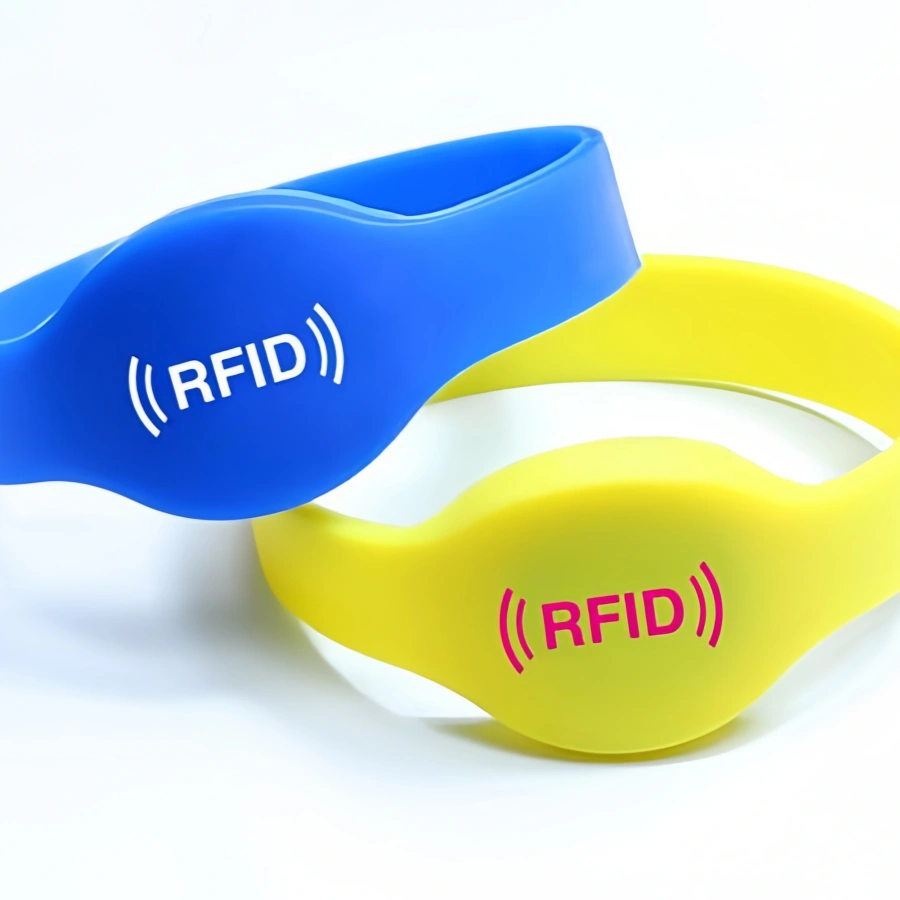
Why B2B Buyers Choose 13.56 MHz RFID Wristbands
The decision is rarely about “RFID vs non-RFID.” It’s about manual processes vs automated systems.
Core Business Value
Faster throughput
Lower labor cost
Fewer errors
Better data visibility
Improved customer experience
In short: less friction, more control.
Problems 13.56 MHz RFID Wristbands Solve
1. Slow Manual Identification
Paper tickets, printed passes, or visual checks slow everything down.
RFID wristbands allow:
Instant tap-and-go access
No line-of-sight scanning
Faster entry, checkout, or verification
Result: higher throughput with the same staff.
2. Ticket Fraud and Unauthorized Access
Traditional tickets are easy to copy, share, or resell.
RFID wristbands:
Use unique UID or encrypted memory
Can be bound to a user, time slot, or system
Are difficult to clone (especially DESFire chips)
Result: reduced revenue leakage and tighter security.
3. Cash Handling and Payment Inefficiency
Cash and physical cards increase risk, reconciliation time, and operational cost.
RFID wristbands enable:
Cashless payments
Closed-loop payment systems
Faster POS transactions
Result: higher per-capita spending and cleaner accounting.
4. Poor Data Collection
Manual systems provide little real-time insight.
RFID wristbands generate:
Entry/exit timestamps
Purchase behavior data
Crowd flow analytics
Result: data-driven decisions instead of guesswork.
5. Disposable Credential Costs
Single-use cards or tickets add recurring cost.
Reusable RFID wristbands:
Last for years
Support re-encoding
Reduce consumable expenses
Result: lower total cost of ownership (TCO).
Major B2B Application Scenarios
Event & Festival Management
Used for:
Admission control
VIP area access
Cashless food & beverage
Anti-counterfeiting tickets
Why HF RFID works:
Short read range avoids accidental reads
Excellent anti-collision performance
Works well in dense crowds
Hotels, Resorts & Water Parks
Applications include:
Room access
Locker management
Cashless payments
Guest identification
Silicone RFID wristbands dominate here due to:
Waterproof design
Comfort for multi-day wear
High durability
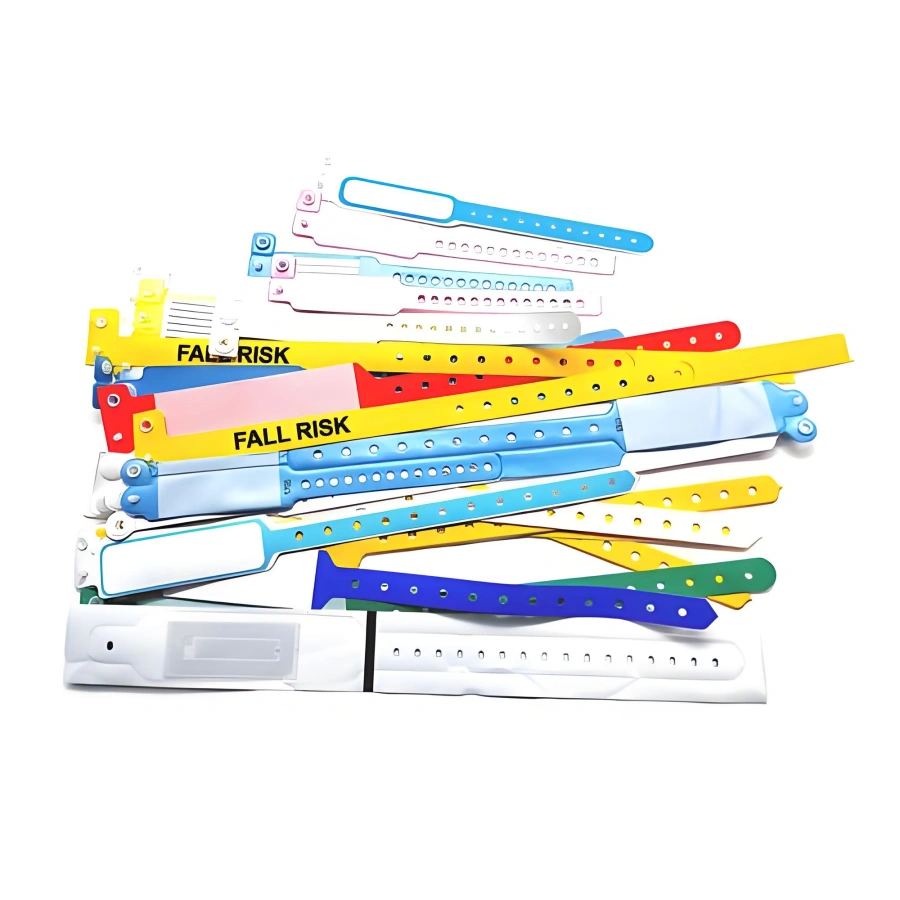
Healthcare & Medical Facilities
Used for:
Patient identification
Medication verification
Access control
Infant tracking
13.56 MHz is preferred because:
Short range reduces misreads
High data integrity
Strong privacy control
Gyms, Clubs & Membership Systems
RFID wristbands replace:
Key fobs
Magnetic cards
Manual sign-in
Benefits:
Faster member check-in
Reduced card loss
Seamless system integration
Corporate Access Control & Campuses
Common uses:
Staff identification
Door access
Attendance tracking
Paired with:
Turnstiles
NFC readers
Existing access control software
Wristband Materials and B2B Selection Logic
Material choice is not aesthetic—it’s operational.
Silicone: Durable, waterproof, reusable, ideal for hospitality and fitness
Fabric (woven): Comfortable, premium feel, popular for events
Tyvek: Low cost, disposable, good for short events
PVC/TPU: Printable, customizable, mid-range durability
B2B buyers typically select based on:
Usage duration
Reusability requirement
Environmental exposure
Branding needs
Customization Options for Brand Owners
Most 13.56 MHz RFID wristbands support:
Logo printing
Serial number or UID printing
QR code + RFID dual identification
Laser engraving
Custom colors and molds
Pre-encoded or encrypted data
This makes them ideal for OEM, private label, and system integrators.
Integration with Existing Systems
From a systems perspective, 13.56 MHz RFID wristbands integrate smoothly with:
Access control software
POS systems
ERP and CRM platforms
Mobile apps (via NFC smartphones)
They work with:
USB readers
Embedded RFID modules
Android NFC devices
Turnstiles and kiosks
No exotic infrastructure required.
Why 13.56 MHz Instead of UHF or LF?
Each frequency has a job. HF just happens to be very good at this one.
Compared to 125 kHz (LF): faster, more secure, supports encryption
Compared to UHF (860–960 MHz): shorter range, more precise, fewer false reads
That precision is why HF dominates people-centric applications.
Long-Term Business Impact
For B2B buyers, the ROI shows up as:
Reduced staffing needs
Faster customer throughput
Higher spending per user
Lower fraud losses
Better operational visibility
The wristband is small. The impact is not.
Conclusion
A 13.56 MHz RFID wristband is not a gadget—it’s an infrastructure component. For B2B buyers in events, hospitality, healthcare, and access control, it delivers a rare combination of security, usability, and scalability.
When properly selected and integrated, it replaces manual processes with automated trust. And in modern operations, trust that runs at the speed of a tap is a competitive advantage.
In a world allergic to friction, the quiet efficiency of a 13.56 MHz RFID wristband does exactly what good technology should do: it disappears—while everything else runs better.